Showing posts with label silly. Show all posts

Friday, October 28, 2011

Research Publication
A Modest Proposal


Library

I love doing science. But some things I love doing less than others. Rewriting papers is one of them. Editing and resubmitting a paper is to research what a wisdom tooth extraction is to a long summer weekend; all things considered you'd really rather be doing something else.

It takes a lot of time to write a long-form paper. The text may go through several revisions over the course of months even before the initial submission, and be picked-over several times by all the authors. The total time we spend may easily be a month or two. Extensive edits or a resubmission can double that time. And a lot of this work is almost invisible; we're debating commas, or precise wordings, or the order of arguments for a minor point in the text.

But very few people will actually read your paper in such detail. Most people who see it will just browse; we all "read" — that is, quickly check the summary and figures — a lot of papers, but we focus in detail only on a few. Some estimate that the average number of serious readers of a paper is around 5. And this probably follows a power-law distribution, where a small number of papers get many hundreds or thousand of readers while most papers get almost none. If your paper isn't in a top-tier journal you can probably assume your serious readership is 0-5 people.

We spend a months worth of work or more on tedious polishing. Meanwhile, almost all of our readers will simply skim the abstract, check a summary of results, look through the bibliography and then move on. Only a very few people — and perhaps nobody — will actually want to know about our work in detail.
 

So perhaps we are all spending our time on the wrong thing. I suggest we stop publishing painstakingly polished 20 or 30-page masterpieces. Instead we publish just a 2-3 page text with an abstract, a to-the-point summary of methods and results, and the bibliography. That will satisfy the vast majority of our readers, and will in fact make it easier for them to find what they want.

Then we meet by video-conferencing with those few who want to know all the details. If we save a month of work by not writing the long-form paper, and a one-hour conference takes a total of three hours with preparation and setup, then we could meet with fifty separate groups and still save valuable time. More likely, as we saw above, only a few people would ever want to discuss the details with us, saving us most of that month of project time. And those that want the details will get something better than a paper: they get the undivided attention of the researcher that did the actual work, and get precise answers to their specific questions.

We record the sessions and put them online. In the near future we'll have automatic transcription of each session as well. That will save the details for posterity and will satisfy most people looking for details, so only those with new questions and novel insights will want an in-person discussion. The just-the-facts summary and the accumulated, searchable discussions will hold far more detail, reasoning and justification of the work than any static paper could ever be able to.


Ok, so perhaps the idea isn't perfect. But it sure looks good to me while I'm sitting here editing a paper…

Tuesday, July 5, 2011

So, Google...

I know I've been very busy the past few weeks, but now I've decompressed a bit and I can't help but notice that you have announced a new toy. A toy that seems to make an almost indecently positive impression on those who try it.

I like you, Google; I use you for search, for much of my email, for my homepage (such as it is), my blog, maps and RSS reader, and I happily use your phone OS. Your browser looks good but lacks some important extensions I use, and your online photo site isn't really a match for your competition, but mostly you do some very, very good stuff.

I don't entirely trust you of course - nobody should trust any corporate entity, and online services are subject to political and legal whims of several countries, so I'm a bit careful about what data I give you. But overall I am very happy with your services, and you do come across as rather more trustworthy and open than some other companies on the web.

I'm not idle by any means - I'm editing a paper, I need to figure out some parameter relations for a model, and I really should start job hunting again - but I do have bits of free time now. Free time that I would be happy to spend trying out this new toy of yours, if you would only let me.

Unfortunately, you're in limited trial and you aren't going to let the unwashed masses in just yet (no, I'm not going to wash for you; I like you, Google, but we're not that close). You want to hammer out bugs and stuff so people get a good first impression, I understand that. Still, it's incredibly frustrating. Like going to a favourite restaurant for dinner, only to find out it's packed with people already. You want to go there, the restaurant wants you there, but it's just not going to happen that particular night.

So, Google, I understand most of us can't get to play just yet. It's OK, I'll wait. Just don't take too long; a restaurant that's always full is a restaurant you eventually give up on, favourite or not. I'd hate to see a good idea fail due to loss of interest and momentum before it even gets off the ground.

Monday, January 31, 2011

JoUR

EEG

So, your research project is on a tight deadline. You're scrambling to put together a paper and push it out to some journal in time for a looming project review. You're hunting references, writing and rewriting your arguments and doing a desperate last-ditch data analysis round in the hope this will be enough to find favour with the journal reviewers. Meanwhile the clock is ticking... tick. tock.

Let's face reality here - you're out of time and out of luck. Your paper looks like what it is, an unfinished cut-and-paste job from your earlier publications, with some obvious editing to make it look vaguely coherent. This really has no chance to be accepted; you'll get a "revise and resubmit" if you're lucky, and an outright "reject" if not. Either way, you'll be spending a month or so rewriting it from scratch.

So why not go a little easy on yourself? Stop panicking and stop wasting precious time you can't afford. Just take whatever you have and submit the unfinished, unreadable mess to Journal of Universal Rejection.

Skip the last-minute editing, the tedious formatting, the Byzantine submission guidelines and the wait in the endless submission queue of other journals, and go directly to the inevitable rejection. The same end result, but weeks - maybe months - faster! Think of all the time you'll save! You'll have your revised, rewritten manuscript ready for submission to a good journal before your colleagues have even received their rejection notifications!
 
Remember: "Journal of Universal Rejection - when 'submitted' is what matters."

Sunday, December 12, 2010

Writers Block - The Definitive Study

Writers block is all too common for anybody who writes. Fortunately, science is here to help. I just stumbled on a wonderful, brief classic paper on the failure of self-treatment of writers block, published in "Journal of Applied Behavior Analysis" in 1974, and freely accessible here. Go on - it's an easy read for non-specialists.

Of course, a lot of psychological research used to be focused exclusively on northern Europeans and Americans. We know better today than to generalize results from one culture to others, so a group of researchers have replicated the original study from a cross-cultural perspective here.

I really have to find a way to cite either study in my next paper.

Wednesday, March 10, 2010

Nördkaffe

Have you heard of "Metal Umlauts", perhaps? When a heavy-metal band wants a name that sounds exotic, gothic and vaguely menacing they will sometimes add an umlaut ("¨" - the two dots in "ä", "ö", "ü" and so on) to a vowel or two. Think "Motörhead", for instance. This can backfire; British metal band "Trojan" famously added an umlaut to their name to become "Tröjan". This means "the shirt" in Swedish, and doesn't really evoke the air of menace the band was aiming for - though I guess it did make for some deliciously self-referential concert t-shirts.

Nördkaffe
Nerd Coffee, Umeda.


There's a recent café in the Umeda underground that's afflicted with a similar case of Umlautitis. It has a Scandinavian theme - the furniture and decorations are Nordic minimalist, and there was even a long text explaining the Swedish tradition of "fika" - an extended coffee break - in passable but "interesting" Swedish and in Japanese. It looks like a very pleasant coffee shop, and I've been meaning to stop by. The name is "Nördkaffe".

Perhaps the owner has lived in Sweden and got inspired to do a Swedish-style café back in Osaka. I think the real name is "Nordkaffe" ("Nordic coffee"), and indeed, the Japanese transcription uses the "nordkafe" (ノードカフェ) pronunciation. The umlaut (and the second "f") is only there to give the name an exotic touch. But as with "Tröjan", this changes the meaning: "Nördkaffe" means "Nerd Coffee" or オタクカフェ. Unlikely to be quite what the owner intended, of course, but the name is memorable and the place looks very nice. We really should stop by next time.

Friday, January 29, 2010

Team Komei

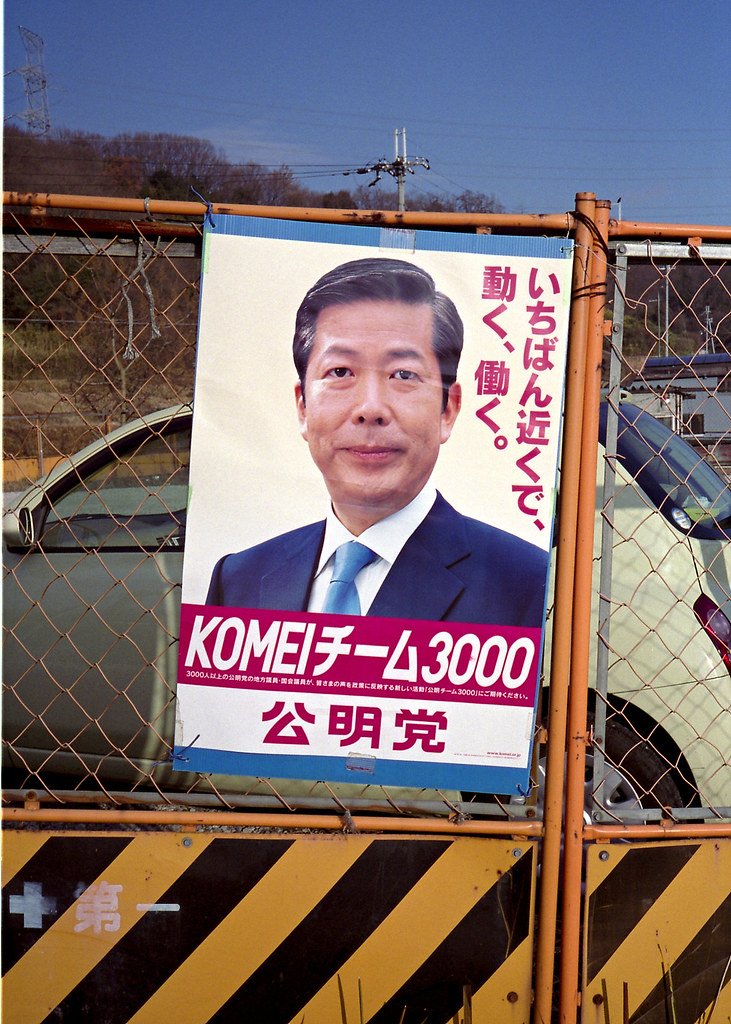
Ikoma had an election to the city council recently, so there's been a few new election posters around. This is a recent one from New Komeito:

Komeito Poster

"The Very Closest to you, Moving, Working. Team Komei 3000"


Now, perhaps it's just me, but frankly, the slogan on the right is a bit creepy: "The Very Closest to you, Moving, Working". What, "Closest"? As in, crowding people on the train? Showing up at home? And "Moving"? Can I expect to stumble over some oily Komeito candidate circling around my feet like some giant, insane suit-wearing cat when I try to get to the bathroom one morning? I can't say it inspires me to vote for them. It does make me want to put up some giant flypaper, perhaps, or maybe there's some kind of spray that'll keep them away.

The slogan on the bottom, "Team Komei 3000", is a bit touching on the other hand. "Now, we don't want our slogan to become dated, like all those 'Whatever-2000' ones did once the century turned. Better make sure we have a bit of a margin". I like the optimistic naivete implied here, that your party will actually be around a century from now, never mind a millennium.

Anyway, I guess the parties try out slogans and the like in local elections before they appear nationally. Just a hunch, but I suspect this one won't make it.

Thursday, October 1, 2009

Ukulele Orchestra of Great Britain

A bit off topic, I know, but: I've long loved the ukulele. It's such an unassuming, friendly little instrument. I even started playing it for a year or so and had a great time1. One day, time permitting, I will get an ukulele and start learning it again.

Anyway, I recently stumbled on to The Ukulele Orchestra Of Great Britain. Lots of good stuff there. But, I'm also a long-time fan of Sergio Leone's old Spaghetti Westerns and of Ennio Morricone's classic film scores he wrote for them.

So, a soulful rendering of "The Good, The Bad, The Ugly" theme by ukulele orchestra is of course as close to musical entertainment nirvana as you can possibly get:


--
#1 Unlike my neighbours, who had to endure a slow, badly played "House Of the Rising Sun" many, many, many more times than any human should ever have to. At least I wasn't singing.

Tuesday, August 11, 2009

Capital Comments.

I'm just back from a short trip to Sapporo; I'll write about it soon, but meanwhile, here's a helpful tip for those who like to post comments anywhere on the net:

When you CAPITALIZE random words to MAKE a POINT, you're NOT really PERSUADING ANYBODY. You JUST make it DIFFICULT to READ your post, and YOU make yourself LOOK like an IRATE CRANK. Please STOP DOING it.

Tuesday, June 9, 2009

Temple Of Love

Time is short, so no long explanation, but one item in this morning's news is worth mentioning: A Love Hotel - the pay-by-hour establishments catering to couples looking for some private time together - has found a nifty way to avoid those pesky taxes: be owned by a religion.

That's right: religious organizations are tax exempt here (it's unclear why, to me). So if they own and run a love hotel under the guise of a temple, there's no need to pay taxes or even account for your earnings. The "Universal Truth Association" is a temple so you are of course not paying for your stay - perish the thought - but "giving alms" (at a fixed hourly rate) is compulsory when you enter.

Is this really legal? Apparently not. It does bring up the question of why an organization should be exempt from taxes and even some laws just because the members all share the same imaginary belief.

Friday, April 10, 2009

The Museum of Bad Art

I got a link from a friend a while agi to The Museum of Bad Art in Massachusetts, USA. It's not a joke, apparently, but a real place. Their online collection is well worth browsing through (pace yourself; a little goes a long way here) and if I ever happen to head in that direction I'd be delighted to pay the museum a visit. More background and other information at the Wikipedia page.

For some reason or other I'm reminded of Skissernas Museum - The Museum of Sketches - in Lund, Sweden. They collect sketches, pre-studies and models of monumental public artworks - and in some cases sketches of proposed works that thankfully were never made at full scale and inflicted on an unsuspecting audience. Like most museum websites, there's precious few examples to view; I wish more places would follow MOBA's example above and actually give visitors a taste of what they have to offer.

Sunday, April 5, 2009

Magnetic Cows

I don't blog about research as a rule, but when I get the chance to use "Magnetic Cows" as a title, how can I resist? Here's a fun paper in PNAS by Burda et al with the delicious title of "Extremely low-frequency electromagnetic fields disrupt magnetic alignment of ruminants". They determine empirically that cows can sense magnetic fields (no Open Access - bad PNAS - but one of the authors have a copy on their homepage (click the English title)).

Apparently cows and deer tend to stand in a north-south direction more often than not. One hypothesis has been that they have a sense for the earth magnetic field; another is that they use visual cues, such as tracking the sun, to do so. It's difficult to do controlled experiments with such large animals, so the authors instead studied what happens with herds around high-voltage power lines, as the Earth magnetic field is disrupted near them. They looked at satellite and flyover images of herds near power lines, and studied deer behavior directly.

And true enough, cows standing near power lines would orient completely randomly, while cows well away from the power lines would tend to orient north-south. More detailed analysis of intermediate distances shows that no other cue (orientation of the power lines themselves, of instance) was responsible and that the compass mechanism, however it works, must be based on the magnetic field intensity rather than field inclination.

The big question in my mind is why cows and deer want to keep north-south? The authors speculate briefly that it may be a way to keep the herd synchronized, or perhaps a navigation strategy much like when we turn ourselves to match the map in our hands. Right now, though, nobody actually knows the real reason. So that cow over there may be a slow, dull meat and milk producer in your eyes, but she's still able to sense something you can't, for reasons she knows and you don't.

Monday, March 16, 2009

Sanity

It's rather busy around here right now, what with a new project to start up and all. And for some reason I've gotten into writing long, rambling posts that take time to write and even more time to prune into something resembling legibility. Things have slowed down around here as a result.

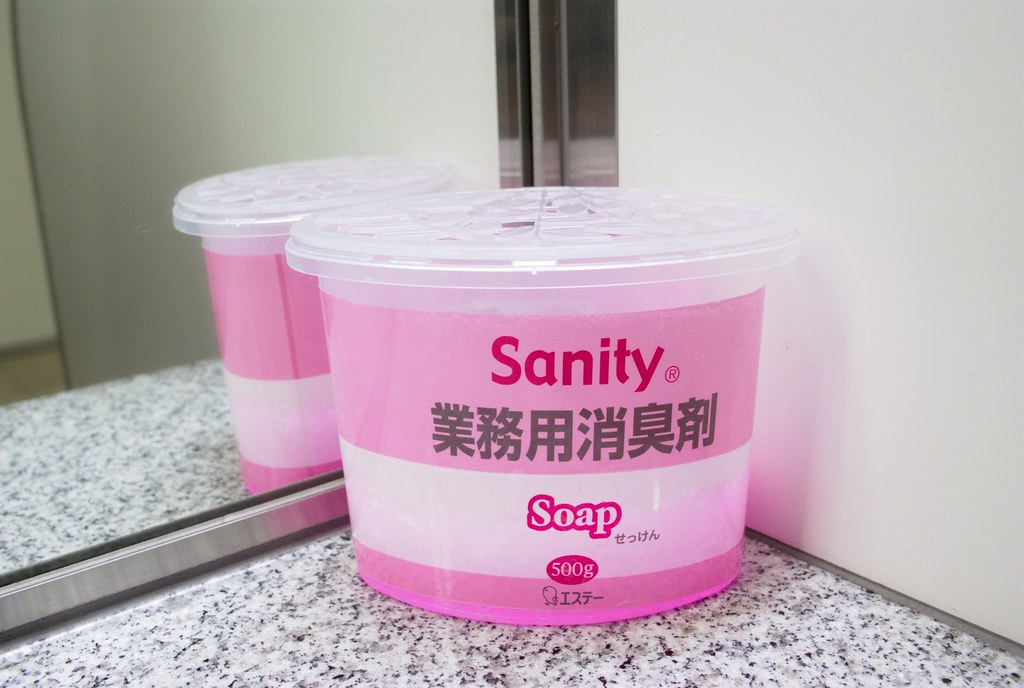
The solution: stop worrying about finishing the long pointless posts, and shove more short, pointless ones out on the blog instead. Such as this picture below, taken in the bathroom at Kita-Ikoma station:

Sanity

Let's try something different today!


The slogan possibilities are endless, really. If you have any good ones, feel free to post them. Bonus for anything relevant to Japanese politics ("Call Mr. Aso and tell him we found it").

Thursday, February 5, 2009

Cheap and Tawdry

The current government of Aso Tarō is not having a good year. With the economy in critical shape, they're being forced by their coalition partner New Komeito to do a very impopular 12000 yen cash giveaway to every resident in Japan. The money will worsen the already critically bad public finances further, and the whole giveaway scheme has also been handled in a remarkably hamfisted way, dragging the government approval ratings further down as a result. The government has support in the 20% range; the economy - and unemployment, and homelessness - is steadily worsening; and there's an election no more than seven months away.

No wonder, then, that LDP members are in full panic over the prospect of losing the next election. So a few of the dimmer stars in the LDP constellation have Come Up With A Plan: Give away more money to the public.

"But.. that's what they're already doing, and it's costing them votes, right?" Right. But they seem to have decided that the current cash giveaway is impopular for two reasons: it's too little, and it costs too much.

First, the thinking seems to go, 12000 yen per person is not enough to bribe comfort the electorate. 12k yen - $150, or SEK1000 - is not chicken feed (the chickens would choke on the tough paper bills) but it's not exactly going to change your life either. So they suggest not another 12k yen, but 600k yen - yes, sixhundred thousand yen, or $6700 or SEK55000 - enough to buy an election revive consumer spending just about anywhere.

The lawmakers suggest a giveaway of around 100 trillion yen, $1.1 trillion or SEK 9 trillion. That's some serious amount of money. Huge, in fact. "Absolutely freaking ginormous" comes to mind. That's about 15% of Japan's GDP. Just about the entire GDP of Sweden - for two years. Real money is what we're talking about here. A financially prudent observer may well pause for a moment and wonder just how they suggest paying for it.

Their suggestion: not pay at all. They propose printing more money - yes, quite literally run the presses and send out the results (by post, presumably) to each and every resident of the Japanese isles. The arguments in favour sound good: the export industry - engine of economic growth - is hurting badly from the expensive yen exchange rate. Also, deflation was a persistent plague on the Japanese economy during the last recession. By diluting the money supply and have people spend it you get a healthy dose of inflation, a drop in the value of the yen, and kickstart the domestic economy. Everybody wins, the LDP lawmakers are hailed as heroes and a grateful electorate will carry them on their shoulders into the Diet and another generation of complete political dominance.

Well, except for one thing - it doesn't really work that way. Printing money without assuming any obligation would generate inflation, sure, and a drop in the value of the currency. But it also destroys the trust in the currency, so there's no reason to expect inflation rate to stabilize or the drop in value to stop. After all, if the government are ready to print money once, why not do it again? And again? Nobody would want to hold Japanese yen, or being paid in yen anymore.

And of course, in aggregate the Japanese households are not poor. They have money; they're just not spending it. Why are they not spending? Worry about the future, worry about the lack of job security, worry about deteriorating social safety nets. Giving each one a big wad of cash is not going to change that. Giving each one a wad of cash in this way will if anything have prudent people lining up to save it in some other currency, on economically safer shores.

And it's the cash giveaway part that really exposes this as the rather amateurish election gambit it is: if you're going to print free money anyhow, how about at least use it to shore up those deteriorating systems - pension, health care, unemployment benefits, social security - that are the main reason people are afraid to spend in the first place?

You know, I wonder: when you become a banana republic, do the banana plants appear by themselves, does the UN send them as part of the first aid programs or are you expected to import them yourself?

Wednesday, February 4, 2009

The Way Things Are Done

There's a peanut-related salmonella outbreak in USA, so peanut-based products imported from there naturally become suspect. A company in Tokyo imported peanut-flavored popcorn, and the health ministry has now ordered them to stop selling the product.

But - and this is where things get interesting - no salmonella has been found in the popcorn so the health ministry apparently can't simply order them to recall the already sold product. Instead they order them to voluntarily recall the popcorn1. Which seems to require some creative reinterpretation of "order", "voluntary" or both.

Now, this is where a certain kind of writer would make hay of this. They'd wildly overgeneralize the thing into some vast gulf of mutual cultural incomprehension, wax rhapsodical about different national characteristics and maybe even have a go at the Mysteries of the Orient and the Inscrutability of the Eastern Mind while they're at it.

That would be very silly. The reality is of course much simpler and less consequential. This amounts to an alert that an involuntary recall will be ordered - with legal repercussions, bad publicity and at considerable inconvenience to everyone involved - if the company doesn't do a recall on its own. The procedural and regulatory praxis has moved on over time while the terminology has not. The resulting mismatch creates anoher small, delightful wrinkle in the language fabric, adding a bit of spice, and nicely illustrating the difference between formal language theory and living, breathing languages in actual use.

It's easy to read too much into things; usually an expression is just an expression, nothing more.

--

#1 No, it's not a translation error; the Yomiuri original says "自主回収を指導した" - "ordered a voluntary recall". And just to forestall an obvious objection, I have it on good authority (my wife) that while "指導" means "guidance" or "coaching" in the context of teaching, the implication is very much "order" when it involves a government agency like this.

Sunday, December 28, 2008

One in Three Stolen Cars Not

Beginning of the holidays and amazingly life manages to become more, not less, hectic. Anyway, a recent nugget of news from a Swedish paper is worth a break: One car in three reported stolen during December is actually not stolen at all (in Swedish).

People forget where they parked, or they mistakenly think they took the car when they didn't, and when they can't find their car they report it stolen. This happens throughout the year, but is especially common during christmas season. Large parking lots, lots of identical-looking cars, and the stress of the upcoming holidays all contribute. I'm not immune myself; I've thought my bicycle has been stolen more than once when I simply couldn't remember where I parked it.

Tuesday, December 23, 2008

When Poodle Groomers Go Bad

Below a sample picture set of a poodle that has been boldly groomed where no poodle has been groomed before:

Creative Grooming Awards

I'm especially impressed by the Teenage Mutant Ninja Turtle one:


Of course, it doesn't hurt the dog in any way (yes, that really is a dog) and they don't have any sense of looking silly or anything. But really, this woman needs to take up sculpture or something.

Wednesday, October 29, 2008

How Not To Get Married

How's this for a scenario: You are a 39 year old salaryman, the night before your wedding. You and your bride have booked a prestigious hotel for the ceremony and the party, and worked for months preparing the event. There's just one little problem: you're already married. To somebody else.

So, it's 2 in the morning. Dawn will break in but a few hours and your fiancée and all your guests will get up and prepare for the big event. Speeches have been written, gifts have been bought, clothes have been carefully laid out. The hotel kitchen staff is undoubtedly already preparing the sumptuous dinner course awaiting the attendees. With some consternation you realize that you've really let this whole "I'm already married"-issue slide for far too long; this very day you will enter the holy state of bigamy in front of your relatives, your friends, your coworkers and your bride to not-really-be. So what can you do? You could come clean and live in shame forever; you could keep silent and hope nobody finds out. You could even try casually mentioning that oh, by the way, my other wife will be moving in with us next week. What do you do?

Well, you could try any of the above. Or, you could simply set fire to the hotel.

Wednesday, September 24, 2008

Pittsburgh, Where Every Student Is Above Average

Pittsburgh has instituted a school policy that no child can score less than 50% on any test, assignment or any other graded work. If the score would be less than 50% it is automatically adjusted up to this cut-off limit.

The reason is to give severely failing students a reason to keep trying; somebody with a 20% score on the first semester would no longer need almost 100% on the remaining semester to pass any more. That won't really work of course, as somebody with the skills and background knowledge to manage only a 20% or 30% score during one semester has no more chance of making 70% or 65%(the needed score) the next semester than they would have had making 100% or 90%. There's a reason the student was failing badly in the first place, and with later material depending on the failed, previous material this is not going to make much of a difference. All it does is mask the problems for a little while longer until the student fails even the new, inflated level.

They could have achieved the same thing by simply adjusting the grade levels downward, with a passing grade at 40-45% rather than 60%. That would have had the benefit of honesty and openness, and would signal that yes, we do value your work even when the score is low. Placing an artificial floor like this, on the other hand, signals that what you do below a certain point simply doesn't matter. Do nothing but make funny noises throughout the test, or work hard and get half right - it's exactly the same as far as the school is concerned. So, if you're going to fail exactly equally in either case, why not spend your time practising your musical burping rather than study for the test?

It never ceases to amaze me how creative people can be when it comes to screwing up the school system, in any country.

Friday, August 22, 2008

An Experiment in Coffee Storage

CoffeeCoffee is perhaps the most popular drug on Earth. There is broad agreement on the different methods to brew coffee, but there is little agreement on how to properly store roasted coffee beans. While everybody agrees that coffee should be ground and used within two weeks or so, this is not always possible. We conducted an informal test and came to the conclusion that chilled, but not frozen, storage offers the best tasting coffee.

Introduction

We drink coffee; so do many people. You get good coffee by buying whole beans and only grind it as you use it. Normally you should use coffee beans within two weeks of roasting. For the disorganized caffeine addict - such as myself - this is not practical as you constantly risk running out of coffee. And having me got without my morning coffee may be entertaining for onlookers, but rather unpleasant - not to mention dangerous - for myself. So it is prudent to buy and store coffee in larger batches.
 
But how to store it? It turns out that there is no consensus on this. Some argue for storage in the freezer; that would preserve ethereal oils in the bean that otherwise evaporate. Other argue for room temperature as it keeps the beans dry and away from other foods that can impart flavour. Both groups generally dismiss refrigeration, arguing that it is neither as dry or free of smell as room temperature, nor as effective as the freezer.

As this is a question of vital importance to humanity - or the subset that depends on coffee to wake up in the morning - we resolved to find out, so in June we set up a small experiment. Since this is a real experiment of sorts I thought it could be a nice illustration on how to go about an experiment like this and how to present it. Science is a method or a way of thinking about things, after all, and it doesn't have to be about complex or esoteric things. As a further illustration I write this post in the approximate format - if not the language - of an academic paper1.

In early June we put fresh coffee beans into three sealed plastic bags. One bag went into the freezer, one into the refrigerator, and one into a cupboard. During the Obon holiday last week we took the now two month old coffee beans, and - making sure we did this double-blind2 - brewed three cups. We tasted all three batches at the same time and ranked them in order of preference. We only identified the coffee after we had ranked the batches.

Coffee testing
The testing setup. We brewed coffee straight into the three glasses at the top, and while still hot, poured into the small glasses for testing.


We were in complete agreement on the rank order from the beginning; the difference between the batches was surprisingly large. Finishing dead last was the room temperature coffee. It felt thin and sour compared to the other two; there really was no contest. The refrigerator and freezer coffees were closer to each other in flavour and smell, but we both agreed that the refrigerated coffee did taste better and more balanced than the freezer coffee.

The result, in short, was:

1. Refrigerator
2. Freezer
3. Room temperature


Method

In early June we took three small freezer bags such as you can find (not at all coincidentally) by the register in Life supermarkets, and filled with two spoonfuls each of whole roasted Hanshin Special Blend beans - our normal coffee. The amount is approximately equal to that needed for half a pot of coffee. The bags were unused and had been checked for holes. All three bags where compressed to remove as much air as possible, then tied up tightly. One bag was put in the kitchen cupboard we normally store coffee and tea; one was placed in the top shelf of the refrigerator door together with bottles of salad dressing and the like; and one was placed in the freezer.

We waited two months. While this is an unusually long time - we normally use a bag within three to four weeks or so - we wanted to give the coffee sufficient time to develop any differences due to storage type. Also, the Obon holiday was the first opportunity we had to conduct the experiment at our leisure.

For the testing we recruited two experimental subjects. The subjects were two healthy adult humans, one male, one female, that fully understood the nature and purpose of the experiment, and agreed to all conditions. Which is not surprising since the subjects are me and Ritsuko ourselves.

RandomizeThe experiment was rendered double blind by randomizing the labeling, twice, as you can see in the illustration to the left. Without Ritsuko in the kitchen I took out the bags and waited until they all were at room temperature. I opened them and poured the beans into bowls labeled 1, 2 and 3, chosen randomly ("Randomize #1" to the left). Then I left and Ritsuko entered. She took the three bowls, and randomly (we used lots) poured them into mugs labeled A, B and C ("Randomize #2"). As a result, she did not know which bag of coffee was 1, 2 or 3. I knew, but did not know which of the bowls had become A, B or C. Neither of us knew which batch of coffee was in which mug, in other words.

We ground each batch using a common mill (not knife) type grinder, with the grinder thoroughly cleaned of coffee grinds before and between each batch (what fun that was). We don't have three coffee pots and filter holders at home unfortunately, instead we took three ordinary glasses (as seen in the picture) and loosely fitted a paper filter with a batch of beans in each of them. We poured the water in two steps, first a little just to soak the grinds, then enough hot water to fill each glass with coffee. The resulting coffee was a bit thicker and stronger than normal for us.
 
To test the coffee we used small snaps-glasses, one glass per batch per person (the small glasses in the image). Tasting was free-form, and we were slow enough that we got to taste each batch both hot and cool. We ranked each batch individually, then compared notes.

Results

The results were completely unambiguous: the room-temperature stored coffee was ranked last by both me and Ritsuko. We were in complete agreement that it was significantly worse in every respect to the other two; thin and with a somewhat unpleasant sour aftertaste. When compared to the other two I was almost hesitant to finish the glass. Almost - I mean, it's still coffee after all.

The two chilled batches were significantly better, and closer in taste and smell to each other, than the room temperature batch. But here too, there was a clear difference and we were both in agreement. The frozen coffee was more bitter and thicker, while the refrigerated coffee was well balanced with somewhat less bitterness and richer flavours. Nothing changed as the coffee cooled: the refrigerated beans tasted somewhat better than the frozen ones, and a lot better than the room-temperature beans.


Discussion

Our aim has been to find out how we should store our coffee - not how people in general should do so. There's a number of factors that could change our results, and we don't really have the time or inclination to control for all of them. The choice of coffee may influence the results, as will the storage time. We chose our coffee and storage time as representative of what we normally drink and the maximum storage time we use respectively. A different brewing method than drip brew, or a different coarseness to the grind may also affect the result.

Our brewing method leaves something to be desired, and could have influenced the results. The basics are sound - mill grinder, pre-wet the beans - but the lack of proper equipment meant that we got stronger coffee than normal, and the three batches were not brewed for precisely the same length of time. The results did not follow the order of brewing time, however, indicating that the effect is modest at best.

So, why this result? First, the poor performance of room-temperature storage seems to indicate that flavours do evaporate over time, even when sealed in an airtight container. It is worth noting, however, that "room temperature" in Osaka in the summer is normally around 30° even with running air conditioning, so this result may not hold in winter or in temperate regions.

We do not know why we have a difference between freezing and refrigeration; a different kind of experiment would be needed to determine it. But we can speculate. First, it seems reasonable to assume - as room-temperature advocates do - that freezing does in fact damage the beans to some extent when they freeze. This damage occurs for other foods as well after all, and is one reason you should not refreeze foods. The result could be that flavours, including bitter ones you don't want, seep out faster into the water than with fresh beans. The frozen, ground coffee would effectively act as if it had been ground more finely than was the case.

As I said in the introduction, refrigeration is generally dismissed with the arguments that it is less effective than freezing, and condensation dampens the beans, damaging them. But if freezing causes damage to the beans then the best storage temperature ought to be just above freezing. Condensation can only happen if there is appreciable amounts of water vapour in the surrounding air to begin with. But we made sure to empty each bag of air as best we could, and seal it tightly. There was little air, and thus little humidity around the beans to condense. It may be that refrigeration is damaging if done in a large jar with much empty space, or oif the coffee is frequently taken out then returned, so that humid air has a chance to enter and condense. Yet another experiment would be needed to determine whether humidity really does harm the beans and whether frequent use increases humidity enough for it to have an effect.

From this informal experiment it does seem that for storage of coffee beans, refrigeration is preferable to either freezing or keeping them at room-temperature. While we can't generalize this result based on one experiment, it seems that refrigeration may be a viable alternative to investigate in the general case as well.


I would like to extend a special thank you to Ritsuko for gracefully putting up with me even when I turn a simple thing like having coffee into an hour-long exercise in science geekiness.


---

Note 1: This is effectively a psychological or psychophysical experiment, so I'm vaguely following the paper structure of that field. While this standard is quite formalistic it's similar in spirit to many other experimental fields:

First a short Abstract that tells you what we did and what we found; just enough that people can decide if the paper is of any interest at all (many aren't after all). Then an Introduction that tells you the background and gives you an overview of the experiment and the results. This section, and the Discussion at the end, is often the only thing people read.

The Methods and Results section dives into all the nitty-gritty details of the experiment and data analysis. This is important information if you want to replicate the experiment or are interested in some specific method information. Most readers are not, and never more than glance at these sections.

In the Discussion we talk about the meaning of our results. Here we can be a little speculative; while the Results section is all about the facts, here we try to interpret them. Why did we get this result? How does it fit in with other studies? Could this be due to experimental errors? What new questions do we have and how could we resolve them (the answer to this is often "give us funding for a follow-up experiment")? This section, together with Introduction, usually has all the important results of the paper, and most people never read more than that.

At the end of the text we thank everybody we think contributed to the work (it's polite - and politic - to thank the agency funding the research for instance). This sometimes gets its own, tiny, section. At the very end come the References. This is actually as important for many readers as the paper itself. Any one paper is usually just one nugget of information, and you need to read and correlate a number of related papers to get the whole image of a particular research area (or read a textbook where someone has done the work for you). References are even more useful the other way around: search for papers referring to the current paper and you can follow the results and consequences of the research. In our case I skip the reference list; on the web it's more natural to embed links directly into the text.


Note 2: Many experiments are about having people comparing things - the taste of different coffee batches in our case, or the results of two different medical procedures, or comparing the effect of a new drug with an older drug or with no drug at all. But we can't just try it and see what happens - we are only human, and our expectations and biases can completely change our perceptions and distort the results.

If a patient in a drug trial knows that they are getting the new drug, for instance, they will show more improvement (and more side-effects) than those not getting it even if the drug really has no effect at all. In the same way, since we expected that the freezer coffee would taste best, we probably would have thought it really did had we known which coffee was which. I noticed a similar effect when I owned a motorcycle: when I had washed my bike, polished it and generally cleaned it up it felt distinctly smoother, faster and more responsive even though its looks have absolutely no effect on performance.

So you want your experimental subjects to be blind to what they are getting. You give some subjects the real drug, others an identical-looking pill with no effect. But, again we are human and we are extremely good at reading people. So if the researcher knows which drug a patient is getting and expecting a certain result, the patient may unconsciously read that expectation from the tone and body language of the researcher and react accordingly - a form of the Clever Hans effect.

The only way to make sure expectations don't affect the results is to make sure nobody involved knows who is getting what. Make both the subjects and the researchers blind to the test; make the test double blind. We only reveal which subjects got the real drug and which did not after the experiment is over. In our case, of course, we are both subjects and researchers, so blind and double blind is effectively the same.

Thursday, August 21, 2008

Halfway

I'm at chapter 10, page 337 of Reason, where Naomi Ishida explains where and why he decided to become an architect. That's just about exactly halfway. Since my last update it's been around 50 working days, and 184 pages, for 3.6 pages per day on average - call it 3.5. At that pace it's 95 days to finish the book, or just over four months. To finish the book within a year I'd have to step up the pace a bit. Which I won't; the pace fits the book, and taking just a few minutes every morning doesn't intrude into anything else.

I just wish Miyabe - the author - didn't have such a ravenous appetite for asides and digressions. This latest digression on the importance of a well-designed internal environment in public buildings for people's well-being is kind of fun, but I don't so far see how this actually relates to the four murders that the book is about; I doubt it was a mad murdering rampage caused by a flickering fluorescent strip.