As you may know, Ichiro Ozawa, general political heavyweight in Japan, is now on trial for his office having accepted some 400 million yen in illegal campaign contributions, after his secretaries have been found guilty of the same. Opinions seem sharply divided if there was criminal intent; whether 400 million is a lot or not; and whether Ozawa knew about it or should shoulder any blame if he didn't.
If we want to get a sense of what is acceptable, it would certainly help to compare with other places. We're (not so) fortuitously right now getting a point of comparison in Swedish politics. Håkan Julholt is the recently elected leader of the largest opposition party. He has now been found to have received too much reimbursement for his working apartment.
A bit of background: House members in the Swedish parliament have a right to an allowance for a place to live in Stockholm if they don't live there already. The (quite reasonable) idea is that they represent their area in the country and shouldn't have to move away permanently to work as House members. On the other hand they do need to spend a substantial part of the year in the capital, which is an expensive place to live. So you get reimbursed for your share of any accommodation in Stockholm — the operative point here being "your share". Most members do not use this; they stay in accommodations provided by the House.
What Juholt has done for years is claim the entire rent on his apartment, while living there with his partner (they're not married, and I don't think the rules would be any different if they were). He should have been claiming only half. The total disclosed amount he has received improperly is 160 000 crowns, about 1,7 million yen. At this point there are people claiming he was informed this was improper, while he and his people say he was not. There is no publicly disclosed evidence either way.
So, 160k crowns — 1.7 million yen — in allowance he should not have received, knowingly or by mistake. As a result, the police and prosecutors have started a criminal investigation. Every newspaper (including those loyal to the opposition party) are combing through years of old receipts and documents to find more. Some party members are already publicly calling for him to step down. Everybody seems to agree that if he hasn't disclosed the total amount or lied in any other way; if there is credible evidence he was warned about this and went ahead anyway; or if the police investigation leads to charges being filed; then he is most certainly gone as party leader and most likely gone from national politics altogether. Even if nothing more surfaces it's an open question whether he can stay on and be an effective leader of his already wounded party.
Politics is a game of trust. Whether you actually do something wrong matters far less than the perception that you did. I'd give Juholt a 50% chance of political life after this, and that's given that nothing more happens. Similarly, whether Ozawa has done anything illegal or not is up to the courts to decide. But Unfairly or not he is already being judged by the media and the public, and ultimately that's what determines his fate. If you're playing a game of trust it doesn't matter if you're technically legal. The perception of you as upright and honest is the only thing that matters.

Showing posts with label politics. Show all posts
Showing posts with label politics. Show all posts
Wednesday, October 12, 2011

Monday, August 29, 2011
Noda new PM
The next political punching bag Finance Ministry handpuppet DPJ party president and Prime minister of Japan is Yoshihiko Noda. He is Finance minister, anti-Ozawa and has recently made some depressingly traditional waves by stating he does not believe the war criminals enshrined at Yasukuni were, in fact, war criminals at all.
The future is notoriously hard to predict, but we do know a few things: there is a regular DPJ party president election in September next year (exact date not fixed). The next lower house election must be held no later than the end of August 2013, but is likely to happen at any time during that spring or summer. There will be less than two years — more like a year and a half, and quite possibly less than that — between the regular party president election and the beginning of general election season and campaigning.
Barring a complete disaster1, the DPJ will not want to throw out their regularly elected leader and switch leaders again just a few months before the general election. This means that whoever wins the regular party president election next year is going to be2 their candidate in the general election in 2013.
If Noda is going to win that party president election next September, he will have to show basic electability. He and his cabinet will have to show decent public support numbers, and he must pull the DPJ up from the gutter and at least become more popular than the LDP. And to do that he'll need to show actual progress of some sort — progress on the economy, on the nuclear disaster mess, on rebuilding Tohoku, on the dysfunctional labour market, you name it. Many of these are problems that the central government has little leverage to do anything about, but all of the responsibility to resolve.
And he'll have to show progress in less than a year. With an opposition whose only tactic is to refuse any legislation offered by the government in order to discredit it. Leading a party where half the members want you out in favour of a champion of their own. And with a foreign policy in tatters before he even forms his cabinet, due to his incredibly boneheaded public defence of the war criminals at Yasukuni.
If he doesn't make it, he'll be out in a year. Everybody knows this, and nobody will risk their own career and throw their weight behind him unless he really seems to make progress and will prevail in next years leadership race. In practice he probably has a grace period of a month or less before the consensus verdict on him is in as either a future political powerhouse or a lame duck counting down the days until he follows Kan, Hatoyama, Aso, Fukuda and Abe into political footnotehood.
You may argue that his election is a momentous event in Japanese politics, that his policy ideas of tax increases and a grand coalition with the opposition will be implemented, and have lasting effect on today's problems and on the political climate. That he will stay on to ultimately contest the general election against the LDP. I would not say you are necessarily wrong. I would say the burden on proof is on you.
--
The future is notoriously hard to predict, but we do know a few things: there is a regular DPJ party president election in September next year (exact date not fixed). The next lower house election must be held no later than the end of August 2013, but is likely to happen at any time during that spring or summer. There will be less than two years — more like a year and a half, and quite possibly less than that — between the regular party president election and the beginning of general election season and campaigning.
Barring a complete disaster1, the DPJ will not want to throw out their regularly elected leader and switch leaders again just a few months before the general election. This means that whoever wins the regular party president election next year is going to be2 their candidate in the general election in 2013.
If Noda is going to win that party president election next September, he will have to show basic electability. He and his cabinet will have to show decent public support numbers, and he must pull the DPJ up from the gutter and at least become more popular than the LDP. And to do that he'll need to show actual progress of some sort — progress on the economy, on the nuclear disaster mess, on rebuilding Tohoku, on the dysfunctional labour market, you name it. Many of these are problems that the central government has little leverage to do anything about, but all of the responsibility to resolve.
And he'll have to show progress in less than a year. With an opposition whose only tactic is to refuse any legislation offered by the government in order to discredit it. Leading a party where half the members want you out in favour of a champion of their own. And with a foreign policy in tatters before he even forms his cabinet, due to his incredibly boneheaded public defence of the war criminals at Yasukuni.
If he doesn't make it, he'll be out in a year. Everybody knows this, and nobody will risk their own career and throw their weight behind him unless he really seems to make progress and will prevail in next years leadership race. In practice he probably has a grace period of a month or less before the consensus verdict on him is in as either a future political powerhouse or a lame duck counting down the days until he follows Kan, Hatoyama, Aso, Fukuda and Abe into political footnotehood.
You may argue that his election is a momentous event in Japanese politics, that his policy ideas of tax increases and a grand coalition with the opposition will be implemented, and have lasting effect on today's problems and on the political climate. That he will stay on to ultimately contest the general election against the LDP. I would not say you are necessarily wrong. I would say the burden on proof is on you.
--
#1 Never underestimate the DPJ. They seem to have an unlimited capacity for political disaster even where you thought it could not possibly happen.
#2 "will hopefully be" is more realistic. See the previous footnote.
It's Monday Morning…
A few Monday morning notes, in no particular order:
- I know paper reviews are simply reviewing your paper, not your work or yourself. That's what I do when I review other peoples papers after all. I know and appreciate that negative reviews are really helpful and we'll have a much better paper in the end. I know all this but I still take the criticism and the rejections personally.
Most researchers I know are perennial — even pathological — optimists. You have to be, in order to deal with constant failure, uncertain funding and all the other stresses of research. I'm not an optimist at heart so I'm not emotionally cut out for this job. - My life would be measurably less stressful if it didn't currently include learning the standard kanji and several hundred obscure Japanese grammar points.
- The election of the next DPJ leader, and thus Japanese prime minister is this afternoon. Get MTC's excellent take on the race here, and a voting analysis by sigma1 here.
I'll write a few words about it once it's over, but I belong firmly in the "who wins doesn't really matter" camp, so I haven't found the energy or time to really cover this in any detail. MTC and the others do a much better job anyhow. - We'll be off to Sweden in another few weeks to see relatives. Central Sweden at the end of September promises to be cold, wet and dark. Right now I can't wait. And with any luck the worst of the summer here will be over by the time we come back.
Really, we're almost ten million people here in Osaka — we could each pick up one piece of the city and move the whole thing to the north coast of Hokkaido. We'd have the same great city as now, but with cooler summers, no typhoons, skiing in the winter and the best seafood in the country!
Tuesday, August 23, 2011
Short Answers to Complicated Questions
Question: Japanese governments are typically weak, squeezed as they are between internal party politics — politicians are less loyal toward their parties than to their factions and money donors — industry associations and special interest groups, and a powerful, unaccountable bureaucracy that ignores the government at will. We've had five Prime ministers in as many years.
The current situation is even worse than usual. The ruling party is close to splitting over internal disagreements. The opposition has control of the upper house and is opposing any and all legislation it can in a bid to force the government to call a general election. A general election that won't be held any time soon: the DPJ knows it will lose many seats and wants to delay as long as possible; the tsunami-ravaged areas are still in no condition to hold any kind of election; and the supreme court has declared the current election district system unconstitutional.
Prime minister Kan has promised the opposition to resign in exchange for the passage of a few budget- and energy-related bills. This will happen within a couple of weeks, and the internal DPJ campaign for electing the next PM is in full swing; Maehara, Noda, Mabuchi and others are all possible candidates. This is just a temporary appointment, though, as the regular party leadership election is scheduled in a year.
The newly appointed PM will have virtually no political leverage with the opposition or the ministries and can count on no public support. Everyone knows they will face a re-election (and likely defeat) in a year, making them a lame duck from day one. The pressing problems — reconstruction of Tohoku, resolution of the Fukushima disaster, rapidly worsening state finances and the effects of a strong yen and worldwide recession — are all mostly out of their hands, but still their public responsibility.
Given the grave situation above, what practical effect will the choice of new Prime minister have on Japanese politics in general; and the task of rebuilding northern Japan, turning around the economy and formulating a new energy policy in particular?
Answer: None.
Thank you for reading this edition of "Short Answers to Complicated Questions". Please join us again for the next edition where we tackle the complicated question of reality-based evidence for a supernatural origin of the universe.
The current situation is even worse than usual. The ruling party is close to splitting over internal disagreements. The opposition has control of the upper house and is opposing any and all legislation it can in a bid to force the government to call a general election. A general election that won't be held any time soon: the DPJ knows it will lose many seats and wants to delay as long as possible; the tsunami-ravaged areas are still in no condition to hold any kind of election; and the supreme court has declared the current election district system unconstitutional.
Prime minister Kan has promised the opposition to resign in exchange for the passage of a few budget- and energy-related bills. This will happen within a couple of weeks, and the internal DPJ campaign for electing the next PM is in full swing; Maehara, Noda, Mabuchi and others are all possible candidates. This is just a temporary appointment, though, as the regular party leadership election is scheduled in a year.
The newly appointed PM will have virtually no political leverage with the opposition or the ministries and can count on no public support. Everyone knows they will face a re-election (and likely defeat) in a year, making them a lame duck from day one. The pressing problems — reconstruction of Tohoku, resolution of the Fukushima disaster, rapidly worsening state finances and the effects of a strong yen and worldwide recession — are all mostly out of their hands, but still their public responsibility.
Given the grave situation above, what practical effect will the choice of new Prime minister have on Japanese politics in general; and the task of rebuilding northern Japan, turning around the economy and formulating a new energy policy in particular?
Answer: None.
Thank you for reading this edition of "Short Answers to Complicated Questions". Please join us again for the next edition where we tackle the complicated question of reality-based evidence for a supernatural origin of the universe.
Saturday, July 30, 2011
Power Company Power
A total of seven power utilities in Japan have ordered their employees to attend public nuclear power-related hearings and symposia and pose as private citizens in favour of nuclear power, some of them even asking questions prepared in advance by the utilities.
Good thing Japan has a nuclear safety agency right? One that has oversight over power companies; an agency that is ready and willing to come down hard on this kind of manipulation? Not quite. At least two of the power companies now say the safety agency asked them to subvert these hearings. The nuclear safety agency is all about the safety of the nuclear power generation business, not about the safety for the people living near the power plants.
It's a perfect example of what I've been harping about here lately: government agencies and ministries see themselves as protecting industry from the public, not protecting the public from industry.
Now imagine the same kind of behaviour in other fields: a food safety agency that protects the food and agriculture industry from the effect of tainted foods; an environmental agency that ensures environmental concerns won't stop industrial development or waste dumping; a drug safety agency that keeps local drug companies safe from competition at the expense of effective, inexpensive treatments available elsewhere; police and prosecutors that are willing to plant evidence and send innocents to prison in order to protect a corrupt colleague, or simply to further their own careers.
Every country, every society, has its share of problems. The unchecked, unaccountable power wielded — sometimes abusively, sometimes wisely, but always without oversight — by public ministries and industrial groups is one of the main problems in Japan today.
Good thing Japan has a nuclear safety agency right? One that has oversight over power companies; an agency that is ready and willing to come down hard on this kind of manipulation? Not quite. At least two of the power companies now say the safety agency asked them to subvert these hearings. The nuclear safety agency is all about the safety of the nuclear power generation business, not about the safety for the people living near the power plants.
It's a perfect example of what I've been harping about here lately: government agencies and ministries see themselves as protecting industry from the public, not protecting the public from industry.
Now imagine the same kind of behaviour in other fields: a food safety agency that protects the food and agriculture industry from the effect of tainted foods; an environmental agency that ensures environmental concerns won't stop industrial development or waste dumping; a drug safety agency that keeps local drug companies safe from competition at the expense of effective, inexpensive treatments available elsewhere; police and prosecutors that are willing to plant evidence and send innocents to prison in order to protect a corrupt colleague, or simply to further their own careers.
Every country, every society, has its share of problems. The unchecked, unaccountable power wielded — sometimes abusively, sometimes wisely, but always without oversight — by public ministries and industrial groups is one of the main problems in Japan today.
Friday, July 29, 2011
Who's Next in the DPJ? Who Cares?
I'm finally seeing the end of a marathon paper writing process — not the end, mind you, but at least there is an end in sight.
Meanwhile, Shisaku is speculating about the next prime minister once Kan leaves office sometime within the next couple of months. I wonder why he bothers. As he points out himself, it doesn't matter who gets appointed as the other major parties are all obstructing any and all possible legislation with the sole aim of forcing a new general election. Largest opposition LDP is fully prepared to vote against their own proposals if the DPJ supports them, that's how bad it is.
That general election won't happen any time soon. The prime minister decides when to hold it, and as the DPJ is certain to get badly beaten, no DPJ leader with aspirations to any kind of political future is going to call it until they absolutely have to, in 2013. Up until then Japan will continue in a state of political deadlock.
And things are very unlikely to improve after the next election. Both the LDP and the DPJ have amply demonstrated that even majority rule is not enough. They are often unable to actually impose any legislation contrary to the wishes of the state ministries and the large industrial and professional lobby groups. Power company executives have been openly mocking the idea of tougher regulations or government oversight; they know an administration can't do it without consent from ministries that see their job as protecting the industry1, not regulating it.
The stasis will continue, in some form or another. The economy and peoples' lives will suffer for it. Those elected by the public will largely be unable to do anything significant about it, while the unelected power brokers obviously do not care. I'm afraid that things may have to become a lot worse before it ever gets better again.
--
Meanwhile, Shisaku is speculating about the next prime minister once Kan leaves office sometime within the next couple of months. I wonder why he bothers. As he points out himself, it doesn't matter who gets appointed as the other major parties are all obstructing any and all possible legislation with the sole aim of forcing a new general election. Largest opposition LDP is fully prepared to vote against their own proposals if the DPJ supports them, that's how bad it is.
That general election won't happen any time soon. The prime minister decides when to hold it, and as the DPJ is certain to get badly beaten, no DPJ leader with aspirations to any kind of political future is going to call it until they absolutely have to, in 2013. Up until then Japan will continue in a state of political deadlock.
And things are very unlikely to improve after the next election. Both the LDP and the DPJ have amply demonstrated that even majority rule is not enough. They are often unable to actually impose any legislation contrary to the wishes of the state ministries and the large industrial and professional lobby groups. Power company executives have been openly mocking the idea of tougher regulations or government oversight; they know an administration can't do it without consent from ministries that see their job as protecting the industry1, not regulating it.
The stasis will continue, in some form or another. The economy and peoples' lives will suffer for it. Those elected by the public will largely be unable to do anything significant about it, while the unelected power brokers obviously do not care. I'm afraid that things may have to become a lot worse before it ever gets better again.
--
#1 and their own extremely well-paid post-retirement jobs in said industries.
Thursday, June 2, 2011
Kan Prevails
In the end, Ozawa withdrew his support for the no-confidence motion. Without his support it stood no chance; the motion was defeated 293-152.
The LDP and to some extent the New Komeito are arguably losers in this. The no-confidence motion would have happened in any case, largely as a symbolic raspberry to the sitting cabinet1, but with Ozawas possible, then probable support it took on real meaning and the LDP leaders invested a fair amount of their political capital in seeing the motion pass.
Kan is, well, not the loser he looked to become just this morning. He had to promise to resign as soon as the Tohoku disaster situation and Fukushima stabilizes, but he was well on his way out already and would not have survived politically beyond that point anyhow.
Yukio "I-must-have-left-my-brain-in-the-other-suit" Hatoyama optimistically predicts mid-June for a leadership change; when you look at the progress in Tohoku and in Fukushima I would not be surprised if he stays until September. And with the no-confidence motion behind him he is guaranteed to break the one-year barrier with his prime-ministership, and become the longest-sitting prime minister since Koizumi.
The Japanese public and the Japanese political system are both losers - but they were the moment a few bright bulbs decided that several hundred thousand citizens in refugee camps and an ongoing nuclear disaster is a perfect time to plunge the country into (worse) political disarray.
The big mystery to me is Ozawa; is he a winner or a loser in this sorry charade? Perhaps he overplayed his hand; he realized he didn't have the numbers to topple Kan and elected to withdraw rather than follow through and get kicked out into the political wilderness. On the other hand, he made the LDP look foolish (there is no love lost between him and that party) and extracted a promise to resign from the prime minister. My bet is that he tried and lost. The current result is a bit of a consolation prize, nothing more.
Now, nothing has really changed. The Kan cabinet will still fall soon; the DPJ will still fly apart in the not too distant future; the LDP is no more ready to rule again than they were a year ago; and nobody has any clue, nor much interest in, breaking out of the political deadlock the country has been stuck in for the past decade.
The LDP and to some extent the New Komeito are arguably losers in this. The no-confidence motion would have happened in any case, largely as a symbolic raspberry to the sitting cabinet1, but with Ozawas possible, then probable support it took on real meaning and the LDP leaders invested a fair amount of their political capital in seeing the motion pass.
Kan is, well, not the loser he looked to become just this morning. He had to promise to resign as soon as the Tohoku disaster situation and Fukushima stabilizes, but he was well on his way out already and would not have survived politically beyond that point anyhow.
Yukio "I-must-have-left-my-brain-in-the-other-suit" Hatoyama optimistically predicts mid-June for a leadership change; when you look at the progress in Tohoku and in Fukushima I would not be surprised if he stays until September. And with the no-confidence motion behind him he is guaranteed to break the one-year barrier with his prime-ministership, and become the longest-sitting prime minister since Koizumi.
The Japanese public and the Japanese political system are both losers - but they were the moment a few bright bulbs decided that several hundred thousand citizens in refugee camps and an ongoing nuclear disaster is a perfect time to plunge the country into (worse) political disarray.
The big mystery to me is Ozawa; is he a winner or a loser in this sorry charade? Perhaps he overplayed his hand; he realized he didn't have the numbers to topple Kan and elected to withdraw rather than follow through and get kicked out into the political wilderness. On the other hand, he made the LDP look foolish (there is no love lost between him and that party) and extracted a promise to resign from the prime minister. My bet is that he tried and lost. The current result is a bit of a consolation prize, nothing more.
Now, nothing has really changed. The Kan cabinet will still fall soon; the DPJ will still fly apart in the not too distant future; the LDP is no more ready to rule again than they were a year ago; and nobody has any clue, nor much interest in, breaking out of the political deadlock the country has been stuck in for the past decade.
#1 This is considered normal, ethical behaviour here. A lot of Japanese politics resemble nothing so much as a schoolyard of spiteful 7-year olds.
Ozawa Rebels
The opposition parties have submitted a no-confidence motion against the government. By itself it's kind of a pointless gesture, and a bit hard to understand; they don't have the votes to make it pass, and they've been getting plenty of criticism for wasting time with this. The DPJ government has been making the expected hash of things of course, but the opposition has also been obstructing things at every turn.
But Ozawa is urging his followers to vote for the no-confidence motion. In a by now familiar pattern, when he realizes he won't be Prime Minister within his current party he leaves and takes his followers with him, and damn the consequences. It's unlikely that he'll be able to round up the 86 DPJ rebels he'd need to topple the Kan government, but the DPJ leadership (what's left of it) has stated that anyone voting for this motion will be expelled from the party. This includes at least five fairly high-ranking party members.
Effectively, the DPJ is splitting down the middle. MTC argues that this is the end of the DPJ. While it's likely the end of the DPJ as an amorphous big-tent alternative to the similarly sprawling LPD, I'm not as sure it's the end of the DPJ party brand.
The rebels are unified mostly in their fealty to Ozawa himself, but to some extent the rebelling diet members all share an ideology beyond that as well. Ozawa has tended to recruit candidates that can subscribe to his vision of Japans political future. They'll leave, and, I guess, either try to build a new party together with a rump of members from the LDP; or possibly try to merge with another existing party.
But that also means the remains of the DPJ are free of a long-running ideological and personal split. The DPJ, like the LDP, has never really made much sense, with members representing almost every conceivable point on the political map. The remaining DPJ will possibly be a fair bit more unified in its political outlook, and with less personal acrimony to thwart coherent policy-making.
And of course the same thing can be said of any future Ozawaist party; if they manage to create a viable organization then it, too, should be able to present a clearer alternative to the voters than its members ever could as part of the DPJ. The New Komeito, Everybody's Party, the long-established small parties all have a coherent ideology of sorts (though the Social Democrats and the New Komeito seem to share "being in power" as a major part of it).
That leaves the LDP as a sprawling "everything-for-everyone" big-tent party. But LDP support is more and more concentrated in the rural Japan, areas that have been losing population and influence for a long time now. They rely on a voting district division that gives disproportionate power to rural areas at the expense of urban Japan, but the supreme court has recently ruled this discrepancy as illegal and unconstitutional. It is very likely that the LDP power base will be substantially reduced when the redistricting happens. That disruption will hopefully be enough for LDP members to split into more coherent parties as well, and will in any case lessen the LDP influence no matter what.
We might see the beginning of the end of the current Japanese political system. A good thing in the long run. Hopefully.
Edit: MTC reports the rebels may have the needed votes, and Kan may be ready to resign. In any case, that doesn't really change the longer-term outlook; the party is falling into pieces, the question is simply who owns what piece.
But Ozawa is urging his followers to vote for the no-confidence motion. In a by now familiar pattern, when he realizes he won't be Prime Minister within his current party he leaves and takes his followers with him, and damn the consequences. It's unlikely that he'll be able to round up the 86 DPJ rebels he'd need to topple the Kan government, but the DPJ leadership (what's left of it) has stated that anyone voting for this motion will be expelled from the party. This includes at least five fairly high-ranking party members.
Effectively, the DPJ is splitting down the middle. MTC argues that this is the end of the DPJ. While it's likely the end of the DPJ as an amorphous big-tent alternative to the similarly sprawling LPD, I'm not as sure it's the end of the DPJ party brand.
The rebels are unified mostly in their fealty to Ozawa himself, but to some extent the rebelling diet members all share an ideology beyond that as well. Ozawa has tended to recruit candidates that can subscribe to his vision of Japans political future. They'll leave, and, I guess, either try to build a new party together with a rump of members from the LDP; or possibly try to merge with another existing party.
But that also means the remains of the DPJ are free of a long-running ideological and personal split. The DPJ, like the LDP, has never really made much sense, with members representing almost every conceivable point on the political map. The remaining DPJ will possibly be a fair bit more unified in its political outlook, and with less personal acrimony to thwart coherent policy-making.
And of course the same thing can be said of any future Ozawaist party; if they manage to create a viable organization then it, too, should be able to present a clearer alternative to the voters than its members ever could as part of the DPJ. The New Komeito, Everybody's Party, the long-established small parties all have a coherent ideology of sorts (though the Social Democrats and the New Komeito seem to share "being in power" as a major part of it).
That leaves the LDP as a sprawling "everything-for-everyone" big-tent party. But LDP support is more and more concentrated in the rural Japan, areas that have been losing population and influence for a long time now. They rely on a voting district division that gives disproportionate power to rural areas at the expense of urban Japan, but the supreme court has recently ruled this discrepancy as illegal and unconstitutional. It is very likely that the LDP power base will be substantially reduced when the redistricting happens. That disruption will hopefully be enough for LDP members to split into more coherent parties as well, and will in any case lessen the LDP influence no matter what.
We might see the beginning of the end of the current Japanese political system. A good thing in the long run. Hopefully.
Edit: MTC reports the rebels may have the needed votes, and Kan may be ready to resign. In any case, that doesn't really change the longer-term outlook; the party is falling into pieces, the question is simply who owns what piece.
Friday, April 22, 2011
Opinion Polls
I've been pushing this text around for a week or more; it's still too wordy by far but it has resisted all my attempts to tighten it up properly. Better post it now than push it around my plate for another week or more.
The latest polls for the Kan administration are out. They're disastrous. This is not exactly a surprise. His government has been indecisive and wavering, and an earthquake and tsunami of historical magnitude with a nuclear breakdown as a chaser doesn't help. After only ten months in office , there's mounting calls for him to step down. Take a look at this figure:

Approval ratings over time.
Notice a trend? Japan has seen its share of less than amazingly competent prime ministers lately - neither Abe nor Hatoyama will ever grace any political top-ten list - but there's something more to this. One or two dud leaders is normal. Five leaders in a row is not1. The leaders range from the muscular nationalist right (Abe) to moderate, almost social democratic center (Kan). Would you believe the next PM - whoever it is - will avoid the same fate?
I don't think so. People who become prime ministers aren't stupid or devoid of talent, by and large. They need plenty of skills and political savvy to ever get into contention in the first place2. But in Japan, at this point, you could elect the genetically cloned love-child of Mahatma Gandhi, Machiavelli and Julius Caesar, and they'd crash and burn at the polls within six month of assuming the Japanese premiership.
I find it frightening that Japanese governments are so weak that opinion polls can actually topple them. I find it strange than nobody else seems to think it is. Think about it - they're media polls. They're not votes and have no legal force. They're anything but impartial; you can get wildly different results depending on who you ask, and how you ask them. It's no surprise that conservative media polls find support for conservative causes, progressive polls find support for progressive causes, and liberal polls for liberal causes.
A government could just shrug and ignore them. And yet, this agenda-driven competition for whoever screams the loudest - a mass media version of extremist gangs roaming the streets, fighting each other - is allowed to set the agenda and to save or topple elected officials. That is frightening. It is mob rule through media.
I don't know what other countries regularly allow a sitting government to topple - not just call an election, but actually remove the sitting prime minister - simply because opinion polls look bad. If anything, the ruling party would normally circle the wagons and protect their leader - and their handle on power - and take a bet that they'll improve things in time for the next election.
But the major Japanese parties aren't really parties in the normal sense. They don't have a unifying ideology or commonality of purpose. They're more like electoral umbrella organizations that lets its members collect contributions and campaign under one name. Both the DPJ and the LDP house wildly divergent political groups within their ranks. The Ozawa group and the Kan group within the DPJ, for instance, have less in common than either have with similar groups in the opposition parties. They're really separate parties in all but name.
So when Kan gets into trouble with the opinion polls, the reaction of the Ozawa faction is not to help and support the party standard bearer. They don't see one of their own under attack; they see a political enemy weakened and will try to use it to bring him down. A Kan government is not "their" government, despite having the same party label, and they see themselves as being in opposition to it. That both groups happen to belong to the DPJ is irrelevant. The same goes for other factions of course, in LDP and DPJ alike.
But why are polls so dismally low? And why are no parties benefiting from this discontent? A recurring refrain from opinion polls is that the government - whoever it is - is passive and unable to to take decisive action to resolve important problems. There is a well-founded belief that the government is sitting on its hands while problems grow worse over time. The opposition is hurt by this too; the public doesn't believe they'll do any better.
The problem is that taking decisive action means making impopular decisions. The current system makes it all but impossible.
Any impopular decision will have an effect in the polls. If it hits a particular group or industry you'll lose their donations and their campaign assistance, and so you'll lose the support of party members that represent them. The parties are weak, with little leverage over their members, and parliamentarians are dependent on outside help to win or retain their seats. They have plenty to gain and little to lose by helping a donor against the wishes of their party.
The unelected, unaccountable state bureaucracy is as powerful as the elected government; the administration may propose a new directive, but if the ministries are opposed it won't ever get implemented. Many ministries are very close to the industry, such as agriculture, energy and construction, that they're supposed to regulate. Senior administrators get an exit and pension plan through amakudari, and in return the ministries work as protectors as much as regulators. Any adverse legislation, such as deregulation of the agricultural sector or tightening safety rules, are fiercely opposed by the ministries. Most administrations have tried to weaken those cosy ties by abolishing amakudari, but as the ministries oppose it that has proven impossible as well.
The administration, the elected parties and the bureaucracy are the three main actors, all with more or less divergent interests. And in Japan, the administration is the weakest of those three. Which means any decision has to find favour with all three entities, with public opinion and with industry interests. This effectively means that impopular or painful decisions can not be made, no matter how necessary, no matter how beneficial they may be further down the road.
Replacing Kan as prime minister will not change anything. Replacing DPJ with LDP - or with Minna no To or any other party - will not change anything either. And every failed administration will weaken the power base for the next administration in turn.
This deadlock is unsustainable. So what will break it? I have no idea. And I suspect I won't like the answer when we find out.
--
The latest polls for the Kan administration are out. They're disastrous. This is not exactly a surprise. His government has been indecisive and wavering, and an earthquake and tsunami of historical magnitude with a nuclear breakdown as a chaser doesn't help. After only ten months in office , there's mounting calls for him to step down. Take a look at this figure:
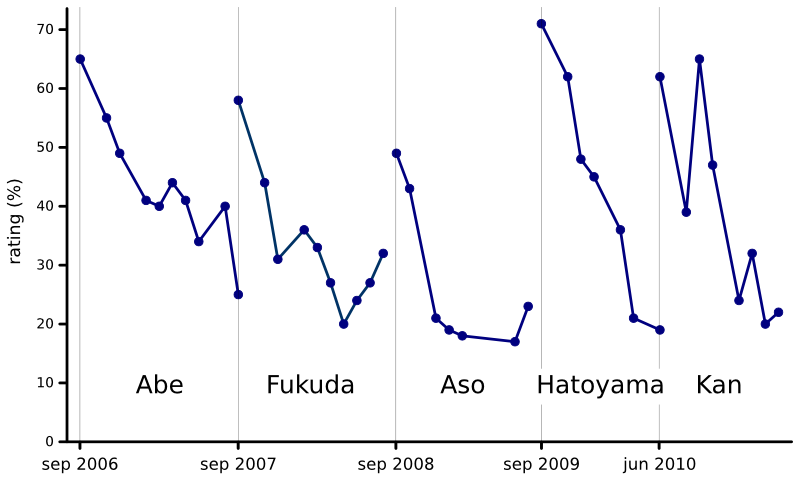
Approval ratings over time.
Notice a trend? Japan has seen its share of less than amazingly competent prime ministers lately - neither Abe nor Hatoyama will ever grace any political top-ten list - but there's something more to this. One or two dud leaders is normal. Five leaders in a row is not1. The leaders range from the muscular nationalist right (Abe) to moderate, almost social democratic center (Kan). Would you believe the next PM - whoever it is - will avoid the same fate?
I don't think so. People who become prime ministers aren't stupid or devoid of talent, by and large. They need plenty of skills and political savvy to ever get into contention in the first place2. But in Japan, at this point, you could elect the genetically cloned love-child of Mahatma Gandhi, Machiavelli and Julius Caesar, and they'd crash and burn at the polls within six month of assuming the Japanese premiership.
I find it frightening that Japanese governments are so weak that opinion polls can actually topple them. I find it strange than nobody else seems to think it is. Think about it - they're media polls. They're not votes and have no legal force. They're anything but impartial; you can get wildly different results depending on who you ask, and how you ask them. It's no surprise that conservative media polls find support for conservative causes, progressive polls find support for progressive causes, and liberal polls for liberal causes.
A government could just shrug and ignore them. And yet, this agenda-driven competition for whoever screams the loudest - a mass media version of extremist gangs roaming the streets, fighting each other - is allowed to set the agenda and to save or topple elected officials. That is frightening. It is mob rule through media.
I don't know what other countries regularly allow a sitting government to topple - not just call an election, but actually remove the sitting prime minister - simply because opinion polls look bad. If anything, the ruling party would normally circle the wagons and protect their leader - and their handle on power - and take a bet that they'll improve things in time for the next election.
But the major Japanese parties aren't really parties in the normal sense. They don't have a unifying ideology or commonality of purpose. They're more like electoral umbrella organizations that lets its members collect contributions and campaign under one name. Both the DPJ and the LDP house wildly divergent political groups within their ranks. The Ozawa group and the Kan group within the DPJ, for instance, have less in common than either have with similar groups in the opposition parties. They're really separate parties in all but name.
So when Kan gets into trouble with the opinion polls, the reaction of the Ozawa faction is not to help and support the party standard bearer. They don't see one of their own under attack; they see a political enemy weakened and will try to use it to bring him down. A Kan government is not "their" government, despite having the same party label, and they see themselves as being in opposition to it. That both groups happen to belong to the DPJ is irrelevant. The same goes for other factions of course, in LDP and DPJ alike.
But why are polls so dismally low? And why are no parties benefiting from this discontent? A recurring refrain from opinion polls is that the government - whoever it is - is passive and unable to to take decisive action to resolve important problems. There is a well-founded belief that the government is sitting on its hands while problems grow worse over time. The opposition is hurt by this too; the public doesn't believe they'll do any better.
The problem is that taking decisive action means making impopular decisions. The current system makes it all but impossible.
Any impopular decision will have an effect in the polls. If it hits a particular group or industry you'll lose their donations and their campaign assistance, and so you'll lose the support of party members that represent them. The parties are weak, with little leverage over their members, and parliamentarians are dependent on outside help to win or retain their seats. They have plenty to gain and little to lose by helping a donor against the wishes of their party.
The unelected, unaccountable state bureaucracy is as powerful as the elected government; the administration may propose a new directive, but if the ministries are opposed it won't ever get implemented. Many ministries are very close to the industry, such as agriculture, energy and construction, that they're supposed to regulate. Senior administrators get an exit and pension plan through amakudari, and in return the ministries work as protectors as much as regulators. Any adverse legislation, such as deregulation of the agricultural sector or tightening safety rules, are fiercely opposed by the ministries. Most administrations have tried to weaken those cosy ties by abolishing amakudari, but as the ministries oppose it that has proven impossible as well.
The administration, the elected parties and the bureaucracy are the three main actors, all with more or less divergent interests. And in Japan, the administration is the weakest of those three. Which means any decision has to find favour with all three entities, with public opinion and with industry interests. This effectively means that impopular or painful decisions can not be made, no matter how necessary, no matter how beneficial they may be further down the road.
Replacing Kan as prime minister will not change anything. Replacing DPJ with LDP - or with Minna no To or any other party - will not change anything either. And every failed administration will weaken the power base for the next administration in turn.
This deadlock is unsustainable. So what will break it? I have no idea. And I suspect I won't like the answer when we find out.
--
#1 Koizumi, before Abe, was exceptional, with a rare gift for public relations, but also lucky to have a captive party and a period of economic recovery. Previous PMs, such as Mori, reverted to similar trends we see here. I decided to look at just the last five as they're all of the same generation and worked in a similar political and economic climate, and comparable polling data becomes difficult to find for much earlier administrations.
#2 Abe and Hatoyama were chosen largely for who they are, not for any ability of their own. Abe was the compromise candidate, with an impeccable family background and with solid support from an important right-wing faction within the LDP. Hatoyama was elected party leader, not prime minister. He is a founder of and basically paid for the establishment of the DPJ, so there was a sense that he'd earned a shot as party leader.
Friday, February 18, 2011
What's Eating Ozawa
I've never met Ozawa, I have no background in Japanese politics and I have never studied political science in my life. Take this - and all my political posts - with the consideration it deserves. Caveat lector.
In my previous post, Claire comments on the possibility that Ozawa join forces with one of the new regional parties:
I don't agree.
Ozawa is an enormously skilled politician. He has a rare ability to take a disparate group and unify them into a well-oiled political machine. Out on the stump he is a master of organizing local efforts to get out the votes and make candidates connect with their voting public. Before Ozawa, the DPJ was a bumbling, ineffectual merger of disparate political groups that were unable to agree on most anything. He, more than anybody else, turned this discussion club into the sharp, unified party that was able to rout the long-time LDP in a general election. The DPJ really is his creation as much as anyones. He has always been - and still is - an enormous asset for any burgeoning political party.
So where does he go wrong? In short, his ambitions do not match his abilities. He wants to become Prime minister, and it is his repeated failed attempts to achieve that position that has been his undoing over the years. It's not that he lacks ability - he is quite possibly the most skilled politician in Japan - but his abilities and his ambitions are misaligned.
Building a political organization and creating an election strategy takes very different skills from being a party leader and prime minister. Ozawa is excellent at the first task; not so much at the second. He is very much like a genius movie director that really rather wants to play the leading role, or the acclaimed conductor that desperately yearns to be the solo violinist.
As long as he is working the back office he is pure gold for any party that has him. But whenever his burning ambition gets the better of him things tend to fall apart. It's not just that he isn't Prime minister material - with the possible exception of Fukuda none of the recent office holders are either - but things go badly because he is such a gifted organizer. Most party members could fight for power without harming their party, but Ozawa can't. He has been a key figure in forging the party into a unified whole, so his power struggles can't but help tearing down that unity again.
A regional party would find Ozawa - his towering skills, his vast national contact networks - almost irresistible. And as long as they can keep a lid on his power ambition he would be an enormous asset. It's telling that the public doesn't resent a party with Ozawa when he is being his organisatorial self. It's only when his ambitions rear their head that the public takes notice. So a regional party may well figure that they can enlist his help for a few years, at which point he may have become too old or frail to continue in politics. Or they may believe that their current political fortunes are better with Ozawa than without, no matter what may happen in the future.
He is called "Ozawa the Destroyer", but what he is mostly destroying is his own impressive legacy, and it is his misplaced ambition that is doing the destruction.
In my previous post, Claire comments on the possibility that Ozawa join forces with one of the new regional parties:
I see what both parties think they could get out of such a tie-up, but it seems like joining up with Ozawa would actually be the kiss of death for someone who's seeking to brand himself as a fresh face.
I don't agree.
Ozawa is an enormously skilled politician. He has a rare ability to take a disparate group and unify them into a well-oiled political machine. Out on the stump he is a master of organizing local efforts to get out the votes and make candidates connect with their voting public. Before Ozawa, the DPJ was a bumbling, ineffectual merger of disparate political groups that were unable to agree on most anything. He, more than anybody else, turned this discussion club into the sharp, unified party that was able to rout the long-time LDP in a general election. The DPJ really is his creation as much as anyones. He has always been - and still is - an enormous asset for any burgeoning political party.
So where does he go wrong? In short, his ambitions do not match his abilities. He wants to become Prime minister, and it is his repeated failed attempts to achieve that position that has been his undoing over the years. It's not that he lacks ability - he is quite possibly the most skilled politician in Japan - but his abilities and his ambitions are misaligned.
Building a political organization and creating an election strategy takes very different skills from being a party leader and prime minister. Ozawa is excellent at the first task; not so much at the second. He is very much like a genius movie director that really rather wants to play the leading role, or the acclaimed conductor that desperately yearns to be the solo violinist.
As long as he is working the back office he is pure gold for any party that has him. But whenever his burning ambition gets the better of him things tend to fall apart. It's not just that he isn't Prime minister material - with the possible exception of Fukuda none of the recent office holders are either - but things go badly because he is such a gifted organizer. Most party members could fight for power without harming their party, but Ozawa can't. He has been a key figure in forging the party into a unified whole, so his power struggles can't but help tearing down that unity again.
A regional party would find Ozawa - his towering skills, his vast national contact networks - almost irresistible. And as long as they can keep a lid on his power ambition he would be an enormous asset. It's telling that the public doesn't resent a party with Ozawa when he is being his organisatorial self. It's only when his ambitions rear their head that the public takes notice. So a regional party may well figure that they can enlist his help for a few years, at which point he may have become too old or frail to continue in politics. Or they may believe that their current political fortunes are better with Ozawa than without, no matter what may happen in the future.
He is called "Ozawa the Destroyer", but what he is mostly destroying is his own impressive legacy, and it is his misplaced ambition that is doing the destruction.
Thursday, February 17, 2011
Ozawa
The man who just keeps bouncing back over and over again after everybody thinks he's gone - no, not Jason, Ozawa - may really be gone this time. Unfortunately, he may decide to bring the DPJ and the Japanese government down with him.
Ozawa was recently formally indicted for his role (if any) in a campaign finance case. DPJ party leader Kan has tried to persuade him to step down ever since, and after he refused, the party governing board decided to suspend him for the duration of the court case. A suspension is apparently according to the internal party rules in such cases.
Now, here is where it gets complicated (it always seems to get complicated whenever Ozawa is involved). He is a strong campaigner and a talented vote-getter. A large group of new DPJ lower house members owe their seats - and their future careers - to Ozawa more than to the party. Ozawa is also very hungry for the prime minister post; that's the one position he has been aiming for for most of his career. In the DPJ leader election last year, Ozawa lost against Kan, but only by a small margin, and he's been looking for another chance ever since.
And it looked like the chance might come soon. The Kan administrations ratings with the public are lousy. The houses are divided, so they need support from at least a couple of small parties to pass any significant legislation - support that the DPJ if finding desperately difficult to drum up. It now looks likely that they will not be able to pass the spring budget. The LDP say they won't vote for any DPJ budget no matter what it contains unless Kan first agrees to call a reelection (and let's generously ignore that the budget bills would be pointless if an election is called), and the smaller parties don't want to attach themselves to a sinking ship. It is only a matter of time until Kan throws in the towel. Enter Ozawa to pick up the fallen mantle, restore the DPJ To Its Full Glory and lead His Glorious Party Into the Glorious Future Under His Glorious Leadership!
Except... He is under suspension, and will be for the duration of the court case. Which might go on for months and months. And under party rules he can't hold any position or stand for election. So if, as seems likely, Kan steps down this spring then Ozawa will be sitting on the sidelines and watch someone else grab the position he so very, very much wants for himself. It'd mean another year or more before another opportunity presents itself, and with his age and health he may not have another couple of years.
So now he is considering leaving the DPJ, taking his supporters along and bringing the governing party down around him. He's done it before - he's called "Ozawa the Destroyer" for a reason - and there's no reason to think he won't do it again. He may well reason that with his chances for premiership gone within the DPJ, he is better off in a new party (with one of the increasingly popular prefectural governors perhaps), and the more damage he can cause to the DPJ on his way out the better.
Sixteen of his lower house members have somewhat incongruously stated that they are no longer part of the governing coalition - although they apparently want to remain in the party. They are threatening to vote against the coming budget bills in revenge of Ozawas suspension; the budget bills presented by their own party, that they seem to think they still belong to. They are effectively saying that unless Ozawa is reinstated and Kan gets the boot, they will leave the party. There's more than a whiff of 3rd-grade "I'll kick and scream until I get my way" playground mentality there.
Now, if Kan actually listens to Ozawa and to whatshisname of the opposition LDP and calls a new election then things could get really interesting. Kan and the DPJ are in dire straits, support-wise, true, but they're not the only ones. For all their bluster about demanding elections, the LDP is completely unprepared for a general election. Newspaper reports say they don't even have viable candidates for many seats around the country, and they're still in the process of downscaling the organization to fit their slimmer economy. Ozawa would not be in a position to contest a general election from the outside at this point either, and he risks having many election-weary voters blame him in part for the whole thing.
So who would win? Seriously, who cares any more? Nobody in this soap opera seems to consider the effect on Japan at large. They're all playing internal politics, manoeuvring for power, while ignoring the corrosive effect this has on Japanese politics. Necessary bills and broadly accepted reforms get lost because somebody can earn a few points by killing them, or they just don't want to give an opponent the satisfaction of achieving something. I'd call these people childish but that'd be doing children an injustice - children grow up, while these sad people never will.

This is not a Diet member. They don't exhibit this sense of responsibility and gravitas.
Ozawa was recently formally indicted for his role (if any) in a campaign finance case. DPJ party leader Kan has tried to persuade him to step down ever since, and after he refused, the party governing board decided to suspend him for the duration of the court case. A suspension is apparently according to the internal party rules in such cases.
Now, here is where it gets complicated (it always seems to get complicated whenever Ozawa is involved). He is a strong campaigner and a talented vote-getter. A large group of new DPJ lower house members owe their seats - and their future careers - to Ozawa more than to the party. Ozawa is also very hungry for the prime minister post; that's the one position he has been aiming for for most of his career. In the DPJ leader election last year, Ozawa lost against Kan, but only by a small margin, and he's been looking for another chance ever since.
And it looked like the chance might come soon. The Kan administrations ratings with the public are lousy. The houses are divided, so they need support from at least a couple of small parties to pass any significant legislation - support that the DPJ if finding desperately difficult to drum up. It now looks likely that they will not be able to pass the spring budget. The LDP say they won't vote for any DPJ budget no matter what it contains unless Kan first agrees to call a reelection (and let's generously ignore that the budget bills would be pointless if an election is called), and the smaller parties don't want to attach themselves to a sinking ship. It is only a matter of time until Kan throws in the towel. Enter Ozawa to pick up the fallen mantle, restore the DPJ To Its Full Glory and lead His Glorious Party Into the Glorious Future Under His Glorious Leadership!
Except... He is under suspension, and will be for the duration of the court case. Which might go on for months and months. And under party rules he can't hold any position or stand for election. So if, as seems likely, Kan steps down this spring then Ozawa will be sitting on the sidelines and watch someone else grab the position he so very, very much wants for himself. It'd mean another year or more before another opportunity presents itself, and with his age and health he may not have another couple of years.
So now he is considering leaving the DPJ, taking his supporters along and bringing the governing party down around him. He's done it before - he's called "Ozawa the Destroyer" for a reason - and there's no reason to think he won't do it again. He may well reason that with his chances for premiership gone within the DPJ, he is better off in a new party (with one of the increasingly popular prefectural governors perhaps), and the more damage he can cause to the DPJ on his way out the better.
Sixteen of his lower house members have somewhat incongruously stated that they are no longer part of the governing coalition - although they apparently want to remain in the party. They are threatening to vote against the coming budget bills in revenge of Ozawas suspension; the budget bills presented by their own party, that they seem to think they still belong to. They are effectively saying that unless Ozawa is reinstated and Kan gets the boot, they will leave the party. There's more than a whiff of 3rd-grade "I'll kick and scream until I get my way" playground mentality there.
Now, if Kan actually listens to Ozawa and to whatshisname of the opposition LDP and calls a new election then things could get really interesting. Kan and the DPJ are in dire straits, support-wise, true, but they're not the only ones. For all their bluster about demanding elections, the LDP is completely unprepared for a general election. Newspaper reports say they don't even have viable candidates for many seats around the country, and they're still in the process of downscaling the organization to fit their slimmer economy. Ozawa would not be in a position to contest a general election from the outside at this point either, and he risks having many election-weary voters blame him in part for the whole thing.
So who would win? Seriously, who cares any more? Nobody in this soap opera seems to consider the effect on Japan at large. They're all playing internal politics, manoeuvring for power, while ignoring the corrosive effect this has on Japanese politics. Necessary bills and broadly accepted reforms get lost because somebody can earn a few points by killing them, or they just don't want to give an opponent the satisfaction of achieving something. I'd call these people childish but that'd be doing children an injustice - children grow up, while these sad people never will.
This is not a Diet member. They don't exhibit this sense of responsibility and gravitas.
Wednesday, February 2, 2011
On Ozawa's Indictment
So, Osawa has been formally indicted for dirty money deals. I have more than a few thoughts on this, so bear with me.
Very briefly, Ozawa's office engaged in some very dodgy and likely illegal land deals that landed him with unlawful campaign money. The subordinates that were directly responsible have already been indicted and have apparently confirmed the facts (though with Japanese prosecutors there's no guarantee it's genuine). The question has been whether Ozawa himself knew about it or approved it, and what responsibility he has as the head of the office.
The prosecutor's office has twice investigated him and twice declined to indict him, citing a lack of any evidence or wrongdoing. Ozawa himself has refused to give a sworn account for the money deals in the lower house. He has refused to leave his party posts, has refused to leave the DPJ and has refused to step down as lower house member. The refusal to give account is probably the most damaging thing; it's difficult to come up with any reason for him to refuse if he doesn't have things to hide.
A panel of citizens were tasked with going through the material, and they determined Ozawa should indeed be indicted. After a second panel did the same thing, the decision became binding, and the prosecutors are obliged to bring him to trial with the material they have. The reason for the citizen panel thing is of course that the Japanese police and judicial systems are anything but clean and trustworthy, and the judicial panels are supposed to make it harder for police and prosecutors to protect their own corrupt members or corrupt politicians from the law.
So far so good. But I agree with Ozawa - he should not step down from the lower house as a result of this indictment. For a normal indictment it's all but given that a lower-house member will resign. But this isn't a normal indictment. Remember, the prosecutors twice determined they didn't have evidence that would actually hold up in court, and they're only going to court because the citizen panel forces them to. A citizen panel that does not have legal experience, and that may well be driven as much by animosity towards Ozawa as by the strength of any evidence; he is a very polarizing political figure here, and his refusal to testify makes him look very suspicious in the eyes of the public.
A panel of private people, with no judge, no accountability, few legal limitations and no way for the accused to defend themselves, should not be able to drive an elected representative out of office. They may have simply decided they dislike Ozawa and want him gone, any actual illegal activity or not. They may of course have found that the prosecutors protected a powerful political ally and he is guilty as sin. The actual trial will (well, may - this is Japan, remember) find that out.
But whether he should occupy his lower-house seat is not up to an unaccountable panel. It is not up to prime minister Kan. It is not up to a howling press. That is between himself and the people in the fourth district of Iwate to decide. Nothing less than an actual conviction should ever force an elected member out of office. Especially a disliked, despised member - would we want majorities to be able to disenfranchise disliked local minorities at will?
Now, the DPJ may well decide he is not fit to hold a position within the party and that is fine. They may decide he is damaging the party enough that they kick him out altogether (and I would agree with such a decision). But the actual lower house seat is not - and should not be - up for discussion. It is true that a deeply unpopular figure like him may not be the most effective representative for the good folks at Iwate 4. But that's up to them to decide - not us, not the DPJ and not an impatient public.
Very briefly, Ozawa's office engaged in some very dodgy and likely illegal land deals that landed him with unlawful campaign money. The subordinates that were directly responsible have already been indicted and have apparently confirmed the facts (though with Japanese prosecutors there's no guarantee it's genuine). The question has been whether Ozawa himself knew about it or approved it, and what responsibility he has as the head of the office.
The prosecutor's office has twice investigated him and twice declined to indict him, citing a lack of any evidence or wrongdoing. Ozawa himself has refused to give a sworn account for the money deals in the lower house. He has refused to leave his party posts, has refused to leave the DPJ and has refused to step down as lower house member. The refusal to give account is probably the most damaging thing; it's difficult to come up with any reason for him to refuse if he doesn't have things to hide.
A panel of citizens were tasked with going through the material, and they determined Ozawa should indeed be indicted. After a second panel did the same thing, the decision became binding, and the prosecutors are obliged to bring him to trial with the material they have. The reason for the citizen panel thing is of course that the Japanese police and judicial systems are anything but clean and trustworthy, and the judicial panels are supposed to make it harder for police and prosecutors to protect their own corrupt members or corrupt politicians from the law.
So far so good. But I agree with Ozawa - he should not step down from the lower house as a result of this indictment. For a normal indictment it's all but given that a lower-house member will resign. But this isn't a normal indictment. Remember, the prosecutors twice determined they didn't have evidence that would actually hold up in court, and they're only going to court because the citizen panel forces them to. A citizen panel that does not have legal experience, and that may well be driven as much by animosity towards Ozawa as by the strength of any evidence; he is a very polarizing political figure here, and his refusal to testify makes him look very suspicious in the eyes of the public.
A panel of private people, with no judge, no accountability, few legal limitations and no way for the accused to defend themselves, should not be able to drive an elected representative out of office. They may have simply decided they dislike Ozawa and want him gone, any actual illegal activity or not. They may of course have found that the prosecutors protected a powerful political ally and he is guilty as sin. The actual trial will (well, may - this is Japan, remember) find that out.
But whether he should occupy his lower-house seat is not up to an unaccountable panel. It is not up to prime minister Kan. It is not up to a howling press. That is between himself and the people in the fourth district of Iwate to decide. Nothing less than an actual conviction should ever force an elected member out of office. Especially a disliked, despised member - would we want majorities to be able to disenfranchise disliked local minorities at will?
Now, the DPJ may well decide he is not fit to hold a position within the party and that is fine. They may decide he is damaging the party enough that they kick him out altogether (and I would agree with such a decision). But the actual lower house seat is not - and should not be - up for discussion. It is true that a deeply unpopular figure like him may not be the most effective representative for the good folks at Iwate 4. But that's up to them to decide - not us, not the DPJ and not an impatient public.
Thursday, September 23, 2010
Close but No Tube of Smoldering Leaves
The vote count is almost over, and the coalition got one more seat, still two shy of a majority. They lacked nine votes in Värmland and seven votes in Gothenburg for those other two seats. Close, but close is not making it. It's fair enough though; they're also 297 votes short of the majority of votes among the seated parties, so the end result pretty much mirrors the vote totals1.
The center-right coalition is trying to get the Greens to support them, but it seems unworkable; the political differences are just too large in several high-profile questions. Other party combinations are even more unviable, as they'd bring together parties with completely different and opposing agendas.
This, by the way, is another reason nobody speaks to SD: they have an agenda in some important issues that differs radically from all the other parties. That makes them impossible to cooperate with quite apart from moral considerations. The SD would work with the center-right coalition as well as the left-wing of the Social Democrats would be; or be as good a fit with the center-left opposition as the Christian Democrats. They're not the only one; the Communists only got into the center-left coalition after the Social democrat party leadership was pressured from their own far left wing, and this likely cost them a fair number of centrist supporters.
So before the SD supporters go wailing in sack-cloth and ashes about how they're being unfairly shut out of government, they'd better realize a party needs to be politically and philosophically close to the other parties they want to work with. And the SD are not close; they're not even on the same planet as the other parties. For instance, the center-right coalition all accept the moral imperative of helping refugees and they wrote and supported the coalition bill for easy work immigration. I have nagging doubts that the SD would be willing to drop their opposition to immigration and turn in favour of these policies as the price for joining the coalition.
A minority government is thus most likely. Minority governments are nothing new in Sweden, and they normally manage to be quite effective. But things feel pretty polarized this time around, and the Nazi-linked SD risks becoming used as a political weapon by the two sides, to the benefit of SD and to the detriment of Swedish politics.
The coming minority government would seem to be quite safe. After all, they need only two opposition members not to vote against an important bill for it to pass. Having a minority government fall is very rare, and it should be even more unlikely in this situation. But the SD complicates matters. Iẗ́'s always fun to speculate - things are easier when you're not constrained by reality - so here is a possible scenario, with interesting (in the Chinese proverb sense) consequences:
The government writes a budget bill. They approach the Greens for support, but they are not even close to agreement - the Greens view their votes as indispensable and demands an arm and a leg, while the coalition figures the opposition don't want to vote with the SD and offers just a few minor concessions. The talks fall through and the government submits a bill with no input from any of the opposition parties.
The opposition all vote against the bill. The Communists are ready to do so no matter what and the Greens are angry at the failed talks with the coalition. And crucially, they assume at least a few of the SD members will vote for the bill. They figure the SD won't want to risk a new election when they just managed to get in. And if the government passes their budget with the help of the SD - inadvertent or not - then that guilt by association is an excellent club to wield against the center-right coalition in the next election.
But the SD is pissed off. They get no respect. None of the other parties will as much as pick up the phone, never mind hold any actual talks or give them any committee seats. They may say they're anti-politics and speaking truth to power, but now they want some of that power they've railed against, damnit. So in a fit of pique they all vote against the budget. After all, some of the Greens will vote for it anyhow, right?
So inadvertently the opposition makes common cause with the racists in SD and topples the center-right government. At that point there'd basically be two possible paths: The parties make another go at assembling a governing coalition, but that runs into the same issues as now. Or, an extra election2 is called and held.
Such an election would be very interesting indeed. The coalition have shown they lack the flexibility to run a minority government. The small coalition parties will have - in the interest of coalition coherence - been all but invisible throughout the process, raising the question of why you should vote for them at all.
The Greens will have exposed a basic weakness; it's easy to say you're straddling left and right, but when reality hits and you have to choose one or the other you end up alienating part of your own supporter base no matter what. And the opposition parties will have felled a democratically elected government by voting with a neo-Nazi minority party, something that is completely antithetical to many of their supporters.
And the SD will have a parliamentary record of complete political non-action, with a messy, costly and completely avoidable extra election as their sole and only accomplishment. Wasting hundreds of millions of tax money and six months of everybody's time is not what most protest voters like to see in their champions.
None of the parties would come off smelling like roses. And as actions speak louder than words, the floating voters would likely vote based on the performance during the few months since this last election, and would also likely want to avoid a repeat of the messy parliamentary situation. How that would translate into votes is of course a completely open question, but I would guess we'd see some rather more dramatic shift of opinion than during normal election cycles.
--
The center-right coalition is trying to get the Greens to support them, but it seems unworkable; the political differences are just too large in several high-profile questions. Other party combinations are even more unviable, as they'd bring together parties with completely different and opposing agendas.
This, by the way, is another reason nobody speaks to SD: they have an agenda in some important issues that differs radically from all the other parties. That makes them impossible to cooperate with quite apart from moral considerations. The SD would work with the center-right coalition as well as the left-wing of the Social Democrats would be; or be as good a fit with the center-left opposition as the Christian Democrats. They're not the only one; the Communists only got into the center-left coalition after the Social democrat party leadership was pressured from their own far left wing, and this likely cost them a fair number of centrist supporters.
So before the SD supporters go wailing in sack-cloth and ashes about how they're being unfairly shut out of government, they'd better realize a party needs to be politically and philosophically close to the other parties they want to work with. And the SD are not close; they're not even on the same planet as the other parties. For instance, the center-right coalition all accept the moral imperative of helping refugees and they wrote and supported the coalition bill for easy work immigration. I have nagging doubts that the SD would be willing to drop their opposition to immigration and turn in favour of these policies as the price for joining the coalition.
A minority government is thus most likely. Minority governments are nothing new in Sweden, and they normally manage to be quite effective. But things feel pretty polarized this time around, and the Nazi-linked SD risks becoming used as a political weapon by the two sides, to the benefit of SD and to the detriment of Swedish politics.
The coming minority government would seem to be quite safe. After all, they need only two opposition members not to vote against an important bill for it to pass. Having a minority government fall is very rare, and it should be even more unlikely in this situation. But the SD complicates matters. Iẗ́'s always fun to speculate - things are easier when you're not constrained by reality - so here is a possible scenario, with interesting (in the Chinese proverb sense) consequences:
The government writes a budget bill. They approach the Greens for support, but they are not even close to agreement - the Greens view their votes as indispensable and demands an arm and a leg, while the coalition figures the opposition don't want to vote with the SD and offers just a few minor concessions. The talks fall through and the government submits a bill with no input from any of the opposition parties.
The opposition all vote against the bill. The Communists are ready to do so no matter what and the Greens are angry at the failed talks with the coalition. And crucially, they assume at least a few of the SD members will vote for the bill. They figure the SD won't want to risk a new election when they just managed to get in. And if the government passes their budget with the help of the SD - inadvertent or not - then that guilt by association is an excellent club to wield against the center-right coalition in the next election.
But the SD is pissed off. They get no respect. None of the other parties will as much as pick up the phone, never mind hold any actual talks or give them any committee seats. They may say they're anti-politics and speaking truth to power, but now they want some of that power they've railed against, damnit. So in a fit of pique they all vote against the budget. After all, some of the Greens will vote for it anyhow, right?
So inadvertently the opposition makes common cause with the racists in SD and topples the center-right government. At that point there'd basically be two possible paths: The parties make another go at assembling a governing coalition, but that runs into the same issues as now. Or, an extra election2 is called and held.
Such an election would be very interesting indeed. The coalition have shown they lack the flexibility to run a minority government. The small coalition parties will have - in the interest of coalition coherence - been all but invisible throughout the process, raising the question of why you should vote for them at all.
The Greens will have exposed a basic weakness; it's easy to say you're straddling left and right, but when reality hits and you have to choose one or the other you end up alienating part of your own supporter base no matter what. And the opposition parties will have felled a democratically elected government by voting with a neo-Nazi minority party, something that is completely antithetical to many of their supporters.
And the SD will have a parliamentary record of complete political non-action, with a messy, costly and completely avoidable extra election as their sole and only accomplishment. Wasting hundreds of millions of tax money and six months of everybody's time is not what most protest voters like to see in their champions.
None of the parties would come off smelling like roses. And as actions speak louder than words, the floating voters would likely vote based on the performance during the few months since this last election, and would also likely want to avoid a repeat of the messy parliamentary situation. How that would translate into votes is of course a completely open question, but I would guess we'd see some rather more dramatic shift of opinion than during normal election cycles.
--
#1 "Fair" is really the wrong word, though. If, say, the coalition would have gotten a majority of popular votes, but just shy of a majority of the seats it would have been unfortunate, and it would have highlighted a bad corner case of the voting system, but it would not have been unfair. The election system is fixed, it's transparent, it doesn't systematically discriminate one party over others, and the rules are accepted by all parties. The result is always fair, though it's not always desirable.
#2 It's an "extra" election, not a new one. The four-year cycle isn't altered. Whoever wins the extra election only has until the next scheduled regular election. This lessens the value for the opposition of toppling a government since you don't get a full election cycle to rule even if you win.
When the Social Democrats lost a crucial vote in 1990 and resigned, one year before the next general election, the same minority government was simply reappointed by the speaker; it was seen as pointless and wasteful to hold an election for a government that wouldn't even have time to implement a budget before their mandate runs out.
When the Social Democrats lost a crucial vote in 1990 and resigned, one year before the next general election, the same minority government was simply reappointed by the speaker; it was seen as pointless and wasteful to hold an election for a government that wouldn't even have time to implement a budget before their mandate runs out.
Wednesday, September 22, 2010
Tuesday, September 21, 2010
Not a Done Deal Yet
The Swedish election was fairly close, with the center-right coalition just three seats from a majority. As it turns out, as few as another 7000 votes could be enough to tip three close seats to the coalition. And as more than 100 000 votes - foreign votes, last minute postal votes and the like - are still being counted there's a real possibility that they get it. Another possibility is that the coalition get a slim majority of votes but still not a majority of seats.
Why is this? All the votes are not just shuffled together and counted. Instead we have a number of electoral districts (29, apparently - shows how much I paid attention in high school) each with a set number of seats to distribute. And a given party may be much closer to another seat in one district than in another. So depending on the district the votes were cast, the same number of votes may give different results.
Also, the counting method (a variation on the Sainte-Laguë method) tends to help large parties a bit at the expense of small ones1. For that reason and for the reasons above the final seat allocation may become somewhat different from what the total voting percentages would suggest.
So some of the seats are not allocated directly, but put in reserve and used to even out this discrepancy in the final count on Wednesday2. This time - with lots of small parties and two large, evenly matched parties - the reserved seats were not enough, and the coalition actually has about two seats less than they would have gotten had there been enough reserve seats to go around.
This means that a very small shift in total votes may trigger a rearrangement of final seats and have quite a large effect; enough that the coalition gains those final seats and a majority. Will they? We'll know on Wednesday or Thursday.
[Edit: the method is Sainte-Laguë, not D'Hondt. They're very similar, though]
--
Why is this? All the votes are not just shuffled together and counted. Instead we have a number of electoral districts (29, apparently - shows how much I paid attention in high school) each with a set number of seats to distribute. And a given party may be much closer to another seat in one district than in another. So depending on the district the votes were cast, the same number of votes may give different results.
Also, the counting method (a variation on the Sainte-Laguë method) tends to help large parties a bit at the expense of small ones1. For that reason and for the reasons above the final seat allocation may become somewhat different from what the total voting percentages would suggest.
So some of the seats are not allocated directly, but put in reserve and used to even out this discrepancy in the final count on Wednesday2. This time - with lots of small parties and two large, evenly matched parties - the reserved seats were not enough, and the coalition actually has about two seats less than they would have gotten had there been enough reserve seats to go around.
This means that a very small shift in total votes may trigger a rearrangement of final seats and have quite a large effect; enough that the coalition gains those final seats and a majority. Will they? We'll know on Wednesday or Thursday.
[Edit: the method is Sainte-Laguë, not D'Hondt. They're very similar, though]
--
#1 Why is Sweden (and other countries) using vote allocation systems that sometimes give wonky results? It's because there is no system that will always give what we would consider a fair allocation. The criteria we have for fair allocation can't all be fulfilled at the same time, so no matter what system you choose you end up with the possibility of a more or less unfair allocation.
#2 Apparently the final count and allocation is always on the Wednesday following the election, and the numbers we hear on election night are all preliminary estimates. Few people ever cared, though, until this year when it suddenly matters.
Monday, September 20, 2010
Election 2010 - Results
The preliminary1 results of the Swedish election are about as expected. The coalition won, but are a meager three seats shy of a majority. The opposition lost, with the Social Democrats the major losers of the election. Nazi party Sweden Democrats got over 5% of the votes and get into parliament. As the Communists and the Christian Democrats managed to stay in parliament, it means every party I loathe is now represented. Oh well, maybe they all fall out next election.
Within the coalition, the Moderates, the largest party, was the clear winner, at 30% of the vote, with a 4% point improvement on the last election, and just one percentage point away from becoming the largest party in Sweden. It's much smaller partners all lost support, perhaps illustrating the perils of being the small partner in a political coalition. The largest party has most of the power, but all parties equally share the responsibility and blame. I don't doubt the coalition will hold up this period too, but I'd expect to see less discipline and more public disagreement as each small member will try to make their mark in preparation for the next election in turn.
The Social Democrats got 31% of the vote. This is quite a disaster. To put it in perspective, this is a party that's long used to rule the country all by itself, and when the got 36% in the last election it was bad enough that then leader and Prime minister Göran Persson resigned during the election night. Losing another 5%-points from that historical low is bad enough that I doubt current leader Mona Sahlin will get another chance.
Why did they do so badly? One reason is the Moderates. They've successfully transformed from a low-taxes-and-a-strong-army conservative party to a centrist general party that have taken over many of the political issues long held by the Social Democrats. When your opponent agrees with you, and even proposes legislation in line with your own older party programs, it's hard to mount an effective campaign.
Another reason is their coalition. Unlike the current center-right coalition, none of the opposition parties have had any history of formally working together. For most of their existence, the Social Democrats and the Communists have been bitter rivals (Sahlin at first tried to exclude the Communists, but was overridden by her own party), and the Green party doesn't really fit in with the other two on the left-right scale. In fact, the Greens and the Communists probably disagree on as many of their important issues (such as conditions for small businesses) as they agree on. The coalition never really looked like anything more than a tactical riposte to the government coalition, and the need for it exposed just how weak the Social Democrats have become.
The rise of racist neo-Nazi Sweden Democrats is the most distressing result. They have certainly taken voters (mostly young, male and poor) from most parties, but it seems the Social Democrats and the Moderates was harder hit than others. The Moderates have moved from the right and towards the center for the past two election cycles so I guess it's only natural some of those on the militaristic right2 no longer felt at home. Some have moved to the People's Party, which has moved to the right, but others no doubt felt more at home with open racism.
There is a streak of xenophobia in the Social Democratic party and their union movement too; while the leadership is quite internationalist, the rank and file keeps its solidarity firmly within Swedens borders. There have been more than a few incidents where union officials have harassed and verbally abused workers from other EU countries quite legally working in Sweden. The Sweden democrats seem to have been able to tap into this ugly vein within the party.
The post-election political dance is in full swing. It's quite clear that the coalition will form a new government - technically the speaker of the house decides who gets the first shot at it - but exactly how is still an open question. The Greens are refusing any idea of cooperation with the coalition, though that may well be a negotiation tactic. At the same time the coalition is strong enough - just a few seats short - that they can form a strong minority government even without a formal deal with another party.
As for the Pirate Party, they did not get a seat, and did not get close. The surprise gain of two seats in the European parliament notwithstanding you can't really build electoral success overnight. It's back to the grind for them, to build a stable cadre of supporters locally and regionally, then try again the next election or the one after that. There are no easy shortcuts to be had.
--
Within the coalition, the Moderates, the largest party, was the clear winner, at 30% of the vote, with a 4% point improvement on the last election, and just one percentage point away from becoming the largest party in Sweden. It's much smaller partners all lost support, perhaps illustrating the perils of being the small partner in a political coalition. The largest party has most of the power, but all parties equally share the responsibility and blame. I don't doubt the coalition will hold up this period too, but I'd expect to see less discipline and more public disagreement as each small member will try to make their mark in preparation for the next election in turn.
The Social Democrats got 31% of the vote. This is quite a disaster. To put it in perspective, this is a party that's long used to rule the country all by itself, and when the got 36% in the last election it was bad enough that then leader and Prime minister Göran Persson resigned during the election night. Losing another 5%-points from that historical low is bad enough that I doubt current leader Mona Sahlin will get another chance.
Why did they do so badly? One reason is the Moderates. They've successfully transformed from a low-taxes-and-a-strong-army conservative party to a centrist general party that have taken over many of the political issues long held by the Social Democrats. When your opponent agrees with you, and even proposes legislation in line with your own older party programs, it's hard to mount an effective campaign.
Another reason is their coalition. Unlike the current center-right coalition, none of the opposition parties have had any history of formally working together. For most of their existence, the Social Democrats and the Communists have been bitter rivals (Sahlin at first tried to exclude the Communists, but was overridden by her own party), and the Green party doesn't really fit in with the other two on the left-right scale. In fact, the Greens and the Communists probably disagree on as many of their important issues (such as conditions for small businesses) as they agree on. The coalition never really looked like anything more than a tactical riposte to the government coalition, and the need for it exposed just how weak the Social Democrats have become.
The rise of racist neo-Nazi Sweden Democrats is the most distressing result. They have certainly taken voters (mostly young, male and poor) from most parties, but it seems the Social Democrats and the Moderates was harder hit than others. The Moderates have moved from the right and towards the center for the past two election cycles so I guess it's only natural some of those on the militaristic right2 no longer felt at home. Some have moved to the People's Party, which has moved to the right, but others no doubt felt more at home with open racism.
There is a streak of xenophobia in the Social Democratic party and their union movement too; while the leadership is quite internationalist, the rank and file keeps its solidarity firmly within Swedens borders. There have been more than a few incidents where union officials have harassed and verbally abused workers from other EU countries quite legally working in Sweden. The Sweden democrats seem to have been able to tap into this ugly vein within the party.
The post-election political dance is in full swing. It's quite clear that the coalition will form a new government - technically the speaker of the house decides who gets the first shot at it - but exactly how is still an open question. The Greens are refusing any idea of cooperation with the coalition, though that may well be a negotiation tactic. At the same time the coalition is strong enough - just a few seats short - that they can form a strong minority government even without a formal deal with another party.
As for the Pirate Party, they did not get a seat, and did not get close. The surprise gain of two seats in the European parliament notwithstanding you can't really build electoral success overnight. It's back to the grind for them, to build a stable cadre of supporters locally and regionally, then try again the next election or the one after that. There are no easy shortcuts to be had.
--
#1 The last batch of mail-in and foreign votes are still being counted so final results aren't in until Wednesday. However, these late votes aren't that many and don't normally differ that significantly from the general results, so while they could conceivably switch a marginal seat from one party to another, they will not affect the overall outcome.
#2 Anecdote is not data, and I certainly don't have any real statistics for this, so take it as a simple observation: when I was in the military service around 1990, a surprisingly and distressingly large number of the younger officers at our regiment had newsletters, music CD's and imagery connected with the Swedish White Power and neo-Nazi movements. And the Moderate party - supporting of military traditions, the nobility and royal house, and pro-militaristic stance - was by far the most popular among them.
Friday, September 17, 2010
Another election coming up
The Swedish election is only a couple of days away. The polls open on Sunday - that's Sunday evening here, and we'll know the results on Monday morning. Throughout summer, the vaguely right ruling coalition and the sort-of left opposition have been more or less neck and neck, while the neo-Nazi Sweden democrats have been hovering right around the 4% limit for getting parliamentary seats.
The last few days have seen the opinions shift decisively towards the ruling coalition; the gap to the opposition seems to have grown to around 8-10 percentage points or so. And it looks very likely that the racist Sweden democrats will indeed gain seats in parliament. This is connected, as a fair number of their likely voters are younger working-class former Social Democrats abandoning their old party. While the opposition still could defy the polls and pull out a win, the most realistic question is if the ruling coalition will get enough seats for a majority or if they'll have to form a minority government.
Now, a minority government is not a disaster, and Sweden has had them before. The opposition is trying to argue that a minority center-right government would have to lean on the Sweden democrats, and a vote for them is an implicit vote for the neo-Nazis. But apart from the fact that the same argument could equally be made against a minority center-left government, it is simply false.
A wrinkle of Swedish parliamentary rules is that a government does not need majority approval to pass the budget (or, I believe, other important bills). All they need is for a majority not to vote against. The government can present the budget bill, and the opposition has to muster a positive majority in order to defeat it. I guess that in principle you don't need a single vote in favour to pass a bill, though that'd be extraordinarily unusual.
This means that the opposition would have to make common cause with the racist SD in order to topple the government. The SD is poaching Social Democrat voters by promises of limiting foreign-born workers and restrict multiculturalism, so some of their parliamentarians may become tempted to try to use this discontent and vote with the SD against a center-right government. And within the Communist party there are those who are blinded enough by their hate for the conservative parties that they may see the SD as the lesser evil, or believe that the end of conservative government justifies the means.
But most Social Democrats and Communists - and certainly all but a vanishing few of Green party members - would be horrified by the association. All parties have loudly renounced any association with the SD, and it's difficult to even come up with a situation where any of them would contemplate common cause with the SD.
A much more likely scenario is for the Green party to act as a silent partner, passively supporting the government in exchange for support for one or two bills of their own. And while many of their members are left-leaning, they aren't very clearly placed in one point of that political scale, so it would not be inconceivable that they could actively support a centrist government at some point.
The last few days have seen the opinions shift decisively towards the ruling coalition; the gap to the opposition seems to have grown to around 8-10 percentage points or so. And it looks very likely that the racist Sweden democrats will indeed gain seats in parliament. This is connected, as a fair number of their likely voters are younger working-class former Social Democrats abandoning their old party. While the opposition still could defy the polls and pull out a win, the most realistic question is if the ruling coalition will get enough seats for a majority or if they'll have to form a minority government.
Now, a minority government is not a disaster, and Sweden has had them before. The opposition is trying to argue that a minority center-right government would have to lean on the Sweden democrats, and a vote for them is an implicit vote for the neo-Nazis. But apart from the fact that the same argument could equally be made against a minority center-left government, it is simply false.
A wrinkle of Swedish parliamentary rules is that a government does not need majority approval to pass the budget (or, I believe, other important bills). All they need is for a majority not to vote against. The government can present the budget bill, and the opposition has to muster a positive majority in order to defeat it. I guess that in principle you don't need a single vote in favour to pass a bill, though that'd be extraordinarily unusual.
This means that the opposition would have to make common cause with the racist SD in order to topple the government. The SD is poaching Social Democrat voters by promises of limiting foreign-born workers and restrict multiculturalism, so some of their parliamentarians may become tempted to try to use this discontent and vote with the SD against a center-right government. And within the Communist party there are those who are blinded enough by their hate for the conservative parties that they may see the SD as the lesser evil, or believe that the end of conservative government justifies the means.
But most Social Democrats and Communists - and certainly all but a vanishing few of Green party members - would be horrified by the association. All parties have loudly renounced any association with the SD, and it's difficult to even come up with a situation where any of them would contemplate common cause with the SD.
A much more likely scenario is for the Green party to act as a silent partner, passively supporting the government in exchange for support for one or two bills of their own. And while many of their members are left-leaning, they aren't very clearly placed in one point of that political scale, so it would not be inconceivable that they could actively support a centrist government at some point.
Tuesday, September 14, 2010
It's Kan
In the DPJ leadership election today, Kan beat Ozawa - and pretty handily too. He got just over half of Diet member votes, 60% of the prefectural chapter votes and over 80% of individual member votes.
The DPJ Diet was evenly split between them, which at first blush would seem like a party breakup just waiting to happen. But the large overweight of chapter and especially individual votes should convince the Ozawa supporters that the party - and the lower house election voters - are not with them on this, and that a defection or split would risk their own Diet seats.
Ozawa would seem to be finished. He's old, he's in failing health, he's under police investigation and he's just lost his last, best hope of becoming Prime minister. But he's been written off so many times only to come back that he's one hockey mask away from being a grumpy political horror-movie cliché.
So Kan wins - what does it mean? Not much. Kan stands for a continuation of the current policies whereas Ozawa would have meant a minor shift. Kan is reluctantly in favour of the US base move to Futenma, but that looks like a completely dead issue, what with all relevant Okinawan political offices populated by a majority of opponents to the move. Kan seems more reluctant than Ozawa to divest power away from Tokyo and to the regions, but the emergence of strong regional politicians in combination with the never-ending circus that is Japanese national politics may force his hand.
And while he got through this scrape OK, he still has 167 days to go to avoid becoming the next record holder for shortest prime ministership. When you consider recent Japanese political history those 167 days are by no means a given.
The DPJ Diet was evenly split between them, which at first blush would seem like a party breakup just waiting to happen. But the large overweight of chapter and especially individual votes should convince the Ozawa supporters that the party - and the lower house election voters - are not with them on this, and that a defection or split would risk their own Diet seats.
Ozawa would seem to be finished. He's old, he's in failing health, he's under police investigation and he's just lost his last, best hope of becoming Prime minister. But he's been written off so many times only to come back that he's one hockey mask away from being a grumpy political horror-movie cliché.
So Kan wins - what does it mean? Not much. Kan stands for a continuation of the current policies whereas Ozawa would have meant a minor shift. Kan is reluctantly in favour of the US base move to Futenma, but that looks like a completely dead issue, what with all relevant Okinawan political offices populated by a majority of opponents to the move. Kan seems more reluctant than Ozawa to divest power away from Tokyo and to the regions, but the emergence of strong regional politicians in combination with the never-ending circus that is Japanese national politics may force his hand.
And while he got through this scrape OK, he still has 167 days to go to avoid becoming the next record holder for shortest prime ministership. When you consider recent Japanese political history those 167 days are by no means a given.
Tuesday, September 7, 2010
That other election
Prime minister Kan and former party secretary and overall heavyweight Ozawa are battling it out for the DPJ party leadership (and, incidentally, the seat of Prime minister) in a week or so. They have fairly different stances on various issues (the balance between rural and urban areas on one hand, and local self-determination - and thus the right to keep tax money at home - on the other for instance), but they matter a lot less than the two candidates themselves. This is really a referendum on Ozawa, more than anything else, made possible in part because Kan failed as a leader in the recent upper house election.
MTC thinks the battle is good for the DPJ, what with the constant media exposure and the DPJ message being drummed into everyone's heads. I'm not as sure. "left-shoe-first-or-right-I-just-can't-decide" Hatoyama came down in support of an Ozawa candidacy (after having kicked him out when Prime minister, and after being against earlier the same day), and others are supporting him due to old political debts. Other factions, local party chapters and supporters are similarly weighing what either candidate would mean for them and their position in the party.
It stinks, in other words, of the same backroom political dealing that the DPJ promised to abolish along with the LDP. It's being shoved into the face of the voters every day for weeks, and this time they won't even have the satisfaction of actually voting for either; they're passive spectators as a few hundred insiders decide who'll be their next Prime minister. Sure, the LDP did the same - three times in a row the past couple of years - but not being worse than the LDP is not exactly a lofty goal to aim for. And again, the whole reason to vote for the DPJ is to get away from exactly this kind of behavior.
Okumura of Globaltalk21 thinks Kan will be the winner. Let's hope so - maybe. Ozawa is very unpopular among voters, and he may cause a permanent rift within the DPJ if he wins. Also, changing Prime ministers after three months would be a new, hard to beat record even in Japan. On the other hand, the LDP hasn't really gained on this unfolding saga, so if the DPJ falls apart that could trigger the political realignment that Japan will eventually have to go through, one way or another.
And there'd be something epic about Ozawa the Destroyer tearing apart his own last, greatest creation at the very moment of reaching his lifelong goal.
MTC thinks the battle is good for the DPJ, what with the constant media exposure and the DPJ message being drummed into everyone's heads. I'm not as sure. "left-shoe-first-or-right-I-just-can't-decide" Hatoyama came down in support of an Ozawa candidacy (after having kicked him out when Prime minister, and after being against earlier the same day), and others are supporting him due to old political debts. Other factions, local party chapters and supporters are similarly weighing what either candidate would mean for them and their position in the party.
It stinks, in other words, of the same backroom political dealing that the DPJ promised to abolish along with the LDP. It's being shoved into the face of the voters every day for weeks, and this time they won't even have the satisfaction of actually voting for either; they're passive spectators as a few hundred insiders decide who'll be their next Prime minister. Sure, the LDP did the same - three times in a row the past couple of years - but not being worse than the LDP is not exactly a lofty goal to aim for. And again, the whole reason to vote for the DPJ is to get away from exactly this kind of behavior.
Okumura of Globaltalk21 thinks Kan will be the winner. Let's hope so - maybe. Ozawa is very unpopular among voters, and he may cause a permanent rift within the DPJ if he wins. Also, changing Prime ministers after three months would be a new, hard to beat record even in Japan. On the other hand, the LDP hasn't really gained on this unfolding saga, so if the DPJ falls apart that could trigger the political realignment that Japan will eventually have to go through, one way or another.
And there'd be something epic about Ozawa the Destroyer tearing apart his own last, greatest creation at the very moment of reaching his lifelong goal.
Monday, July 12, 2010
DPJ Fail
Upper house election is done, and a loss - a fair, well-deserved loss - for the DPJ. They would have needed 60 seats to get full control over the house, and 54 seats to keep their pre-election numbers. They got only 44, a net loss of ten seats. This is an indictment on the incompetent rule of Hatoyama for the past year, of course, but also pretty much a vote of no-confidence in new leader Kan, who has exhibited a tin-ear for public discourse and managed to disillusion his supporters in just a few short weeks.
Is there something in the water at DPJ headquarters that makes their leaders lose about 50 points of IQ and any political sense the moment they get elected? Or is it simply that the kind of personality and abilities that will get you to the highest ranks of the party are a liability for the specific job of Prime Minister, who, after all, is primarily a salesman and PR representative rather than a policy wonk.
Their former coalition partner PNP lost all three seats they had before the election - half the seats they have in the upper house. The Communist party and Social democratic party each lost one seat, continuing their slow decline. The New Komeito lost two seats; they haven't been able to capitalize on the woes of the ruling block.
The short-term winner is the LDP, who picked up 13 seats. Their support base seems to shift ever stronger toward the rural and peripheral areas of the country, though, which is not a political growth area in any sense of the word. And long-term, this result is rather bad for the LDP. They party has managed to avoid any serious self-reflection or any reform of their own policies and party structure after the disaster last year, and with this bump any chance of serious reform is likely gone. Their current leader Whatshisname is sure to stay on, as is most of their old guard. And without real reform and structural change the party is probably doomed to become a second-tier party long term, perhaps a special-interest party for the rural periphery.
The real winner this time wasHere Comes Everybody Your Party, who went from one seat to eleven in this election, winning one more seat than the New Komeito. They've become the fourth largest party in the upper house, and are aiming at replacing New Komeito as the new third alternative. It's still a long shot, but they could well become the new center-right in Japanese politics, especially as neither the LDP nor the DPJ has shown much ability to step up to the current political challenges.
Which, in my mind, leaves a rather large gap: A moderate, rational center right is being formed, but where is its counterpart? The traditional left is in long-term decline, while attitude polls show there's a fairly large constituency that is very sympathetic to a moderate left. Seems to me that there should be a market opening here for a new social liberal party that nobody is yet stepping up to fill.
Lots - and much better - election comments from σ1, Shisaku, Dispatch Japan, and Observing Japan.
Is there something in the water at DPJ headquarters that makes their leaders lose about 50 points of IQ and any political sense the moment they get elected? Or is it simply that the kind of personality and abilities that will get you to the highest ranks of the party are a liability for the specific job of Prime Minister, who, after all, is primarily a salesman and PR representative rather than a policy wonk.
Their former coalition partner PNP lost all three seats they had before the election - half the seats they have in the upper house. The Communist party and Social democratic party each lost one seat, continuing their slow decline. The New Komeito lost two seats; they haven't been able to capitalize on the woes of the ruling block.
The short-term winner is the LDP, who picked up 13 seats. Their support base seems to shift ever stronger toward the rural and peripheral areas of the country, though, which is not a political growth area in any sense of the word. And long-term, this result is rather bad for the LDP. They party has managed to avoid any serious self-reflection or any reform of their own policies and party structure after the disaster last year, and with this bump any chance of serious reform is likely gone. Their current leader Whatshisname is sure to stay on, as is most of their old guard. And without real reform and structural change the party is probably doomed to become a second-tier party long term, perhaps a special-interest party for the rural periphery.
The real winner this time was
Which, in my mind, leaves a rather large gap: A moderate, rational center right is being formed, but where is its counterpart? The traditional left is in long-term decline, while attitude polls show there's a fairly large constituency that is very sympathetic to a moderate left. Seems to me that there should be a market opening here for a new social liberal party that nobody is yet stepping up to fill.
Lots - and much better - election comments from σ1, Shisaku, Dispatch Japan, and Observing Japan.
Subscribe to:
Posts (Atom)