Showing posts with label sweden. Show all posts

Wednesday, December 7, 2011

Sweden

At long last, pictures and notes from our vacation in Sweden this September. Still stuck writing for work, so I'll mostly post images with captions and short fragments. Less to write, less to read. Everybody wins!

City Hall
Stockholm city hall. The Nobel Price award dinner is held here every December.

We flew with Finnair from Osaka to Stockholm via Helsinki. It's the most convenient route by far, and a good choice for any destination in northern Europe. On the way to Helsinki I saw Princess Toyotomi. It's a recent movie set in Osaka, based around the idea that a heir of the Toyotomi clan escaped the sacking of Osaka castle some 400 years ago, and the descendants are still secretly living in Osaka as royalty of a secret "Osaka nation".

It's a charming adventure movie. There's some fun characters and an implausible but creative story line. It sags a bit toward the end though; I guess they didn't know how to tie it all up. The main pleasure for me was the city itself; large parts of it is set right around where we live — at the Karahori market street, Osaka castle, the City hall and so on. Fun movie, so see it if you get the chance. Anyway…

Skandia
Skandia, a movie house in Stockholm, still with the classical logo.

Vasagatan
Vasagatan, Stockholm.

We stayed at a hotel right next to the train station. Very convenient, what with all the bags and stuff we brought. First night we ate at a Belgian place along Vasagatan called Duvel Café. Pretty good food and a huge selection of Belgian beers seems to make the place very popular for younger professionals to go after work. I kept hearing snippets about cloud storage, Android programming and the next new shiny Apple gadget from the people around us. The people at the next table over were enduring a dinner sales pitch about some cross-platform persistent communications library. In a different life, one where I never went to Japan, I might have ended up as one of the regulars here.

Plankstek
I finally got my plankstek. Steak, sauce and mashed potatoes on a wooden board, finished in a hot oven. This restaurant had such huge portions — that, and I'm no longer used to eating so much — that I had to leave almost half of the food.

Sushi
Sushi in Stockholm. Specifically, sushi in a cheap Thai restaurant next to the station. Hey, it's all Asian, right?

I wanted to try ramen while in Stockholm. The place I wanted to go to was quite expensive; worse, it was open only open for dinner. Ramen is cheap lunch food to me, so we gave up on that and had a nigiri-sushi lunch set at Kungshallen food court instead. Not bad but not great; the rice was a little undercooked and the flavours weren't very exciting. The miso soup was good, though, and they managed to serve it together with the sushi, unlike the sushi place we tried in Paris last year.

Norstedts
Norstedts is one of the largest publishers in Sweden, and one of the oldest. Their head office "palace" on Riddarholmen island is arguably one of the best addresses in Sweden.

Paperwork

We're leaving Stockholm by train. As are these uniformed, supposedly hard-to-see gentlemen, apparently catching up on paperwork while waiting for a connecting train. There is no way to avoid it is there; I bet Genghis Khan would have conquered the rest of the world as well, but after taking Asia he was held up by piles of paperwork that just couldn't wait…

Reflect

On our way to Borlänge and my parents we stopped by Uppsala to visit friends. The town (an old university city rival to my own Lund) has been blessed with a new concert hall. It's a popular place, apparently, with a good lunch restaurant on street level (and again with huge portions). It's also nicely photogenic. Here you can see the cathedral, the castle and the university library reflected in the top floor corridors.

Borlänge

Borlänge is an industrial town with a large steel mill and a paper mill, located right in the middle of some of the most beautiful woodland area of the country.

Pond
One benefit of small towns like this is, nature is close everywhere you go (OK, so it's not always a benefit, exactly - see "TBE"). The Dalälven river goes right through town, and there's ots of small ponds and inlets like this along the banks. This spot along the river is a leisurely ten minutes by foot from the town center.

Birch
Another benefit of small, rural towns: plenty of space. This back yard with a barn or storage shed in the background is right in town, a few blocks away from the main road and close to the pond above. You would have to be very wealthy — and very ostentatious — indeed to have a place like this in, say, Osaka city.

It was good to be back in Sweden for a few days. I got to hear my own language for a change, and spend some time in my own culture. But it did feel a little strange for much of the time. I guess culture and language — slang, catchphrases, current events — is beginning to diverge enough from my own remembered experience that it starts to be noticeable and become just a little disorienting. It's like hearing a new version of an old favourite tune that you haven't heard in years. Not worse than you remember, just a little different.

More pictures in the Flickr set.

Monday, August 29, 2011

It's Monday Morning…

A few Monday morning notes, in no particular order:

  • I know paper reviews are simply reviewing your paper, not your work or yourself. That's what I do when I review other peoples papers after all. I know and appreciate that negative reviews are really helpful and we'll have a much better paper in the end. I know all this but I still take the criticism and the rejections personally.

    Most researchers I know are perennial — even pathological — optimists. You have to be, in order to deal with constant failure, uncertain funding and all the other stresses of research. I'm not an optimist at heart so I'm not emotionally cut out for this job.


  • My life would be measurably less stressful if it didn't currently include learning the standard kanji and several hundred obscure Japanese grammar points.


  • The election of the next DPJ leader, and thus Japanese prime minister is this afternoon. Get MTC's excellent take on the race here, and a voting analysis by sigma1 here.

    I'll write a few words about it once it's over, but I belong firmly in the "who wins doesn't really matter" camp, so I haven't found the energy or time to really cover this in any detail. MTC and the others do a much better job anyhow.


  • We'll be off to Sweden in another few weeks to see relatives. Central Sweden at the end of September promises to be cold, wet and dark. Right now I can't wait. And with any luck the worst of the summer here will be over by the time we come back.

    Really, we're almost ten million people here in Osaka ­— we could each pick up one piece of the city and move the whole thing to the north coast of Hokkaido. We'd have the same great city as now, but with cooler summers, no typhoons, skiing in the winter and the best seafood in the country!


Thursday, March 17, 2011

Dagens Nyheter hits a Low Point

Dagens Nyheter is the largest paper and normally a quite serious publication. The current headline is "Räddningsarbetare Har Hastigt Insjuknat" - "Rescue Workers Suddenly Sicken". The huge lettering gives you a mental image of nuclear plant workers tumbling like bowling pins before an Invisible Radiation Scythe Of Death, blood spurting from mouth and ears in classic splatterfilm style.

If you click on the article, though, your first subheading is a quote: "Det är bara att duscha bort strålningen" - "It washes away in the shower". The article is blowing up injuries among nuclear plant workers in an attempt to build panic and increase the readership.

The pedestrian truth is a total of 25 injuries or so among plant workers, some of which were sustained in the earthquake or tsunami, not in the nuclear accident. The expert they interview, nuclear physicist Forsell-Aronsson, does her best to give calm explanations, while the reporter is trying to blow it up as much as humanly possible.

Worst bit is towards the end. The reporter: "It's hard to say, but Eva Forsell Aronsson believes that people will be able to live in Japan in the future." Followed by a direct quote from her: "The area right around the plant will have to be decontaminated. But if it's one kilometer or perhaps more is hard to say."

I really have to wonder what the reporter asked her, what she answered, and how much he had to twist the answer around to make it seem thinks all of Japan might become uninhabitable, when she clearly is only concerned a one-kilometer radius might need decontamination. Perhaps "Would you say you believe parts of Japan might remain inhabitable?" With her answer "[huh? what a moron] Well, duh, of course I believe that". And presto, the expert suddenly seems to say Japan might not.

What scares me a bit is that if Dagens Nyheter stoops to this, there's probably no limit to what the real trash rags are printing. What angers me is that all of the coverage is about the power plant, with not a word on the front page about the real disaster any more. What saddens me is that a paper I respect, a paper that I used to subscribe to when in Sweden, feels fit to sink to this level in the first place.

Friday, February 25, 2011

Surströmming

I gave a presentation at my home department at Kyoto university this week - I normally work at NAIST in Nara as I'm collaborating with a researcher there - and after the presentation we had a small get-together. Last year, a graduate student had bought a can of Swedish surströmming, fermented herring with a fairly distinct odour (don't confuse it with pickled herring), but had chickened out before opening it. The can had sat unopened for the past year, slowly bulging as the contents fermented, and I was asked to show how to eat it.

Now, this food has a well-founded reputation for being smelly. But if you handle it properly the smell is not a problem. Most of the odour comes not from the fish itself but from the brine. Take the can outside with a bucket or large pot of water, put in the can and open it under water. Pour out the brine in the bucket and dispose of the water. Rinse off the fillets, pat them dry then bring them inside. There'll still be a bit of an smell but it'll no longer be overpowering. The smell soon dissipates - it doesn't cling or stick to anything, and you don't carry it with you after eating the fish either.

The herring itself is good - a fresh sour and salty flavour overlaying a savory base. We had it on bread with sliced cooked potatoes and finely chopped onion. I'd brought a small bottle of snaps, which goes well with it. We were perhaps a dozen people or a few more, all of whom tried it, and the reactions were typical: everybody found it edible, and not nearly as bad as they'd expected (a low bar to clear, admittedly). Most didn't take to it, but some did, and a couple found it quite good and had more than one fillet. The medium-sized can was all gone within the hour.

This is not a tradition in my family so I never grew up with it. But I had it now and again while a student and I like it. About four or five fillets is my normal limit though; bread, potatoes and herring is heavy food. In northern Sweden, where this dish originates, some people eat this perhaps once a week during the season, but once or twice a year is plenty for me. Of course, I hadn't had this for almost ten years so I still have some catching up to do.

Thursday, September 23, 2010

Close but No Tube of Smoldering Leaves

The vote count is almost over, and the coalition got one more seat, still two shy of a majority. They lacked nine votes in Värmland and seven votes in Gothenburg for those other two seats. Close, but close is not making it. It's fair enough though; they're also 297 votes short of the majority of votes among the seated parties, so the end result pretty much mirrors the vote totals1.

The center-right coalition is trying to get the Greens to support them, but it seems unworkable; the political differences are just too large in several high-profile questions. Other party combinations are even more unviable, as they'd bring together parties with completely different and opposing agendas.

This, by the way, is another reason nobody speaks to SD: they have an agenda in some important issues that differs radically from all the other parties. That makes them impossible to cooperate with quite apart from moral considerations. The SD would work with the center-right coalition as well as the left-wing of the Social Democrats would be; or be as good a fit with the center-left opposition as the Christian Democrats. They're not the only one; the Communists only got into the center-left coalition after the Social democrat party leadership was pressured from their own far left wing, and this likely cost them a fair number of centrist supporters.

So before the SD supporters go wailing in sack-cloth and ashes about how they're being unfairly shut out of government, they'd better realize a party needs to be politically and philosophically close to the other parties they want to work with. And the SD are not close; they're not even on the same planet as the other parties. For instance, the center-right coalition all accept the moral imperative of helping refugees and they wrote and supported the coalition bill for easy work immigration. I have nagging doubts that the SD would be willing to drop their opposition to immigration and turn in favour of these policies as the price for joining the coalition.

A minority government is thus most likely. Minority governments are nothing new in Sweden, and they normally manage to be quite effective. But things feel pretty polarized this time around, and the Nazi-linked SD risks becoming used as a political weapon by the two sides, to the benefit of SD and to the detriment of Swedish politics.

The coming minority government would seem to be quite safe. After all, they need only two opposition members not to vote against an important bill for it to pass. Having a minority government fall is very rare, and it should be even more unlikely in this situation. But the SD complicates matters. Iẗ́'s always fun to speculate - things are easier when you're not constrained by reality - so here is a possible scenario, with interesting (in the Chinese proverb sense) consequences:


The government writes a budget bill. They approach the Greens for support, but they are not even close to agreement - the Greens view their votes as indispensable and demands an arm and a leg, while the coalition figures the opposition don't want to vote with the SD and offers just a few minor concessions. The talks fall through and the government submits a bill with no input from any of the opposition parties.

The opposition all vote against the bill. The Communists are ready to do so no matter what and the Greens are angry at the failed talks with the coalition. And crucially, they assume at least a few of the SD members will vote for the bill. They figure the SD won't want to risk a new election when they just managed to get in. And if the government passes their budget with the help of the SD - inadvertent or not - then that guilt by association is an excellent club to wield against the center-right coalition in the next election.

But the SD is pissed off. They get no respect. None of the other parties will as much as pick up the phone, never mind hold any actual talks or give them any committee seats. They may say they're anti-politics and speaking truth to power, but now they want some of that power they've railed against, damnit. So in a fit of pique they all vote against the budget. After all, some of the Greens will vote for it anyhow, right?

So inadvertently the opposition makes common cause with the racists in SD and topples the center-right government. At that point there'd basically be two possible paths: The parties make another go at assembling a governing coalition, but that runs into the same issues as now. Or, an extra election2 is called and held.


Such an election would be very interesting indeed. The coalition have shown they lack the flexibility to run a minority government. The small coalition parties will have - in the interest of coalition coherence - been all but invisible throughout the process, raising the question of why you should vote for them at all.

The Greens will have exposed a basic weakness; it's easy to say you're straddling left and right, but when reality hits and you have to choose one or the other you end up alienating part of your own supporter base no matter what. And the opposition parties will have felled a democratically elected government by voting with a neo-Nazi minority party, something that is completely antithetical to many of their supporters.

And the SD will have a parliamentary record of complete political non-action, with a messy, costly and completely avoidable extra election as their sole and only accomplishment. Wasting hundreds of millions of tax money and six months of everybody's time is not what most protest voters like to see in their champions.

None of the parties would come off smelling like roses. And as actions speak louder than words, the floating voters would likely vote based on the performance during the few months since this last election, and would also likely want to avoid a repeat of the messy parliamentary situation. How that would translate into votes is of course a completely open question, but I would guess we'd see some rather more dramatic shift of opinion than during normal election cycles.

--
#1 "Fair" is really the wrong word, though. If, say, the coalition would have gotten a majority of popular votes, but just shy of a majority of the seats it would have been unfortunate, and it would have highlighted a bad corner case of the voting system, but it would not have been unfair. The election system is fixed, it's transparent, it doesn't systematically discriminate one party over others, and the rules are accepted by all parties. The result is always fair, though it's not always desirable.


#2 It's an "extra" election, not a new one. The four-year cycle isn't altered. Whoever wins the extra election only has until the next scheduled regular election. This lessens the value for the opposition of toppling a government since you don't get a full election cycle to rule even if you win.

When the Social Democrats lost a crucial vote in 1990 and resigned, one year before the next general election, the same minority government was simply reappointed by the speaker; it was seen as pointless and wasteful to hold an election for a government that wouldn't even have time to implement a budget before their mandate runs out.

Wednesday, September 22, 2010

Tuesday, September 21, 2010

Not a Done Deal Yet

The Swedish election was fairly close, with the center-right coalition just three seats from a majority. As it turns out, as few as another 7000 votes could be enough to tip three close seats to the coalition. And as more than 100 000 votes - foreign votes, last minute postal votes and the like - are still being counted there's a real possibility that they get it. Another possibility is that the coalition get a slim majority of votes but still not a majority of seats.

Why is this? All the votes are not just shuffled together and counted. Instead we have a number of electoral districts (29, apparently - shows how much I paid attention in high school) each with a set number of seats to distribute. And a given party may be much closer to another seat in one district than in another. So depending on the district the votes were cast, the same number of votes may give different results.

Also, the counting method (a variation on the Sainte-Laguë method) tends to help large parties a bit at the expense of small ones1. For that reason and for the reasons above the final seat allocation may become somewhat different from what the total voting percentages would suggest.

So some of the seats are not allocated directly, but put in reserve and used to even out this discrepancy in the final count on Wednesday2. This time - with lots of small parties and two large, evenly matched parties - the reserved seats were not enough, and the coalition actually has about two seats less than they would have gotten had there been enough reserve seats to go around.

This means that a very small shift in total votes may trigger a rearrangement of final seats and have quite a large effect; enough that the coalition gains those final seats and a majority. Will they? We'll know on Wednesday or Thursday.

[Edit: the method is Sainte-Laguë, not D'Hondt. They're very similar, though]

--
#1 Why is Sweden (and other countries) using vote allocation systems that sometimes give wonky results? It's because there is no system that will always give what we would consider a fair allocation. The criteria we have for fair allocation can't all be fulfilled at the same time, so no matter what system you choose you end up with the possibility of a more or less unfair allocation.


#2 Apparently the final count and allocation is always on the Wednesday following the election, and the numbers we hear on election night are all preliminary estimates. Few people ever cared, though, until this year when it suddenly matters.

Monday, September 20, 2010

Election 2010 - Results

The preliminary1 results of the Swedish election are about as expected. The coalition won, but are a meager three seats shy of a majority. The opposition lost, with the Social Democrats the major losers of the election. Nazi party Sweden Democrats got over 5% of the votes and get into parliament. As the Communists and the Christian Democrats managed to stay in parliament, it means every party I loathe is now represented. Oh well, maybe they all fall out next election.

Within the coalition, the Moderates, the largest party, was the clear winner, at 30% of the vote, with a 4% point improvement on the last election, and just one percentage point away from becoming the largest party in Sweden. It's much smaller partners all lost support, perhaps illustrating the perils of being the small partner in a political coalition. The largest party has most of the power, but all parties equally share the responsibility and blame. I don't doubt the coalition will hold up this period too, but I'd expect to see less discipline and more public disagreement as each small member will try to make their mark in preparation for the next election in turn.


The Social Democrats got 31% of the vote. This is quite a disaster. To put it in perspective, this is a party that's long used to rule the country all by itself, and when the got 36% in the last election it was bad enough that then leader and Prime minister Göran Persson resigned during the election night. Losing another 5%-points from that historical low is bad enough that I doubt current leader Mona Sahlin will get another chance.

Why did they do so badly? One reason is the Moderates. They've successfully transformed from a low-taxes-and-a-strong-army conservative party to a centrist general party that have taken over many of the political issues long held by the Social Democrats. When your opponent agrees with you, and even proposes legislation in line with your own older party programs, it's hard to mount an effective campaign.

Another reason is their coalition. Unlike the current center-right coalition, none of the opposition parties have had any history of formally working together. For most of their existence, the Social Democrats and the Communists have been bitter rivals (Sahlin at first tried to exclude the Communists, but was overridden by her own party), and the Green party doesn't really fit in with the other two on the left-right scale. In fact, the Greens and the Communists probably disagree on as many of their important issues (such as conditions for small businesses) as they agree on. The coalition never really looked like anything more than a tactical riposte to the government coalition, and the need for it exposed just how weak the Social Democrats have become.


The rise of racist neo-Nazi Sweden Democrats is the most distressing result. They have certainly taken voters (mostly young, male and poor) from most parties, but it seems the Social Democrats and the Moderates was harder hit than others. The Moderates have moved from the right and towards the center for the past two election cycles so I guess it's only natural some of those on the militaristic right2 no longer felt at home. Some have moved to the People's Party, which has moved to the right, but others no doubt felt more at home with open racism.

There is a streak of xenophobia in the Social Democratic party and their union movement too; while the leadership is quite internationalist, the rank and file keeps its solidarity firmly within Swedens borders. There have been more than a few incidents where union officials have harassed and verbally abused workers from other EU countries quite legally working in Sweden. The Sweden democrats seem to have been able to tap into this ugly vein within the party.


The post-election political dance is in full swing. It's quite clear that the coalition will form a new government - technically the speaker of the house decides who gets the first shot at it - but exactly how is still an open question. The Greens are refusing any idea of cooperation with the coalition, though that may well be a negotiation tactic. At the same time the coalition is strong enough - just a few seats short - that they can form a strong minority government even without a formal deal with another party.

As for the Pirate Party, they did not get a seat, and did not get close. The surprise gain of two seats in the European parliament notwithstanding you can't really build electoral success overnight. It's back to the grind for them, to build a stable cadre of supporters locally and regionally, then try again the next election or the one after that. There are no easy shortcuts to be had.

--
#1 The last batch of mail-in and foreign votes are still being counted so final results aren't in until Wednesday. However, these late votes aren't that many and don't normally differ that significantly from the general results, so while they could conceivably switch a marginal seat from one party to another, they will not affect the overall outcome.


#2 Anecdote is not data, and I certainly don't have any real statistics for this, so take it as a simple observation: when I was in the military service around 1990, a surprisingly and distressingly large number of the younger officers at our regiment had newsletters, music CD's and imagery connected with the Swedish White Power and neo-Nazi movements. And the Moderate party - supporting of military traditions, the nobility and royal house, and pro-militaristic stance - was by far the most popular among them.

Friday, September 17, 2010

Another election coming up

The Swedish election is only a couple of days away. The polls open on Sunday - that's Sunday evening here, and we'll know the results on Monday morning. Throughout summer, the vaguely right ruling coalition and the sort-of left opposition have been more or less neck and neck, while the neo-Nazi Sweden democrats have been hovering right around the 4% limit for getting parliamentary seats.

The last few days have seen the opinions shift decisively towards the ruling coalition; the gap to the opposition seems to have grown to around 8-10 percentage points or so. And it looks very likely that the racist Sweden democrats will indeed gain seats in parliament. This is connected, as a fair number of their likely voters are younger working-class former Social Democrats abandoning their old party. While the opposition still could defy the polls and pull out a win, the most realistic question is if the ruling coalition will get enough seats for a majority or if they'll have to form a minority government.

Now, a minority government is not a disaster, and Sweden has had them before. The opposition is trying to argue that a minority center-right government would have to lean on the Sweden democrats, and a vote for them is an implicit vote for the neo-Nazis. But apart from the fact that the same argument could equally be made against a minority center-left government, it is simply false.

A wrinkle of Swedish parliamentary rules is that a government does not need majority approval to pass the budget (or, I believe, other important bills). All they need is for a majority not to vote against. The government can present the budget bill, and the opposition has to muster a positive majority in order to defeat it. I guess that in principle you don't need a single vote in favour to pass a bill, though that'd be extraordinarily unusual.

This means that the opposition would have to make common cause with the racist SD in order to topple the government. The SD is poaching Social Democrat voters by promises of limiting foreign-born workers and restrict multiculturalism, so some of their parliamentarians may become tempted to try to use this discontent and vote with the SD against a center-right government. And within the Communist party there are those who are blinded enough by their hate for the conservative parties that they may see the SD as the lesser evil, or believe that the end of conservative government justifies the means.

But most Social Democrats and Communists - and certainly all but a vanishing few of Green party members - would be horrified by the association. All parties have loudly renounced any association with the SD, and it's difficult to even come up with a situation where any of them would contemplate common cause with the SD.

A much more likely scenario is for the Green party to act as a silent partner, passively supporting the government in exchange for support for one or two bills of their own. And while many of their members are left-leaning, they aren't very clearly placed in one point of that political scale, so it would not be inconceivable that they could actively support a centrist government at some point.

Saturday, August 21, 2010

Election - one month ahead

We're packing our things and leaving for Paris tomorrow. Meanwhile:

The Swedish election is one month away. The two major coalitions - the somewhere-around-center-right and the vaguely left - stand completely even at around 46-47% in recent polls. Neo-nazi outgrowth Sweden Democrats now hover below the 4% limit. The Pirate Party doesn't register enough support to be listed separately. Ho hum.

But 22% of voters are undecided. Three coalition parties - the Communists on the left, and the Center party and the Christian Democrats on the right - are below 6%, and have all hovered right at the 4% limit at one time or another. Failure by any of them to get into parliament would completely alter the election and probably give the opposing coalition a comfortable majority.

The past few months have seen political triangulation at its finest - to the point where, if the election rhethoric could be believed, it wouldn't matter much which coalition ends up winning anymore. The opinion polls reflect this: for all the polling hype, the two coalitions have been in a dead heat for more than a year, with nary a blip to relieve the tedium.

There's been a bit of fireworks this summer. A minister in the center-right coalition resigned when accused of going to a prostitute by Aftonbladet, a left-leaning gutter press that later turned out to have made it up. This week, two Social Democrat candidates where caught by police in an LO1 apartment with a couple of prostitutes. Entertainment for the public, and wrecked lives for everyone involved and their families, but largely irrelevant for the election.

I voted this week, ahead of the trip. Postal voting makes it easy to vote wherever you are so there's no real reason not to. What did I vote on? None of the coalition parties. I feel no close affinity to any of them, and I have an enduring dislike for the Communists and the Christian Democrats and will not vote for any coalition if either is a member. And I would slit my wrists rather than vote for the racist bigots of the Sweden Democrats.

Instead, I vote for the Pirate Party. They focus on open government, freedom of information and communication, intellectual property reform and privacy issues. It is a one-issue party of course, but as issues go this is important, and becoming more so every year. How we resolve these issues now will help determine what kind of society we live in a generation from now. And it's of course more important than tenths of percentage points in the building tax rate or the number of ATMs in Stockholm subway, which is the kind of thing the two coalitions are bickering about. Do I agree with everything in their program? No. But I do feel strongly for many of the important issues, which is more than I can say for either of the two coalitions.

Will they get into parliament? Doubtful. But that doesn't mean my vote is wasted - voting for a coalition I don't actually agree with, on the other hand, would. And it's not like the chance of making it is zero; they managed to get two EU parliament seats against all odds after all.

If you're Swedish, vote. And if you don't much like either of the two main alternatives, you can do much worse than the Pirate Party.

---

#1 LO is the largest Swedish worker's union, theoretically separate from the Social Democrats but in practice they're two wings of the same organization.

Sunday, July 11, 2010

Election Time

It's election day in Japan today. Rain is pouring over Osaka, which means low turnout and a boost for the DPJ as protest voters stay home - or a loss for the DPJ as disillusioned supporters don't bother voting. Whichever happens, they will not get an outright majority in the upper house, but will have to refine their art of coalition governing. With whom is an open question; but when actual power is in the offing there's rarely any shortage of willing candidates.

Meanwhile, in Sweden the election campaign proper has kicked off with the traditional Almedalen Week. Every year around this time - and especially on election years - all the major parties, press and television, lobbyists, economic and political wonks, NPO's and political organizations descend on Almedalen1 in Visby on the island of Gotland, a week of policy speeches, election promises, planted leaks, badmouthing your opponents and so on. Think of it as a combination of election manifesto presentations and months worth of countrywide speaker-van platitudes and blog punditry all concentrated into one place and a few days.

I haven't had the energy or time to really follow it, as there's just too much dross to wade through. A couple of things did stand out to me:

the anti-EU Communist party - and to a lesser extent the EU-sceptical Green Party - have had to completely abandon their stance in the interest of the coalition with the Social Democrats. That's going to disappoint a fair number of their more recent supporters, as leaving EU has been a high-profile vote-getter issue for them. It also means there is no mainstream party left for those EU sceptics - a dwindling number, but still - that want concrete steps toward leaving the union.

The Moderates and Social Democrats are both perfecting the art of "triangulation", and taking over each other's political issues. A few more election cycles like this and they'll be all but completely interchangeable.

Also, political commentators seem to mostly agree that the Christian Democrats attempt to widen their support base by talking about "real people" isn't working; and that reminding people about their religious origins and basis of their policies is off-putting to voters. So, on one hand they can't rally their base (the kind of people who think the Earth is 4000 years old) without scaring off moderate, non-religious conservatives, and they seem unable to actually build a non-sectarian moral conservative base on the other. And they can't simply rely on their base the way New Komeito does, as it's simply not large enough to get over the 4% limit and give them a seat in parliament. They spent 20 years out of parliament before they learned they had to reach beyond their religious base, and they'll get dumped outside again the moment they forget.

--
#1 Why Almedalen? One Prime Minister liked to take his summer vacation on Gotland, and started giving a summer speech to the local party faithful since he was there anyway. The event grew over time into this unofficial election kick-off. It's a shame, in a way, that he didn't like northern trekking - it would've been fun to see a thousand-people lemming train of politicians, lobbyists and press in plaid shirts and backpacks slowly working their way over some bare mountain pass in the far northern mountains every year.

Friday, June 25, 2010

Swedish Election 2010

As I've said, there's a general election coming up in Sweden in September. I've been trying to write about this for a long time but I find it surprisingly difficult. The basic problem is that Swedish politics is pretty dull and uneventful, unlike the roller-coaster-on-LSD that is the Japanese political process. "Dull" may be good for the country, but it doesn't make for good blog posts.

The governing term in Sweden is fixed - four years, with election held on the third Sunday of September of the fourth year. Even if a government would fall and an extra election held, it would not alter the schedule; the new government would only sit until the next regular election. This pretty much removes any incentive for people to play politics with the election schedule or topple the government before its time, and is, I believe, one of three reasons governments are fairly stable.

Another reason for the stability is that we only have one chamber, so there's no Upper house to second-guess or derail governmental decisions, and no risk of split majorities. Lastly, no-confidence motions against the government need to be majority decisions. It's not enough that the government doesn't get a majority approval; a majority has to actively vote against the government. And of course, if you're a presumptive coalition partner, an active opposing vote isn't going to be looked at kindly by the other members of the coalition.


Historically, Swedish politics have been dominated by the Social Democrats. They were continuously in power for over forty years after the second world war and have only occasionally been out of power since. They're like the Japanese LDP in a way, as they are more or less the architects of the current society and political systems. Unlike the LDP, however, they have not turned sclerotic or collapsed, and they can probably thank the occasional loss of power for that. There's nothing like a few years in opposition to rethink your ideology and sharpen your arguments.

The current government is a center-right coalition. They have done a decent job, overall, and has managed to keep together for the entire term; having the coalition partners still speaking to each other after four years is a novel change from previous conservative attempts at government. They seem to really have developed into a genuine coalition more than a temporary governing union.

The current coalition has proved stable, popular and surprisingly capable of governance. This has forced the center-left Social Democrats - who have always formed governments alone even when they depended on other parties' support - to create a formal coalition of their own in response. They tend to poll around the 30-35% level, which ties them as the largest party but is still a far cry from the 45% or more they could count on a generation ago.


In the opposition center-left coalition, the Social Democrats are joined by the Green party, the third largest party overall in the opinion polls with around 10%. While they've historically been leaning left, the Greens aren't strictly left on the traditional scale. The currently dominant faction has a pragmatic outlook, values individual liberty and small business and would have little trouble cooperating with the centrist parties of the ruling coalition. It's fair to say the coalition needs them more than they need the coalition.

The third partner is the (un)reformed Communists, who get only about 5% in the polls - uncomfortably close to the cutoff point of 4 percent - and is completely dependent on the good-will of the Social Democrats to get a seat in power. They'd love to knock off some support from the Greens, partners or not, and they're not the most reliable people to have around. It doesn't help that Mona Sahlin, the Social Democrat leader and Prime minister candidate, didn't want them in the coalition, but was overruled by her own party.


The governing center-right coalition is dominated by the Moderates, which is formerly tax-cut pro-business right-wing, now pragmatically centrist, and polling at around 30% or so. They were opposed to the building of the modern welfare state early last century, and they spent a few generations trying to dismantle it in favour of a low-tax individualistic society in the mould of USA and Thatcherite Britain. Eventually - it only took half a century - they came to realize that most people, including a fair number of their own voters, actually like the high-tax, high-service welfare state, and they want to keep it. So the party has shifted from wanting to dismantle the welfare state to lower its cost and increase the efficiency, something that seems to resonate with a fairly large part of the voting public.

The Center party is formerly rural, with an environmental and small-business agenda not unlike the Greens. They're joined by the People's Party, which used to be classically liberal, but has swung towards the hard law-and-order right. Both tend to poll in the 5-8% range, uncomfortably close to the cutoff point, and it must be especially galling for the People's party that used to be the third largest party at 10% or more before their ideological lurch toward the right.

The final coalition partner is the Christian Democrats. They are the odd man out in the parliament with their opposition to abortion and gay marriage (they were the only party in parliament to vote against it) and a fundamentalist christian base. They hover right on the edge of the cutoff point of 4% and may not even make it into the parliament. Part of their problem is that while a fair number of voters like their pro-family and social conservative policies, they are put off by the religious content. So the less voters hear about their actual program the better they do in the polls. Every time voters get reminded of their background and their ideological similarity to conservative religious movements elsewhere their support drops.


There's a number of small parties vying for a seat in parliament. Most of them aren't really of any general interest, but two of them are worth mentioning here.

First, and distastefully, is the Sweden Democrats, polling at around 3-4%. They are a cleaned-up and polished political outgrowth of the xenophobic far right, with their members drawn from Neo-nazi and racist organizations. Their ideology, such as it is, is a thoroughly confused mix of social conservatism, xenophobia and a longing for an ethnically and religiously homogeneous 1950's Sweden that has never actually existed. They draw a fair number of their supporters from the same pool as the Christian Democrats, and they in turn have responded by sliding out toward the far right, trying to get those voters back. If these two parties would manage to keep each other out of parliament I'd be happy.

Second is the Pirate Party. It is largely a one-issue party, concerned with individual freedom, privacy and intellectual property rights, online and off. Of course, that one issue actually encompasses a number of very important questions such as the right to speech, regulation of the internet, the nature of property and so on. They managed quite an upset in the EU election last year, getting two members into the European parliament, but unless they pull an upset it doesn't look likely that they'll be able surmount the 4% cutoff point and get into parliament in September. Whether they do or not, their existence has given much higher visibility to these questions than before.


So, what would my ideal election result look like? Probably something like a governing coalition of the Moderates, the Center, the Greens and the Pirate Party; with the Christian Democrats, the Communists and the Sweden Democrats all failing to get seats in parliament. Not going to happen, I know, but I can dream.

Friday, May 21, 2010

End of the Draft

The Swedish parliament voted yesterday for a bill that ends compulsory draft and military service for male 18-year old citizens. From July 1st the draft and military service will officially be voluntary.

In practice, though, service has been voluntary for years already. In Sweden, every 18-year old man (it was always voluntary for women) got called in for a day or two of physical and mental testing, and those considered fit to serve got assigned to a military position. When I had the misfortune of encountering the system, most people were still actually assigned, and you were expected to do anything from seven months to a year and a half of service (guess who got a year and a half). Conscientious objectors could do civilian service instead, being assigned as a wartime nurse, firefighter or similar, and spend a year or two training for that job instead.

Over time, technological change and shifting priorities made the mass army obsolete. Military planning now aims for fewer but better trained and equipped soldiers, and towards targeted missions rather than mass homeland defence (Sweden has a fair number of UN troops in Afghanistan for instance). For the past decade people have still been drafted, but automatically placed in the inactive reserves unless they ask to do active duty. And a fair number of people do; completed military service can be good to have on your CV, especially if you want to become a policeman, firefighter or anything like that.

So while service has become voluntary, the draft - compulsory for men, voluntary for women - has remained one of the few areas with legal gender discrimination. The actual military utility of the draft is long gone; most defenders of the practice have had to resort to vague arguments about camaraderie and building character. Yesterdays decision to abolish the draft is finally removing a long-standing discriminatory practice that should have disappeared years ago.

Wednesday, March 10, 2010

Nördkaffe

Have you heard of "Metal Umlauts", perhaps? When a heavy-metal band wants a name that sounds exotic, gothic and vaguely menacing they will sometimes add an umlaut ("¨" - the two dots in "ä", "ö", "ü" and so on) to a vowel or two. Think "Motörhead", for instance. This can backfire; British metal band "Trojan" famously added an umlaut to their name to become "Tröjan". This means "the shirt" in Swedish, and doesn't really evoke the air of menace the band was aiming for - though I guess it did make for some deliciously self-referential concert t-shirts.

Nördkaffe
Nerd Coffee, Umeda.


There's a recent café in the Umeda underground that's afflicted with a similar case of Umlautitis. It has a Scandinavian theme - the furniture and decorations are Nordic minimalist, and there was even a long text explaining the Swedish tradition of "fika" - an extended coffee break - in passable but "interesting" Swedish and in Japanese. It looks like a very pleasant coffee shop, and I've been meaning to stop by. The name is "Nördkaffe".

Perhaps the owner has lived in Sweden and got inspired to do a Swedish-style café back in Osaka. I think the real name is "Nordkaffe" ("Nordic coffee"), and indeed, the Japanese transcription uses the "nordkafe" (ノードカフェ) pronunciation. The umlaut (and the second "f") is only there to give the name an exotic touch. But as with "Tröjan", this changes the meaning: "Nördkaffe" means "Nerd Coffee" or オタクカフェ. Unlikely to be quite what the owner intended, of course, but the name is memorable and the place looks very nice. We really should stop by next time.

Tuesday, January 5, 2010

Looking forward to 2010

It's Tuesday and the new year work-week has begun. Oh, technically it began yesterday - and I was toiling away at work, like a good little scientist - but half the businesses were still closed and the morning train was empty enough that I got a seat at once. Today, though, it's all back to business as normal.

What do we have to look forward to with this new, shiny still-has-that-new-year-smell 2010? Politically we have the Japanese upper house elections in July, and we have the Swedish parliamentary elections in September.

In Japan the ruling DPJ hopes to get an outright majority in the upper house, of course, so they don't have to tiptoe around their small allies in the current government. Will they get it? It's hard to say. They've been making decent moves on some issues (they're floating a proposal to loosen the bizarre restrictions on campaigning online, for instance) but rather messing up other things such as the future location of US bases in Okinawa1.

They've had some interesting approaches to dealing with their more boneheaded election promises. The promise to abolish highway tolls - going against the premise of their financing and against any environmental goals - is in practice a removal of tolls this year only, and excepting some of the most heavily trafficked areas. The "gasoline surcharge" will be removed - but immediately replaced with an environmental tax instead.

Both Ozawa and Hatoyama are still parading in the headlines almost daily due to their "fundraising irregularities", something for which the LDP is assuredly eternally grateful.

Nevertheless, the DPJ government still has a majority approval in opinion polls even in the most rabidly anti-DPJ newspapers. I think the election really is a matter of whether the voters see the current mess as teething problems, or deep-seated incompetence. And of course, the alternative is the LDP which has yet to give anybody a reason to vote for them again after their collapse last August.

In Sweden there's parliamentary elections on the 19th of September. The current center-right coalition government has done a decent job overall, but is down in the polls. The center-left opposition is well ahead, and the betting money would be on them forming the next government.

However, the coalitions are none too stable, and two new, small parties could upset the election results. The Pirate Party is concerned with information freedom, intellectual property reform and the right of privacy on the net and off; they got two Swedish seats in the European parliament last year. The neonazi-related xenophobic Sweden Democrats has yet to encounter a problem you can't solve by getting rid of immigrants, Muslims, Jews, gays, liberals and atheists. Charming bunch.

If - as it's now likely - the Sweden Democrats gain seats in the parliament, it may create a very interesting2 situation where any coalition would be dead set on avoiding becoming dependent on them, while at the same time not creating an impression of subverting the election results by shutting out a duly elected party.

Both elections promise to be moderately interesting to follow.

--
#1 It doesn't help that the US is rather unsubtly trying to intimidate Japan into obedience, completely ignoring how that plays out in public. And they're not even doing small gestures to make any accommodation easier. It's not the bases themselves as much as small related things that mostly seem to rankle people, and the US could probably get most of what it wanted simply by addressing them.

For instance, Japan is apparently spending a chunk of defence money to maintain a golf course for US servicemen, something few people would argue to be essential for the protection of the country. The US could easily make a gesture out of it by agreeing to pick up the cost of such perks (and never mind that the money still would come from Japan indirectly).


#2 In a "may you live in interesting times" kind of sense.

Wednesday, November 11, 2009

Smoke Detector Stats

Busy, busy, but I have to take up an obvious piece of faulty reasoning here. An opinionator in the Swedish daily paper Dagens Nyheter by the name of Malin Siwe has a short piece arguing against excessive safety regulations. It's not really unusually bad; indeed, that's my problem with it. This is rather typical for newspaper opinion pieces, in fact.

She is trying to make a perfectly good point: when safety rules become too numerous and too detailed, people end up trying to comply with the rules rather than actually improving safety. The problem with the piece is that her main example is an argument in favour of more rules, not against it. And her lack of statistical understanding means she is completely oblivious to that fact. Here's the relevant passages (roughly translated, emphases mine):

All apartment buildings built since 1999 must have smoke detectors. Many local governments rule that all homes must have them installed. Nine out of ten households have such smoke detectors today.

...

Most cases [of deadly home fires] lacked a smoke detector, but they were there in a large minority of cases - and some worked.


She's arguing that smoke detectors don't help, and that a law mandating them everywhere wouldn't do any good. But she is innumerate enough that her example is actually arguing against her position. Now, can anybody spot the problem above? The information in bold is enough to figure it out.

90% of homes have smoke detectors and 10% do not. Now, if smoke detectors really were useless, then 90% of the fatal fires would also happen in smoke detector-equipped homes while 10% would happen in detector-less ones. But they don't. As she says, a "large minority" of fatal cases happened when a smoke detector was present. Even with a generous interpretation of "large minority", less than half of fatal fires happened when there was a smoke detector in the home.

Let's be very generous, in fact, and say that half - 50% - of fatal fires happened in homes with smoke detectors. In that case, you're nine times less likely to die if you have a smoke detector than if you don't. If "large minority had smoke detectors" actually is something like a third then the number is closer to 20 times. That, to me, is some very persuasive data in favour of mandating smoke detectors.

I don't have a background in statistics1. I suck at this kind of reasoning, so I always need to draw a figure or two to really understand what is going on. Just to make it clear, take a look at the figures below:


diagram 1

The total area of the rectangle above is all the homes, smoke detector or not. The blue part - 90% - is the homes with a smoke detector. The small orange part at 10% are the homes without. We want to figure out how much more likely you are to have a fatal fire if you're in a home without a smoke detector.


diagram 2

Now we add the fires; that's the small rectangle straddling the two home areas. We don't know how many fires there are compared to the overall number of homes, but it doesn't matter. We're only interested in the difference in risk between smoke detector and detector-less homes.

We were generous above, and said that half the fires where in homes with smoke detectors. So half of the "fire" area is on the "smoke detector" side, and half on the "no detector" side. Again, the size of the "fire" area depends on how many fires there are, but the proportions don't change.

Now, note that the "fire"-part is a much bigger part of the "no detector" area than it is of the "smoke detector" area. That is the point - a much larger proportion of no-detector homes will have a fire than the proportion of smoke detector ones. You're much more likely to have a fatal fire without a smoke detector than when you do.


Let's make it clearer still: Here's the "no detector" area at the top, and the "smoke detector" area at the bottom. We've scaled them so we can compare them directly. Again, the "fire" area - the risk of having a fatal fire - is much larger for the detector-less homes than for those with a detector.

How large the risk is depends on the total number of homes and the number of fatal fires. But the difference in risk depends only on the proportion of smoke detectors, and the proportion of fires in those homes. With our numbers - 90% of homes have smoke detectors, and have 50% of the fires - it turns out you're nine times more likely to have a fatal fire when you don't have a detector than when you do.


Now, she points out that only some smoke detectors actually work. True enough - but that means a larger proportion of fires should be counted among households without smoke detectors too, and becomes an argument in favour of mandating smoke detectors and periodic checks, rather than against. Even with the most pessimistic estimate of working smoke detectors, you're still a couple of times more likely to avoid a fatal fire when you have one in your home2.

For those who can't read Swedish she also has a rather confused line of argument around the total number of fatal fires, but it's so incomplete and specious that the only thing it shows is that she doesn't understand high-school level statistics.

Now, I don't blame her. She's not good with statistics - but then, most people are not. Nobody is good at everything. Where she goes wrong is not in misunderstanding statistics; it's in not asking somebody who does understand it for feedback and help.

This is why I despair over the future of the newspaper. After all, the defining difference between professionally staffed newspapers and bloggers is supposed to be that newspapers have the time, the resources and the know-how to check original sources, ask experts for second opinions, fact-check every word and edit the finished text. This opinion piece could have been sanity-checked in ten minutes by anybody with a basic mathematical background. No need to even go outside; somebody from the newspaper's Accounting or IT department would have enough math background to catch the faulty reasoning.

But it wasn't fact checked. As it is, the columnist has published a blog post an opinion piece arguing against the (otherwise quite reasonable) standpoint it was meant to support. When newspaper opinion and editorials ends up reading like second-rate blog posts, I'd rather just skip the papers and read first-rate posts on the net instead.


#1 To the occasional frustration of my coworkers.


#2 I don't know about you, but given the choice I'd rather not burn to death if I can help it. Fire safety is cheap compared to the consequences.

We have legally required smoke detectors, central fire alarm and sprinkler system throughout the apartment, a fire door in the corridor and an emergency ladder on the balcony. It is tested and checked once a year by a couple of fire-safety inspectors; we even get to activate the ladder and climb onto it if we want so we really know how it works. In addition we've added a small fire extinguisher in the kitchen near the gas stove, and we plan to add another one in the bedroom.

Living right on top of an active fault in an earthquake-prone country tends to focus your mind in these matters.

Friday, June 19, 2009

Midsummer

Today is Midsummer in Sweden. The actual summer solstice is on Sunday, but the celebration is on the Friday closest to the solstice. It's for practical reasons - nobody wants to have to go to work the next day if they can at all avoid it. No celebration for us here in Osaka - just as well; I'm still embarrassed from getting far too drunk last year - but we did have a vaguely north-European dinner tonight, with German sausages, smoked salmon, goat-cheese toast and mashed potatoes with dill.

Happy Midsummer, wherever you are!

Thursday, April 2, 2009

A bit of good news from Sweden

Happy Couple
Osaka Gay
Parade 2007

In a happy bit of news, the Swedish parliament have just overwhelmingly (261 out of 349 in favor, with only 22 against) voted to extend marriage to same-sex couples. Notably, every party but the Christian Democrats (never saw that one coming, did you?) - from the Conservatives to the Communists - were in favor and with just smattering of members from the conservative end dissenting. A sex-neutral partnership law has existed for a number of years already, and public opinion has been solidly in favor of extending all the rights of marriage to same-sex couples for a long time. In the end, the debate had been reduced to whether it would be called "marriage" or something else. I'm happy to say that it is "marriage" and nothing else no matter what the gender distribution of the couple.

There is one thing they missed, I think, that the Japanese system gets right: Marriage in the legal sense should only be a legal contract between two individuals, and not have any religious or other ceremonial connection. When I and Ritsuko got married we went down to the ward office, turned in an application and documents of eligibility, and that was it. No ceremony - civil or religious - necessary. The current Swedish system is an awkward hybrid where the state has granted the power to marry to various religious organizations, along with people eligible to perform nonreligious marriages. That nonreligious marriage is still a ceremony of sorts, though, with witnesses and all. There's ongoing legal friction as to whether somebody invested with a power of civil authority can legally refuse marriages they do not accept for religious or other reasons.

Better to have a completely clean break: Legal marriage as a a strictly legal procedure, then let churches have their ceremonies for whomever they want, in whatever way they desire. As a bonus you no longer need to wrestle with who should be allowed to marry people - this religion is OK, that cult is not; that sort of thing. I'm willing to bet, though, that this will change eventually too.

Tuesday, November 25, 2008

IKEA

Ikea is: A source of inexpensive design furniture; a famously penny-pinching but attractive employer; killer of local furniture stores; a symbol of globalized trade gone wild. For Swedish exiles like me, Ikea is a so-so restaurant and seller of hard to find Swedish foods that just happens to also sell furniture in the back.

Ikea

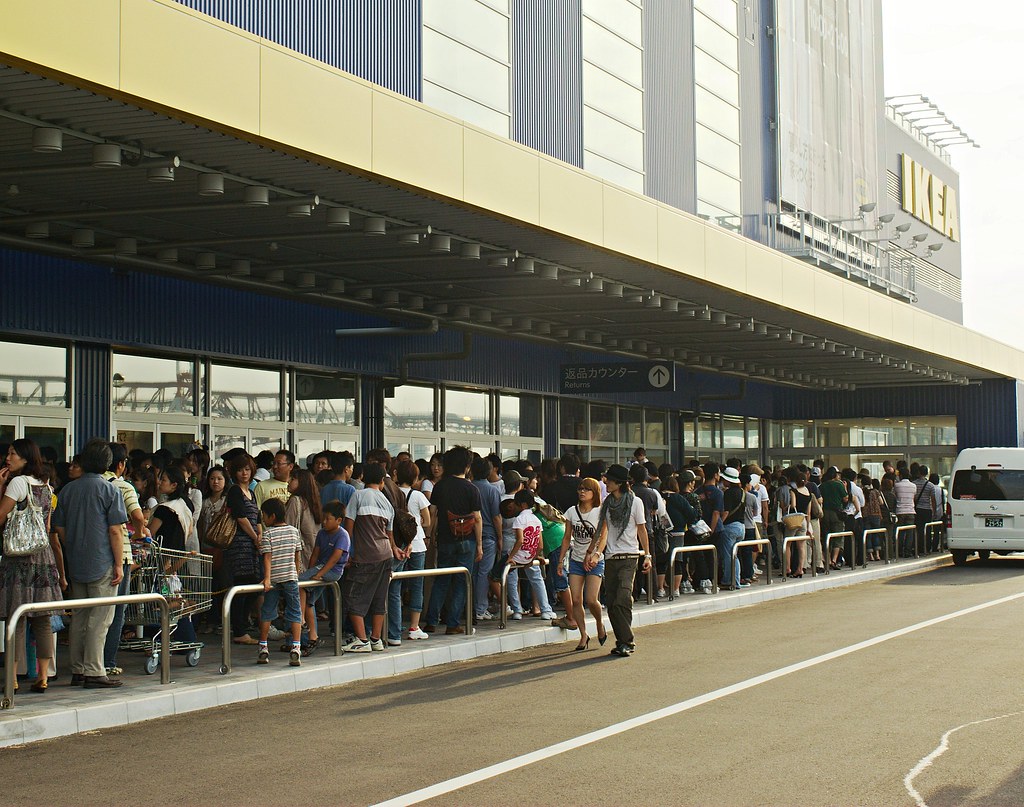
Ikea is really popular here; during rush hours you still sometimes have to stand in line outside the store to get in. Better to go during off-hours with less people, no lines to the restaurant and more time to browse.


IKEA

The warehouse area feels like the soul of Ikea. This is where the magic happens; where the shimmering dream from the showroom upstairs comes true, manifested in oblong boxes with mystical incantations like "Granemo", "Ektorp" and "Numerär" offered in supplication to appease the Dark Gods of Furniture Assembly Resting Eternally (Though Very Comfortably) Outside Space And Time1.


Last year we got an Ikea store in Kobe, out on Port Island in the bay. It's right next to a train station and the trip from home takes us an hour or so; we often go to Kobe anyway so it's not far. This August, another store finally opened in Osaka. It's out in the Taishō harbour district to the southwest, not that far from where we live. This is great - or, it would have been had the location been slightly different.

Ikea likes harbours and industrial parks. The land is cheap, it's easy to reach with a car or delivery truck, and such areas are often economically depressed so they can get tax breaks and development help from the local governments. But the Osaka store out by the bay is far from any train or subway station. You can take the subway halfway to the store, then line up for an Ikea shuttle bus running every twenty minutes; or you can go to Namba, then stand in line for the shuttle bus running from there. Either way it takes almost exactly as long for us to go to Ikea in Osaka as to Ikea in Kobe - and when we go to Kobe we don't need to stand in line for a bus.

Rooftops

You can just see Ikea beyond the sea of warehouses and small-scale industries.


On the other hand, the Osaka Ikea is right in the harbour area - a real, working industrial harbour - and the human male isn't born that doesn't find freight ships, cranes, and the whole dilapidated industrial environment fascinating, even romantic. It is, I think, a mix of the big, bulky hands-on technology on display, with the promise of faraway travel and adventure; it's a glimpse of life beyond the ordinary. Just going to the harbour area is a treat, whether or not you actually stop by a furniture store on the way.

The last time we went to Ikea in Osaka, therefore, we didn't go by bus but on bicycle. It is about 8 km if you go more or less straight there. Not that far, especially since much of Osaka is flat and bicycle-friendly. On the other hand, "straight there" is pretty much impossible for me, so it took a while.

Ship and Crane

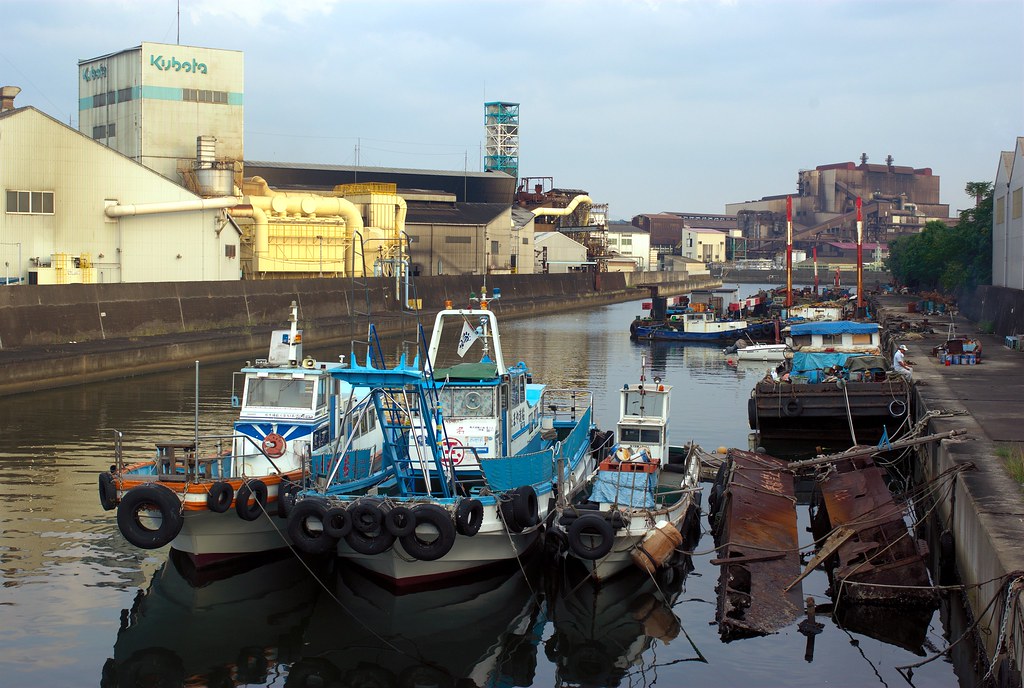
Osaka harbour. Or, a very small part of it at least.


Chitose Bridge

There's several large, high bridges in the harbour, and amazingly most of them have walkways and bicycle lanes on them. There's no better place to get a good birds-eye view of the area. Just don't be too worried about heights.


Channel

There's lots of places like this in the area. Small side canals with rundown piers, forgotten old boats and equipment. Sure, they're dirty, dingy and decaying. Yes, they're marks of poverty and failure. No, none of these places will ever be finalists in the Urban Sparkling Radiant Freshness Award of the Year competition. But they have a hesitant beauty of their own, I think, one worth preserving or at least acknowledge before they disappear.


---

#1If you happen to own a Theremin, this is the time to take it out for some quick sound effects.

Sunday, September 28, 2008

Osaka Crime

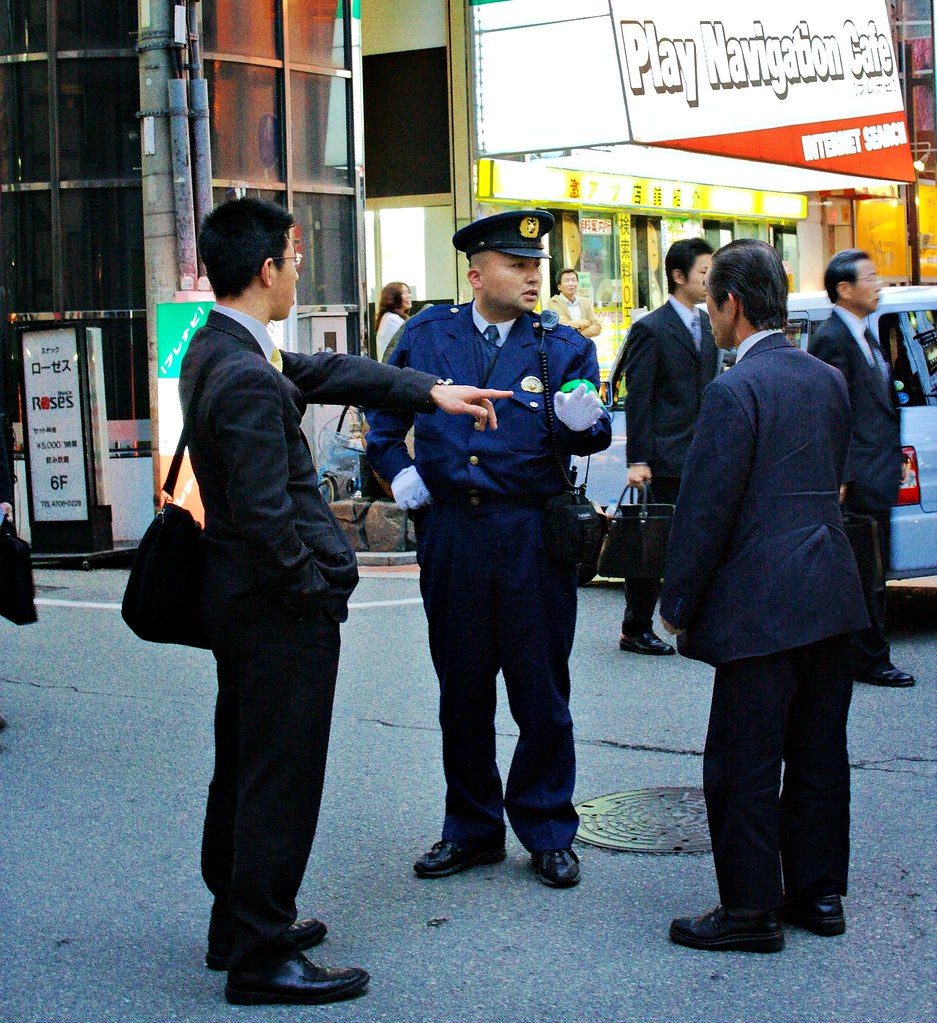
Police
Policeman breaks up
a fight between a
drunk and a taxidriver

It can't have escaped any reader of this blog that I like Osaka. I really like the place, in fact - the always surprising architecture included.

But Osaka has another side. It has a reputation for being a crime-ridden, yakuza-infested dump, a place where you should be careful going out at night. And there is something to this reputation. Asahi Shimbun published some comparative crime statistics recently, but the statistics they printed are pretty useless - they don't adjust for population for instance, and they only look at the largest cities in Japan. The printed table is also quite sparse, with only the first two cities and Tokyo listed (it seems Tokyo uses a different basis for their statistics so comparisons are dificult) so it's difficult to adjust the data. Osaka is certainly among the top cities for crime in Japan, but it's clearly not as bad as popular sentiment would make you believe; most statistics I've seen place it only third or fourth for violent crime, for instance.

But how unsafe is it actually? Anecdotally, I have never felt threatened or unsafe anywhere I've gone in Osaka, day or night. Being a scruffy-looking foreigner does have something to do with it of course; there's easier- and wealthier-looking targets out there if you want to rob or harass somebody, and targeting a western foreigner tends to bring a lot of police scrutiny. It doesn't help that I have the situational and social awareness of a half-brick. So, let's do a quick comparison of Osaka and the largest Swedish cities.
 
Below is the yearly rates per 100,000 people for Osaka compared to Stockholm, Gothenburg and Malmö, the three largest cities of Sweden. I took only the statistics for a few crimes that seem comparable (we just don't have enough vending machines in Sweden to even record vandalism of them as a separate crime), that are relevant for the feeling of safety on the street, and that I had readily available figures for. The last column is the percentage of occurrence for Osaka as compared to the highest incidence in Sweden.


Crime rate in Osaka and the largest Swedish cities
 OsakaStockholmGothenburgMalmö% Osaka
Purse-snatching94505666143%
Bicycle Theft662480631159242%
Car Theft545616753538%
Street Robbery51491842083%


The street robbery column does look pretty incredible. It is quite possible that Sweden and Japan have different definitions of street robbery (some snatchings in Japan could be counted as robberies in Sweden for instance), but even the most skewed interpretation I could make will not make much of a difference. Street robbery and street violence in general just isn't very common in Osaka compared to Swedish cities.

To get a fuller picture we'd have to look at more crimes (assaults, rape and so on) and we'd have to be much more careful about interpreting the statistics so we know we are counting the same thing, That's quite a bit of work, however, and this quick comparison already shows what I suspected: the feeling I have that Osaka is a very safe city is fully justified, and spending time out on the streets here poses very little danger.