So, it was announced today that this year's Nobel Peace price goes to Barack Obama, president of the United States. Let me be the first to say "Huh?!"
I'm perhaps naive here, but I assumed the Peace price was like the other Nobel prices in that it went to people who had, you know, actually done something. I mean, he's been president for all of nine months, and all he's done is basically to continue a withdrawal of occupying forces in Iraq that his predecessor already initiated. The Norwegian Nobel committee's handwaving about giving hope for the future sounds suspiciously like giving, say, the price in chemistry to some young researchers with the motivation that they're young and bright and seem likely to discover something significant in the future. Sure, Obama improved the prospects for peace simply by replacing Bush, but frankly, a moderately bright gerbil winning the presidency would have had the same result.
The Peace price has often been criticized for being controversial. This is not controversial however; this is just vaguely embarrassing.

Friday, October 9, 2009

Wednesday, October 7, 2009
Sendai
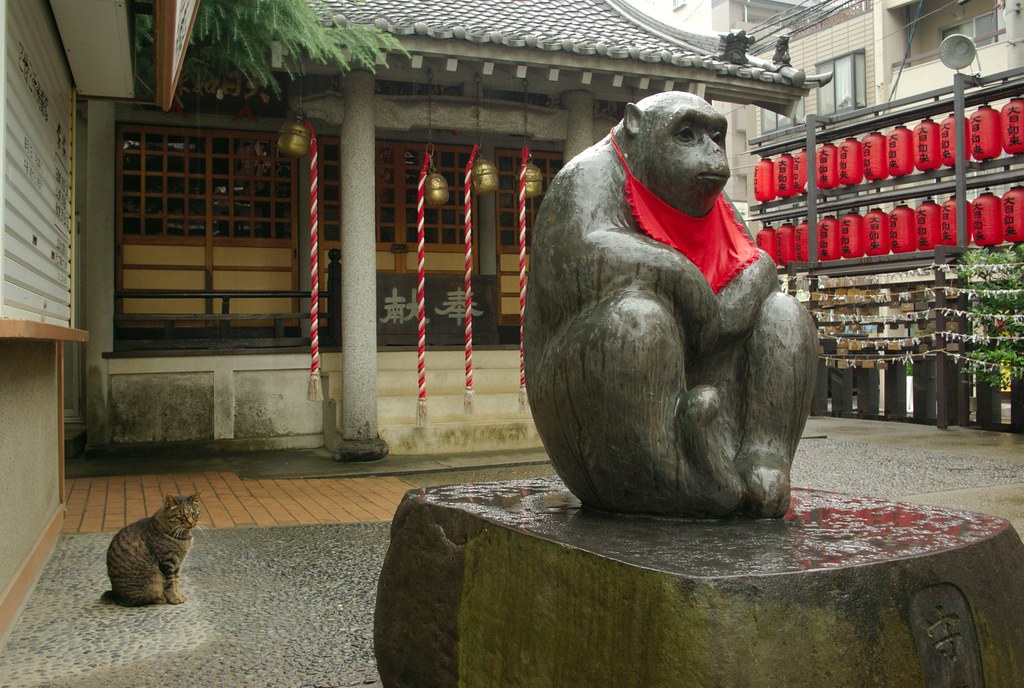
Rain-drenched small temple. The cat had found itself a dry spot and wasn't going to move no matter who was taking his picture.
Sendai is a city of just over a million people near the eastern cost of northern Honshu. I was visiting Tohoku university for a conference. The weather was bad when I arrived, with the drab downtown drenched in a depressing drizzle.
The second day cleared up and the city brightened along with my mood. Sendai is sometimes called "the city of trees"; the moniker apparently comes from pre-war Sendai, but the city seems to take the slogan seriously so many major roads are tree-lined and leafy.

The good thing about cheap hotels is that the view is often much more interesting than some bland landscape. This time my room was just meters away from the Shinkansen line to Sendai with a near-perfect view of the first curve.
I stayed at a hotel chain called Toyoko-inn. They're cheap but they're good where it matters. The hotels are fairly central, simple breakfast is included and the rooms have internet access. Other than that, well, you don't spend much time at the hotel anyways.
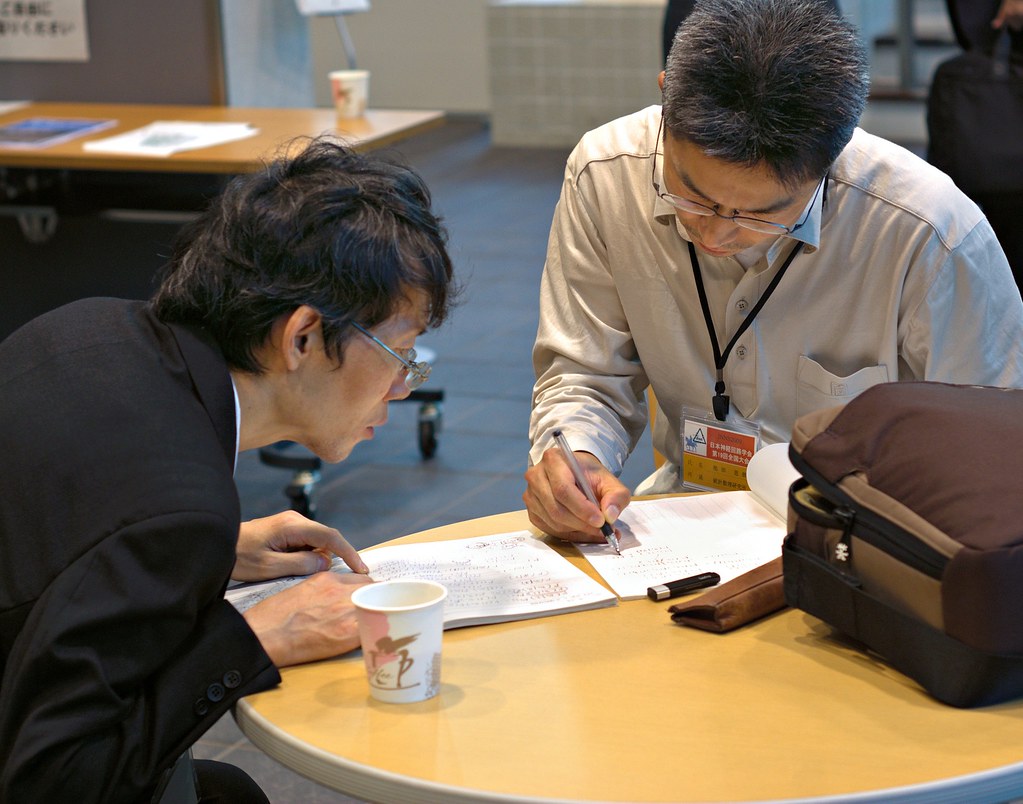
This is the point of conferences. After all, you can download the presented papers any time you want; to me the talks are just an excuse for gathering people and having them talk to each other.
The conference - the reason for the trip - was fun, and I got to talk to some interesting people. It was all in Japanese - I believe I was the only non-Japanese there - which is good language practice for me if nothing else. It's still very difficult for me to understand presentations given in Japanese. Poster sessions are much easier since you get to talk to people individually, ask questions and get feedback on your own work. I normally prefer poster sessions to talks in English-language conferences too.
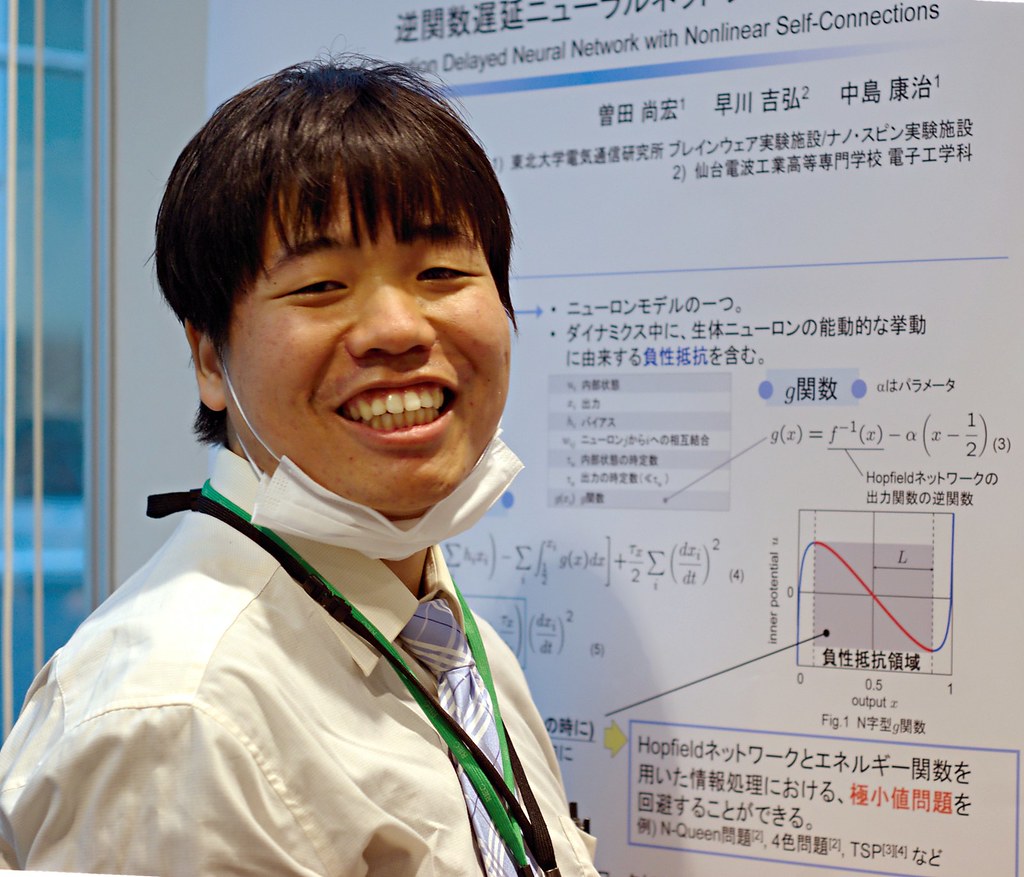
Remember swine flu? I love what this picture tells us about face masks. The mask really is a visible signal that "I do care about your health; trust me, I won't infect you". It doesn't do anything to limit the spread of infection when you wear it under your chin - of course, it doesn't do much worn over your mouth either.
Beef tongue is a Sendai speciality for vague historical reasons, and you can find lots of beef tongue restaurants serving it every way imaginable. It's flavourful, tender meat, and beef tongue stew will just melt in your mouth with savoury goodness. Beef tongue sashimi, however, was a little too bland and chewy for my taste. I got some ready-made beef-tongue stew and beef-tongue curry to take home. There's a really good kind of tofu here too, with grated or crushed green beans mixed into the tofu; unfortunately tofu is not very amenable to transportation so I couldn't take any home.

Tohoku university in Sendai is pretty big, and like any university city there's a fair amount of odd book-stores. This one was odder than most - the picture is taken perhaps one meter in from the front door. The owner has to step out whenever someone comes in to browse. You have no chance to even glimpse 90% of the books here, which of course just makes the place more fascinating.
In all, Sendai was a fairly pleasant experience. A comfortable, convenient city, and I'm sure living there is pretty good. It does however feel a little bland, a little anonymous, a little lacking in color. If cities were clothing, Sendai would be a pair of beige slacks1. Perfectly nice place for a business trip, but not really a first choice for a holiday.
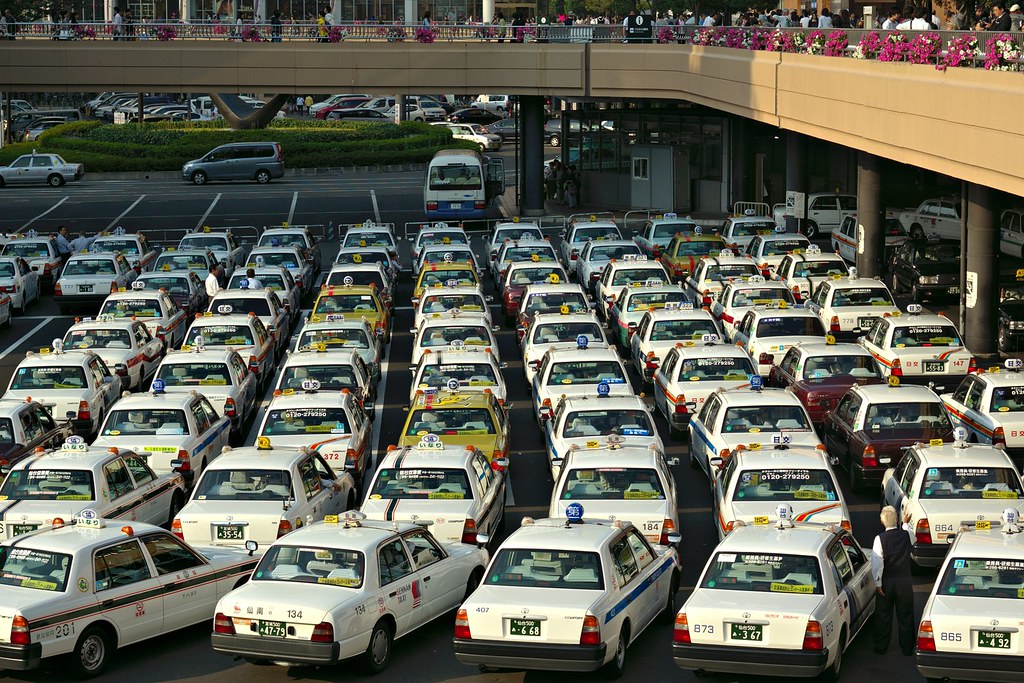
If you go to Sendai, don't worry - you will find a taxi. They have you covered in the taxi department. Taxi? No problem.
--
#1 In all fairness Osaka would probably be a strawberry-pink and lime green striped satin jacket with enormous lapels, worn collar, torn lining, with a jaunty water-squirting fake flower in the breast pocket - ugly but fun and not easy to forget.
Sunday, October 4, 2009
Nakagawa dies
Shoichi Nakagawa, former LDP finance minister, was found dead in his bed today. He was 56 years old. He is the minister who showed up drunk at a G-7 press conference in Rome last year. Apparently he was an alcoholic, something which had been a long-time open secret among journalists and politicos - including his friend Taro Aso who appointed his to the post despite his condition. He lost his seat in the August election, and with the drubbing the LDP took as a whole, and his disgraceful end as minister he was not likely to rebuild his political career anytime soon.
Now, before anybody starts to speculate, the police has no definite cause of death but they have said there's no evidence of it being a suicide at this time. He'd been using sleeping pills, and an accidental overdose could well be a cause (especially if he took them with alcohol), or it could be a heart attack or some other unrelated thing.
I'm feel sympathetic to him no matter what his political views, and no matter how he died I feel sad that he had to end up like this. I certainly have no warm feelings toward the LDP, but that doesn't mean I automatically dislike its members individually. It is easy to ridicule and despise politicians - and many of them do make it easy for us - but the truth is rather more nuanced than that. Yes, Nakagawa was likely out of his depth as finance minister, especially during a world-wide economic crisis and even more so with a debilitating condition like untreated alcoholism.
Some spectacular exceptions aside, politicians are generally no more evil or wilfully criminal than the rest of us. They usually get into politics from a genuine desire to improve the country and the lives of its citizens - "improvement" can of course mean very different things, but political views don't become criminal or evil just because you disagree with them.
And politicians at higher levels are not incompetent. Being out of your depth - to be promoted to beyond your ability - does not mean you're a dunce. It just means you tried for a bit too much, and that you (and others) misjudged just how much you're capable of. Nakagawa may not have been cut out to be finance minister of the third largest economy in the world. But failing at this level is like failing in the Olympics - you have to be very, very good indeed to even get the opportunity. That he was even seriously considered for the job means he was a more capable man in his field than any of us chattering about it afterwards.
Now, before anybody starts to speculate, the police has no definite cause of death but they have said there's no evidence of it being a suicide at this time. He'd been using sleeping pills, and an accidental overdose could well be a cause (especially if he took them with alcohol), or it could be a heart attack or some other unrelated thing.
I'm feel sympathetic to him no matter what his political views, and no matter how he died I feel sad that he had to end up like this. I certainly have no warm feelings toward the LDP, but that doesn't mean I automatically dislike its members individually. It is easy to ridicule and despise politicians - and many of them do make it easy for us - but the truth is rather more nuanced than that. Yes, Nakagawa was likely out of his depth as finance minister, especially during a world-wide economic crisis and even more so with a debilitating condition like untreated alcoholism.
Some spectacular exceptions aside, politicians are generally no more evil or wilfully criminal than the rest of us. They usually get into politics from a genuine desire to improve the country and the lives of its citizens - "improvement" can of course mean very different things, but political views don't become criminal or evil just because you disagree with them.
And politicians at higher levels are not incompetent. Being out of your depth - to be promoted to beyond your ability - does not mean you're a dunce. It just means you tried for a bit too much, and that you (and others) misjudged just how much you're capable of. Nakagawa may not have been cut out to be finance minister of the third largest economy in the world. But failing at this level is like failing in the Olympics - you have to be very, very good indeed to even get the opportunity. That he was even seriously considered for the job means he was a more capable man in his field than any of us chattering about it afterwards.
Thursday, October 1, 2009
Ukulele Orchestra of Great Britain
A bit off topic, I know, but: I've long loved the ukulele. It's such an unassuming, friendly little instrument. I even started playing it for a year or so and had a great time1. One day, time permitting, I will get an ukulele and start learning it again.
Anyway, I recently stumbled on to The Ukulele Orchestra Of Great Britain. Lots of good stuff there. But, I'm also a long-time fan of Sergio Leone's old Spaghetti Westerns and of Ennio Morricone's classic film scores he wrote for them.
So, a soulful rendering of "The Good, The Bad, The Ugly" theme by ukulele orchestra is of course as close to musical entertainment nirvana as you can possibly get:
--
Anyway, I recently stumbled on to The Ukulele Orchestra Of Great Britain. Lots of good stuff there. But, I'm also a long-time fan of Sergio Leone's old Spaghetti Westerns and of Ennio Morricone's classic film scores he wrote for them.
So, a soulful rendering of "The Good, The Bad, The Ugly" theme by ukulele orchestra is of course as close to musical entertainment nirvana as you can possibly get:
--
#1 Unlike my neighbours, who had to endure a slow, badly played "House Of the Rising Sun" many, many, many more times than any human should ever have to. At least I wasn't singing.
Tuesday, September 29, 2009
Too Few Science Students?
There's a fair amount of angsty discussion, in newspapers and blogs, about the state of science in society. One claim is that too few young people are choosing a science-related education today, opting instead for popular media- or design-related careers that are generally very competitive, have lousy job security and low pay. Yet people do choose to study them, and in large part it's because they're seen as creative and cool. If we could only present science as cool and fun, the thinking goes, students would soon flock to science courses.
There's just one problem: Science isn't cool, not by any reasonable definition of the word. You're not going to get famous, rub shoulders with the Beautiful People or strike it rich with a major hit. Rather, most science jobs are like being, say, a certified accountant, or corporate contract lawyer, or materials procurement workflow consultant. The job can be absolutely riveting for the right kind of person, but unless you have a genuine interest in the subject it's probably going to be difficult and quite dull. And yet, you don't hear plaintive cries about the lack of economy or law students. So why do lots of people still choose to become accountants or lawyers - or any number of other unglamorous careers?
They offer money or stability instead. There's really three ways you can motivate people to consider a career apart from their own personal interest in it: it may give you status (coolness being one aspect of it); it may make you rich; or it may give you stability. A career that demands a long, difficult and expensive training period will generally need more incentives like these than a career that is easy to get into. A TV manuscript writer has no job security and low pay but is regarded as cool. A contract law job is not cool but is fairly stable and pays very well. An accountant is the antithesis of cool and has modest pay but great job security.
Science jobs are often unstable, and if not they are relatively low paid. The careers that lead to jobs that are perceived as cool (pet veterinarian, say, or marine biologist) or high status (university professor) tend to have a corresponding lack of stability and pay1. In a sense, a permanent position as a research university professor or marine biologist is akin to breaking into the big time as a musician or writer in that few that embark on the career will ever reach such a point of stability, pay and status.
So if there are too few students of science then the solution would be simple: raise the salary level or offer greater stability (higher salaries are cheaper). Which is exactly what employers would do if there really was a persistent lack of science graduates. Salaries are not increasing, however, which likely means there is no shortage. Indeed, in relatively high-status science jobs, such as academic science, there's a vast surplus of qualified applicants today with several people for every available position. We mostly have the science graduates we need.
So why claim that too few people are studying science? Employers, of course, naturally prefer as large a pool of candidates as possible. And universities really do have a lack of students. In many places they have too few applicants for their science courses - sometimes fewer applicants than seats. They are in the business of educating people after all, and if there's a lack of bodies to fill lecture seats then the university loses money. If the offending department doesn't improve it's enrolment it will soon see its budget and personnel cut. They have a powerful incentive to increase enrolment whether their graduates can find jobs in their field or not.
As always, when somebody makes public claims, consider the source. What's their perspective and what reasons do they have to push those particular claims? In this case, do they really think society has an enduring lack of science graduates, or are they more concerned with finding cheaper employees or more students to fill their lecture halls?
---
There's just one problem: Science isn't cool, not by any reasonable definition of the word. You're not going to get famous, rub shoulders with the Beautiful People or strike it rich with a major hit. Rather, most science jobs are like being, say, a certified accountant, or corporate contract lawyer, or materials procurement workflow consultant. The job can be absolutely riveting for the right kind of person, but unless you have a genuine interest in the subject it's probably going to be difficult and quite dull. And yet, you don't hear plaintive cries about the lack of economy or law students. So why do lots of people still choose to become accountants or lawyers - or any number of other unglamorous careers?
They offer money or stability instead. There's really three ways you can motivate people to consider a career apart from their own personal interest in it: it may give you status (coolness being one aspect of it); it may make you rich; or it may give you stability. A career that demands a long, difficult and expensive training period will generally need more incentives like these than a career that is easy to get into. A TV manuscript writer has no job security and low pay but is regarded as cool. A contract law job is not cool but is fairly stable and pays very well. An accountant is the antithesis of cool and has modest pay but great job security.
Science jobs are often unstable, and if not they are relatively low paid. The careers that lead to jobs that are perceived as cool (pet veterinarian, say, or marine biologist) or high status (university professor) tend to have a corresponding lack of stability and pay1. In a sense, a permanent position as a research university professor or marine biologist is akin to breaking into the big time as a musician or writer in that few that embark on the career will ever reach such a point of stability, pay and status.
So if there are too few students of science then the solution would be simple: raise the salary level or offer greater stability (higher salaries are cheaper). Which is exactly what employers would do if there really was a persistent lack of science graduates. Salaries are not increasing, however, which likely means there is no shortage. Indeed, in relatively high-status science jobs, such as academic science, there's a vast surplus of qualified applicants today with several people for every available position. We mostly have the science graduates we need.
So why claim that too few people are studying science? Employers, of course, naturally prefer as large a pool of candidates as possible. And universities really do have a lack of students. In many places they have too few applicants for their science courses - sometimes fewer applicants than seats. They are in the business of educating people after all, and if there's a lack of bodies to fill lecture seats then the university loses money. If the offending department doesn't improve it's enrolment it will soon see its budget and personnel cut. They have a powerful incentive to increase enrolment whether their graduates can find jobs in their field or not.
As always, when somebody makes public claims, consider the source. What's their perspective and what reasons do they have to push those particular claims? In this case, do they really think society has an enduring lack of science graduates, or are they more concerned with finding cheaper employees or more students to fill their lecture halls?
---
#1 One exception would be physician, a science-related career that is high status, stable and very well paid - and that's reflected in the very intense competition for entry to medical schools. The intense, enduring competition probably means, frankly, that physicians are overpaid in some markets.
Friday, September 25, 2009
Still in Sendai...
A city in rain and same city in sunshine is so utterly different you'd not think it was even the same place. Don't let your first impressions be your last.
Tuesday, September 22, 2009
To Sendai
I'm off to a three-day conference in Sendai tomorrow. The conference itself promises to be fun, though of course the presentations will be in Japanese and range from very difficult to completely impossible for me to understand.
Sendai, by the way, has about one million inhabitants, making it the largest city in Japan I had no idea existed. Which is fine - with no expectations I can only get pleasantly surprised. It's apparently the "city of trees" (there's trees around, I guess) and beef tongue is a speciality for no particular reason I am aware of. People talk very highly of the city, so it should be good. Of course, I'll mostly see the inside of a conference hall and budget hotel but I hope there'll be a few hours to see a bit of the city as well.
Sendai, by the way, has about one million inhabitants, making it the largest city in Japan I had no idea existed. Which is fine - with no expectations I can only get pleasantly surprised. It's apparently the "city of trees" (there's trees around, I guess) and beef tongue is a speciality for no particular reason I am aware of. People talk very highly of the city, so it should be good. Of course, I'll mostly see the inside of a conference hall and budget hotel but I hope there'll be a few hours to see a bit of the city as well.
Subscribe to:
Posts (Atom)