Have you heard of "Metal Umlauts", perhaps? When a heavy-metal band wants a name that sounds exotic, gothic and vaguely menacing they will sometimes add an umlaut ("¨" - the two dots in "ä", "ö", "ü" and so on) to a vowel or two. Think "Motörhead", for instance. This can backfire; British metal band "Trojan" famously added an umlaut to their name to become "Tröjan". This means "the shirt" in Swedish, and doesn't really evoke the air of menace the band was aiming for - though I guess it did make for some deliciously self-referential concert t-shirts.
There's a recent café in the Umeda underground that's afflicted with a similar case of Umlautitis. It has a Scandinavian theme - the furniture and decorations are Nordic minimalist, and there was even a long text explaining the Swedish tradition of "fika" - an extended coffee break - in passable but "interesting" Swedish and in Japanese. It looks like a very pleasant coffee shop, and I've been meaning to stop by. The name is "Nördkaffe".
Perhaps the owner has lived in Sweden and got inspired to do a Swedish-style café back in Osaka. I think the real name is "Nordkaffe" ("Nordic coffee"), and indeed, the Japanese transcription uses the "nordkafe" (ノードカフェ) pronunciation. The umlaut (and the second "f") is only there to give the name an exotic touch. But as with "Tröjan", this changes the meaning: "Nördkaffe" means "Nerd Coffee" or オタクカフェ. Unlikely to be quite what the owner intended, of course, but the name is memorable and the place looks very nice. We really should stop by next time.
Wednesday, March 10, 2010
Monday, March 8, 2010
Lava Lamp Centrifuge
Short, short link post: Does a lava lamp work in high gravity? One way to find out is to build a centrifuge for the lamp. A gentleman named Neil Fraser went ahead and did just that.
We clearly don't have enough terrifying and somewhat dangerous science-related machinery at home.
Friday, March 5, 2010
City Life
I really love Osaka. Sennichimae is a major east-west thoroughfare through south Osaka, and around Namba it crosses Midōsuji street and cuts right through the south city center, where department stores, train stations and shopping arcades crowd each other for space. Takashimaya, Maruichi, Bic Camera...
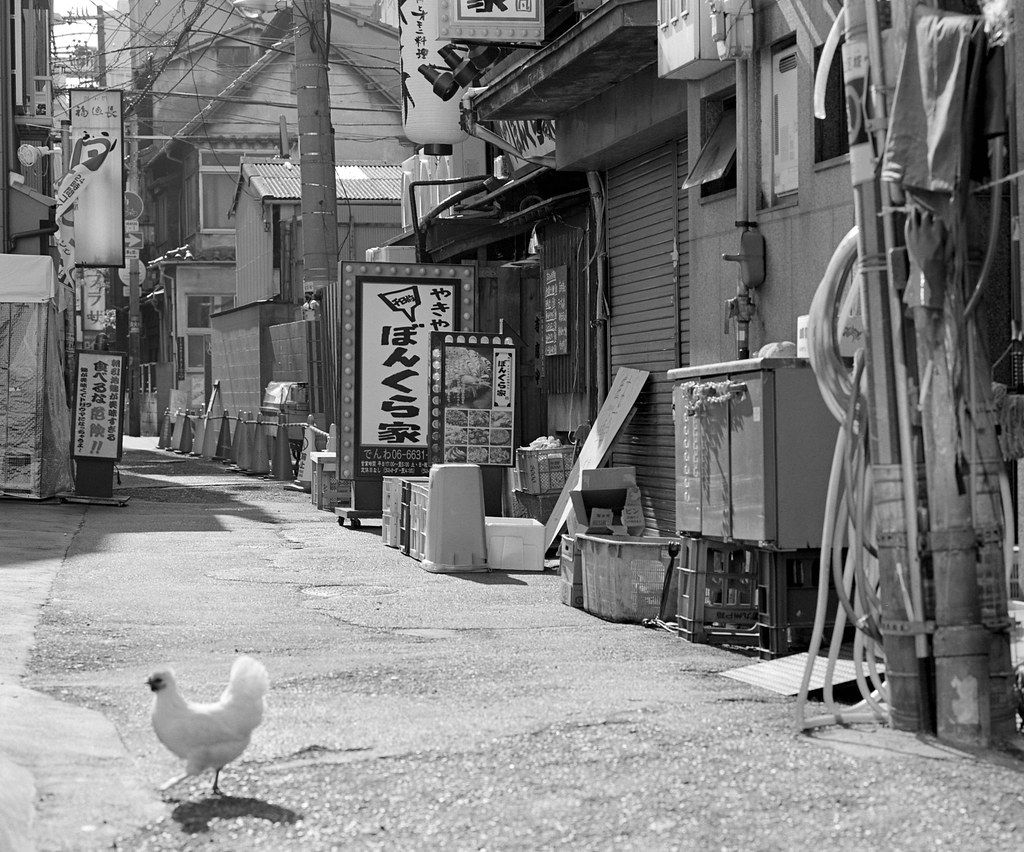
But take a turn off Sennichimae, walk ten steps, and you find this:
Side street off Sennichimae. That's a couple of cheap hot-plate eateries and single homes in the background - and, yes, a chicken crossing the road. It has a roost by the wall to the right, so it's not a runaway. Feisty bird - the rats around here are almost as big as it is.
This scene has probably not changed for the past fifty years, and I love that there's still areas like this right in the middle of the city.
A girl stopped to see what I was photographing, and on seeing the bird she promptly emitted one of those ultrasonic "kawaiiiiiii!!!"-sounds that young Japanese girls are want to do. The bird itself is apparently quite used to strangers and seemed to enjoy the attention.
Did I mention that I love this place?
But take a turn off Sennichimae, walk ten steps, and you find this:
Side street off Sennichimae. That's a couple of cheap hot-plate eateries and single homes in the background - and, yes, a chicken crossing the road. It has a roost by the wall to the right, so it's not a runaway. Feisty bird - the rats around here are almost as big as it is.
This scene has probably not changed for the past fifty years, and I love that there's still areas like this right in the middle of the city.
A girl stopped to see what I was photographing, and on seeing the bird she promptly emitted one of those ultrasonic "kawaiiiiiii!!!"-sounds that young Japanese girls are want to do. The bird itself is apparently quite used to strangers and seemed to enjoy the attention.
Did I mention that I love this place?
Tuesday, March 2, 2010
Disorganizer
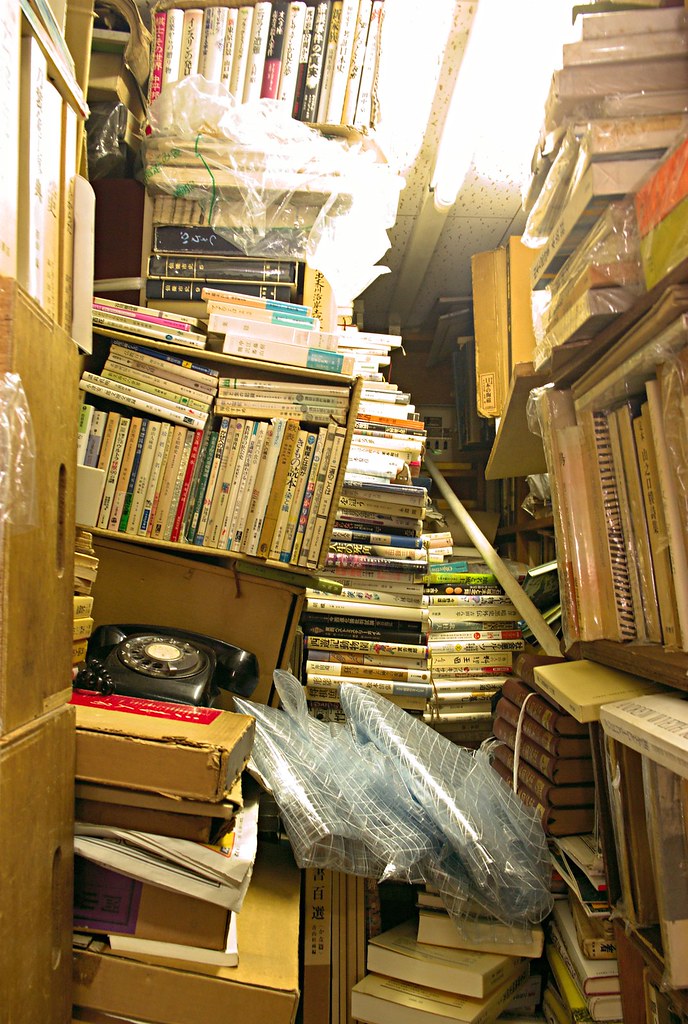
I'm not an organized person. I mean, I'm really not organized. I have "could be useful" emails by the thousands in my inboxes. Most of my documents are completely unsorted, with helpful names like "brain5.txt". There'd be no point in me getting a nice desk as I'd never see it under piles of books, papers, unwashed coffee cups and long-forgotten forms anyway.
It's not just general messiness either. I tend to forget about seminars and meetings unless I get reminded, and I neglect administrative deadlines as a matter of course. I can never remember passwords, so I write them down - but then I forget where. Worse, I recently completely missed a submission deadline (not the one I've been working on), which is not just inconvenient, but fairly serious.
Last week I got the idea that I should try some kind of computer scheduling program. I looked around a bit and found one that's gotten a lot of good word of mouth. Simple and straightforward to use, and integrates nicely with my other desktop tools.
So I try to install it, but get a message to the effect that GTG can't be updated because it's already running. It turns out I already had this idea in January. I'd downloaded an earlier version, started it - and forgotten all about it. I found it open behind some ongoing blog entries, a forgotten instance of Octave and a couple of open PDF files.
It's not just general messiness either. I tend to forget about seminars and meetings unless I get reminded, and I neglect administrative deadlines as a matter of course. I can never remember passwords, so I write them down - but then I forget where. Worse, I recently completely missed a submission deadline (not the one I've been working on), which is not just inconvenient, but fairly serious.
Last week I got the idea that I should try some kind of computer scheduling program. I looked around a bit and found one that's gotten a lot of good word of mouth. Simple and straightforward to use, and integrates nicely with my other desktop tools.
So I try to install it, but get a message to the effect that GTG can't be updated because it's already running. It turns out I already had this idea in January. I'd downloaded an earlier version, started it - and forgotten all about it. I found it open behind some ongoing blog entries, a forgotten instance of Octave and a couple of open PDF files.
So much for that bright idea.
Friday, February 26, 2010
Sleepy Time!
The paper I'm doing starts to look decent by now (not that it's any guarantee for it being accepted of course), but I'm not going to have much time for blogging or anything until it's submitted. However, I saw an interesting, short article on midday naps in the Economist, and thought I'd point it out.
The article reports on some resent experimental research that shows that napping improves memory performance; about 1-1.5 hours is optimal. I really don't have too much time to comment on it, to say nothing of going through the original paper, but I didn't want to ignore it altogether. After all, sleep is something dear to all of us, and something that's been on my mind quite a bit lately (in the "Oh, for a few more hours of sleep" sense).
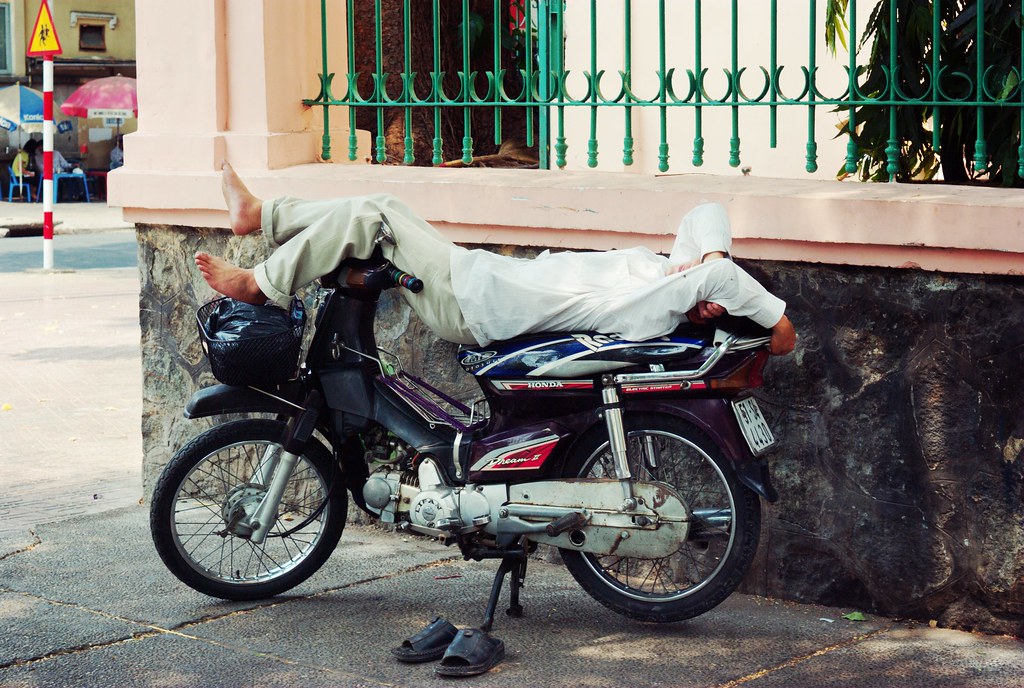
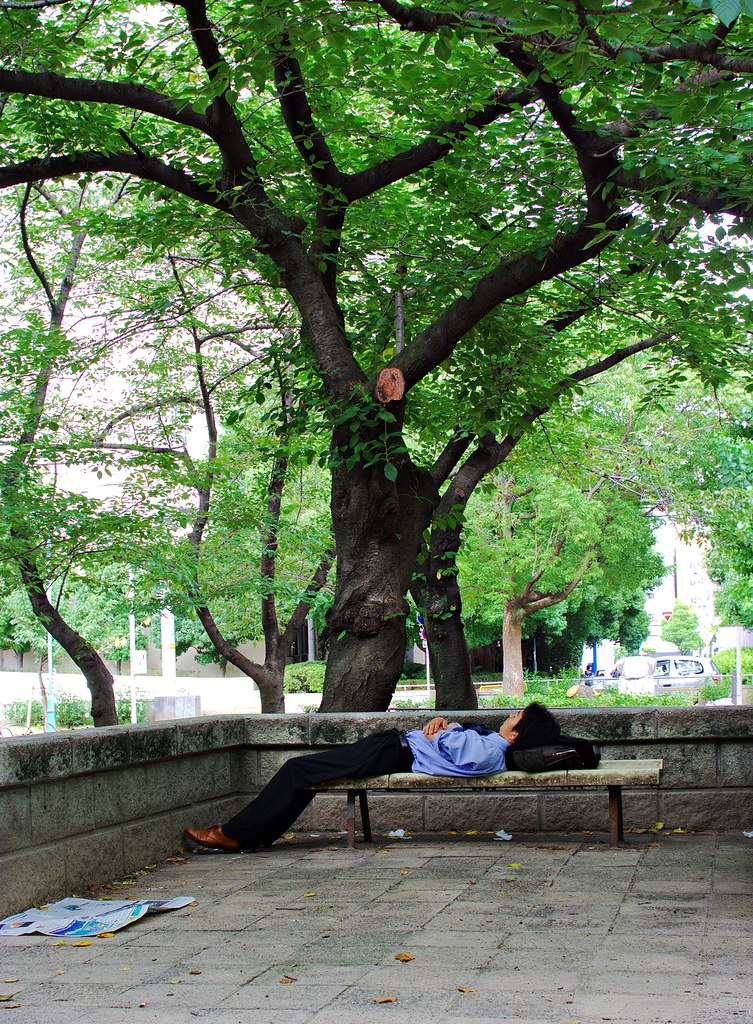
When you think about it, not having a siesta is pretty weird. Most cultures have condoned, or even encouraged, a longish break around midday. Our own bodies seem to have a pretty strong opinion on the matter too; I know I can't get a single thing done during the hour right after lunch. I usually sit half-asleep staring blankly at my work, or I spend the time with something that doesn't require much actual thinking - browsing the web, writing the blog, that sort of thing. But as this research points out, it's probably better to stop fighting it, lean back and take a real, refreshing nap instead.
The article reports on some resent experimental research that shows that napping improves memory performance; about 1-1.5 hours is optimal. I really don't have too much time to comment on it, to say nothing of going through the original paper, but I didn't want to ignore it altogether. After all, sleep is something dear to all of us, and something that's been on my mind quite a bit lately (in the "Oh, for a few more hours of sleep" sense).
When you think about it, not having a siesta is pretty weird. Most cultures have condoned, or even encouraged, a longish break around midday. Our own bodies seem to have a pretty strong opinion on the matter too; I know I can't get a single thing done during the hour right after lunch. I usually sit half-asleep staring blankly at my work, or I spend the time with something that doesn't require much actual thinking - browsing the web, writing the blog, that sort of thing. But as this research points out, it's probably better to stop fighting it, lean back and take a real, refreshing nap instead.
Tuesday, February 23, 2010
Fifteen
..degrees, that is, with a hazy midday sun making it feel even warmer. After lunch I bought the first ice cream of the year and ate it while enjoying a short walk around the campus area.
Then, spring weather or not, back to my desk and to the paper I'm trying to beat into shape in time for a submission deadline.
Sunday, February 21, 2010
Library Without Librarians (sometimes)
Still fighting the conference paper. We got ourselves a deadline extension. That's another week to make the paper presentable (Yay!) - and another week of harried writing, with little time for modelling, Japanese lessons or anything else (Booo!).
Anyway, here's a bright idea (I needed an excuse to use the image on left): A library in Veberöd outside Lund, Sweden, is open on evenings without librarians or anybody else. The light is left on and the door unlocked when the staff leaves in the evening and people can come in to read, borrow and return books by themselves. It closes at ten when a caretaker presumably shoos out the visitors and locks the doors. It's such a success that they now consider extending the opening hours of most libraries in Lund in the same way.
A few reactions of mine:
First, this would probably not be possible without automation. All books are tagged so borrowing and returning can be done automatically - put the books on the borrowing counter, swipe your library card and they're all registered. Also, unchecked books will set off an alarm at the door if someone tries to bring them out; plenty enough to deter dishonest or forgetful patrons. It's not stated outright but I guess you need to use your library card to get inside too.
Also, this says more about the local culture in and around Lund than about anything else. A place like Veberöd is small, and library patrons at least recognize each other by sight. Lund itself is larger of course, but also very dominated by the university (more than a third of the city works or studies there) and libraries tend to have a fairly enthusiastic following. It would be difficult to cause trouble without strong reactions from other people. I'm not sure this would work as well in a large, anonymous city.
This is not about removing librarians; the article is very clear about that. It's about extending opening hours on a low budget. A good thing, as long as no local politician starts fantasizing about truly librarian-less libraries. Once upon a time the Swedish school system (it never saw a crackpot pedagogical theory it didn't like) experimented with "teacher-less lessons" in 7- to 9th grade in order to save money. Students were not impressed, nor were they stupid, and they soon became "teacher and student-less lessons" - an impressive monetary savings, if perhaps not conductive to any academic progress.
As a child I spent an inordinate amount of time in the local library (when I visited for the first time in fifteen years, the first thing the librarian said was "Oh, hi Janne, it's been a while"), and this news inspired me to take a look online for Osaka libraries. The Osaka central library is great with a huge amount of material and open every day, and I occasionally visit. But it takes twenty minutes by bicycle from home, so it's a bit too far to just casually drop in for a book or two. As it turns out, there's a branch library at the Senior Center just a couple hundred meters south of here, with opening hours almost as generous. I must check it out as soon as my workload lets up just a bit. Hey, maybe there's a book on setting up your own darkroom...
Anyway, here's a bright idea (I needed an excuse to use the image on left): A library in Veberöd outside Lund, Sweden, is open on evenings without librarians or anybody else. The light is left on and the door unlocked when the staff leaves in the evening and people can come in to read, borrow and return books by themselves. It closes at ten when a caretaker presumably shoos out the visitors and locks the doors. It's such a success that they now consider extending the opening hours of most libraries in Lund in the same way.
A few reactions of mine:
First, this would probably not be possible without automation. All books are tagged so borrowing and returning can be done automatically - put the books on the borrowing counter, swipe your library card and they're all registered. Also, unchecked books will set off an alarm at the door if someone tries to bring them out; plenty enough to deter dishonest or forgetful patrons. It's not stated outright but I guess you need to use your library card to get inside too.
Also, this says more about the local culture in and around Lund than about anything else. A place like Veberöd is small, and library patrons at least recognize each other by sight. Lund itself is larger of course, but also very dominated by the university (more than a third of the city works or studies there) and libraries tend to have a fairly enthusiastic following. It would be difficult to cause trouble without strong reactions from other people. I'm not sure this would work as well in a large, anonymous city.
This is not about removing librarians; the article is very clear about that. It's about extending opening hours on a low budget. A good thing, as long as no local politician starts fantasizing about truly librarian-less libraries. Once upon a time the Swedish school system (it never saw a crackpot pedagogical theory it didn't like) experimented with "teacher-less lessons" in 7- to 9th grade in order to save money. Students were not impressed, nor were they stupid, and they soon became "teacher and student-less lessons" - an impressive monetary savings, if perhaps not conductive to any academic progress.
As a child I spent an inordinate amount of time in the local library (when I visited for the first time in fifteen years, the first thing the librarian said was "Oh, hi Janne, it's been a while"), and this news inspired me to take a look online for Osaka libraries. The Osaka central library is great with a huge amount of material and open every day, and I occasionally visit. But it takes twenty minutes by bicycle from home, so it's a bit too far to just casually drop in for a book or two. As it turns out, there's a branch library at the Senior Center just a couple hundred meters south of here, with opening hours almost as generous. I must check it out as soon as my workload lets up just a bit. Hey, maybe there's a book on setting up your own darkroom...
Subscribe to:
Posts (Atom)