Showing posts with label conference. Show all posts

Friday, October 1, 2010

Paris III: The Conference

The point of this trip was the SAB conference. As I was mostly working, there wasn't much time for sightseeing. The conference was a total of five days, workshop included, from early morning until night. It was fun, certainly - it's perhaps my favourite conference - but conference rooms are not normally noted for their touristy appeal. But this conference was held at the Museum of Natural History, perhaps the coolest conference venue I've ever had the pleasure to visit. And we got free passes to all the main exhibits.

The Paris Museum of Natural History

This museum seems to explicitly allow cameras. My regret is that I didn't bring the Pentax 67 and a real tripod. Carrying it around for a week would have been a small price to pay for a better chance at scenes like this.


The SAB conference itself was good; it usually is. I attended the active sensing workshop which had a really good talk (and a related talk in the main conference) about how insects use visual flow not just for short-term navigation but also for elevation control. If insects try to keep the ground below moving at a constant speed they can regulate their speed, and start and land simply by changing the flying height, and they will automatically land if the wind grows too strong to fly in. Another good talk was about how weakly electric fish actually decide the location of obstacles based on potential changes along the electrical sense organs (here's their conference paper).

The Mosque Cafe

The coffee breaks were not at the museum, but at the Paris Mosque right next door at a restaurant and cafe. Again, it's a far cry from the usual table set up outside the conference rooms, and apparently cheaper as well.


My favourite talk at the conference was about a slime-mold inspired robot by Andrew Russell (he doesn't seem to have the robot on his website yet). It used active smell - send out a puff of alcohol, then sense the concentration around the robot - to find obstacles, and it also had a simple but ingenious way to create omnidirectional movement without having to deal with complex, expensive omnidirectional wheels. Exactly the kind of creative and slightly oddball research I hope to find at this conference.

There were a couple of fun papers on rat whiskers, how rats use them to sense their environment and how we could use them for robotics. The whiskers are not passive touch sensors; the rat constantly sweeps them about to feel not just the position and range of obstacles but also texture and other features of its environment. And the groups are of course building whisker-equipped robots to test their models in the real world. Makes me want to do the same.

The title Insectomorphic Robot Maneuvering on a Movable Ball says it all, really. If you have an insect-like robot, how can it climb onto a large ball, move about by rotating the ball with its legs, and then get off again? My reaction was, in order: "Heh. Fun." Followed by "Why on earth would you want to do this?" immediately silenced by "I would love to have a robot insect balancing on a ball! An entire robot circus! With steam-powered mechanical elephants!" But yes, there's a serious angle to this: Robots need to adapt to a dynamic world where their actions affect the world in turn, and getting onto and balancing on a large moveable ball is a neat, well-defined test problem. Still: I want my Arachnoid Acrobat Automatons!

My own talk, about our model of the early saccade generation system, was just a little abstract for this conference. We don't use a robot or any kind of real-life input yet, and the model itself is too computationally intensive to be immediately useful in robotics so we got a bit of criticism for that. Our aim is to understand the original biological system at this stage, rather than create an effective synthetic one. We were far from the only abstract paper of course, but it's the papers with tangible results that people really like in this conference. The papers I mention above are all practical in nature.

Here's the whole proceedings if you have institutional access (springer is pretty uptight about access rights). If not, there's plenty of other ways to find the papers of course.

Zamansky Tower

The workshops and the poster sessions were not at the museum, but at the Zamansky Tower in Marie Curie University. At the top floor. The view is quite breathtaking; you can see a shot from there in the first post from Paris.


Every conference gives you stuff. Not just the proceedings, but anything from notebooks to bags to pens to coffee mugs to keyrings... They come from the conference itself, from sponsors and from who-knows-where. We got the usual conference bag with a notebook, a flipbook and bookmark with all conference poster designs (most of them made by Jean Solé and really cool - see previous ones here), proceedings and data on a CD - and The Pen.

All-in-One

It's a pen. It's a laser pointer. It's a 2Gb USB memory. Almost everything a presenter needs.


The Pen is almost everything you need for a conference. There's never a laser pointer around when you need one, or if there is the batteries have just run out. And in case disaster strikes and you lose your laptop - could be dropped, get stolen, taken in customs, have coffee spilled all over it an so on - you need backups of your presentation1 and all your important travel information. With your data on a memory stick you can at least borrow somebody's laptop and give your talk.

Buffet

The buffet at the poster sessions. Between the food and the view a lot of people had trouble focusing on the posters, and that included some of the poster presenters.


Museum of Natural History

Giraffes.


Museum of Natural History

Whale skeleton. I think.


Clos Luce

Clos Luce, Amboise.


The last day of the conference was not in Paris but in Amboise a couple of hours away. Clos Luce is where Leonardo da Vinci spent the last few years of his life, invited by some king or other. Today it's a museum and conference place. Very pleasant. We had a final session and the panel discussion at the mansion, followed by lunch.

Helicopter

Replica helicopter design by da Vinci. Not likely to fly anytime soon. As someone pointed out at the conference, if you want to become known as an inventor it certainly helps to be a world-famous artist first.


Les Caves Duhard

Les Caves Duhard.


We left the mansion in the afternoon for a wine cellar tour and wine tasting event at the nearby Les Caves Duhard. They're a wine wholesaler with a set of limestone tunnels to store wine. The tour is fun, and the wine tasting and dinner/snack was great. Various kinds of wines and plenty of cheeses, sausage, fruits and other stuff to enjoy with it.

Les Caves Duhard

Limestone wine cellars.


#1 A tip: save your Powerpoint or Openoffice file if you want, but also export the presentation as a PDF file. PDF viewers have a "presentation mode" that lets you show the PDF as a presentation. And since you have all graphics and all non-standard fonts and everything embedded in the file itself it is sure to work no matter what kind of computer you end up showing your presentation from. It's no fun to have half your text missing because you used a locale, font or character encoding that's not installed in the particular computer you use.

And if you have a poster, also print it out as a set of A3 or A4-sized tiles and stick in an envelope in your bag. If something happens to your poster you can still tile these on the poster board with thumb tacks. Not as neat as a real poster but much better than showing up empty-handed.

Thursday, August 19, 2010

Bertie Wooster as Batman

I'm really, really busy trying to prepare for the SAB conference next week. Then, right after returning to Japan I'm off again for NEURO 2010 in Kobe where we're showing a poster; a poster I have to finish before leaving for Paris since it's too late by the time I return. At least Kobe is close enough that I can go home every night instead of having to stay at a hotel.

Anyway, while I'm tearing my hair out1 over this, you could do worse than visit MightyGodKing.com and especially what it'd be like if Bertie Wooster was Batman. Enjoy.


#1 What little is left of it.

Wednesday, February 10, 2010

Rusutsu: Hokkaido Redux

In mid-January, barely back from our christmas vacation, I was back in Hokkaido again, this time for a three-day neuroscience workshop. It's a yearly event, held at Rusutsu ski resort west of Sapporo. It's in the middle of nowhere, but it's easy to get there by bus directly from Chitose airport.

Rusutsu

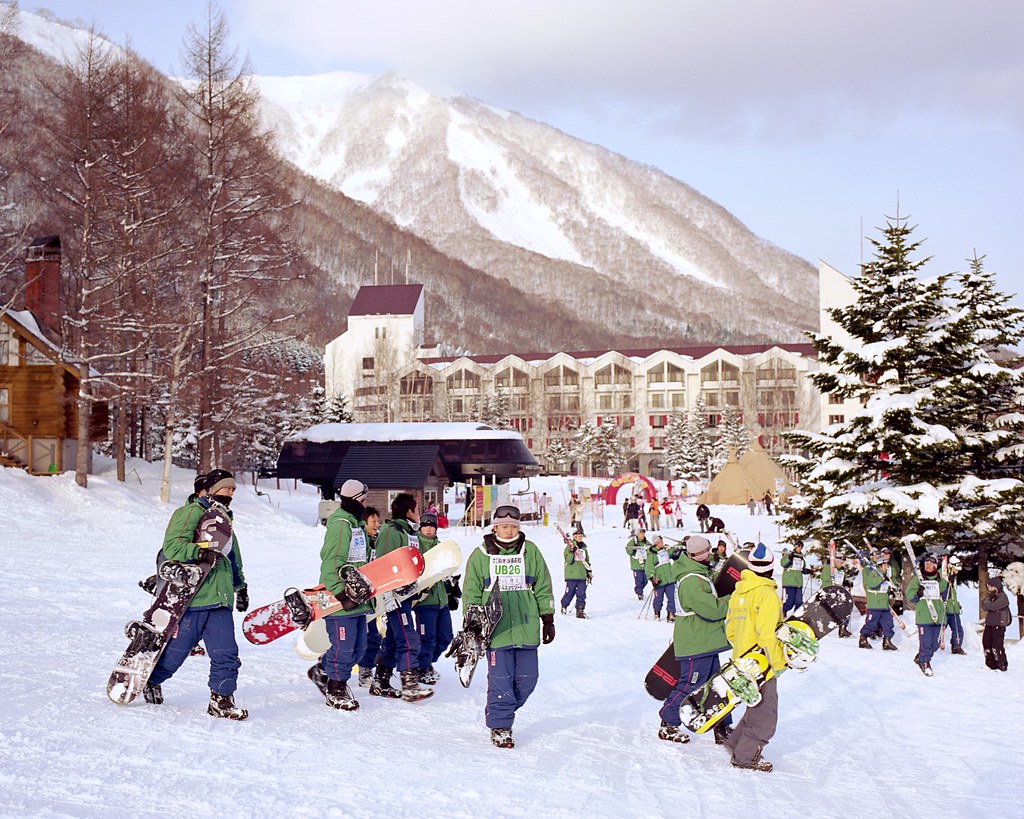
Rusutsu resort hotel. The green-clothed skiers are a high-school tour group, enrolled in a snowboard class. There were lots of school and university student groups staying at the hotel. Unlike working people, students can take time off mid-week for skiing, and they're price-sensitive travellers so cheaper weekday skiing probably appeals to them for that reason too, I guess.


It may sound a little strange to schedule a workshop at a resort hotel, but it's not a bad idea at all. They have a lot of experience handling large travel groups and have very good group discounts; they have much more and cheaper space than cramped city hotels so there's plenty of room for presentations, poster sessions and demonstrations; and they're well provided with restaurants, pubs, shops and the like so people don't need to venture away - and split up - for food or drinks. Most of their business is on weekends, so hosting conferences and tour groups is a good way to fill up rooms during the week.

Rusutsu is a full-service resort. There's a dozen restaurants, cafés, various shops (both souvenirs and actual useful stuff like ski-wear), convenience stores, a bathhouse and swimming pool, conference rooms, playground, equipment rental and ski schools and so on. It's actually two mountains and two hotels, with a cable car and a monorail connecting them. I didn't check the slope maps but the system looks to be fairly extensive and the slopes seemed very well prepared from what I saw.

Rusutsu Cabin

The cabin main room, at 2:30 in the morning, and some of the students were having a party. Of course, it being graduate students, the talk was mostly about the day's presentations and each other's research.


Our accommodation (I stayed at a log cabin with a dozen other people rather than a hotel room) was breakfast and dinner included; for dinner you got a meal ticket you could use for a dinner course at any restaurant. We had washoku the first night and chinese the second, and both courses were extensive and enjoyable. We only had one hour scheduled for dinner, however, which was too short for these slow-paced meals - we had to skip dessert the first night so we didn't miss the speaker.

There was some time set aside for skiing, but I passed this time. It's still business travel, ski slopes or not, and I had plenty of work to focus on, especially as it was my first time at this workshop. Also, I haven't actually stood on a pair of skis for over twenty years; I'd really hate to miss half the workshop on account of having my leg set and put in a cast. If I return next year, however, I'd love to take a half-day snowboarding course. Never done that, and it looks like fun.

Roller Coaster

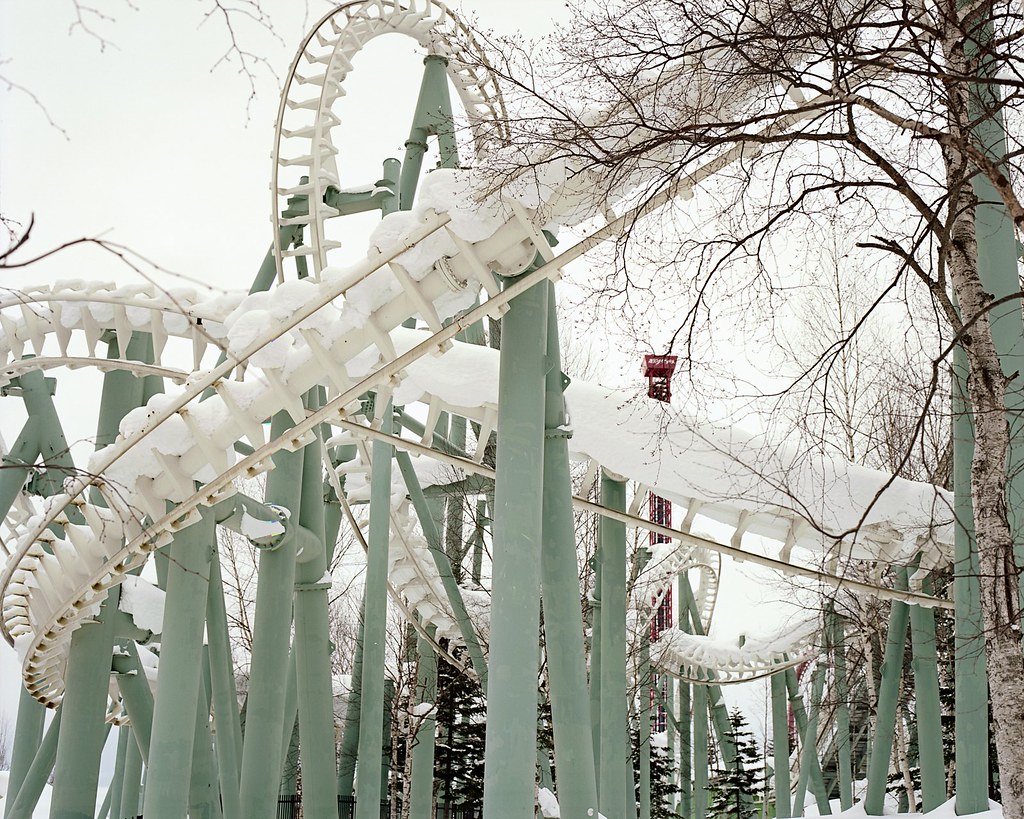
Rusutsu is a summer resort as well, with golf courses, and a large amusement park. The park is completely snowed over in winter but to me that just makes it more interesting. I couldn't get far into the park itself due to the snow; next time I'll rent snow shoes.


Instead, I took some time for a walk and a few pictures. I couldn't get very far with all the snow, but there's still a fair amount of interesting scenery near the hotel. I only brought the Pentax 67 with me, which forces you to slow down and think things through before pressing the shutter. You only have ten images on a roll. The film was Ektar 100, a very fine-detail film with good colour, but as it's fairly slow you're pretty much forced to rely on a tripod for everything but daytime outdoor shots.

Ferris Wheel

The amusement park is pretty large. They have the shrewd idea of buying up the better attractions of closed amusement parks rather than having original - expensive - designs. If you like rides, this is probably a very good place to come in summer.


Carousel

I love this kind of still winter dusk, when the light is fading and colors are muted. There's no wind and not a sound to stir the moment.


Flying Machine

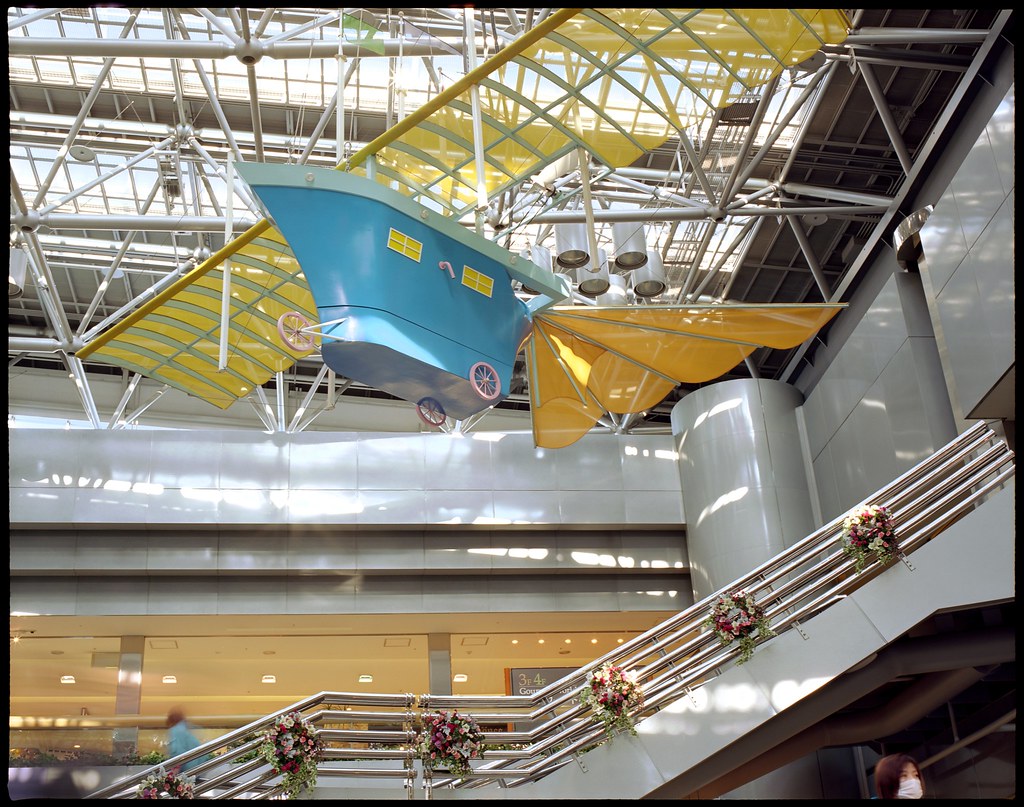
Main hall, New Chitose airport south of Sapporo. This kind of public decoration I like. It's thematically right for the place, and I enjoy the whimsy of taking a child-like design, blow it up to full size and display as if it really could work. It hangs opposite a Da Vinci flying machine-style design; an interesting contrast in imagination, though of course neither would ultimately be able to fly in reality.

Saturday, January 26, 2008

..and exhale.

Deadlines are necessary. They're unavoidable. They are even beneficial - I would not get half as much done if I wasn't occasionally pinned in a corner like a rabid rat by a looming deadline. The feeling of beating a deadline, of handing in the work finished and on time, is wonderful. But the actual bit when you struggle to make recalcitrant hardware and software behave as intended as the clock creeps towards the end is, well, not so much.

This deadline was for a conference to be held in Osaka this summer, and I managed to submit the paper on time. Actually, I lie. I was late, very late - but then, so was most everybody else. What happened was a deadline extension. The actual deadline was two weeks ago, a deadline that got extended to yesterday evening. And since I knew the deadline would most likely be extended I wasn't even close to finished with my submission for the original deadline - the system was still not working and the paper was little more than a vague outline. The original deadline came and went with me not even trying to meet it.

So how did I know there'd be an extension? Did I perhaps know one of the organizers, or did I send an army of tiny robotic cockroaches to spy on my behalf? Not at all. Every scientific conference has a deadline extension. It used to be that conferences had a deadline and if you missed it, well good luck next year. But then, in extrardinary circumstances - you couldn't get you submission typed out on time perhaps, or the postal service fell down on the job - you could ask for a few extra days. But gradually, as more and more people asked for extra time, conferences began granting extra time to everyone so that some people would not have that extra edge.

And now, of course, every conference does it. They have no choice; most people just never submit anything for the original deadline, knowing that there'll be an extension anyway. Not granting an extension would be tantamount to canceling the conference. This it is bad for everybody. You used to know exactly when your paper was due. Now the deadline is in some fuzzy time period of between a week to a month after the posted time, and you won't find out exactly when until just before the original deadline. And it's bad for the organizers that have to plan around a "real" deadline as well as a later one (you need to line up reviewers and make sure they're available for instance).

But nobody can really do anything about it. It's a very neat game-theoretic trap: no conference can skip the extension because people know all other conferences grant them so they'd be severely hurt. And since they grant extensions, so, in turn, must everybody else. Instead, some conferences have begun granting second extensions; there's still people with legitimate reasons to be late, after all, and not giving them a bit of extra time would be churlish. Expect to see a second extension become standard within he next ten-fifteen years. Of course, the time needed to process submissions is much less than it used to be so no real harm done I guess. I look forward to the day when you can show up on the opening day of a conference, paper in hand, and have it reviewed by on-site reviewers, revised and accepted as a poster before the day ends.