Showing posts with label crime. Show all posts

Monday, November 14, 2011

If you want to sell news, at least get it right

I've mentioned the worldwide drop in violence previously, and I've occasionally touched on the role of media in distorting the perception of violence, crime rates and the perception of risk in general.

Here is a fresh new example, from both Asahi Shimbun and Yomiuri Shimbun, based on a white paper from the ministry of justice1. They report that "40% recidivism rate among youths released from juvenile facilities". Repeat crime rate among all arrested minors have risen to almost 32%, and has been increasing for the past 14 years! In 2004 the total rate was only about 27%; it's risen 5 points, or almost 20% in these eight years! Panic! Mayhem! Blood on the streets! Mass Hysteria!! Cats and Dogs Living Together!!!

Except, well, not.

Take a look at the graph from Asahi (reproduced here, as newspaper links have a tendency to disappear):


See something interesting? The rate of repeat offences — the red graph at the top — have indeed gone up. But look at the dark blue bar at the bottom: the number of repeat offenders have dropped, from around 4 minors in 10000 in early 2000's down to about 2.7 minors last year. That's a drop of 30%! Let me say it again: the number of repeat juvenile offenders have dropped by a third in ten years. This is good news.

And look at the light blue bars, with total juvenile arrests: from around 14 per 10000 in 2000-2002 down to about 8.5 last year. That's a drop in arrested minors of 40%! So, the proportion of arrested repeat offenders have dropped, but the total number of arrests have dropped even more. That's how the repeat offender rate has been rising — not from any worsening trend, but from two good trends, with one improving even faster than the other.

That's nowhere to be found in the Asahi article though. Even with their own graph in plain view, the text discusses only the repeat offences and never mentions that the total rates are down, not up. Yomiuri notes in a single sentence that the total number of offences has been dropping, with no further comment or any attempt to connect it to the rate.

Why the alarmist treatment? One reason can be that a bad news angle sells more papers, and the editors are more interested in their sales numbers than in the accuracy of their reporting. That, or the reporters at both Asahi and Yomiuri are so innumerate that they do not even realize what these figures are telling them.

I've been interested in the Asahi online subscription, where you get the full paper online at another 1000 yen over the subscription we already have. I'd happily pay for factual, balanced, well-researched news, but shoddy pieces like this are putting me off the whole idea.


#1 I've ben browsing their site but I can't seem to locate the white paper itself; it's either not obvious from the title, or it is obvious but my Japanese is insufficient to understand it. This is unfortunate, as Asahi talks about 40% youth repeat offenders while Yomiuri seems to talk about repeat offenders in general, though possibly about juvenile criminals that get arrested again as adults. I can't check this without the original report. Why can't media put links to their source material now that it's so easy to do?

Sunday, September 28, 2008

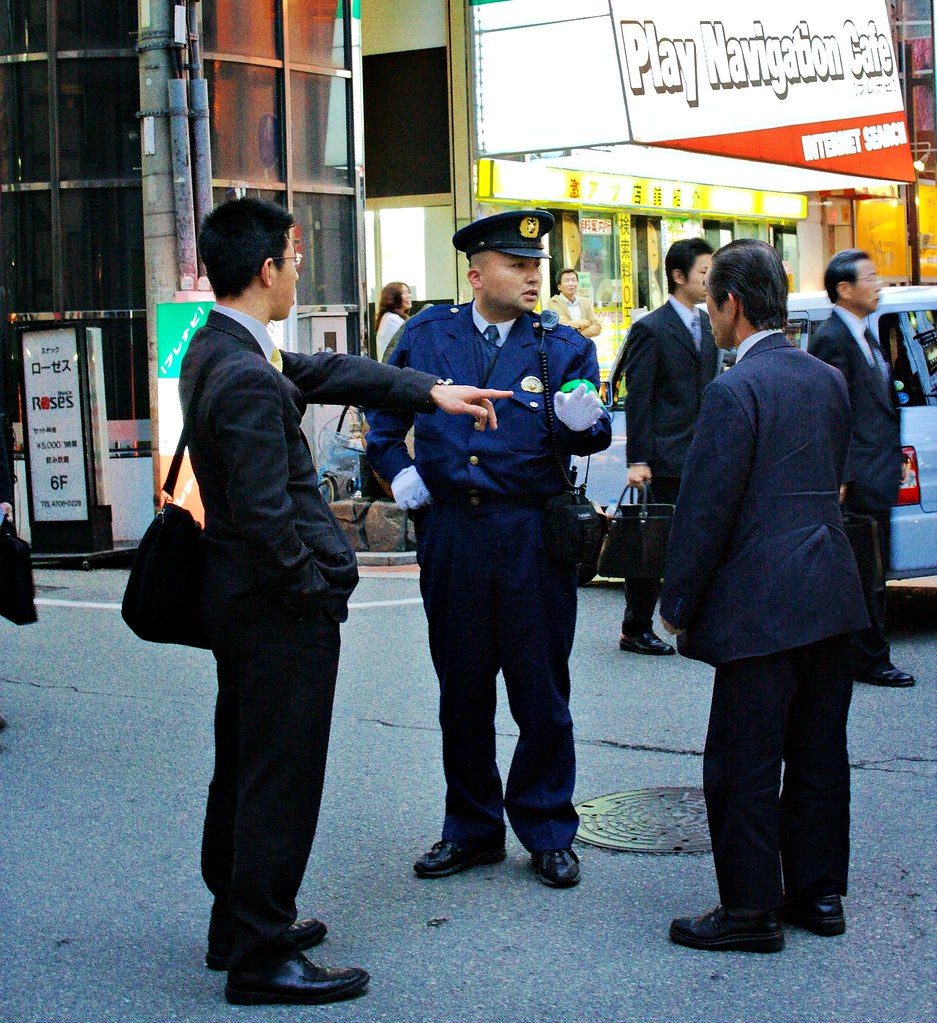
Osaka Crime

Police
Policeman breaks up
a fight between a
drunk and a taxidriver

It can't have escaped any reader of this blog that I like Osaka. I really like the place, in fact - the always surprising architecture included.

But Osaka has another side. It has a reputation for being a crime-ridden, yakuza-infested dump, a place where you should be careful going out at night. And there is something to this reputation. Asahi Shimbun published some comparative crime statistics recently, but the statistics they printed are pretty useless - they don't adjust for population for instance, and they only look at the largest cities in Japan. The printed table is also quite sparse, with only the first two cities and Tokyo listed (it seems Tokyo uses a different basis for their statistics so comparisons are dificult) so it's difficult to adjust the data. Osaka is certainly among the top cities for crime in Japan, but it's clearly not as bad as popular sentiment would make you believe; most statistics I've seen place it only third or fourth for violent crime, for instance.

But how unsafe is it actually? Anecdotally, I have never felt threatened or unsafe anywhere I've gone in Osaka, day or night. Being a scruffy-looking foreigner does have something to do with it of course; there's easier- and wealthier-looking targets out there if you want to rob or harass somebody, and targeting a western foreigner tends to bring a lot of police scrutiny. It doesn't help that I have the situational and social awareness of a half-brick. So, let's do a quick comparison of Osaka and the largest Swedish cities.
 
Below is the yearly rates per 100,000 people for Osaka compared to Stockholm, Gothenburg and Malmö, the three largest cities of Sweden. I took only the statistics for a few crimes that seem comparable (we just don't have enough vending machines in Sweden to even record vandalism of them as a separate crime), that are relevant for the feeling of safety on the street, and that I had readily available figures for. The last column is the percentage of occurrence for Osaka as compared to the highest incidence in Sweden.


Crime rate in Osaka and the largest Swedish cities
 OsakaStockholmGothenburgMalmö% Osaka
Purse-snatching94505666143%
Bicycle Theft662480631159242%
Car Theft545616753538%
Street Robbery51491842083%


The street robbery column does look pretty incredible. It is quite possible that Sweden and Japan have different definitions of street robbery (some snatchings in Japan could be counted as robberies in Sweden for instance), but even the most skewed interpretation I could make will not make much of a difference. Street robbery and street violence in general just isn't very common in Osaka compared to Swedish cities.

To get a fuller picture we'd have to look at more crimes (assaults, rape and so on) and we'd have to be much more careful about interpreting the statistics so we know we are counting the same thing, That's quite a bit of work, however, and this quick comparison already shows what I suspected: the feeling I have that Osaka is a very safe city is fully justified, and spending time out on the streets here poses very little danger.

Wednesday, July 2, 2008

This just in: Researchers also Stupid

In further proof that a) scientists are no smarter than anyone else outside their own field; and b) nobody really understands all the research funding rules any longer, Tokyo university researchers in engineering and medicine have been caught falsifying their accounting in order to keep unused research funds to use the next year. The sad thing is, the funding rules would have allowed them to keep the unused funds without resorting to false accounting had anyone bothered to check....

Monday, November 26, 2007

Our Post Office Robbed

Our local post office got robbed today, and three people got stabbed - nobody fatally, as luck would have it. The robber wasn't the clearest of thinkers apparently; could have been on drugs, or is perhaps mentally ill. He didn't have pants on, only undershorts, and was armed with a kitchen knife. He got a load of money (about 1450000 yen), and stabbed two people on the way out. A postal worker followed him as he fled onto Sakaisuji street, where he stabbed a third person, and down into our subway station. The police managed to grab him just as he tried to board the subway - a mode of transport not widely known as an efficient robbery escape vehicle.

The thing that really hits me when hearing about this (I was at work, of course, and haven't seen anything directly) is just how rare an event this is, even in a big city like Osaka. You certainly do have violent crime here - this is a center of yakuza activity after all - but the violence is more often than not gang-related or family tragedies, and random nearby people very rarely get involved or hurt in any way. There aren't many other metropolitan areas around the world where I could contemplate walking right through the worst part of town at night, alone, and still be perfectly safe.