Here's a treat for you: An hour-long television program on statistics.
Wait! Don't run away! First, it's a BBC production: excellent production values, good pacing, great footage. Also, the host, Hans Rosling, is exceedingly energetic, engaging and entertaining as he euphorically enthuses about how statistics can describe our world. This is easily worth one hour of your time. I've never liked statistics as a student, and I watched this straight through.
For a quick taste to see what you're in for, take a look at Rosling when he describes 200 years of the world in four minutes.
Update: changed the first link; now it hopefully works for everyone.

Showing posts with label statistics. Show all posts
Showing posts with label statistics. Show all posts
Wednesday, January 5, 2011

Thursday, November 13, 2008
Gender Gap Rankings
World Economic Forum has posted their annual survey (pdf format) of the gender gap in different countries. They measure criteria like political and economic opportunities, access to health care and education. The index measures the male-female gap only; the absolute level available is not taken into account. A poor country with very limited health care resources may thus score highly on health care access if those limited resources are available equally to men and women, for example. An explanation of the criteria (from last year) is available as a pdf file here: index2007.pdf
My home country Sweden drops to third place after Norway and Finland, with Iceland and New Zealand rounding out the top five; the United States is at 27, ahead of Belgium (28) and Canada (31); China is at 57. Japan sits at 98, slightly ahead of Kuwait (101) and Nigeria (102) but behind Malaysia (96) and Indonesia (93). Sad to say, I don't think that ranking is in any way unfair. Japan does very well in health care access and access to primary schools but pretty much drops the ball on the other criteria. With a contracting population ahead, the last thing this country needs is to discourage half its citizens from being full economic and social participants, or for everyone to have to choose between family or working life.
My home country Sweden drops to third place after Norway and Finland, with Iceland and New Zealand rounding out the top five; the United States is at 27, ahead of Belgium (28) and Canada (31); China is at 57. Japan sits at 98, slightly ahead of Kuwait (101) and Nigeria (102) but behind Malaysia (96) and Indonesia (93). Sad to say, I don't think that ranking is in any way unfair. Japan does very well in health care access and access to primary schools but pretty much drops the ball on the other criteria. With a contracting population ahead, the last thing this country needs is to discourage half its citizens from being full economic and social participants, or for everyone to have to choose between family or working life.
Sunday, September 28, 2008
Osaka Crime
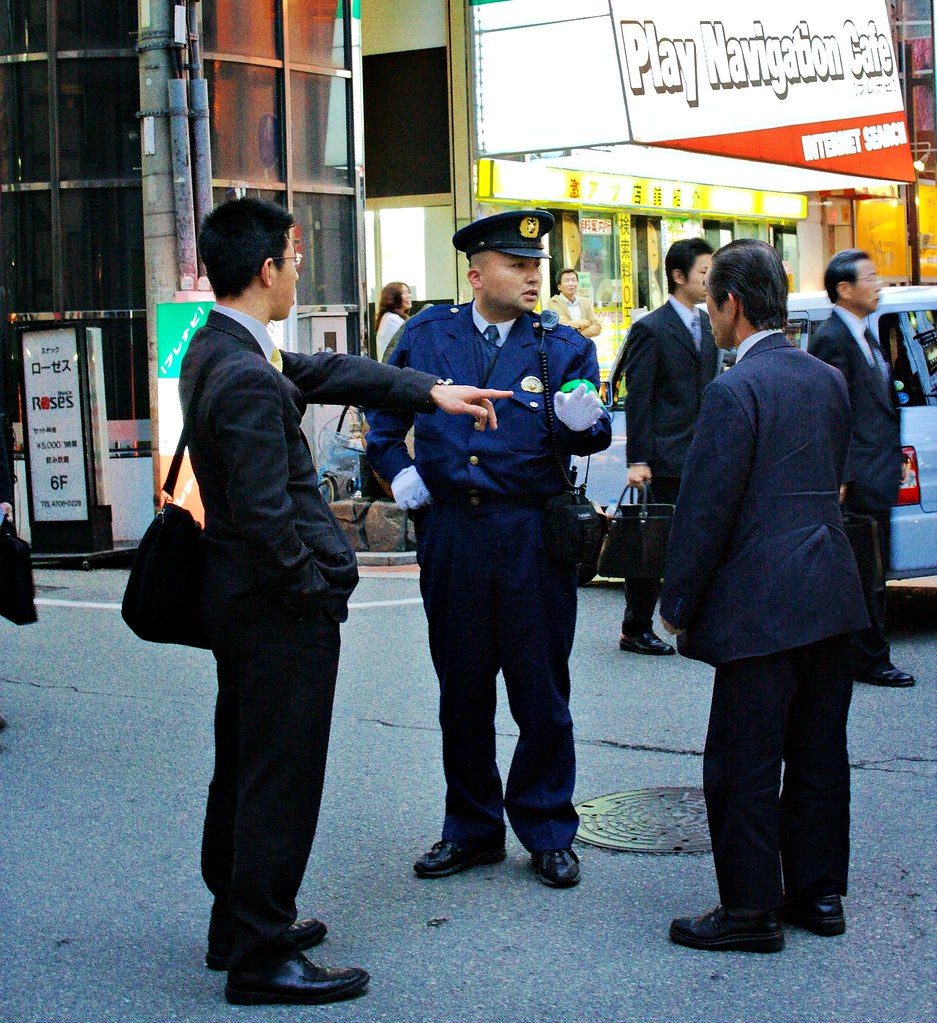
Policeman breaks up
a fight between a
drunk and a taxidriver
But Osaka has another side. It has a reputation for being a crime-ridden, yakuza-infested dump, a place where you should be careful going out at night. And there is something to this reputation. Asahi Shimbun published some comparative crime statistics recently, but the statistics they printed are pretty useless - they don't adjust for population for instance, and they only look at the largest cities in Japan. The printed table is also quite sparse, with only the first two cities and Tokyo listed (it seems Tokyo uses a different basis for their statistics so comparisons are dificult) so it's difficult to adjust the data. Osaka is certainly among the top cities for crime in Japan, but it's clearly not as bad as popular sentiment would make you believe; most statistics I've seen place it only third or fourth for violent crime, for instance.
But how unsafe is it actually? Anecdotally, I have never felt threatened or unsafe anywhere I've gone in Osaka, day or night. Being a scruffy-looking foreigner does have something to do with it of course; there's easier- and wealthier-looking targets out there if you want to rob or harass somebody, and targeting a western foreigner tends to bring a lot of police scrutiny. It doesn't help that I have the situational and social awareness of a half-brick. So, let's do a quick comparison of Osaka and the largest Swedish cities.
Below is the yearly rates per 100,000 people for Osaka compared to Stockholm, Gothenburg and Malmö, the three largest cities of Sweden. I took only the statistics for a few crimes that seem comparable (we just don't have enough vending machines in Sweden to even record vandalism of them as a separate crime), that are relevant for the feeling of safety on the street, and that I had readily available figures for. The last column is the percentage of occurrence for Osaka as compared to the highest incidence in Sweden.
| Osaka | Stockholm | Gothenburg | Malmö | % Osaka | |
|---|---|---|---|---|---|
| Purse-snatching | 94 | 50 | 56 | 66 | 143% |
| Bicycle Theft | 662 | 480 | 631 | 1592 | 42% |
| Car Theft | 54 | 561 | 675 | 353 | 8% |
| Street Robbery | 5 | 149 | 184 | 208 | 3% |
The street robbery column does look pretty incredible. It is quite possible that Sweden and Japan have different definitions of street robbery (some snatchings in Japan could be counted as robberies in Sweden for instance), but even the most skewed interpretation I could make will not make much of a difference. Street robbery and street violence in general just isn't very common in Osaka compared to Swedish cities.
To get a fuller picture we'd have to look at more crimes (assaults, rape and so on) and we'd have to be much more careful about interpreting the statistics so we know we are counting the same thing, That's quite a bit of work, however, and this quick comparison already shows what I suspected: the feeling I have that Osaka is a very safe city is fully justified, and spending time out on the streets here poses very little danger.
Sunday, January 27, 2008
Commuting time
The weekend section of Asahi Shinbun has a fun regular feature where they present some recent surprising statistic (ok, I think it's fun; your mileage may vary). It's short and simple enough that I can read it without too much trouble. Today they displayed the total one-way commuting time for students (including university students) and workers, respectively, in the Tokyo and Osaka areas, and how it changes over time (sorry, not online; I eyeballed the numbers for the Osaka area in the graph below). The current one-way average time for students and workers is about 72 and 67 minutes around Tokyo and 76 and 63 minutes around Osaka.

One-way commuting time around the Osaka area. Very approximate.
The piece highlights the fact that students in fact spend more time than workers on the commute though the common perception is very much the opposite. I find two other things more interesting, though: first that my own commute, at an hour and ten minutes, is just about exactly average. And since I travel against the flow so to speak - out of the city in the morning, in again at night - I get to sit quite comfortably for most of my trip; I have nothing at all to complain about in other words.
The other interesting thing is the dip in the graph. The 1995 peak coincides with the economical bubble in Japan and the subsequent dip with the recession. What, I wonder, is the actual reason for that?
It's not employment directly. The survey is the time taken for commuters, so people not commuting - like the unemployed - aren't counted. Besides, the school commute shows the same peak and dip, and I don't think school attendance swings up and down along with employment. If anything, university and trade school enrolment would tend to move in the opposite direction as people without work choose to study instead.
So the distance commuted is changing, perhaps. People move closer to their workplace when economy is bad, and further away when it is good. Not impossible: move to leafy suburbs with big houses in good times, or scrimp and save in cheap company-owned dormitories in bad. The overall trend would be explained as well, with more people moving to suburbs over time. But while the underlying trend may be explained in part by this it doesn't feel like you'd see such a large effect from the bubble, recession and recovery on this short a time scale. And it's not changing to jobs closer or further away either; if anything I'd expect the average workplace to be further away in a recession, as you can't be as picky about what job you take.
So perhaps distance doesn't change but the time taken does. The government will tend to splurge on public infrastructure in down years in order to stimulate the economy - you'd get more bus lines, denser train departures and new roads, bridges and tunnels; the Japanese government is of course notorious for spending money in this manner. But then, those bridges or buses don't generally disappear again in boom years (the great thing about infrastructure is that it tends to stick around), so you wouldn't see such a neat uptick in commuting time in good years.
The final possibility - and my guess - is other commuters. With a better economy you have more people commuting. Which means more traffic congestion, full trains and delayed buses. And I suspect especially that in a boom economy more people use their car rather than public transport, something which especially in dense urban areas can actually take you longer than the subway (and longer still, of course, when stuck in a traffic jam due to all the other car-borne commuters).
So, if the trip to work or school seems to take longer than ever, be happy - things are going well overall in other words. If your commute is getting faster and smoother on the other hand, it's time to worry about job security. And if you're the only living person in sight one morning, it's time to wonder if you perhaps should have paid a bit more attention to that news flash on some radioactive giant reptile attacking the city. Remember, learning important Japanese like "怪獣" (kaijuu) may save your life one day. Or at least let you sleep late one morning.
One-way commuting time around the Osaka area. Very approximate.
The piece highlights the fact that students in fact spend more time than workers on the commute though the common perception is very much the opposite. I find two other things more interesting, though: first that my own commute, at an hour and ten minutes, is just about exactly average. And since I travel against the flow so to speak - out of the city in the morning, in again at night - I get to sit quite comfortably for most of my trip; I have nothing at all to complain about in other words.
The other interesting thing is the dip in the graph. The 1995 peak coincides with the economical bubble in Japan and the subsequent dip with the recession. What, I wonder, is the actual reason for that?
It's not employment directly. The survey is the time taken for commuters, so people not commuting - like the unemployed - aren't counted. Besides, the school commute shows the same peak and dip, and I don't think school attendance swings up and down along with employment. If anything, university and trade school enrolment would tend to move in the opposite direction as people without work choose to study instead.
So the distance commuted is changing, perhaps. People move closer to their workplace when economy is bad, and further away when it is good. Not impossible: move to leafy suburbs with big houses in good times, or scrimp and save in cheap company-owned dormitories in bad. The overall trend would be explained as well, with more people moving to suburbs over time. But while the underlying trend may be explained in part by this it doesn't feel like you'd see such a large effect from the bubble, recession and recovery on this short a time scale. And it's not changing to jobs closer or further away either; if anything I'd expect the average workplace to be further away in a recession, as you can't be as picky about what job you take.
So perhaps distance doesn't change but the time taken does. The government will tend to splurge on public infrastructure in down years in order to stimulate the economy - you'd get more bus lines, denser train departures and new roads, bridges and tunnels; the Japanese government is of course notorious for spending money in this manner. But then, those bridges or buses don't generally disappear again in boom years (the great thing about infrastructure is that it tends to stick around), so you wouldn't see such a neat uptick in commuting time in good years.
The final possibility - and my guess - is other commuters. With a better economy you have more people commuting. Which means more traffic congestion, full trains and delayed buses. And I suspect especially that in a boom economy more people use their car rather than public transport, something which especially in dense urban areas can actually take you longer than the subway (and longer still, of course, when stuck in a traffic jam due to all the other car-borne commuters).
So, if the trip to work or school seems to take longer than ever, be happy - things are going well overall in other words. If your commute is getting faster and smoother on the other hand, it's time to worry about job security. And if you're the only living person in sight one morning, it's time to wonder if you perhaps should have paid a bit more attention to that news flash on some radioactive giant reptile attacking the city. Remember, learning important Japanese like "怪獣" (kaijuu) may save your life one day. Or at least let you sleep late one morning.
Subscribe to:
Posts (Atom)