Showing posts with label language. Show all posts

Friday, September 30, 2011

The Em-Dash and You

John McIntyre, newspaper copyeditor and proprietor of You Don't Say1 recently had some much needed advice for all of us writing online: Know when to use the em-dash.

"Em-dash" is not, as you may believe, a short-distance foot race of some kind or another. It's the long horizontal mark we use to indicate a parenthetical remark — like this one — in our text. It's also used at times to indicate dialogue:

— You mean like this?

— Yes, exactly.

Note that it is a long dash. It is not the minus-sign we use for compound words (like in "minus-sign"). Why not use the minus-sign? Because the text looks cleaner and more professional, and is easier to read with the wide dash. There really is no reason not to use it. But how do you write it when it doesn't seem to actually be on our keyboards? fear not: it's easy to write. The Wikipedia page has instructions for many systems and programs, so check it out.

Under Linux you press the Compose key, then '---'. "Compose" key? On full-size keyboards it is often the right-hand "Win" key or right-hand Alt, but you can change which key is "Compose" in your keyboard layout settings. I always set Compose to be my Caps Lock key; I never, ever actually need Caps Lock, and hitting it by mistake is annoying, so I much prefer it to work as Compose.

While you're at it, it's time you also started using ellipsis '…' rather than simply write three full stops '...'. Depending on what font you use they may look identical, but trust me, they're not. The true ellipsis is one character while the dots are three. This matters particularly when you use a fixed-width font, such as in text editors or when writing Japanese. You write it by pressing Compose, then '..'.

A couple of other useful Compose characters:

  • Degree symbol '°' as in "His fever was 39.2°": press Compose then 'oo'.

  • Cross product or cross mark '×', as in "1024×768": Compose then 'xx'.

  • Long o 'ō' as when you write long-o Japanese words with alphabet, as in "Ōsaka": press Compose then '_' (that is shift+'-'), then 'o' or 'O'.

  • Copyright symbol '©' and trademark symbol '™', as in "Navelicious© — The Go-to Website™ For Your Bellybutton Needs!": Compose then 'oc', and Compose then 'tm'.

  • In case you have no Swedish vowels in your keyboard, you can still write 'å' 'ä' and 'ö': Compose then 'o' then 'a', and Compose then '"' then 'a' or 'o'.


Those are not the only characters of course, and you have many, many more if you use the "AltGr" key (may be something else on a laptop keyboard), such as '·', '÷', 'µ' and so on. It's worth looking up these key combinations for your keyboard and system; it's surprisingly useful.

And use Em-dash, OK? Give the poor minus-sign a rest.

--
#1 Sadly, while this is the personal blog of McIntyre it is hosted with his employer The Baltimore Sun, who in turn has decided to lock all its content behind a paywall beginning October 10. Since local news is of no interest for people like me living on a separate continent most readers are faced with the prospect of paying over 8000 yen per year for a single blog. Which, as you can expect, few to no people are ready to do no matter how good the content.

So unfortunately one of my favourite blogs will effectively disappear from the net beginning early next month. Do take the chance to browse through his archives while you have the chance; there's a lot of good stuff there to read.


Sunday, December 6, 2009

JLPT 1

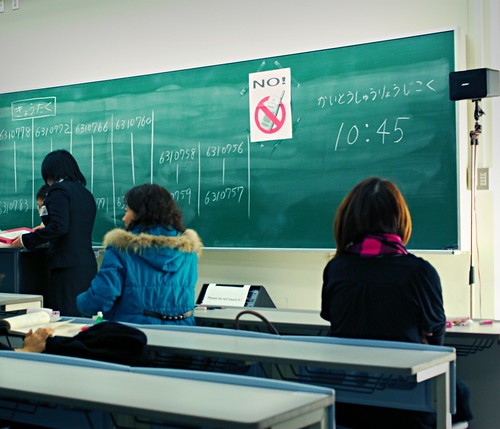
Yes, it's the time of year again, when the leaves have fallen, when the rain turns cold and miserable, and when people's thoughts turn towards the year-end parties and the coming holiday - and when foreigners throughout the country gather to take the Japanese Language Proficiency Test. Like last year I took the level 1 test, and like last year I'm going to fail.

Which is fine; I took it just for practice. Unlike last year, however, it didn't feel impossible. I have a decent idea on what parts of the language need improvement (everything) and how much more I need to improve (a lot.) The JLPT is being remade next year, with a new level in between the current 2 and 3, a somewhat different scoring system, and new names for the levels. Oh, and level 1 will reportedly become slightly harder.

So I figure that to the extent passing level 1 has any meaning1 I might as well take the new test rather than the old. My current plan is to make a real attempt on level one this time next year, and if/when I fail that, try again in June next year. Of course, the vagaries of life can and will interfere (when work and study competes for attention work wins every time) but that's the plan at least. I've already started going through the vocabulary and kanji "for real". We'll see.

--

#1 A lot of people seem to really overestimate the value of a JLPT1 certificate. Here's a bit of reality: If Japanese proficiency is important for a job, then having JLPT1 or JLPT2 may make the difference between landing a job interview and not doing so. But that's it - no interviewer, in Japan or abroad, is going settle with a test score. They'll make sure you actually can use the language, including conversation and writing which are not covered by the test. Actually knowing the language is critical in other words; having a test certificate is much less so. "Studying for the test" is relly pointless in this case.

And if Japanese is not important then a JLPT test certificate is much like being treasurer at your local photography club, or having a forklift licence - it makes for a nicely rounded CV but it's not going to have any material effect.

Tuesday, October 20, 2009

Konkatsu

The Japanese language has a thing for coining new words by abbreviation. A common pattern is to take one syllable or character from each of two words to create a new one. For instance, "結婚 約束" (kekkon yakusoku, "marriage-promise") is today abbreviated to "婚約" (konyaku, "engagement"). "京都 大学" (Kyoto Daigaku, "Kyoto University"), my current employer, is normally referred to as "京大" (Kyodai); other large universities tend to follow the same pattern. A common word among the students here is "就活" (shūkatsu, "job hunting"), which comes from "就職 活動" (shūshoku katsudō, "employment-finding activity").

Today I learned of a fairly new, increasingly popular word borrowing the same "katsu"-ending: "婚活" (konkatsu, "marriage hunting"), from "結婚 活動" (kekkon katsudo, "marriage activity")1. The longer phrase does not (to my knowledge) exist; the pattern is copied straight from "job hunting" above. Apparently "konkatsu" can be used in any marriage-seeking context; the tv show this morning was showing "konkatsu hair styles" and "konkatsu meiku" (makeup) which I assume is some style that makes you look eligible and desireable for marriage or something like that. A "konkatsu event" is a matchmaking party, and so on.

Of course, there's no way of knowing if this neologism will have staying power. Most new, trendy words have their time in the sun only to fade away again after a while. My guess is it will hang around. Marriage - or lack thereof - is a constant worry for a lot of younger people here2, and konkatsu is a useful and catchy term for all matchmaking and marriage-seeking issues. Of course, tv shows and advertisements blaring "婚活しよう!" ("Let's seek marriage!") and "婚活は20代から!" ("Marriage hunting starts at 20!") could well turn people off the word permanently - to say nothing of turning people off the idea of marriage itself.

--

#1 To the best of my knowledge, the origin of "tonkatsu" has nothing to do with hunting pigs.


#2 You know, maybe if this society was not so single-mindedly focused on marriage as the sole approved form of partnership, it would not be such a major hang-up for so many people. The current idea of a formally married nuclear family with breadwinner and housewife is a very recent invention after all; it's not like you'd be giving up an age-old tradition or anything if other forms of partnerships would be legally and socially recognized.

Wednesday, June 17, 2009

When Danger Strikes!

Nara has its first swine flu infection, and an email has gone out to everybody at my work with information and advice. Sensible enough. They send it out in Japanese as well as English, which is very appreciated by us non-Japanese. I just wish they had somebody do a quick check that the translation is hitting the right tone.

The passage I reacted to reads, in Japanese:

各位におかれましては、引き続き、下記の点にご留意いただき、適切な対応をお願いいたします。

Approximately translated as:

Everybody, please remember to take heed of the following points and take appropriate precautions.

The English email, however, said:

The University urges all the members to be alarmed about the following points and must respond to this matter with serious attention.

Which, frankly, is rather more panic-inducing that I believe the authors may have intended. To me "being alarmed" is appropriate when, say, Godzilla has eaten the lunch cafeteria and is approaching our building for dessert.

On the other hand, I'd not have read it with such rapt attention had the word "alarmed" not jumped out at me from the text.

Monday, March 9, 2009

Teito University and Maichō Shinbun

If you have followed my writeup of "The Devotion of Suspect X", you may have noticed the main characters are all graduates of Teito University (帝都大学). While the "Galileo" mystery series may be the most visible example today, Teito university is the home of a number of fictional graduates or the setting for fictional events.

So it is entirely appropriate that Teito university itself is nonexistent. It's one of those things, like Acme Corporation in English, that exist only by the implicit consensus of the writers using it in their own fiction. Another Japanese example is Maichō Shinbun, a fictional newspaper frequently used in television series and literature. The Necronomicon is a fictional book originally made up by Lovecraft that appears in many works of horror or fantasy fiction.

The appeal for writers is that the reader or viewer is likely to have vaguely heard of it already. We are hardwired to see familiarity as a proxy for importance and plausibility (this is why "branding" advertisements work) so the writer gains a sense of veracity with little effort. You can get the same effect by using real places and placing real people in fictional stories of course. But there's no basis in reality, so the writer is free to add or change whatever features they wish. If a writer needs Teito university to have a particle accelerator or Maichō Shinbun to have a Paris news bureau, then they can without anybody protesting that the real thing doesn't have it.

But once a fictional thing becomes really popular, the fictional features become "real" enough that readers or viewers would protest if a writer changed an accepted part of it. In the case of The Necronomicon, for instance, the fictional author is "Abdul Alhazred", and any writer changing that does so at their own peril (and their readers' displeasure). Any movie portraying an "Acme" brand device as high-quality, useful and defect-free would similarly break a consensual agreement on what "Acme Corporation" should all be about. You can get to the point where the fictional entity is just as rigidly defined as any real thing. Terry Pratchett, writer of the extremely popular Discworld book series, has complained that his own fictional city of Ankh-Morpork has become so detailed through the years - with published maps and guidebooks, no less - that he has real trouble adding or changing things without getting called out by his fans for violating known "facts" about the city.

Of course, nobody actually tells you when they present a fictional place or thing as real. Many people probably assume that Teito University is a real place, and there's even people who think The Necronomicon is an actual medieval-era mystical book. It hasn't helped that there's several real books published with the "Necronomicon" title, purporting to be the real thing, it being a figment of Lovecraft's fertile imagination nonwidstanding.

Wednesday, February 4, 2009

The Way Things Are Done

There's a peanut-related salmonella outbreak in USA, so peanut-based products imported from there naturally become suspect. A company in Tokyo imported peanut-flavored popcorn, and the health ministry has now ordered them to stop selling the product.

But - and this is where things get interesting - no salmonella has been found in the popcorn so the health ministry apparently can't simply order them to recall the already sold product. Instead they order them to voluntarily recall the popcorn1. Which seems to require some creative reinterpretation of "order", "voluntary" or both.

Now, this is where a certain kind of writer would make hay of this. They'd wildly overgeneralize the thing into some vast gulf of mutual cultural incomprehension, wax rhapsodical about different national characteristics and maybe even have a go at the Mysteries of the Orient and the Inscrutability of the Eastern Mind while they're at it.

That would be very silly. The reality is of course much simpler and less consequential. This amounts to an alert that an involuntary recall will be ordered - with legal repercussions, bad publicity and at considerable inconvenience to everyone involved - if the company doesn't do a recall on its own. The procedural and regulatory praxis has moved on over time while the terminology has not. The resulting mismatch creates anoher small, delightful wrinkle in the language fabric, adding a bit of spice, and nicely illustrating the difference between formal language theory and living, breathing languages in actual use.

It's easy to read too much into things; usually an expression is just an expression, nothing more.

--

#1 No, it's not a translation error; the Yomiuri original says "自主回収を指導した" - "ordered a voluntary recall". And just to forestall an obvious objection, I have it on good authority (my wife) that while "指導" means "guidance" or "coaching" in the context of teaching, the implication is very much "order" when it involves a government agency like this.

Monday, December 8, 2008

JLPT 1

Yes, it's this time of year again, when Japanese learners of all levels leave their solitary dens to gather and mingle like lemmings, if lemmings were to mingle in unheated university lecture halls on an early Sunday morning in December. And today, after one years absence, I gathered with all the rest.

Flow
Flow.


As I accidentally passed level 2 two years ago, my next - and last - level is level 1. I plan to try to take it next year, and so I took level 1 now just to have a base of comparison. That means I did no studying or preparation whatsoever for this year, not even looking at an earlier test; I want to see what I know and what I don't. So of course I'll flunk this one. That's OK; it's on purpose.

Testing

This is not an easy event to photograph. Worn classrooms aren't intrinsically photogenic, and I think it'd be impolite and perhaps even a breach of privacy to post an easily recognizable image of a test-taker. Oh well.


First of all, kanji and vocabulary. It is a lot more difficult than level 2 was and I didn't stand a chance. This is the most criticized part of the level 1 test as the questions frequently go beyond just testing your knowledge and into the realm of word puzzles. You may be asked to match words using the same kanji given only their pronunciation, for instance. Ugh. Some practice is called for here. So far my kanji studies have been piecemeal and ad hoc; it seems I'll need a more structured approach the coming year.

The listening part went so-so; not very difficult as such, but I did miss a fair few questions due to my deficient vocabulary. I didn't expect to have to work a lot on my listening and it looks like I won't have to.

Reading was the positive surprise of the day. I managed to pass level 2 mainly on the strength of this section and again I did a lot better than I thought I would. Spending every weekday morning the past couple of years with my nose in a book has been paying off I guess. Again my limited vocabulary tripped me up a lot, but I even though I thought I was too slow in reading everything I still managed to have almost 40 minutes left for the grammar section. Again, I won't need any specific reading practice for next year.

The grammar... I've never enjoyed studying grammar, and I've only just started covering the frequently obscure or rare grammar that comes up at this level. I actually knew a couple of the grammar questions, could make informed guesses on some but basically just answered most of them completely at random. I really need to get to work on this.

The maximum score is 400, and the passing score is 280. If you just guess on everything you can expect around 100 points. Me, I should have somewhere around 150-180 points or so I think. Which is fine - the lower my current score, the more I'll have improved when I retake it next year after all.

Thursday, July 31, 2008

It's a Trend!

I just saw today that the experimental post-Windows pipe-dream operating system in development at Microsoft Research is codenamed "midori", Japanese for "green" or "greenery". And the very same day, the Mozilla foundation announces an unstable alpha version of the next Firefox, codenamed "Shiretoko", the northernmost peninsula on Hokkaido in Japan.

And since two examples is more than enough statistical material to constitute a trend in the blog world (many real newspapers don't require even one), I hereby declare this to be the Year of Japanese Language Software Codenames. Remember, you heard it here first!

New Torii

Monday, June 2, 2008

Short takes

Life revolves around work at the moment, and as I try to avoid work-related posts here (I blog to get a break from work, not to further it) posting is light. There's nevertheless a few interesting tidbits worth posting about.

Banpeiyu
Center, work time; right, spending time with Ritsuko-time; left, language study time. Not visible at this resolution, blog time.

Actually, it's a "Banpeiyu", a kind of pomelo, and the worlds larges citrus fruit. It lasted us for days.


Shisaku points to some welcome news: the LDP far-right is preoccupying itself with campaigning for a return to Meiji-era grammar and spelling for the Japanese language, citing reasons such as the Japanese spirit being embodied in its characters - and I do believe they mean a quite literal spirit here - and the post-war orthography reforms having destroyed it (and thus, I presume, being part to blame for the lack of children, independent women and a viable political opposition).

The good news? Every hour of effort they spend on this doomed project is an hour they're not spending on something that could actually affect anybody. And it should be but a short step to convince these people that computers, internet and word processing is similarly soul-destroying for the language, so they'll end up writing their policy proposals in longhand, sending drafts to each other by courier. With any luck, it could keep them from doing any legislative mischief for years.

Monday, May 12, 2008

Hotchkiss

[Repost] You've never heard of mr. Eliphalet Hubbell Hotchkiss? He was an American business owner whose company started production of a paper stapler at the end of the nineteenth century, and exported a lot of them to the Japanese government. Which is why a word for "stapler" in Japanese is "ホチキス" (hochikisu). Which I found strange, started to look around and found this site on antique staplers. Which, if nothing else, it's a good place to get your fill of esoteric knowledge you can bore people to tears with.

Thursday, May 1, 2008

"Easier visa for Japanese Speakers" plan announced

I wrote in January about a tentative suggestion that Japanese language ability be counted in your favour when applying for visas.

Now, Asahi Shimbun reports in Japanese and English that a firm plan is being announced today. And it seems it might really be an easing of restrictions as a way to encourage language ability (rather than a roundabout way of imposing further restrictions on those with little language skill). Among other things, the article mentions extending visa durations to five rather than the current three years; and relaxed qualifications for the professional visas. As it happens, the vague rumours of a revamped Japanese Language Proficiency Test seem to be solidifying as well, with documents floating around suggesting the possibility of testing language use in some manner, not just understanding.

Tuesday, January 29, 2008

Learn Japanese, get a Visa

Last week the Japanese foreign ministry tentatively suggested that language proficiency be connected to long-term visas. Now, the first (and natural) reaction would be that "oh, another ploy to keep as many foreigners out of the country as possible", but this really does not seem to be the case. Instead, is seems the purpose is the opposite, making it easier than before to gain a long-term visa as a way to promote language fluency, and to have more long-term immigrants be proficient in the language.

New Torii Practice, practice - just not on national cultural treasures, please.


The announcement was very careful about emphasizing that it would not make it more difficult to gain visas for non-speakers than it already is today; instead the purpose is to make it easier for those who do gain Japanese proficiency to stay. The article in Japan Today gives as an example lessening the required work experience for engineers if they have attained a certain level of language fluency. Other sources have implied that the term length of visas to be granted could be affected as well; several kinds of visas (like spouse of a Japanese national) actually come in several terms - like six months, a year and three years - before they need to be renewed, and one suggestion is apparently to give proficient speakers the longer-term visas earlier.

This is actually a very good idea, and one that I suspect they can get very broad support for. It hits all the right buttons for a lot of people: liberals will like the prospect of making it easier for committed people to stay; the right-wing nationalists will love the idea of making the Japanese language a requirement for anything; business interests will like the broadening pool of skilled employees being made available. And for us foreigners - yes, it's a good thing for us too. Remember, the idea is not to make it more difficult than it already is if you don't know Japanese (and to be fair, Japan is really not that difficult, visa-wise, compared to a lot of countries), but you get a real, substantial benefit if you do choose to spend all that time studying.

All statements are very vague, but the general consensus seems to be (and I agree) that this really is a preparative step in accepting more long-term immigration in response to the shrinking workforce. And - coming from a country with a large number of immigrants - since many of the problems associated with immigration stem in part from a lack of language ability, making this a condition is only prudent. It's not like Japan would be particularly exceptional if this was enacted either; Canada, for instance, gives you a bonus both for knowing English and French if you want to move there.

And really - people who are indifferent or negative towards a country do not spend years studying its language. The kind of people that willingly go through with something like that are enthusiastic, even passionate, about it, and should be exactly the kind of people you'd want to encourage to come.

I think this plan may actually be further along than the articles say and than people think. The article in Japan Today above specifically mentions the JLPT as the test to use for measuring proficiency, and there's what seems to be quite solid rumours that the JLPT is being redesigned right now, with a new, intermediate level between level 2 and the top level 1. A long-standing criticism of the test has been that the jump from 2 to 1 is very large, and that level 1 tests a lot of things that aren't very useful in daily life. The redesign is rumoured to add an intermediate level, while possibly push the current level 1 a bit further still. Another rumour - less reliable - hints at the test will be given twice a year rather than just once. The new test is apparently due to be tried out this summer and deployed for real in 2009.

As it happens, an intermediate level above level 2 would be perfect as a "proficient" level for work-related purposes. Level 2 itself is still a little on the low side, while the current level 1 is overkill in several ways. Having a "pre-1" that focuses on proficiency in practical use and making level 1 a real nerdcore test of obscure language points would both make for a better test and fit nicely with these visa plans. And, of course, making the JLPT count for visa determinations means you need to give the test reasonably often so that people don't get left hanging. The rumours of giving it twice a year thus fit in nicely as well.

If the new test is now designed to be rolled out in spring 2009, then that would give textbook authors time to create new study materials and give the test administration a year - a spring session and a winter session - to iron out any problems if the new immigration law is adopted in the spring Diet session a year from now and implemented from April 1st 2010. Time will tell, but I hope it'll happen.

Friday, December 14, 2007

Reason

I've looked for a new book to start on after finishing Harry Potter. My criteria is that it be a Japanese long-form novel; no translation, nonfiction or short stories. I considered Yoshimoto Banana's "Kitchen" and Murakami Haruki's "Kafka on the Shore" but decided against them for now. It's late autumn, after all, with winter just days away. It's a time of falling leaves and wet streets. A time of cold wind and rain cutting you to the bone, of gloomy days and frosty nights. A time of hot drinks, warm blankets - and murder mysteries.

Dripping

Rainy, chilly days ahead.

Miyabe Miyuki is a very popular current Japanese writer. Her works range from contemporary crime novels and historical mysteries to fantasy and science fiction. The book I've started on is called 理由 (riyuu), "Reason", and is a crime novel set in a Tokyo suburb in the late 1990's. I have only read the prologue and the first bit of chapter 1, about twenty pages in all, and I've only just come to the bit with the actual murder so I can't really say anything definite about it yet. It is decidedly more difficult than Harry Potter was, and the lack of furigana isn't helping. At this rate I'll have reading material for my morning commute well into spring.

So far, though, the setup and tone reminds me a lot of the Swedish authors Maj Sjövall and Per Wahlöö and their 1970's series of police novels (available in English). The book has a tone reminiscent of theirs (so far), and just like Sjövall and Wahlöö, Miyabe's book is as much about the setting as about the story itself. They use the plot as a guide to describe a changing city and a changing society and how these changes affect all the ordinary people caught up in them. In the case of Sjövall and Wahlöö it is Stockholm and Sweden during the cold war and economic depression of the 1970's; for Miyabe it's Tokyo and Japan in the post-bubble era of the 1990's.

"Riyuu" looks to be a very enjoyable read despite the difficult (for me) language. That it's been able to hook me already despite my lack of language skills is a testament to how well-written it is. My only regret so far is that it's only available in Japanese so I can't pass it on to other people that I know would love it as well.

Wednesday, November 14, 2007

Done With Harry Potter

I posted in my old blog long ago about my first attempt to read Harry Potter in Japanese (which of course failed spectacularly); and then, this summer I picked it up again for a new attempt.

And now, after about three and a half months, it's finished. I haven't been reading it all day, every day, of course, or I'd been done earlier. Mostly I've been reading it during my crowded morning commute, and occasionally during lunch break. At about 45 minutes per day it's taken me 60 hours to read it, for an average of about eight minutes per page average. Nowhere near my normal reading speed, but a pretty good improvement on the 15 minutes per page I spent in the beginning.

The reading speed, I've found, alters the whole reading experience. Sometimes an author hits a slow patch or goes off on a tangent for twenty or thirty pages. At my normal speed I'd breeze through it in fifteen-twenty minutes; just a quick breathing space before the plot picks up again. But in Japanese those thirty pages translate into a whole week with no plot advancement at all. An insignificant change of pace in English becomes almost painfully slow and drawn out in Japanese.

The practice has paid off in familiarity, though. I don't feel intimidated by large chunks of Japanese text anymore - I may still not understand it but now that just makes me annoyed, not cowed. And I have a much easier time now scanning a text for specific information even if I don't grasp the details.

What's next? I won't continue with the next Potter book yet. Authors tend to stay with the same vocabulary and expressions over time so I'm better off reading a different author, and preferably something written in Japanese rather than translated. For bed-reading I'm working through "Rubyレシピブック" (Ruby Recipebook), a computer language book with short one or two-page programming tips*. I can read a tip each night and it teaches me some computer-related vocabulary. So, while I have some other non-fiction waiting I want to continue with fiction for my morning commute.

A good option is "Kitchen" by Banana Yoshimoto, suggested by my teacher. Another would be something by Junko Sakai; Ritsuko enjoys her books a lot and from what I've seen I probably will too. She is an essayist, though, and I'd really prefer to tackle another novel. I suggested "Snow Country" by Yasunari Kawatabata, but my teacher said it's much too difficult and Ritsuko said it's much too boring. So no Nobel-price winning author for me yet.

If anybody has any ideas for book-length Japanese fiction that's not too difficult I'd love to hear about it.


* "Ruby" is the name of a programming language. It's a clean, well-designed language that has gained a lot of positive attention the past few years. It is also the language with the most.. special online programming tutorial ever (special in the sense of "precious" or in the sense of "special olympics" is up to you): Why's (poignant) guide to Ruby. Seriously, even if you have no interest in computers or programs at all, you owe it to yourself to take a look at the first few pages.