Showing posts with label japanese. Show all posts

Monday, February 14, 2011

Son of Return of Revenge of the JLPT1

The Japanese Language Proficiency test results are in, and as expected I failed. Like last year, and like the year before that.

Imazato Line

The test was on the eastern side of Osaka, so I got to go on the Imazato subway line for the first time. It's the newest line in Osaka, and like the Tsurumi-Ryoukushi line it's a linear motor system. The center line on the tracks here is effectively the stator while the train itself is the rotor in a flattened-out electric motor. Look at it go - Wheeee!!!


I didn't study at all for the test, and I didn't aim to pass it in the first place. Like those previous years, I took level 1 as a practice test. This year was the first time with the new scoring system1 which makes it difficult to compare with previous years. I do intend to try for real next year - but then, I said the same thing last year and ended up with no time to do so.
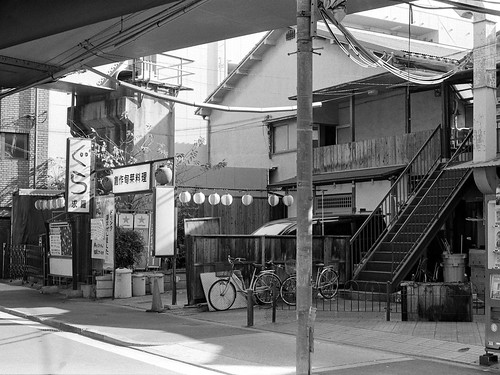
Under the Tracks

Higashi Osaka has a town-y feel to it. It's the kind of place where events seem to pass it by without ever really affecting it. This is a restaurant under the Shinkansen tracks that pass through the city.


I did so-so. Not good - I didn't pass after all - but not a complete disaster either. You have three sections nowadays, with a maximum of 60 points for each. You need to get at least 19 points in each section, and 100 (out of 180) in total to pass. I got 21/60 for vocabulary and grammar; 31/60 for reading and 26/60 for listening. I passed the section minimums, but I would have needed 33-34 points in each section to pass overall. The tests are really not comparable any more but that said, two years ago my score was only 61% of the passing score, last year was 70%, and this year was 78%. If the trend holds I'll pass the test in 2013.
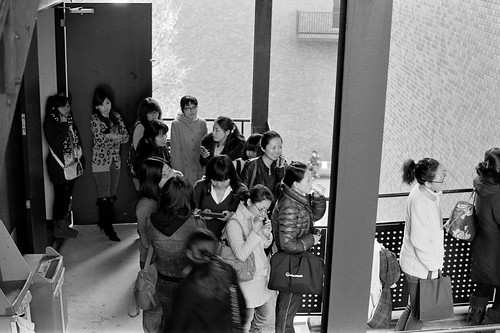
Make a pee-line

The test was at the University of Economics. Large crowds and breaks at about the same time for everyone mean long lines to the bathrooms for the female test takers.


My strong point is reading. It keeps improving and it's now on par with my listening; I guess reading the Asahi Shimbun on the train every morning really helps.

Grammar - well, I suck at that. It's not just Japanese - I suck at English and Swedish grammar too, and I've yet to grasp simple things such as the difference between adverbs and adjectives. Sure, I'll keep struggling through grammar exercise books but really, it doesn't really seem to improve my understanding. I eventually mastered English grammar simply by reading and hearing enough of it to internalize the correct patterns. I suspect the same thing will eventually happen with Japanese too.

DAM - The Hyper Karaoke

I love this retro-futuristic karaoke-sign in Higashi Osaka. Who wouldn't want to experience Hyper-Karaoke at least once in their life?


#1 The points are no longer directly connected to the number of correct answers. The new test uses something called Item Response Theory to score the test.

The basic idea is - I think - that you determine the difficulty score of each question by how many people answered correctly. The score represents the level of knowledge - the higher the score the more you know. So the difficulty score of a question is the level of knowledge that the question tests - half the people with a knowledge level at that exact score will get it right, half will not.

Then you look at all the questions each individual test taker got right or wrong, and you determine statistically which score would be most likely to give this pattern of results. That score is the score you get on the test.

Why do it this way? It's more reliable. Your score will be the same whether you get an easy test or a difficult one, and you can even compare your score with other tests as long as the other tests use the same scoring system.

Friday, February 5, 2010

JLPT 1 Results - and Pictures

It looks to become a yearly tradition, this: A year ago I took the JLPT 1, the Japanese proficiency exam, and failed it. This year I again took the JLPT 1 - and failed it.

Nerves

A JLPT examinee in deep thoughts during the morning break between Vocabulary and Listening.


Failing it is fine by me, and I didn't expect otherwise. I had a vague idea that I'd start preparing for the JLPT a bit after last year, but I've since started a new job and a new project that's kept me rather busy. It's been a struggle just to keep to regular language lessons every two weeks; test preparation has been far from my mind.

JLPT Test Takers

A trio of fellow examinees, probably from India (check the bag on the left if you need convincing), taking the test somewhat more seriously than I did.


So how did I do? 196 points out of 400, or just about half. And all three parts - kanji and vocab, listening, and reading and grammar - individually reached the halfway mark too. If we do the (overly simplified, not-to-be-relied on) analysis I did last year, I "knew" 128 points worth of questions this year compared to 93 a year ago1. The improvement (if there actually was any) was completely in the reading section; that would make sense as most of my limited study time this year has been spent reading.

Next year I'm going to take the test for real. Not pass it, perhaps, but at least make a serious attempt. I'm going to ignore the listening, as I already listen to Japanese all day, every day, after all. I've begun reviewing the vocabulary and kanji2. My regular book habit on the train every morning should cover the reading. Soon I'll start going through the grammar as well; not a prospect that fills me with unalloyed joy, exactly, but there's no helping it I guess.

I don't have the time to really go through everything by December, but I should be able to get within shouting distance of a passing score. The big question for next year is the new test format. The JLPT is changing, with a new intermediate level and the new level 1 is reportedly going to be slightly more difficult. There's also rumours that the new test will require a passing score on each of the subsections, not just an overall pass. If that is true then it's a welcome change, but it would also make the test substantially harder. We'll see, I guess.

Practice

Practice makes perfect. A baseball team at Osaka International University, where the test was held this year.


Kayashima

Kayashima station, near the test site, is pretty cool. The line and platform is elevated, and there's a large tree growing right through the platform and up through the roof above. I like this area for this reason alone


---
#1 This is accurate only if you assume that I guessed exactly 1/4 of the unknown answers correctly. If we wanted to know if I really improved, we would need to take the expected random variation of answers into account and see if this improvement is likely to be due just to chance or not. That starts looking uncomfortably like work, however, so I happily leave it as an exercise for those who are interested.


#2 On the off chance that you intend to take any of the lower levels (n5 to n3) of the JLPT this year, here's a tip: when you study the kanji, take the time to memorize all the normal readings and meanings, not just the ones you need for your test level. You will thank yourself when you study for level 1 a couple of years down the road.

But you'll also find it immediately useful once you start reading real texts. They don't restrict themselves to the readings you learn for the JLPT, and there's few things as annoying as when you know the character but still have to stop and look up the reading. If you know the full range of readings it becomes much easier to start a reading habit and to pick up new vocabulary.

Sunday, December 6, 2009

JLPT 1

Yes, it's the time of year again, when the leaves have fallen, when the rain turns cold and miserable, and when people's thoughts turn towards the year-end parties and the coming holiday - and when foreigners throughout the country gather to take the Japanese Language Proficiency Test. Like last year I took the level 1 test, and like last year I'm going to fail.

Which is fine; I took it just for practice. Unlike last year, however, it didn't feel impossible. I have a decent idea on what parts of the language need improvement (everything) and how much more I need to improve (a lot.) The JLPT is being remade next year, with a new level in between the current 2 and 3, a somewhat different scoring system, and new names for the levels. Oh, and level 1 will reportedly become slightly harder.

So I figure that to the extent passing level 1 has any meaning1 I might as well take the new test rather than the old. My current plan is to make a real attempt on level one this time next year, and if/when I fail that, try again in June next year. Of course, the vagaries of life can and will interfere (when work and study competes for attention work wins every time) but that's the plan at least. I've already started going through the vocabulary and kanji "for real". We'll see.

--

#1 A lot of people seem to really overestimate the value of a JLPT1 certificate. Here's a bit of reality: If Japanese proficiency is important for a job, then having JLPT1 or JLPT2 may make the difference between landing a job interview and not doing so. But that's it - no interviewer, in Japan or abroad, is going settle with a test score. They'll make sure you actually can use the language, including conversation and writing which are not covered by the test. Actually knowing the language is critical in other words; having a test certificate is much less so. "Studying for the test" is relly pointless in this case.

And if Japanese is not important then a JLPT test certificate is much like being treasurer at your local photography club, or having a forklift licence - it makes for a nicely rounded CV but it's not going to have any material effect.

Saturday, January 10, 2009

The Devotion of Suspect X - Chapter 2

Time is at a premium for me, still, so reading has taken a back seat to other things for a while. Nevertheless, I haven't been able to completely stay away from our hostess-turned-bakery-assistant and her wayward husband we met in chapter 1. Onward!

Chapter 2

Our journey through "The Devotion of Suspect X" continues, despite work- and holiday-related interruptions. When we last left the book at the end of Chapter 1, Yasuko and her daughter Misato had a decidedly unsavoury visit from Yasuko's abusive former husband and ne'er-do-well Toshige, and we left just as Misato clubbed him over the head with a heavy copper vase in the hallway.

Was he hurt? Dead, perhaps? No. Enraged he stepped up and proceeded to beat up Misato. Fearing that he'd actually kill their daughter, Yasuko grabs a power cord from the kotatsu table and yanks it around his neck. Misato holds on to the desperately struggling Toshige while while her mother Yasuko strangles him with the cord. I must say that in an era where family activities are disappearing and generations no longer interact, it's uplifting to see three people really come together as a family and enjoy a physical activity with each other rather than be cooped up alone with the tv or some video game.

Anyway, the wayward husband, father and overall douchebag has only barely kicked the bucket when the doorbell rings. Yasuko sends Misato to the other room, covers the undearly departed with the kotatsu blanket and opens the door. It's none other than Ishigami, our lovestruck math teacher from chapter one. He lives right next door, it turns out, and wonders what the noise was. Yasuko mumbles some excuse about chasing a cockroach and sends him away.

Yasuko has just decided she'll have to call the police, despite her worries about Misato (she did help kill her father after all) when the phone rings. It's Ishigami - again - now wondering if she would appreciate help with the dead body she's got, seeing how a single woman would have a hard time moving it.

Our math teacher, having nothing on Sherlock Holmes, has figured out what happened only from vague clues glimpsed through the door crack: her tousled hair, cigarette smoke from a discarded soda can, that sort of thing. Never mind that the same clues could have a simpler, more likely explanation; this is a detective story and suspension of disbelief is part of the package.

After a bit of back and forth she decides the police can wait, so Misato cleans the crime scene while Yasuko and Ishigami drags the very deceased Toshige's body over to his apartment. As the saying goes: "Friends will help you move; real friends will help you move bodies". And truly, Ishigami is a veritable sir Lancelot here, apart from the whole cover-up-a-murder thing, which I don't theing the real Lancelot would have approved of. He does a bit of thinking, and decides a false trail is appropriate. As we leave the scene he asks her to help him get the clothes off the body.

--

Oh, and if it's not clear from my tone above, I truly enjoy murder mysteries in general, and this book in particular. They have a lot of genre conventions, and the plots are not meant to make a huge amount of sense. Poking gentle fun at them is part of the enjoyment.

Wednesday, December 10, 2008

The Devotion of Suspect X

Or, "容疑者Xの献身" in the original. The book, a murder mystery, is part of a series by Keigo Higashigo. It's fairly recent and due to be turned into a movie. Compared to Reason it is a significantly easier read, and the book is shorter as well, so it should be reasonably quick. On the other hand, as it is easier I have time to really make sure I do understand everything so it may not be that much faster overall. I started it on the 1st of December and have read the first chapter. I thought I'd summarize each chapter here as I finish them. If you intend to read the book and don't want to know the plot it may be a good idea to skip these posts in the future.

Chapter 1

Our tale starts with Tetsuya Ishigami, teacher in mathematics, on his way to work in a Tokyo school. He is sharp-eyed and friendly, as evidenced by his reflecitions on the people he meets during his walk. On the way, he stops by the Bentencho lunch-box takeout place. This is not strictly because he needs lunch, but because of his secret crush on the shop assistant..

..Yasuko Hanaoka, divorcee and former bar hostess. She left hostessing for a shop assistant job when her daughter Misato was getting old enough to start school. When shop owner Sayoko Yonezawa points out that the teacher guy seems to have a crush on her and knows which days she comes to work, Yasuko freaks out. She has no favourable impression of the middle-aged and chubby Ishigami and worries he may be stalking her. The reason for her distrust soon becomes clear as the shop gets a visit from her estranged former husband..

..Shinji Toshige, smooth-talking former car salesman; you can practically hear the oily hair and too-sharp suit in the text. He swept her off her feet when they first met at a bar; they married, had Misato and Yasuko quit working. But soon Toshige was fired for embezzlement and he settled on a life of drinking and gambling while Yasuko returns to bar hostessing to earn money, money which he promptly takes from her. Tired of the abuse she finally files for divorce, but he continues to stalk her and her daughter and demanding money until she quits her job and moves away to start over at the lunch-box restaurant. I don't think we're supposed to like this guy very much.

He insists that they get together again for unstated reasons and he threatens to catch Misato at her school if Yasuko doesn't agree to meet him after work. He sneers, he even laughs evilly. She meets him after work and refuses his advances. Once she gets home, however, it turns out he's followed her. He forces himself in, smokes against her wish, makes a general nuisance of himself, and pockets some of her money almost absentmindedly. Really, all the guy needs is a goatee and a cape and the character is complete.

As Misato comes home he is naturally a complete bastard towards her as well. As she flees into another room, he follows her briefly then returns and starts to leave. As he bends to put on his shoes Misato shows up - and swings a heavy copper vase at the back of his head, felling him like an ox. Is he hurt? Is he dead? Is he going to be not happy at all about this? Ah, but that will be made clear in the next chapter...

Sunday, September 7, 2008

JLPT

I've sent off my application for the JLPT (Japanese Language Proficiency Test) level 1 in December. It's the highest level, and passing it supposedly indicates that you have "an integrated command of the language sufficient for life in Japanese society." You're supposed to have a vocabulary of about 10000 words, know the standard 2000 kanji studied up through high school and pretty much all the grammar you're ever likely to encounter in modern Japanese (as well as a fair amount of grammar that is rare or obsolete). Oh, and you need 70% for a passing grade rather than the 60% needed at the lower levels.

So, I know the above, right? Nope. Not a chance. This year I'm only taking the test for practice. I vaguely plan to try level 1 for real in another year, after taking the test for practice again next spring. Beginning in 2010 the JLPT will be revamped, with an extra level in between level 2 and 3, and some general reshuffling of content that will result in level 1 becoming slightly more difficult. It makes sense, I think, to at least make a reasonable effort to pass the current level 1 before that time.

And for some reason the JLPT is quite fun to take. It's always on a Sunday in early December, held someplace like a university campus. Early December typically means high, clear skies and cool temperatures. You get up indecently early in the morning, mill about with hundreds of other mostly young, mostly Asian test takers on an otherwise abandoned test site, eat a bento lunch while fretting over the results so far. In the end you go home, feeling completely drained, but magically you suddenly feel you know a lot more Japanese than you thought you did before the test. It's a fun outing.

Monday, June 2, 2008

Short takes

Life revolves around work at the moment, and as I try to avoid work-related posts here (I blog to get a break from work, not to further it) posting is light. There's nevertheless a few interesting tidbits worth posting about.

Banpeiyu
Center, work time; right, spending time with Ritsuko-time; left, language study time. Not visible at this resolution, blog time.

Actually, it's a "Banpeiyu", a kind of pomelo, and the worlds larges citrus fruit. It lasted us for days.


Shisaku points to some welcome news: the LDP far-right is preoccupying itself with campaigning for a return to Meiji-era grammar and spelling for the Japanese language, citing reasons such as the Japanese spirit being embodied in its characters - and I do believe they mean a quite literal spirit here - and the post-war orthography reforms having destroyed it (and thus, I presume, being part to blame for the lack of children, independent women and a viable political opposition).

The good news? Every hour of effort they spend on this doomed project is an hour they're not spending on something that could actually affect anybody. And it should be but a short step to convince these people that computers, internet and word processing is similarly soul-destroying for the language, so they'll end up writing their policy proposals in longhand, sending drafts to each other by courier. With any luck, it could keep them from doing any legislative mischief for years.

Thursday, May 1, 2008

"Easier visa for Japanese Speakers" plan announced

I wrote in January about a tentative suggestion that Japanese language ability be counted in your favour when applying for visas.

Now, Asahi Shimbun reports in Japanese and English that a firm plan is being announced today. And it seems it might really be an easing of restrictions as a way to encourage language ability (rather than a roundabout way of imposing further restrictions on those with little language skill). Among other things, the article mentions extending visa durations to five rather than the current three years; and relaxed qualifications for the professional visas. As it happens, the vague rumours of a revamped Japanese Language Proficiency Test seem to be solidifying as well, with documents floating around suggesting the possibility of testing language use in some manner, not just understanding.

Tuesday, January 29, 2008

Learn Japanese, get a Visa

Last week the Japanese foreign ministry tentatively suggested that language proficiency be connected to long-term visas. Now, the first (and natural) reaction would be that "oh, another ploy to keep as many foreigners out of the country as possible", but this really does not seem to be the case. Instead, is seems the purpose is the opposite, making it easier than before to gain a long-term visa as a way to promote language fluency, and to have more long-term immigrants be proficient in the language.

New Torii Practice, practice - just not on national cultural treasures, please.


The announcement was very careful about emphasizing that it would not make it more difficult to gain visas for non-speakers than it already is today; instead the purpose is to make it easier for those who do gain Japanese proficiency to stay. The article in Japan Today gives as an example lessening the required work experience for engineers if they have attained a certain level of language fluency. Other sources have implied that the term length of visas to be granted could be affected as well; several kinds of visas (like spouse of a Japanese national) actually come in several terms - like six months, a year and three years - before they need to be renewed, and one suggestion is apparently to give proficient speakers the longer-term visas earlier.

This is actually a very good idea, and one that I suspect they can get very broad support for. It hits all the right buttons for a lot of people: liberals will like the prospect of making it easier for committed people to stay; the right-wing nationalists will love the idea of making the Japanese language a requirement for anything; business interests will like the broadening pool of skilled employees being made available. And for us foreigners - yes, it's a good thing for us too. Remember, the idea is not to make it more difficult than it already is if you don't know Japanese (and to be fair, Japan is really not that difficult, visa-wise, compared to a lot of countries), but you get a real, substantial benefit if you do choose to spend all that time studying.

All statements are very vague, but the general consensus seems to be (and I agree) that this really is a preparative step in accepting more long-term immigration in response to the shrinking workforce. And - coming from a country with a large number of immigrants - since many of the problems associated with immigration stem in part from a lack of language ability, making this a condition is only prudent. It's not like Japan would be particularly exceptional if this was enacted either; Canada, for instance, gives you a bonus both for knowing English and French if you want to move there.

And really - people who are indifferent or negative towards a country do not spend years studying its language. The kind of people that willingly go through with something like that are enthusiastic, even passionate, about it, and should be exactly the kind of people you'd want to encourage to come.

I think this plan may actually be further along than the articles say and than people think. The article in Japan Today above specifically mentions the JLPT as the test to use for measuring proficiency, and there's what seems to be quite solid rumours that the JLPT is being redesigned right now, with a new, intermediate level between level 2 and the top level 1. A long-standing criticism of the test has been that the jump from 2 to 1 is very large, and that level 1 tests a lot of things that aren't very useful in daily life. The redesign is rumoured to add an intermediate level, while possibly push the current level 1 a bit further still. Another rumour - less reliable - hints at the test will be given twice a year rather than just once. The new test is apparently due to be tried out this summer and deployed for real in 2009.

As it happens, an intermediate level above level 2 would be perfect as a "proficient" level for work-related purposes. Level 2 itself is still a little on the low side, while the current level 1 is overkill in several ways. Having a "pre-1" that focuses on proficiency in practical use and making level 1 a real nerdcore test of obscure language points would both make for a better test and fit nicely with these visa plans. And, of course, making the JLPT count for visa determinations means you need to give the test reasonably often so that people don't get left hanging. The rumours of giving it twice a year thus fit in nicely as well.

If the new test is now designed to be rolled out in spring 2009, then that would give textbook authors time to create new study materials and give the test administration a year - a spring session and a winter session - to iron out any problems if the new immigration law is adopted in the spring Diet session a year from now and implemented from April 1st 2010. Time will tell, but I hope it'll happen.

Wednesday, November 14, 2007

Done With Harry Potter

I posted in my old blog long ago about my first attempt to read Harry Potter in Japanese (which of course failed spectacularly); and then, this summer I picked it up again for a new attempt.

And now, after about three and a half months, it's finished. I haven't been reading it all day, every day, of course, or I'd been done earlier. Mostly I've been reading it during my crowded morning commute, and occasionally during lunch break. At about 45 minutes per day it's taken me 60 hours to read it, for an average of about eight minutes per page average. Nowhere near my normal reading speed, but a pretty good improvement on the 15 minutes per page I spent in the beginning.

The reading speed, I've found, alters the whole reading experience. Sometimes an author hits a slow patch or goes off on a tangent for twenty or thirty pages. At my normal speed I'd breeze through it in fifteen-twenty minutes; just a quick breathing space before the plot picks up again. But in Japanese those thirty pages translate into a whole week with no plot advancement at all. An insignificant change of pace in English becomes almost painfully slow and drawn out in Japanese.

The practice has paid off in familiarity, though. I don't feel intimidated by large chunks of Japanese text anymore - I may still not understand it but now that just makes me annoyed, not cowed. And I have a much easier time now scanning a text for specific information even if I don't grasp the details.

What's next? I won't continue with the next Potter book yet. Authors tend to stay with the same vocabulary and expressions over time so I'm better off reading a different author, and preferably something written in Japanese rather than translated. For bed-reading I'm working through "Rubyレシピブック" (Ruby Recipebook), a computer language book with short one or two-page programming tips*. I can read a tip each night and it teaches me some computer-related vocabulary. So, while I have some other non-fiction waiting I want to continue with fiction for my morning commute.

A good option is "Kitchen" by Banana Yoshimoto, suggested by my teacher. Another would be something by Junko Sakai; Ritsuko enjoys her books a lot and from what I've seen I probably will too. She is an essayist, though, and I'd really prefer to tackle another novel. I suggested "Snow Country" by Yasunari Kawatabata, but my teacher said it's much too difficult and Ritsuko said it's much too boring. So no Nobel-price winning author for me yet.

If anybody has any ideas for book-length Japanese fiction that's not too difficult I'd love to hear about it.


* "Ruby" is the name of a programming language. It's a clean, well-designed language that has gained a lot of positive attention the past few years. It is also the language with the most.. special online programming tutorial ever (special in the sense of "precious" or in the sense of "special olympics" is up to you): Why's (poignant) guide to Ruby. Seriously, even if you have no interest in computers or programs at all, you owe it to yourself to take a look at the first few pages.