Prime minister Hatoyama just announced that he'll be stepping down in response to the fallout from the US base mess and the resulting breakup of the coalition. No word on exactly when he's leaving - or if he'll manage to drag Ozawa down with him - but he'll address the members of both houses today.
Presumably he'll tell everyone exactly when he'll step down at that point. Or he'll tell people he's changed his mind and would like to continue, or decide he hasn't decided on the Futenma relocation after all, or fail to show up when he couldn't decide on what tie to wear. Steely resolve has never been his strong point.
Japanese politics may have many faults. Being boring is not one of them, thankfully.
Update: Hatoyama's apparently leaving before the election - as soon as a new leader (Naoto Kan, presumably) is elected. More significantly, Ozawa has agreed to step down as well. The end of an era, and of one of the more interesting political operators in Japan.

Showing posts with label hatoyama. Show all posts
Showing posts with label hatoyama. Show all posts
Wednesday, June 2, 2010

Monday, May 31, 2010
Breaking Up Is Hard To Do
I haven't written about politics here for a while. I'm kind of burnt out on it, frankly, and my focus has been split up over Japan, the upcoming Swedish elections (it starts to look like a nailbiter) and general European activities as well. But with the latest turns of events here I'm long overdue for an update.
The political situation here is a complete, utter dysfunctional mess. Nothing new in other words. The very short summary of the current state is that support for the DPJ, who won the last lower-house election, and the Hatoyama government has dropped from solid 70% support ratings down to the 20-odd percent disaster zone, in less than a year. Even more amazing, they've managed that stomach-churning drop all by themselves; the opposition LDP has been invisible, has not managed to pick up any support - that's more than a little impressive, frankly - and doesn't even seem to be in the game at all. The two largest parties now have a combined support from only 40% of all voters. Shisaku has the latest numbers (though no links to the sources).
This past week the DPJ has very publicly and very noisily reneged on an election promise - one that is fundamental to their SDP coalition partner - after wavering for over six months. The SDP has proceeded to break the coalition a month or so before the upcoming upper-house election. The only question now, really, is whether Hatoyama leaves before the election (unlikely; it's too close and there's nobody willing to step up), or if he gets kicked out after it to take responsibility for what promises to become quite a disaster at the polls.
The Hatoyama government has displayed many facets of venal incompetence the past year - let it never be said they're not a well-rounded team - but what has sealed its fate is the American military base in Futenma, Okinawa. The Futenma base is right next to Naha city, causing a lot of disturbance, noise and pollution, and the base isn't able to expand. The LDP and the US signed an agreement many years ago to move the base to Nago, again in Okinawa. There's two problems with the move, however: The area has still-unspoiled coral reefs and is home to endangered species. A base on the coast would wipe it out. Also, most US bases are in Okinawa already, and Okinawans are understandable more than a little angry that they alone have to accept the burden while the rest of the country mostly does not. A move, many think, should be somewhere else, and especially out of Okinawa to distribute this burden a bit more equitably.
Up until last year's election, this was all mostly of interest to Okinawan residents and to foreign-policy wonks. The DPJ technically only promised to review the Futenma move; the way it was presented and received by the public, however, it was effectively a promise to move Futenma base out of Okinawa. This impression was reinforced by the coalition with the SDP that has vocally and strongly opposed the base move from the outset.
When Hatoyama brought up changing the agreed-on plan with the US, they flatly refused to even discuss the matter. Over the past winter Hatoyama has repeatedly set new deadlines for resolving the issue, and sent up trial balloons for any number of solutions all of which have been shot down without even a hearing by the US authorities as well as any local government that would be affected. Hatoyama's been back-tracking in a series of public and humiliating steps - forced by US stonewalling and his own political incompetence - until last week when he announced that the existing plan would be implemented without so much as a face-saving cosmetic change.
The SDP leader Fukushima, a cabinet minister, publicly refused to sign the decision, and was kicked out of the government by Hatoyama last week and yesterday the SDP announced they're withdrawing from the coalition altogether.
Who are the losers? Hatoyama, of course. He has amply demonstrated his lack of decision-making and political skills, and his remaining time as prime minister is probably mercifully short. The DPJ takes a lot of political damage over this as well; it's their government after all, and they're the ones that elected Hatoyama prime minister candidate in the first place. The LDP has completely failed to capitalize on this in opposition. The current government inherited the whole mess from them, and if there was any issue they could not use to their advantage this was it.
The US is another loser, and they can partly blame themselves for it. The move was locally unpopular but it wasn't a major problem; people still elected local pro-base leaders based on other political issues. Had they agreed to review the decision and to make some substantive but peripheral changes to it, they would have been able to defuse much of the opposition. They may well even have been able to keep the base in Okinawa. But the stonewalling, the public humiliating treatment of the Japanese prime minister and the resulting six-month non-stop media coverage has brought the issue front and center. As Our Man in Abiko says, the public debate has shifted from base relocations to a larger, and more questioning, debate about the presence of foreign military in Japan. The public was previously non-committal towards the whole issue; now opinion has hardened into opposition.
The "victory" itself is likely to prove illusory. As Kamei, the politically shrewd leader of the People's New Party, another minor coalition member, said, this decision probably doesn't mean a thing in practice, since actually relocating the base to Nago has now become politically impossible. The current governor and local mayor are solidly anti-base and opposition runs strong thanks to the combination of US indifference and Hatoyama's bumbling. As a result, the US isn't going to actually see a new base for a generation, perhaps longer. Meanwhile, using Futenma will continue to become less viable over time due to the noise and danger. Another plane crash in an urban area like the one a few years ago, and using the base may become untenable.
Winners? The SDP, of course. They lost much of their electorate once due to a compromise over their core values; sticking with them this time seems to have paid immediate dividends in the healthy bounce in support reported by MTC above. With the election only about a month away, and with the Futenma issue fairly certain to stay fresh in the media in the run-up, they're likely to see an election payoff from those numbers too. Another winner is, likely, Your Party (Minna No To). which has sailed up as the third largest party lately, and looks well placed to soak up a good deal of disappointed centrist voters (I heard one of their speaker trucks a while ago; a major slogan was "we're neither LDP nor DPJ").
A final, perhaps surprising, winner may be the Okinawans. The move itself looks likely to be a dead duck, a resolution on paper only with little chance of actually being implemented. Meanwhile, the long-festering local problem has burst on to the national stage, a bona-fide election issue, with the public largely in support. Their chances of getting a fair hearing nationally has probably never been as good.
The political situation here is a complete, utter dysfunctional mess. Nothing new in other words. The very short summary of the current state is that support for the DPJ, who won the last lower-house election, and the Hatoyama government has dropped from solid 70% support ratings down to the 20-odd percent disaster zone, in less than a year. Even more amazing, they've managed that stomach-churning drop all by themselves; the opposition LDP has been invisible, has not managed to pick up any support - that's more than a little impressive, frankly - and doesn't even seem to be in the game at all. The two largest parties now have a combined support from only 40% of all voters. Shisaku has the latest numbers (though no links to the sources).
This past week the DPJ has very publicly and very noisily reneged on an election promise - one that is fundamental to their SDP coalition partner - after wavering for over six months. The SDP has proceeded to break the coalition a month or so before the upcoming upper-house election. The only question now, really, is whether Hatoyama leaves before the election (unlikely; it's too close and there's nobody willing to step up), or if he gets kicked out after it to take responsibility for what promises to become quite a disaster at the polls.
The Hatoyama government has displayed many facets of venal incompetence the past year - let it never be said they're not a well-rounded team - but what has sealed its fate is the American military base in Futenma, Okinawa. The Futenma base is right next to Naha city, causing a lot of disturbance, noise and pollution, and the base isn't able to expand. The LDP and the US signed an agreement many years ago to move the base to Nago, again in Okinawa. There's two problems with the move, however: The area has still-unspoiled coral reefs and is home to endangered species. A base on the coast would wipe it out. Also, most US bases are in Okinawa already, and Okinawans are understandable more than a little angry that they alone have to accept the burden while the rest of the country mostly does not. A move, many think, should be somewhere else, and especially out of Okinawa to distribute this burden a bit more equitably.
Up until last year's election, this was all mostly of interest to Okinawan residents and to foreign-policy wonks. The DPJ technically only promised to review the Futenma move; the way it was presented and received by the public, however, it was effectively a promise to move Futenma base out of Okinawa. This impression was reinforced by the coalition with the SDP that has vocally and strongly opposed the base move from the outset.
When Hatoyama brought up changing the agreed-on plan with the US, they flatly refused to even discuss the matter. Over the past winter Hatoyama has repeatedly set new deadlines for resolving the issue, and sent up trial balloons for any number of solutions all of which have been shot down without even a hearing by the US authorities as well as any local government that would be affected. Hatoyama's been back-tracking in a series of public and humiliating steps - forced by US stonewalling and his own political incompetence - until last week when he announced that the existing plan would be implemented without so much as a face-saving cosmetic change.
The SDP leader Fukushima, a cabinet minister, publicly refused to sign the decision, and was kicked out of the government by Hatoyama last week and yesterday the SDP announced they're withdrawing from the coalition altogether.
Who are the losers? Hatoyama, of course. He has amply demonstrated his lack of decision-making and political skills, and his remaining time as prime minister is probably mercifully short. The DPJ takes a lot of political damage over this as well; it's their government after all, and they're the ones that elected Hatoyama prime minister candidate in the first place. The LDP has completely failed to capitalize on this in opposition. The current government inherited the whole mess from them, and if there was any issue they could not use to their advantage this was it.
The US is another loser, and they can partly blame themselves for it. The move was locally unpopular but it wasn't a major problem; people still elected local pro-base leaders based on other political issues. Had they agreed to review the decision and to make some substantive but peripheral changes to it, they would have been able to defuse much of the opposition. They may well even have been able to keep the base in Okinawa. But the stonewalling, the public humiliating treatment of the Japanese prime minister and the resulting six-month non-stop media coverage has brought the issue front and center. As Our Man in Abiko says, the public debate has shifted from base relocations to a larger, and more questioning, debate about the presence of foreign military in Japan. The public was previously non-committal towards the whole issue; now opinion has hardened into opposition.
The "victory" itself is likely to prove illusory. As Kamei, the politically shrewd leader of the People's New Party, another minor coalition member, said, this decision probably doesn't mean a thing in practice, since actually relocating the base to Nago has now become politically impossible. The current governor and local mayor are solidly anti-base and opposition runs strong thanks to the combination of US indifference and Hatoyama's bumbling. As a result, the US isn't going to actually see a new base for a generation, perhaps longer. Meanwhile, using Futenma will continue to become less viable over time due to the noise and danger. Another plane crash in an urban area like the one a few years ago, and using the base may become untenable.
Winners? The SDP, of course. They lost much of their electorate once due to a compromise over their core values; sticking with them this time seems to have paid immediate dividends in the healthy bounce in support reported by MTC above. With the election only about a month away, and with the Futenma issue fairly certain to stay fresh in the media in the run-up, they're likely to see an election payoff from those numbers too. Another winner is, likely, Your Party (Minna No To). which has sailed up as the third largest party lately, and looks well placed to soak up a good deal of disappointed centrist voters (I heard one of their speaker trucks a while ago; a major slogan was "we're neither LDP nor DPJ").
A final, perhaps surprising, winner may be the Okinawans. The move itself looks likely to be a dead duck, a resolution on paper only with little chance of actually being implemented. Meanwhile, the long-festering local problem has burst on to the national stage, a bona-fide election issue, with the public largely in support. Their chances of getting a fair hearing nationally has probably never been as good.
Thursday, December 3, 2009
Hatoyama Gets Off
The amount a person or a company can donate to a politicians fund-raising organization is pretty strictly limited. Notably this goes even for the politicians themselves; even if you're very rich you're subject to the same limitation on how much money you can give and use for your own campaign1. Running for office and staying in office both take a lot of money, though, so it's not surprising that people habitually try to circumvent or outright ignore those rules.
To the relief of the prime minister and his party, the prosecutor has decided not to indict him. Hatoyama was suspected of creating fake donors - using the names of dead people, and of unwitting people who never donated anything - and padding receipts to funnel 350 million yen of his own money into his political organization. The prosecutors have determined that one of his aides - who had access to some of his funds - probably acted alone in registering fake donors. They can't show that Hatoyama himself actually knew about this.
Now, I don't move in the kind of esoteric circles that the likes of Bridgestone heirs do, and I realize the value of money is different to people like him, but I do find it stretching my credulity to believe that 350 million could just go unnoticed and that he never asked what might have happened to it. I mean, it's not the kind of money that can get lost under the sofa cushions - it'd be obviously too lumpy to sit in.
"Um, it seems there's been 350 million yen withdrawn from this account since 2004? About 100 million per year."
"Yes, sir, quite right."
"Oh. Where'd it go to?"
"Sundry expenses, sir."
"Ahh, I see. Detergent, pool cleaning and such, no doubt. Oh, but just look what a lot of donations the campaign fund got over the same period! About 100 million yen extra each year. Amazing isn't it!"
"Yes sir. Quite, sir. Amazing, sir."
Another part of the investigation is about 900 million yen given as "loans" to the organization from his mother. This is a different issue, and related to the Japanese tax laws. The inheritance tax is fairly substantial here, so there's a lot of legal do's and don'ts about what you do with your assets. These "loans" where never meant to be repaid; they were effectively gifts to Hatoyama from his mother (his brother also received similar "loans"), and probably intended to get around the inheritance tax. He and/or she will probably have to pay gift tax on that money, and possibly a penalty as well.
As an aside, an inheritance tax sounds reasonable, and probably is when done right. The problem is, in practice it hits very unevenly, and can end up with the opposite effect from what was intended. If you apply an inheritance tax evenly on all assets you get effects like widows forced from their family homes and family-owned companies broken up in order to pay the tax. That seems morally wrong to the public and is politically unpalatable, so most countries' tax laws give special - and rather arbitrary - exemptions for such things. But all exemptions give more loopholes for people to get around the tax, which lawmakers then try to close with more specific laws.
We end up with a situation where, if you use your savings to buy a home your children will pay no tax once you pass away, but if you sell the home to move to assisted living - or you just prefer to rent an apartment rather than buy - they'll have to pay tax on that very same money. If you're wealthy enough to own a controlling stake in a company your inheritance tax rate will end up much lower than if you don't. And you get laws like gift taxes between family members, that people - like the Hatoyama's - then try to get around by disguising the gifts as loans or something else.
As the system grows more Byzantine, the one constant throughout is that the more money you have, the more opportunities are open for you to lessen or avoid the tax altogether. The tax ends up hitting those will less money harder than those with more, and the few families with huge fortunes ends up paying almost nothing at all, relatively speaking - which more often than not is completely opposite of the stated goal of such a tax.
Sweden got rid of the inheritance tax a few years ago; it cost almost as much to administer as it brought in revenue, and in practice it had none of the equalizing effects it was supposed to. It's still politically contentious, though, and if the opposition wins the election next year it's not unlikely that some form of the tax is reinstated. The leaders of all three parties in the opposition coalition - the Social Democrats, the Greens and the Communists - know the tax is useless in practice. But it's a potent symbolic question for the Communists, and reinstating it'd be a cheap way to placate their members and gain their support for the overall budget. Ah, well.
#1 A noble intent to level the playing field, no doubt, but in practice you pretty much have to be wealthy to stand for election anyway; you don't have time to hold down a job and campaign at the same time. If you and your family can't afford you to quit your job, campaign for a year and then find yourself unelected and unemployed then you don't have any business in politics. And of course, if you're wealthy you're likely to have wealthy friends, relatives and business contacts that are happy to donate to you and round up more donations on your behalf. The thought is nice, though.
Monday, September 14, 2009
The "Science Cabinet"
However, I do want to reflect a bit over a piece in Yomiuri Shinbun that dubs the upcoming government the "science cabinet". It turns out that not only does incoming prime minister Hatoyama have a science background (he's got an engineering PhD), but so does Hirofumi Hirano (cabinet secretary) and Naoto Kan (state strategy minister, whatever that means) who both have undergraduate science degrees. The article correctly points out that a science background is pretty rare in the world of politics where most people tend to be lawyers or economists.
Of course, when three ministers are lawyers you don't call it a "legal cabinet". The article really has a strong vibe of a reporter short on ideas and short on time desperately trying to come up with a new angle on the incoming cabinet. But fluff piece or not, it does bring up a relevant question: how will the cabinet change when some of the main members have a science background?
Mostly it won't change at all. The piece tries to push the "logical technocrat" angle, but frankly, anybody looking for a Mr. Spock would have better luck at the movies or book store than in a real university science department. A science background doesn't make you immune to biases, rationalizations, wishful thinking or outright denial of reality - as engineers and physicians connected to "young earth" creationism, Aum Shinrikyo and other bizarre cults can attest.
Competence in one field doesn't necessarily translate to competence in another1. What really distinguishes the sciences from other fields is its method of inquiry, but that's not really applicable to political decision-making. To the extent that experiments, observational studies or modeling can be applied to politics, social science and economy, those fields are already doing it. Besides, of the people above only Hatoyama has experience in doing science rather than applying it. Decision making won't change in any material way.
Neither does it mean you finally get "smart" people in charge. It's popular to bash politicians as incompetent and dumb, but that's simply not true. Anybody that manages to rise to the top in politics - or any competitive field - and stay at the top for years is likely to be intelligent and fairly competent (that, or they're great at surrounding themselves with people who are - which can be even better). They might be crooked, they might be dishonest, and they might even be evil, manipulating and greedy, but they're generally not stupid or ignorant. The educational background doesn't matter.
With that said, this might mean a welcome improvement in one small way: a science or engineering background means you're familiar and comfortable with numbers. Innumeracy - the inability to or interest in reading and understanding numeral amounts, charts, statistics and so on - is a serious impediment for a decision maker, and distressingly common even among otherwise intelligent, rational people. But whether you like it or not, numeracy is necessary in order to fully grasp complex situations and understand the pros and cons of different courses of action. If you rely on other people to interpret statistics and and explain probabilities to you, you're effectively delegating part of your decision power to them2. Imagine, if you will, an illiterate politician, completely dependent on his assistants, lobbyists and colleagues to read and explain the gist of printed text for him. Consider how much power he gives them all to color things according to their own biases and expectations, even when they try to be completely neutral. An innumerate decision maker is in the same situation; it's just less obvious to onlookers (some of whom may be innumerate themselves).
In any case, we're talking about three people in a cabinet of a couple of dozen, and only one with an actual background as a scientist. Even if scientists and engineers really had been a breed apart in politics, this wouldn't have mattered much. It's mostly a curiosity that gives Hatoyama a bit of personal colour, like Icelandic prime minister Jóhanna Sigurðardóttir being openly gay, or former Czech president Vaclav Havel being a celebrated playwright. Mildly interesting but not a big deal.
--
#1 This is another reason I write little about science here. I don't want posts about things I do know about to lend authority to posts about things I don't (which, frankly, is pretty much every single word on this blog)
#2 This is reportedly why scientists and statisticians are rarely asked to serve on trial juries in the US - neither the prosecution nor the defence wants to lose their power to interpret the evidence for the jury.
Friday, August 28, 2009
Posters - The Last Appeal
The election is just two days away. As the voters walk through town to the polling stations the parties have one final chance to appeal, through the wordless faces of the party leaders pleading with the electorate from their campaign posters. Ignore the words on these campaign posters for the moment and let's read what their faces seem to be saying us.
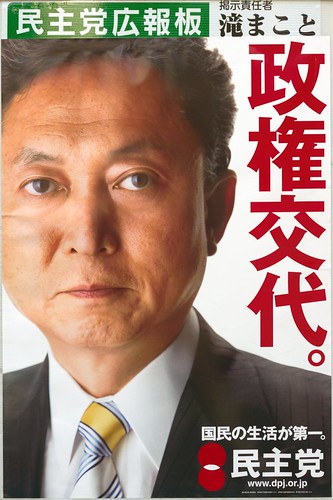
DPJ, Yukio Hatoyama: "We care. We care about you and we're concerned about you. We're concerned and caring. You can see my concern and my care right here, in my eyes. Look into my eyes, and see my concern, and my care, deep in my eyes. Come close and look deep into my eyes. Look deeper, deeeper. You are feeling sleeepyy, so sleeepy. You see nothing but my eyes. You feel relaxed and happy and care only about my eyes. You will vote DPJ on Sunday. You will vote DPJ ..."

New Komeito, Akihiro Ota: "Come Sunday I know you'll vote Komeito, right? 'Cause you care about fairness, right? I got this religious cult, see, full of members that are all zealous-like about fairness, and they get disappointed when we don't get our fair share of votes, see. They're like kids to me, these people, just like my own kids, right, and I get real upset when they get all disappointed. We had dis guy disappointin' us one time, see, and I got so upset I freakin' snapped his neck with dese hands here, dry twig-like, just snapped it clean off, so upset was I, see. So you don't want to be disappointin' us in any way on Sunday, understand?"
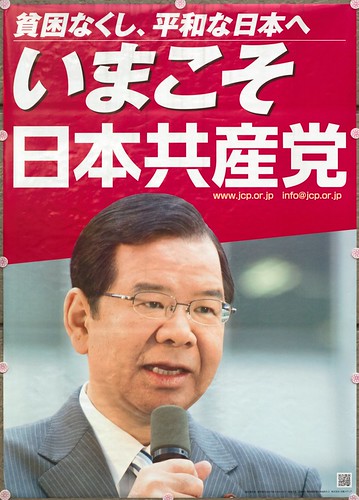
JCP, Kazuo Shii: "Hello, um, is this thing on? Hi, we're the radical party! Um, except, you know, not radically radical, don't worry, heh. We're really reliable and stable, in fact. Um, our platform hasn't changed since before the war, and hasn't touched reality in decades, that's how stable and reliable we are. Um, what? Slogan? Oh, OK. Comrades, listen up! Let Us Boldly March - no, scratch that, sorry, forget I said anything - Let Us Gingerly And After Careful Deliberation Slowly Edge Backwards To A Past Where We Still Were The Future!"
[Edit: It helps if you actually spell people's name right]
--
DPJ, Yukio Hatoyama: "We care. We care about you and we're concerned about you. We're concerned and caring. You can see my concern and my care right here, in my eyes. Look into my eyes, and see my concern, and my care, deep in my eyes. Come close and look deep into my eyes. Look deeper, deeeper. You are feeling sleeepyy, so sleeepy. You see nothing but my eyes. You feel relaxed and happy and care only about my eyes. You will vote DPJ on Sunday. You will vote DPJ ..."
New Komeito, Akihiro Ota: "Come Sunday I know you'll vote Komeito, right? 'Cause you care about fairness, right? I got this religious cult, see, full of members that are all zealous-like about fairness, and they get disappointed when we don't get our fair share of votes, see. They're like kids to me, these people, just like my own kids, right, and I get real upset when they get all disappointed. We had dis guy disappointin' us one time, see, and I got so upset I freakin' snapped his neck with dese hands here, dry twig-like, just snapped it clean off, so upset was I, see. So you don't want to be disappointin' us in any way on Sunday, understand?"
JCP, Kazuo Shii: "Hello, um, is this thing on? Hi, we're the radical party! Um, except, you know, not radically radical, don't worry, heh. We're really reliable and stable, in fact. Um, our platform hasn't changed since before the war, and hasn't touched reality in decades, that's how stable and reliable we are. Um, what? Slogan? Oh, OK. Comrades, listen up! Let Us Boldly March - no, scratch that, sorry, forget I said anything - Let Us Gingerly And After Careful Deliberation Slowly Edge Backwards To A Past Where We Still Were The Future!"

[Edit: It helps if you actually spell people's name right]
--
#1 In two weeks of idle searching I couldn't find a single Aso poster anywhere in town, so I had to get this one from the LDP website.
Saturday, May 16, 2009
Hatoyama is new DPJ leader
According to Mainichi Shinbun, Yukio Hatoyama is elected new DPJ leader, beating the other challenger Okada.
I don't know much about either Okada or Hatoyama so I have no strong opinion on this. I do know that Hatoyama is a hereditary politician while Okada is not. On the other hand, he does have a bouffant hairdo to rival North Korea's Kim Jong Il who managed to grab power and stay leader in his country for many years now; a good omen of sorts for the DPJ perhaps.
[Edit] I'm just saying:

Perhaps they can exchange barbershop tips during top-level meetings. Left from kremlin.ru, second and fourth from DPJ website, third Creative commons.
I don't know much about either Okada or Hatoyama so I have no strong opinion on this. I do know that Hatoyama is a hereditary politician while Okada is not. On the other hand, he does have a bouffant hairdo to rival North Korea's Kim Jong Il who managed to grab power and stay leader in his country for many years now; a good omen of sorts for the DPJ perhaps.
[Edit] I'm just saying:

Perhaps they can exchange barbershop tips during top-level meetings. Left from kremlin.ru, second and fourth from DPJ website, third Creative commons.
Subscribe to:
Posts (Atom)