Our rice cooker broke the other day. The magic smoke has escaped; it's gone, passed away, pushing up the daisies, taken down the sign, wearing a wooden overcoat. Bereft of life, it's gone to meet its maker. It is an ex- ... you get the idea.
When I first came here I was just a little bewildered over the rice cooker. Sure, people eat rice everyday, but why have a separate machine taking up space in the small kitchen just to cook something? I used to eat pasta almost every day (and had the waistline to prove it), but I never felt a need for a pasta cooker or anything.
Pasta or potatoes are simply boiled until done. But rice is rinsed, soaked for half an hour or more, then slow cooked until dry. It's a slower process, where you need to measure rice and water precisely, wait for it to soak, then monitor the cooking pot so it doesn't burn. It's a hassle, it keeps you around the kitchen for almost an hour, and if you forget the pot you'll eat burnt, crunchy rice, and perhaps even get to explain the wailing smoke alarms and the black, smoldering pot on the balcony to the frowning fireman standing at your door.
With a rice cooker you never burn your rice. They run the cooking process without any help. You can fill the cooker with rice and water in the morning, set the timer, go to work, and have soft, fluffy rice waiting when you get home at night. They can keep the finished rice warm and soft for hours and hours, so it doesn't matter if you end up eating much later than you thought. And they're insulated so they're more energy efficient than a stove - and they don't heat up the kitchen in the hot summer.
Our stove has a rice-cooking function that monitors the temperature and turns off the gas when the water runs out in the pot. This works fairly well, actually, and has given us some time to shop around for a new rice cooker. And we've needed it - it's amazing just how many variations there are on this simple theme. From basic rice cookers for a couple thousand yen or so, up to SuperUltraDeluxe models in the nosebleed-inducing 70000-80000 yen range.
They all do much the same thing of course. It's basically an enclosed metal pot with a heater and temperature sensor in the bottom and a tight lid with a pressure valve at the top. Put rice and water in it and press the button. It will let the rice soak, then heat it until it slow boils. When the water is absorbed the temperature starts rising in the bottom, and the cooker cuts the heater temperature until it just keeps the rice warm. The remaining steam in the pot can't escape through the tight lid so it keeps the rice moist and soft.
As you move up in price you get better brands, larger capacity, induction heating (apparently improves on the keeping time and energy use), non-stick and copper pots, better design, steamer function and so on. Seems that paying much more than 15-20k yen won't really get you any better functionality or quality though. We'll see, but we have to get one soon - they're too convenient to go without.

Showing posts with label japan population. Show all posts
Showing posts with label japan population. Show all posts
Wednesday, November 18, 2009

Tuesday, July 28, 2009
Taishō
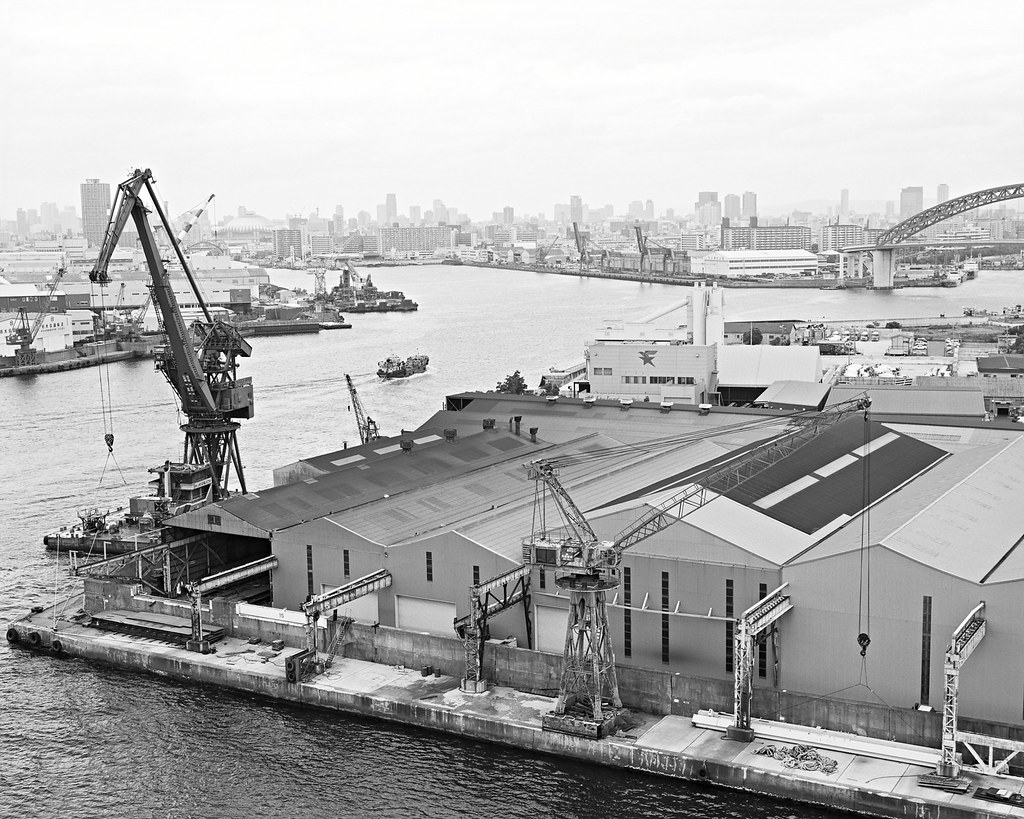
Osaka harbour seen from one of the tall canal bridges.
Taishō is one of the westernmost wards in Osaka city. As it's by the sea, it's part of the Kansai harbour complex. The harbour itself (actually several separate harbours) is absolutely huge; the entire coastline from Sakai in the south, through Osaka and on to Kobe in the northwest is really all harbour, with terminals, piers, wharfs, warehouses, manufacturing plants and supporting businesses.
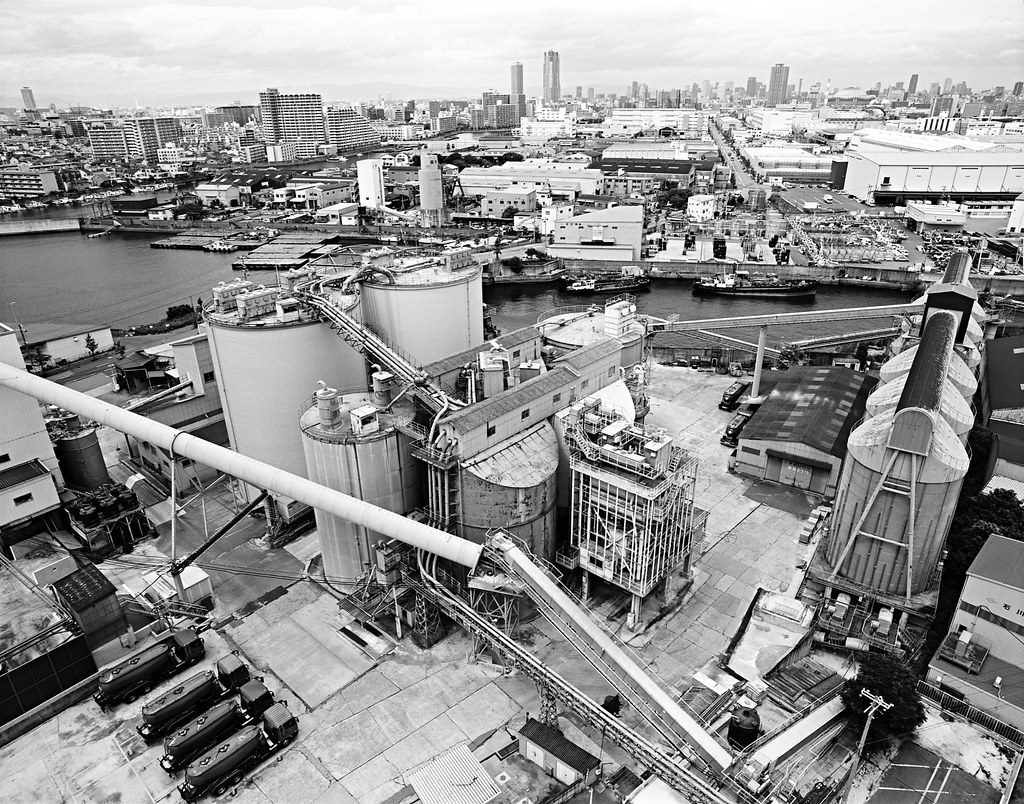
Ishigawa cement factory out in the harbour. I guess the heavy raw materials can be shipped in cheaply by barge. In the far right, the Osaka Dome (actually "Kyocera Dome" nowadays).
This being Japan, it's not a pure industrial area, but thoroughly mixed, with middle-class neighbourhoods rubbing shoulders with city tenement blocks, chemical plants and harbour installations. Many Okinawans that came to Osaka settled in Taishō, and it's still noticeable in the area. It's also notable for being the site of Ikea in Osaka, a decent place for Swedish foods and ingredients, candy and other things you miss when living abroad if you happen to be Swedish.
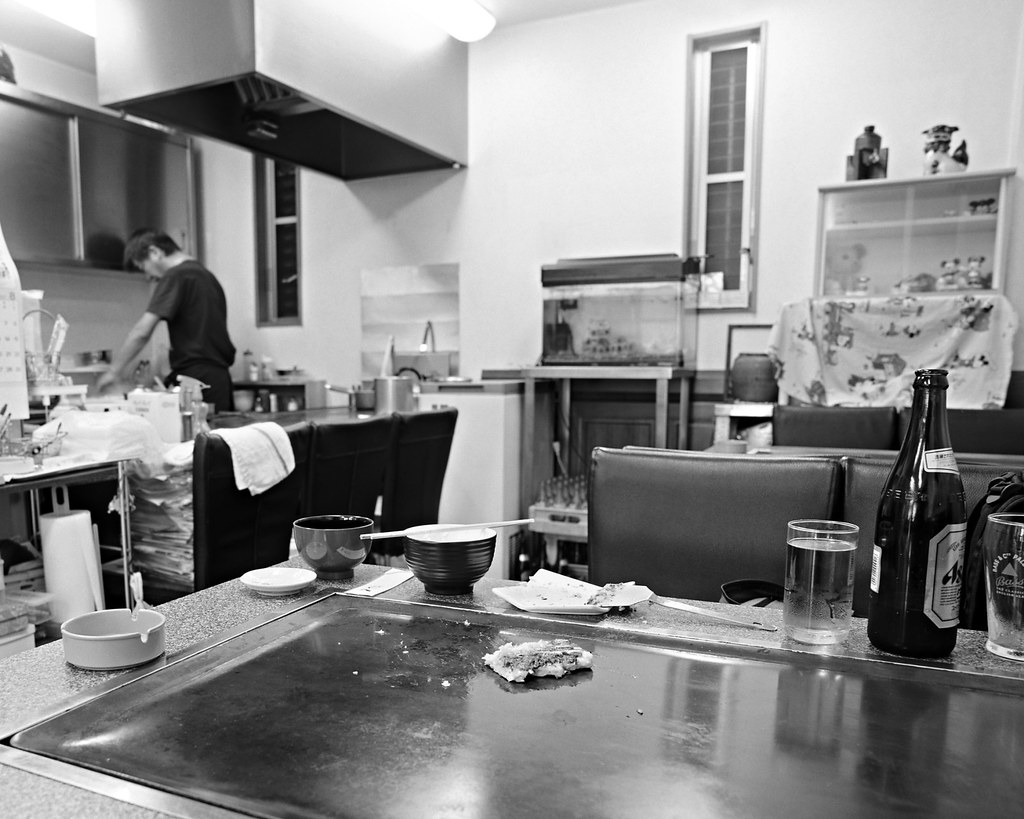
Lunch at an Okonomiyaki place along the main street Taishodori, right where it turns sharply right in the south. I really like the atmosphere in this kind of place, and the food is usually way better than the low price would lead you to believe.
We've passed by the area a few times to visit Ikea. I always felt it'd be fun to come here for sightseeing and perhaps take some pictures. When Ritsuko was in Sweden last week I left for Taishō over a Sunday to explore the place. The weather was not good, unfortunately, with heavy clouds and occasional drifting rain (which save you from getting a sunburn; I'm still flaking as I post this). The weather was not good for photography, and I tended to choose subjects as much for whether I'd get rained on or not as much as anything. Worse, I had just gotten a new wide-angle lens, and I took every chance to use my new toy, even when wildly inappropriate. In short, I got a bunch of images that are grey and lacking in contrast, and with interesting features reduced to mere pinpricks.

Disused crane installation along a pier. A wide-angle shot isn't always wrong.

Meganebashi - "glasses bridge"- is a landmark here. The bridges have to be high to accommodate large ships, but a normal on-ramp takes a lot of space. So here they built two spiral on-ramps and a curved bridgeway in between, making it look like a huge pair of old-fashioned spectacles from above. The space below seems to be used for baseball practice and sports.
Ritsuko pointed out, quite reasonably, that we should go to the harbour area in the fall instead. The weather is much better after all, with high skies and cool air. By then I'll be over the lure of the 45mm and can go back to try for good pictures rather than wide ones. For more pictures I have a Flickr set here.
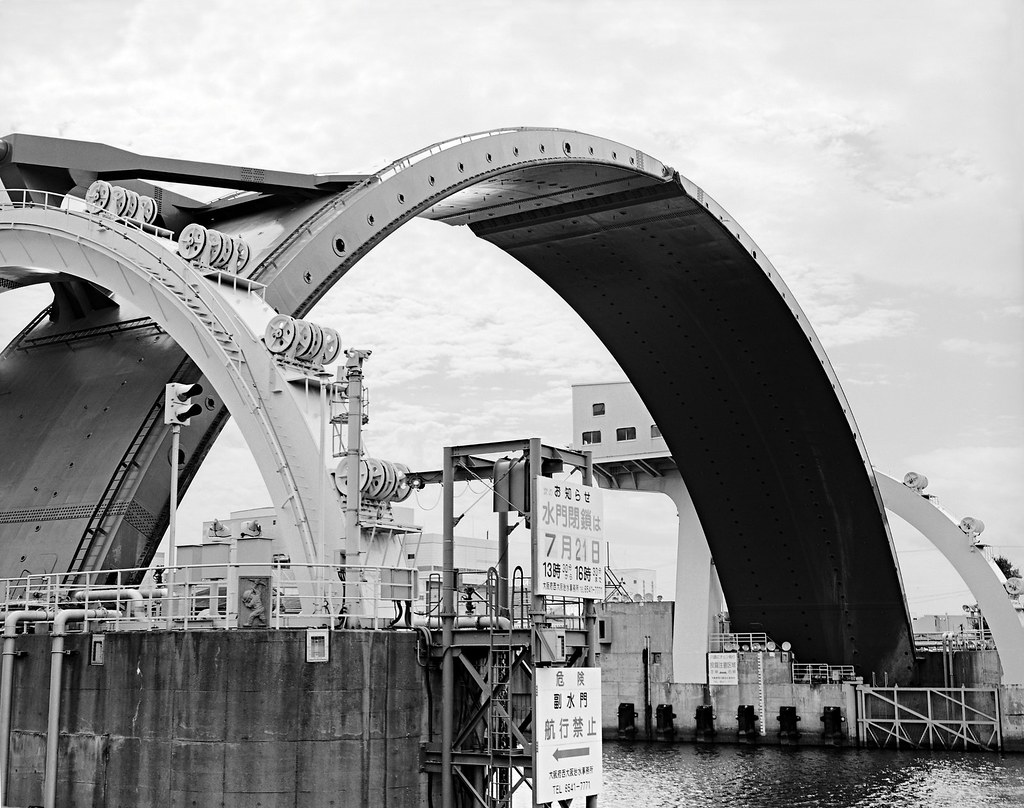
Typhoons and heavy rains are a fact of life here, so the channels leading by the city all have flood gates of various types. This one apparently rotates down toward the right to close it.
Saturday, November 24, 2007
Urbanisation
(this is the last post about population trends in Japan; the introduction is here and the second part, about population decline, is here)
The last trend is urbanisation, and unlike rural depopulation and population decline this has not generated any headlines or introspective newspaper columns. This year is estimated to be the first time in history with the urban population larger than the rural population in the world. In Japan the urban population is now 66% (two out of three people) and slowly increasing. The three largest metropolitan areas - Tokyo, Osaka and Nagoya - has more than 45% or the total population and that ratio is also slowly increasing.
This is actually quite low for an industrialized nation; Europe (including the eastern European states) is 76% urban, and my native Sweden is about 83% urban by comparison - note though that only 25% of Europeans or Swedes live in large metropolitan areas, while almost half of Japanese do. And this increase of urban population, while gradual, is happening not just in Japan but almost everywhere in the world; the only places with no urban increase are those already at near-saturation levels.
This is not hard to understand. "Urban" is, after all, just another name for "Environment completely adapted for human benefit". And it is. Even at the most basic level an urban environment is better for humans than the countryside: it's lit up day and night; there's food and shelter against inclement weather everywhere; there's few to none dangerous organisms; it's very easy to go from place to place; and you have security in numbers that you lack in a remote area.
If we look beyond the most basic benefits, the urban environment offers quick, dense, 24-hour access to essential services like hospitals, police and fire brigades; running water, sewage and electricity; convenient resources like supermarkets, speciality stores, entertainment, communications and public transport; and life and career opportunities in the form of work, schools and universities, banking and speciality services. And while you can rightly protest that the shanty-towns of the developing world offers far less than this full range, keep in mind that the surrounding countryside there is similarly more impoverished and makes even a third-world slum a better option with more opportunities.
But most of all, the urban environment is full of other people, the facilitator of all the other benefits, and something most of us just can't have enough of (no matter how we may protest otherwise). We're wired to like being around people. And as people attract people, it means urbanisation becomes a process that is hard to reverse; you can plug into a dense social network in an urban area, whether for work, hobby or personal use, and once you've done so, moving out and away from those networks can be very painful, even debilitating. It is, I think, somewhat interesting that most of the flow out to rural areas are by older people who've often already lost their most significant network - the work-related one - on retirement, and have perhaps weakened social networks due to time and attrition and so are less socially tied down than younger people.
So what does it mean for rural communities? People recognize the greater opportunities of city life and leave. This goes especially for young people who are more mobile by nature, not being as tied down with family, work, property, mortgages and so on. They leave to find work, or go to university, or because they're sick of the town and want to see the lights of Shibuya. And since urban life and other people is an attractor, they don't come back; instead, they get a job, create a family, set down roots and become permanent inhabitants. In fact, as we saw, the largest centers grow disproportionally; small urban communities are losing people to larger ones, who are losing people to the big metropolitan areas. It's not just a loss of farming villages; small semi-urban communities - small towns - are also losing people. Rural areas are steadily losing people (-3.2 percent during 1995-2000), but within those areas the regional population centers have grown while smaller communities have withered (there's an increase in very small communities but with very low population numbers).

Population of "shi" and "ku" (cities and metropolitan wards) on one hand, and "machi" and "mura" (towns and villages) on the other. Note that this is not exactly urban/rural but it's analogous and shows how small communities have withered in favour of larger ones.
So what will happen? Are all areas outside the major population centers doomed to utter extinction? No. A reasonable guess is that Japan will gradually become more like much of the rest of the industrialized world, with an urban population at 80-90% or thereabouts. Other industrialized countries have mostly ended up in that range, with similarly densely populated, large countries like Great Britain or Germany in the high end.
The lower limit on the rural population is really set by the jobs that really need to be done in those areas. Most work can be done anywhere, and will gravitate to urban centers. But some work - agriculture, forestry and tourism especially - is inherently rural, so they set an overall lower limit to the rural population. That lower limit seems to be around 8-15% if we go by the trends in other countries. Add another five percentage points or so of people that will stay in the countryside despite a lack of work or amenities, or move there after retirement, and you end up in the range of most industrialized countries.
But at that ratio, it is not possible for all current communities to survive. Some areas - whether culturally, culinary or historically significant, extraordinarily beautiful, or very fertile - will of course live on with only some adjustments (more larger communities, few isolated villages) bolstered by tourism, back-to-nature population inflow and production of sought-after local specialities. Some towns have specific resources - mines, power plants - that ensure a viable future for the community. But for every area that makes it, many others will not. And what will happen there depends on agricultural policy more than anything else.
Japan has so far treated agriculture more as a cultural tradition than as an industry. This is not by accident but is a specific policy. The agriculture sector is infused with an unearthly amount of rules, ownership restrictions, quota systems and other regulations, all designed to keep farms and the farming sector the same as it has "always" been - small family-style farms tending traditional crops, rather than large-scale farms bringing up whatever is selling in the market today.
But just as we saw for population growth, there is a large and widening gap between the old ideal encoded in official policy on one hand, and the reality on the other. Japan has a very low rate of self-sufficiency - about 60% - while at the same time having big surpluses of crops like rice. This is no accident. Small-scale farming can't produce everything Japan needs today, and eating habits and taste have naturally changed a lot over the past century, with a monotonous diet based on rice no longer very attractive compared to a varied selection of foods and menus from all over the world. Again, it's not that the status quo has become worse, but that the alternatives are so much more appealing.
And for the prospective ambitious young farmer, too, the reality is different. You can't decide how much to grow since you'll have specific quotas, and you'll have to plow down any excess (this happened this spring with an unusually good daikon harvest); you can't compete on price since minimum prices are set and enforced centrally; and you can't expand your business - the law is putting strict limits on how much land one farmer can own or use. Meanwhile, university education is becoming the norm, not a luxury option for the few, and all the life opportunities in the cities grow ever more varied and appealing.
As far as the "farming as culture" policy, people are voting with their feet. Continuing this policy will indeed prevent large-scale farming - but at the cost of having little farming of any kind in many areas, with fields going fallow for a lack of people willing to use them. What to prefer is of course a political - and ultimately social - decision. But keeping the idealized Meiji-era cultured landscape intact is not on the table no matter how much some people would wish it so; and it is worth noting that the people waxing eloquent over the innate beauty and superiority of that old-style farming landscape never ever seem to be actual farmers living and working there.
Conclusion
So, in short, the traditional countryside is disappearing in many areas. The reason is not population changes but the greater pull of urban life, exacerbated by the heavy-handed regulation of farming and other rural industries - regulation which, as we have seen in the news lately, does nothing at all for the consumer; the price of produce is very high while the quality is uneven and frequently poor, and cheating on the part of the producers seems to be the rule rather than the exception.
The countryside will not disappear altogether, of course. As I wrote above I expect Japan to settle into a similar pattern to other industrial economies, with about 80-90% urban population rather than the 65% of today. There'll be many rural areas running a modern farming system that can create good-quality produce in an effective and environmentally good way (and yes, compared to the older-style farming done now, it really can be a lot better); and there'll be some areas with "extra value" keeping a traditional farming culture as the visitor draw, but with the bulk of income coming from tourism, seasonal inhabitants and high-value speciality products.
I don't believe there will ever be a real system-shift; those just don't seem to happen in this country. Rather, there'll be a series of exemptions and "clarifications" to the farming regulations that will gradually enable something like a modern farming system to form. The first steps - some, though not total, equalization of rural and urban votes - were taken years ago. And there are recent rules in place allowing an elderly farmer to "receive help" from a nearby farmer that can grow rice on the plot, give the rice to the plot owner, and get paid in rice in turn. The next, natural step would be for absent "farmers" in Tokyo or Osaka to get help with their inherited lands in the same way, while perhaps keeping the house as a summer home. I expect modern farming to grow out of a patchwork of regulatory exemptions like this.
The last trend is urbanisation, and unlike rural depopulation and population decline this has not generated any headlines or introspective newspaper columns. This year is estimated to be the first time in history with the urban population larger than the rural population in the world. In Japan the urban population is now 66% (two out of three people) and slowly increasing. The three largest metropolitan areas - Tokyo, Osaka and Nagoya - has more than 45% or the total population and that ratio is also slowly increasing.
This is actually quite low for an industrialized nation; Europe (including the eastern European states) is 76% urban, and my native Sweden is about 83% urban by comparison - note though that only 25% of Europeans or Swedes live in large metropolitan areas, while almost half of Japanese do. And this increase of urban population, while gradual, is happening not just in Japan but almost everywhere in the world; the only places with no urban increase are those already at near-saturation levels.
This is not hard to understand. "Urban" is, after all, just another name for "Environment completely adapted for human benefit". And it is. Even at the most basic level an urban environment is better for humans than the countryside: it's lit up day and night; there's food and shelter against inclement weather everywhere; there's few to none dangerous organisms; it's very easy to go from place to place; and you have security in numbers that you lack in a remote area.
If we look beyond the most basic benefits, the urban environment offers quick, dense, 24-hour access to essential services like hospitals, police and fire brigades; running water, sewage and electricity; convenient resources like supermarkets, speciality stores, entertainment, communications and public transport; and life and career opportunities in the form of work, schools and universities, banking and speciality services. And while you can rightly protest that the shanty-towns of the developing world offers far less than this full range, keep in mind that the surrounding countryside there is similarly more impoverished and makes even a third-world slum a better option with more opportunities.
But most of all, the urban environment is full of other people, the facilitator of all the other benefits, and something most of us just can't have enough of (no matter how we may protest otherwise). We're wired to like being around people. And as people attract people, it means urbanisation becomes a process that is hard to reverse; you can plug into a dense social network in an urban area, whether for work, hobby or personal use, and once you've done so, moving out and away from those networks can be very painful, even debilitating. It is, I think, somewhat interesting that most of the flow out to rural areas are by older people who've often already lost their most significant network - the work-related one - on retirement, and have perhaps weakened social networks due to time and attrition and so are less socially tied down than younger people.
So what does it mean for rural communities? People recognize the greater opportunities of city life and leave. This goes especially for young people who are more mobile by nature, not being as tied down with family, work, property, mortgages and so on. They leave to find work, or go to university, or because they're sick of the town and want to see the lights of Shibuya. And since urban life and other people is an attractor, they don't come back; instead, they get a job, create a family, set down roots and become permanent inhabitants. In fact, as we saw, the largest centers grow disproportionally; small urban communities are losing people to larger ones, who are losing people to the big metropolitan areas. It's not just a loss of farming villages; small semi-urban communities - small towns - are also losing people. Rural areas are steadily losing people (-3.2 percent during 1995-2000), but within those areas the regional population centers have grown while smaller communities have withered (there's an increase in very small communities but with very low population numbers).
Population of "shi" and "ku" (cities and metropolitan wards) on one hand, and "machi" and "mura" (towns and villages) on the other. Note that this is not exactly urban/rural but it's analogous and shows how small communities have withered in favour of larger ones.
So what will happen? Are all areas outside the major population centers doomed to utter extinction? No. A reasonable guess is that Japan will gradually become more like much of the rest of the industrialized world, with an urban population at 80-90% or thereabouts. Other industrialized countries have mostly ended up in that range, with similarly densely populated, large countries like Great Britain or Germany in the high end.
The lower limit on the rural population is really set by the jobs that really need to be done in those areas. Most work can be done anywhere, and will gravitate to urban centers. But some work - agriculture, forestry and tourism especially - is inherently rural, so they set an overall lower limit to the rural population. That lower limit seems to be around 8-15% if we go by the trends in other countries. Add another five percentage points or so of people that will stay in the countryside despite a lack of work or amenities, or move there after retirement, and you end up in the range of most industrialized countries.
But at that ratio, it is not possible for all current communities to survive. Some areas - whether culturally, culinary or historically significant, extraordinarily beautiful, or very fertile - will of course live on with only some adjustments (more larger communities, few isolated villages) bolstered by tourism, back-to-nature population inflow and production of sought-after local specialities. Some towns have specific resources - mines, power plants - that ensure a viable future for the community. But for every area that makes it, many others will not. And what will happen there depends on agricultural policy more than anything else.
Japan has so far treated agriculture more as a cultural tradition than as an industry. This is not by accident but is a specific policy. The agriculture sector is infused with an unearthly amount of rules, ownership restrictions, quota systems and other regulations, all designed to keep farms and the farming sector the same as it has "always" been - small family-style farms tending traditional crops, rather than large-scale farms bringing up whatever is selling in the market today.
But just as we saw for population growth, there is a large and widening gap between the old ideal encoded in official policy on one hand, and the reality on the other. Japan has a very low rate of self-sufficiency - about 60% - while at the same time having big surpluses of crops like rice. This is no accident. Small-scale farming can't produce everything Japan needs today, and eating habits and taste have naturally changed a lot over the past century, with a monotonous diet based on rice no longer very attractive compared to a varied selection of foods and menus from all over the world. Again, it's not that the status quo has become worse, but that the alternatives are so much more appealing.
And for the prospective ambitious young farmer, too, the reality is different. You can't decide how much to grow since you'll have specific quotas, and you'll have to plow down any excess (this happened this spring with an unusually good daikon harvest); you can't compete on price since minimum prices are set and enforced centrally; and you can't expand your business - the law is putting strict limits on how much land one farmer can own or use. Meanwhile, university education is becoming the norm, not a luxury option for the few, and all the life opportunities in the cities grow ever more varied and appealing.
As far as the "farming as culture" policy, people are voting with their feet. Continuing this policy will indeed prevent large-scale farming - but at the cost of having little farming of any kind in many areas, with fields going fallow for a lack of people willing to use them. What to prefer is of course a political - and ultimately social - decision. But keeping the idealized Meiji-era cultured landscape intact is not on the table no matter how much some people would wish it so; and it is worth noting that the people waxing eloquent over the innate beauty and superiority of that old-style farming landscape never ever seem to be actual farmers living and working there.
Conclusion
So, in short, the traditional countryside is disappearing in many areas. The reason is not population changes but the greater pull of urban life, exacerbated by the heavy-handed regulation of farming and other rural industries - regulation which, as we have seen in the news lately, does nothing at all for the consumer; the price of produce is very high while the quality is uneven and frequently poor, and cheating on the part of the producers seems to be the rule rather than the exception.
The countryside will not disappear altogether, of course. As I wrote above I expect Japan to settle into a similar pattern to other industrial economies, with about 80-90% urban population rather than the 65% of today. There'll be many rural areas running a modern farming system that can create good-quality produce in an effective and environmentally good way (and yes, compared to the older-style farming done now, it really can be a lot better); and there'll be some areas with "extra value" keeping a traditional farming culture as the visitor draw, but with the bulk of income coming from tourism, seasonal inhabitants and high-value speciality products.
I don't believe there will ever be a real system-shift; those just don't seem to happen in this country. Rather, there'll be a series of exemptions and "clarifications" to the farming regulations that will gradually enable something like a modern farming system to form. The first steps - some, though not total, equalization of rural and urban votes - were taken years ago. And there are recent rules in place allowing an elderly farmer to "receive help" from a nearby farmer that can grow rice on the plot, give the rice to the plot owner, and get paid in rice in turn. The next, natural step would be for absent "farmers" in Tokyo or Osaka to get help with their inherited lands in the same way, while perhaps keeping the house as a summer home. I expect modern farming to grow out of a patchwork of regulatory exemptions like this.
Subscribe to:
Posts (Atom)