Saturday, November 16, 2013

It's a Wash


Small pieces of structural plastic have been showing up in the washing machine filter lately. And now it's started to make expensive-sounding noises when it runs.

It's already eight years old, and will need to be replaced rather than repaired. I guess it's time to spend some quality time in the serene quiet and zen-like stillness of the Yodobashi Camera appliance department. And some quality money.

It's interesting, by the way, how I've just taken a thing like this for granted. We're able to wash our clothes at any time, from dirty to clean in an hour, without effort, and never even thought about it. But now that we can't rely on this working, it feels like a small part of our safety net is yanked away from under our feet. Our effortless life style is really composed of many, many puzzle pieces like that washing machine; ignored and invisible, but a lot more complicated and fragile than we think. It's good to be reminded of that from time to time.

Splash!
Summer day in Suma, east of Kobe. A reminder of a happier time. A time of warmth and sun and joy. A time when the washing machine still worked. OK, I'll stop complaining now.

Thursday, November 7, 2013

Ten Years


On the 7th of November 2003 — ten years ago today — I arrived at Narita, bag in hand, for a one-year research project at a lab in south Kyoto. The idea was to do a small project, return to Sweden, then look for work. Things did not turn out according to plan.

To the left we're at a restaurant in Kobe in the summer of 2004. To the right we're having coffee in Hanoi in autumn 2013. Both pictures by Ritsuko.

A lot of things can change in ten years. When I came here I was 34 years old, single and staying in a one-room short-term rental unit out in nowhere. Now I'm 44, married to Ritsuko, and we're living in a spacious apartment in central Osaka.

I came to Japan holding a six-month Cultural Activities visa — the researcher visa application was late, so the embassy in Stockholm issued this to let me leave for Japan in time. Of course, calling robotics research "cultural activities" was probably stretching the rules well past their breaking point. Now I have a permanent residency permit that doesn't expire and lets me do almost any work I'd like.

At 34 I weighed about 90kg, had a dark beard and a receding hairline. Now I weigh 68kg, the beard is turning white, and my hairline is nowhere to be seen.

When I stepped off the plane at Narita in 2003, I didn't know more than a few words of Japanese. Today I can read newspapers and novels with some effort, and I can make myself understood in most situations.

My first job here was a project-based post-doc on a yearly contract. Ten years on, my current job is ...well, a project-based post-doc on a yearly contract. So not everything changes, I guess.


The next ten years? You never know of course — I wouldn't have guessed at my current life ten years ago — but I think we'll still live in Osaka. I'll be 54, probably white-haired, and hopefully nearly fluent in Japanese. What I'll work with is anybody's guess, but I'm getting too old for post-docs and I don't have the language skills for teaching. Whatever I do, though, I'm probably enjoying it. Time will tell.


Monday, November 4, 2013

Hanoi


Summer vacation, and we spent almost a week in Hanoi. It's not the first time in Vietnam, as we went to Ho-Chi-Minh city almost six years ago, but it's the first time in Hanoi. We've been to Kuala Lumpur and we spent new Year in Bangkok last winter, but Vietnam feels distinctly different from other Asian countries we've visited. It's more mentally tiring than any other place I've been, but perhaps also more rewarding.

Old Town
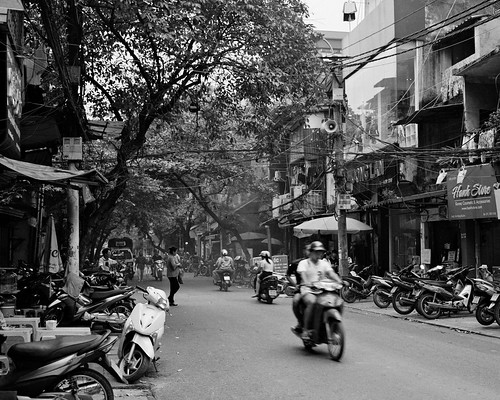
The Old Quarter. For whatever reason, Hanoi works much better with black and white shots than Bangkok did. The light is more subdued and colours a bit more muted.

We stayed in the Old Quarter, where the original narrow street layout is retained and most buildings are, if not old, then at least very much looking the part. The area merchants are mostly organized by street, so you'd find hardware stores lining up along one street, a cluster of cafes on another, and kitchen supplies spilling out on the sidewalk on a third. There's plenty of tourists around — the south end near the Hoan Kiem lake is a bit of a tourist trap — but it still feels very much like a living, breathing part of the city.

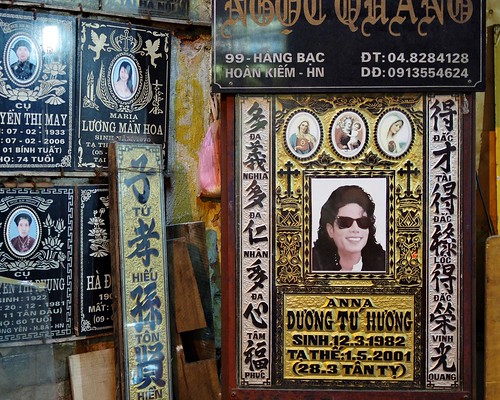
Funeral Plaques
Funeral plaques along the funeral street. I suspect these are samples, not actual customers. This, by the way, is the only place I saw kanji still in use, and even here each character is annotated with the Vietnamese pronunciation.

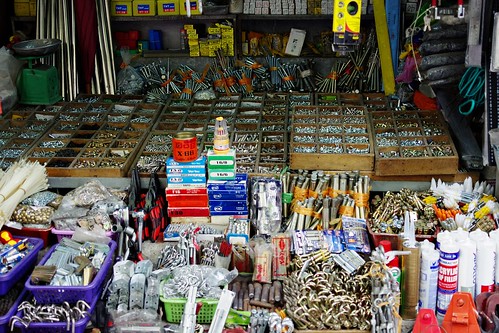
Hardware store
Hardware store, along the hardware store street. Half the merchandize spills out onto the sidewalk. I did get a couple of steel brushes and a ruler.

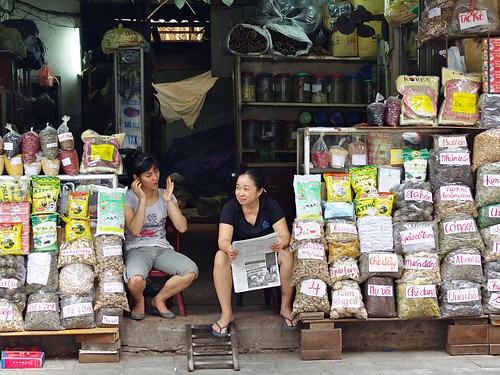
Kampo
Kanpo — herbal medicines — in the Old Quarter.


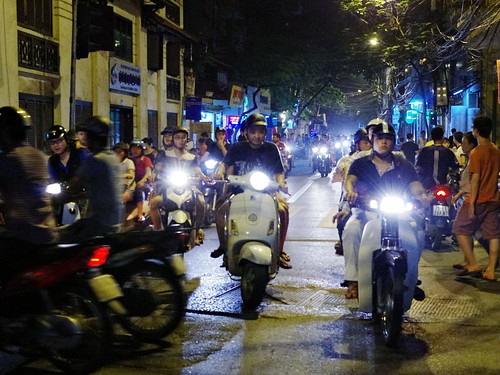
The traffic is the same chaotic mess we remember from Ho-Chi-Minh City, where nobody cares much for traffic rules and nobody stops for anybody else; though in a nod to basic self-preservation people mostly do stop for red lights in large intersections. Mostly. You cross a street by stepping right out in traffic and calmly — and predictably — walk across while bikes and cars zip by close enough to touch.

Traffic
Crossing the street — slowly, carefully, and unsafely.

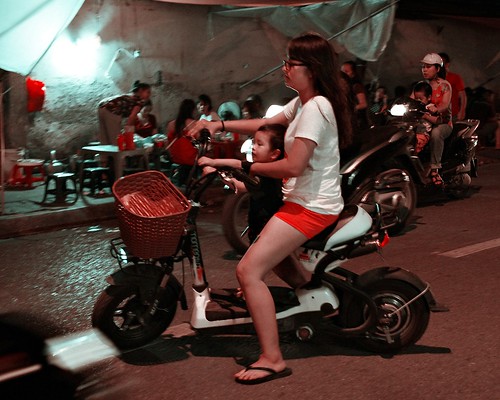
Many people drive small bikes, though there's a fair number of cars too. There's only a few bicycles, and I can't blame anyone for not risking life and limb in this environment. The bikes are mostly new or well maintained, and there's some electric bikes around as well. While they're somewhat rare (one bike in 20 or 40 perhaps) they're often driven by younger, trendier-looking female drivers. Helmets are common but far from ubiquitous.

Electric Bike
A young woman and a child on an electric bike. Sadly, being trendy seems to mean not using a helmet.

The traffic does work, in the sense that there's no gridlock and you do get around. But a quick check on Wikipedia shows that Vietnam has a fatality rate of 24.4 people per 100 000, almost five times that of Japan. Hard to say if it's the large number of bikes (much more likely to be in an accident) or the lack of rules, but in any case driving here is something to avoid if you can.

Not Enjoying It
Hanoi weather is unpredictable and wet. People know this and are well prepared. But being prepared is not the same thing as enjoying it.

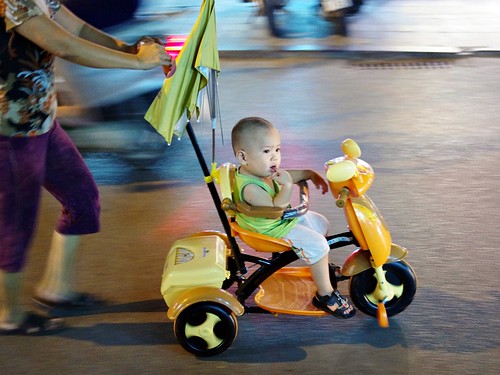
Early Training
Early training for a future bike life.


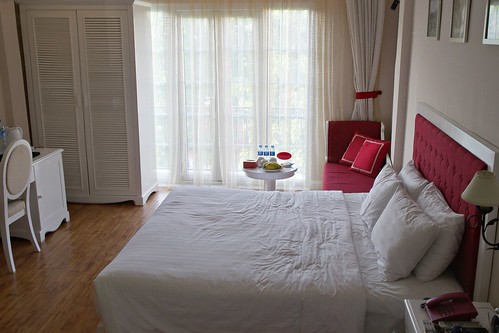
Calypso Grabd Hotel is a boutique hotel, just six stories high with about three rooms per floor. The rooms are spacious and airy, and seem to have been renovated fairly recently. The room facilities, faucets and so on are clearly chosen for their design as much as their utility — we actually had to ask the front desk for help a couple of times when we failed to figure out how things worked on our own. The service was friendly and professional the whole time we spent there.

Calypso Hotel
Our room at the Calypso hotel. Good place to stay.

Wifi access quality was a bit hit and miss, but it was tolerable. The breakfast is really good; you have a small buffet of bread, fruits and so on, and you can order any number of light meals from pho to BLT sandwiches. I'm partial to soups in the morning but rarely get the chance, so a bowl of pho was pretty much a perfect way to start the day for me.


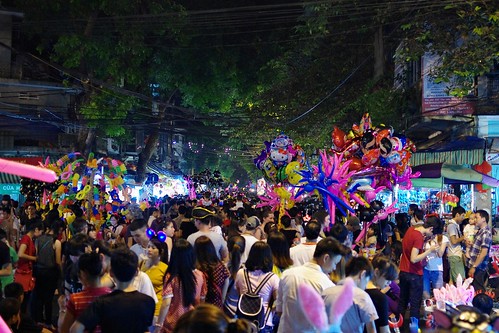
We came right on the day of the Mid-autumn festival, a yearly childrens festival. Hordes of people, many of them kids, thronged all over the area. The chaos and noise didn't exactly help with the initial culture shock.

Autumn festival
The autumn festival brings out an insane amount of people onto the narrow streets. The weather is unpredictable; when a sudden rainstorm appeared, everybody cleared out and escaped to the sidewalks within seconds. The rain stopped a few minutes later, and the crowds poured right back out on to the streets again. People are used to the weather here, I guess.

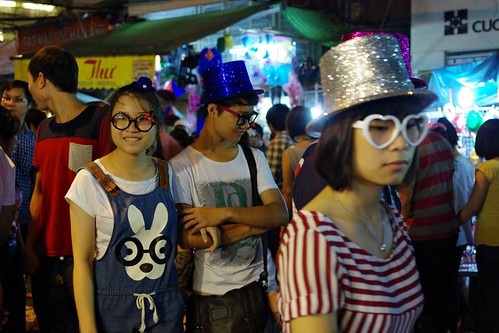
Glasses!
Glasses! Older kids dressed up and showing off.

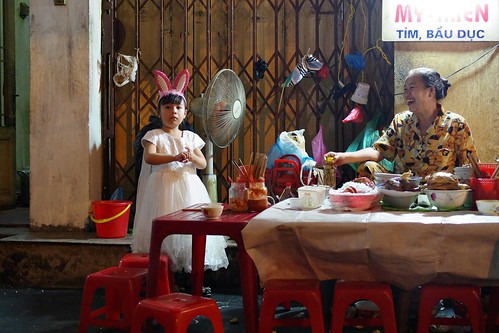
Princess Rabbit
A small girl with rabbit ears and her grandma.


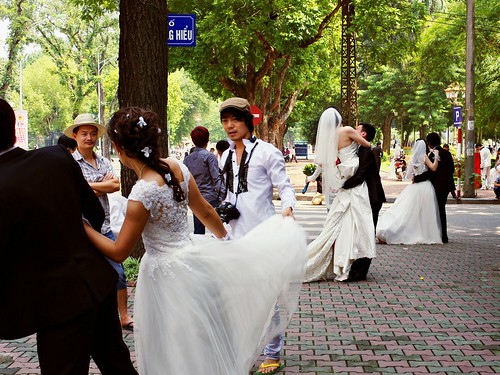
This must the time of year for weddings — or perhaps it's the festival weekend — but around the Opera house, Hilton hotel and Hoan Kiem lake there were a lot of wedding photographers and couples in wedding dress out on photo shoots. And when I say "a lot" I mean that we must have seen more than a hundred couples in the span of a few hours.

Photoshoots
The wedding couples here — along with the multiple couples in the background — are taking wedding pictures in front of the Hilton hotel. And no, they did not seem to be part of the same group or anything like that.


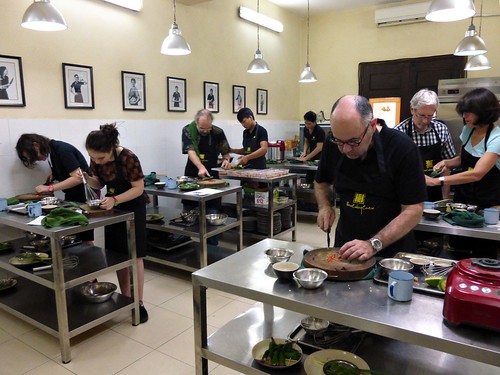
The single greatest event for us was a half-day cooking class at Hanoi Cooking Centre. It's a school and cafe north of Old Town, with a range of classes and events; we took the "food from the coast" class.

Cooking Class
The classroom. Your humble correspondent is cutting chilies in the background. Picture by Ritsuko.

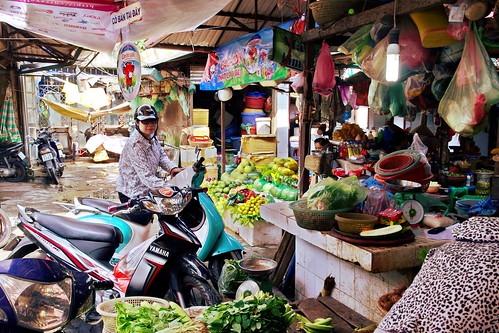
We were seven students in all - a couple from the US; a photographer and his twin daughters from New Zealand; and me and Ritsuko from Japan. The teacher first took us to the nearby market where he introduced the ingredients common in Vietnamese cooking; after asking if anyone would like to try it, he also got a duck egg with a chick inside and some live grubs for us to taste later.

Food Market
The local market.

Everything But The Squeal
Everything is on sale in the market, from the snout to the tail.


The class was hands-on (not always the case elsewhere, apparently, so check beforehand), where the teacher first demonstrated how to do a part of the dish, giving us useful pointers along the way, then we tried it ourselves at our tables. We cooked for four hours, but it felt like no more than an hour or so. Time really flies when you're having fun.

We made four dishes in total: prawn, pork and rice rolls, clams steamed in beer, squid cakes and a crab and pomelo salad. The prawn was great — we've made it twice at home since — and the squid cakes and pomelo salad are also really good. The steamed clams need something to offset the tartness of the beer, though.

Shrimp, Pork and Green Rice rolls
Port and rice rolls frying on the stove.

Meanwhile the teacher prepared the duck egg and the live grubs. The grubs were straightforward: quickly fried in a hot skillet, then flambéd before serving with a glass of beer. A nice soft and spicy snack.

I was rather more nervous about the duck egg. It was boiled for 20 minutes — it's a meat dish, so it needs the time — then peeled. I needn't have worried. The chick is still very immature and hasn't even developed bones yet, so it's pretty much unrecognizable; it's just a bite-sized chunk of duck meat. And slow-cooked in its own juices for twenty minutes it becomes very juicy, tender and flavourful — delicious, in fact. It's popular as a late-night street snack, and no wonder. If I get the chance I will certainly have this again.


Food is a central theme for us when we travel. We choose our destinations based on the cuisine (if you've seen one historical site you've seen them all), and our planning revolves around what, where, and when to eat. And Vietnam has an abundance of foods.

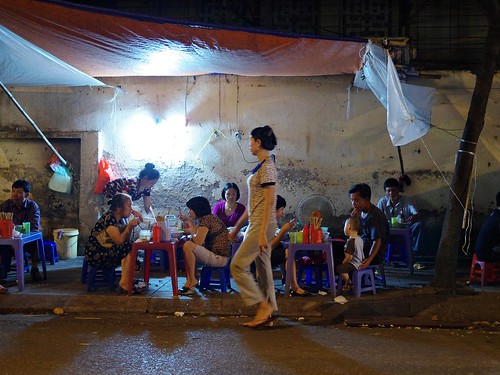
Eatery
People have dinner at a street-side food stall. The small plastic chairs are used everywhere.

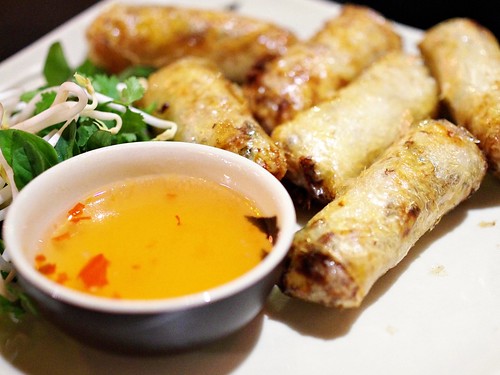
Fried spring rolls
Fried spring rolls at "Highway 4", a mid-tier Vietnamese restaurant. Pretty good place.

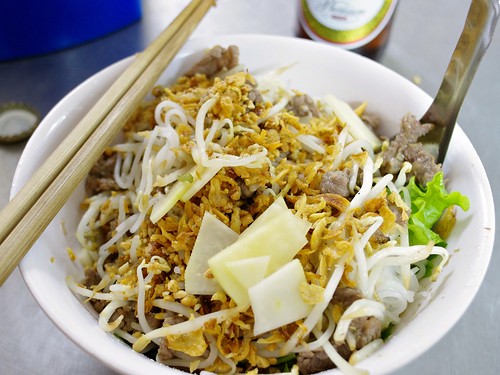
Bun Bo
Bun Bo — rice noodles with beef and lots of vegetables — at a street-side restaurant. Possibly my favourite meal of the trip.

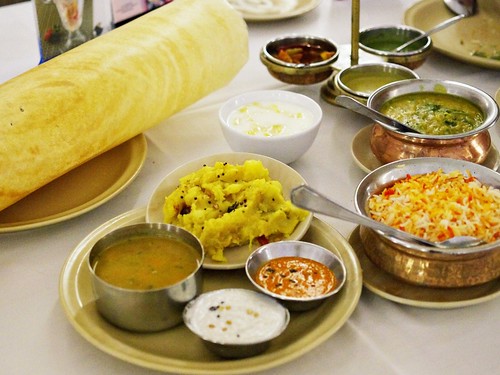
Indian
Lunch at an Indian restaurant. Dosa, curry and rice. There's a fair amount of good international restaurants around if you want a break from the Vietnamese for a day. Also, we try to have Indian anywhere we go, just for comparison.


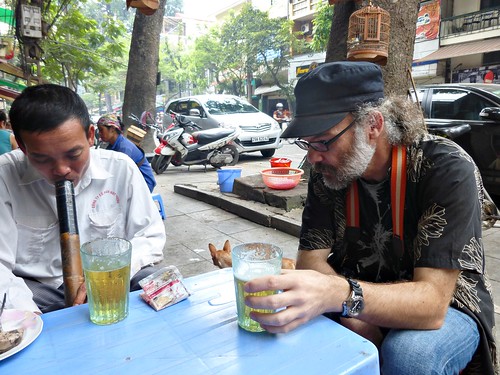
Bia Hoi is known as the cheapest beer in the world, at about 4-5000 dong or 25 yen per glass. It's brewed literally overnight, shipped out in steel barrels in the morning and any left-overs are thrown away by closing time since it doesn't keep. It's mostly served at street-side cafes, not in "real" bars or restaurants. To my surprise it's not just cheap, it's quite good. It has a very fresh, raw kind of grassy flavour that's really refreshing. If you could find a way to store that flavour in a regular beer I bet it would sell well.

Bia Hoi
Your humble correspondent enjoys a mid-afternoon glass of Bia Hoi.


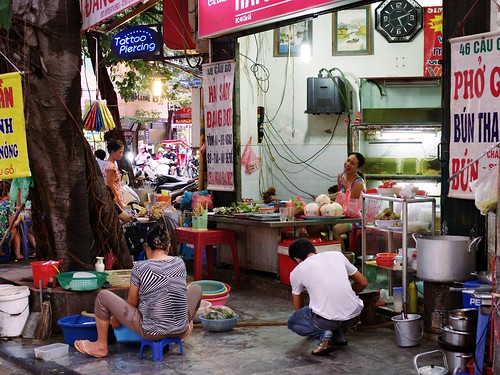
A lot of life in the Old Quarter happens right on the street. Restaurants, cafes and shops spill out onto the sidewalks, along with parking, storage and displays. People use the smaller streets to ply a trade, play games, having a party or just relax with their neighbours, even as a steady stream of bikes weave right among them. Alleyways are effectively people's back yards.

Pho Restaurant
A typical street-side pho restaurant. Half-indoors, but spilling out onto the street.

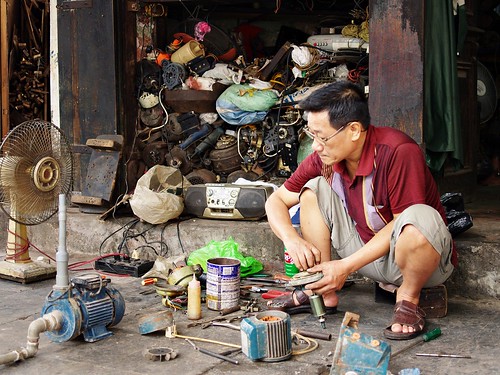
Fan Repairs
Air fan repair business. He's got the tools and stock inside, but works outside on the sidewalk. In part because of lack of space, in part to socialize with other shop owners, but it probably also helps promote the business; people can just stop and ask about repairs without even having to enter the store.

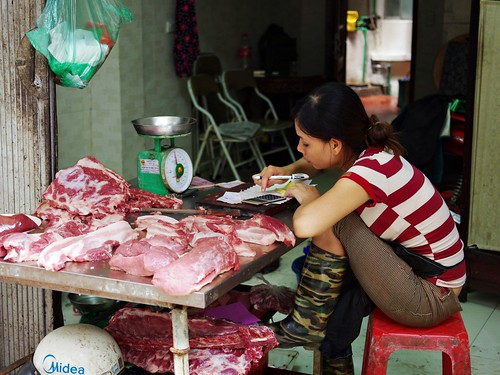
Butcher
Alleyway butcher.

Xiangqi
An evening game of Xiangqi — Chinese-style chess — on the sidewalk. It seems a lot of regular life happens out in public rather than indoors. I'm curious if that's the case in winter as well, though.

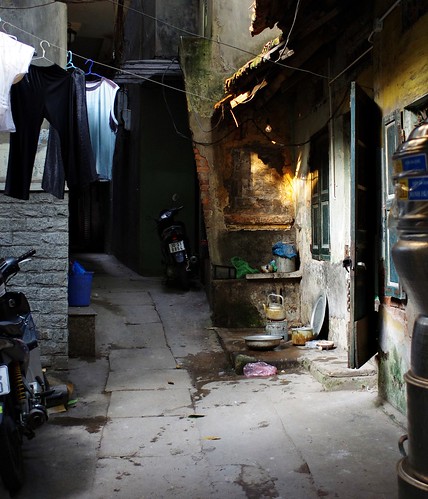
Back Street Tea
An alleyway used as kitchen, parking space, laundry and storage.


Hoan Kiem is a lake south of the Old Quarter, surrounded by a large park. It's a great relief to take a walk around the lake after fighting through the narrow streets of Old Quarter or the busy thoroughfares of the modern city. You're not the only one with that idea of course, so it's not exactly quiet, but it's still relaxing, especially at night.

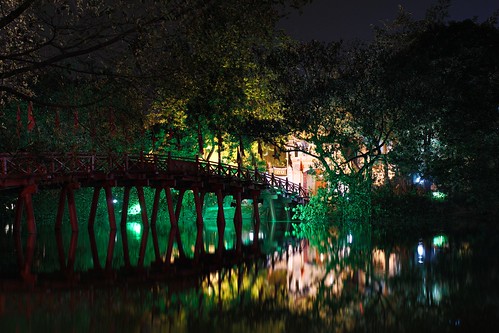
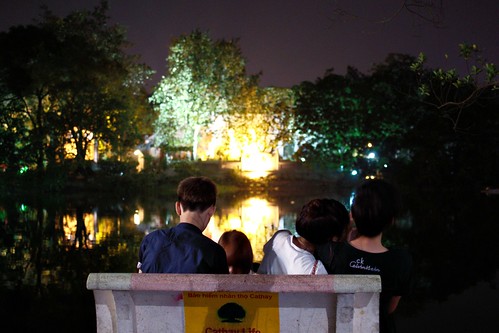
Hoan Kiem
There's a temple on a tiny island in the lake, connected with a red wooden bridge. This has got to be one of the most photographed spots in the city.

Tea Break
Near the south end is a cafe and people selling tea by the glass. It's a good spot for a break.

Hoan Kiem
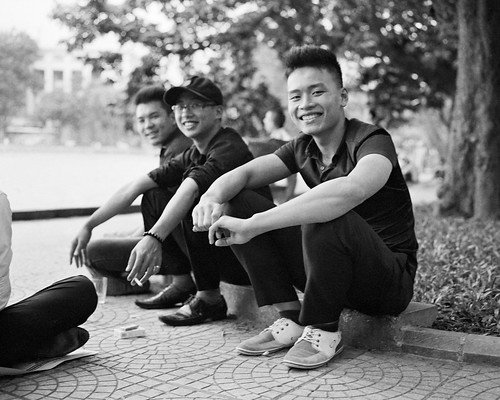
The north end is very busy — and rather touristy — and many young people hang out around the shore.


The modern parts of the city are more orderly than the Old Quarter, but there's still the same sense of private and public spaces intermingling in a way that feels very foreign — in a good way — to someone from Japan or Sweden. I hope this attitude doesn't disappear, and perhaps even spreads a little to other societies.

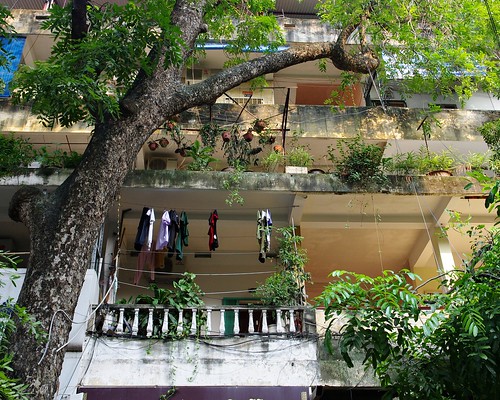
Shady
A huge tree shades an apartment block. Very soothing. There's a lot of greenery throughout Hanoi, much more than in Osaka, and it contributes to the calm, airy atmosphere despite the busy, noisy streets.

How to be a Sexier men
I'm happy to say Japan has no monopoly on interesting English.


No place has left such a strong impression on me as Hanoi. The sounds, the smells, the light is all very different from anywhere else I've been, and I'm still reminded by it more than a month after we came back. We will visit Vietnam again, and soon. The whole set of Vietnam images is available here.

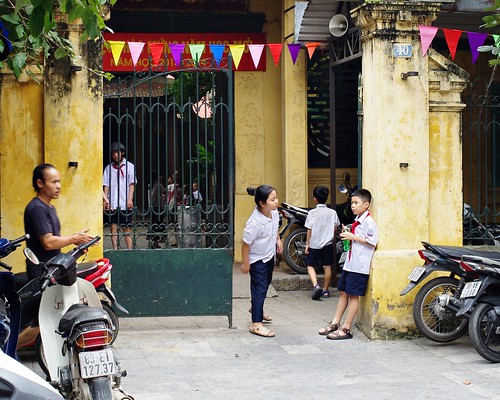
School Gates
Elementary school.

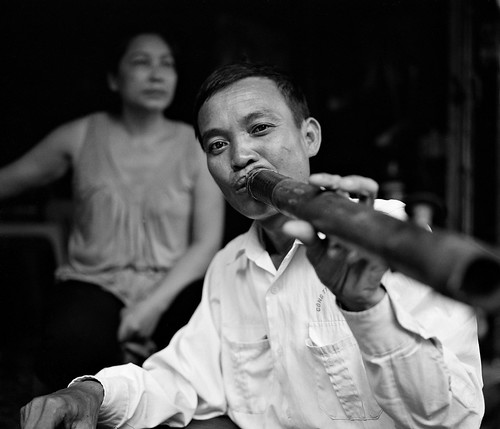
Smoker
A pipe smoker in the Old Quarter.

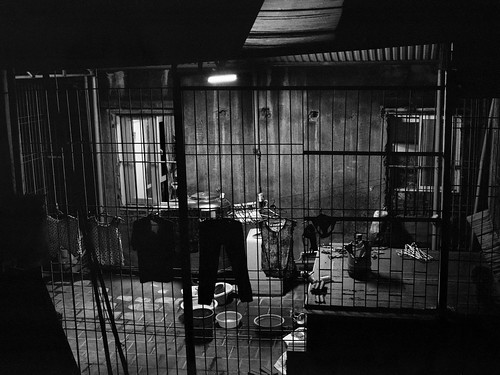
Back Porch
Back Porch.


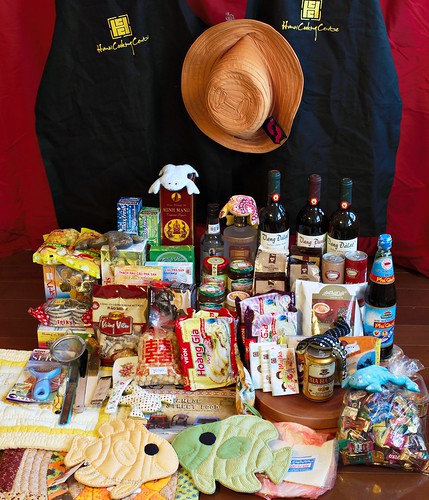
Frogs!
Vietnam Airlines allow up to 40kg even for economy passengers. So we brought a few things back. The aprons are from the cooking school and really good quality; made by a Swedish company that makes protective clothing. We got various coffee beans, noodles, wine, jam, cookies, sweets, cutting boards, cookbooks, pillow cases and lots of other things. Including some cute cloth frogs — they're all clearly visible in this picture but not easy to find. Have a go at counting them if you like.



Wednesday, October 30, 2013

The Pupillary Light Reflex and Your Attention


Here's a quick note of a couple of interesting papers: Attention to Bright Surfaces Enhances the Pupillary Light Reflex   (Journal of Neuroscience — paywalled) and The Pupillary Light Response Reveals the Focus of Covert Visual Attention (PLoS One, Open Access)

The pupillary light response is the reflex that contracts the pupil in bright light to let less light in, and relaxes (opens) it in darkness. It's exactly like the aperture on a camera, and one of the ways we adapt our eyes to very different light levels. Just like a camera aperture, by the way, the pupil size also changes the depth of field. That's one reason it's much harder to read in dim light than in bright light when you are middle aged and have presbyopia.

The thing about the light response is that it's completely automatic. A circuit senses the amount of light coming in, and if it's way bright it contracts the pupil a bit; if it's really dark it relaxes it. Separately, the pupils can also actively dilate when you get excited; you see something (or someone...) that really interests you, the pupils will react along with your blood pressure, sweat glands and so on. But that's independent of the light level.


What these papers show is that the light level-adaptation is not quite as independent and automatic as we thought. The amount of dilation depends not just on the overall light level, or the light at the point of focus, or even the amount of light we believe is coming in (rather than the amount that is actually coming in), but also on the brightness of the area you're mentally attending to.

Let's say you keep your eyes fixed on one spot. But your attention wanders across the scene. If you attend a bright area — a shining lamp, say — then your pupils will contract a bit, even though the amount of light coming in the eyes doesn't change. And if you then attend to a spot in deep shadow, the pupils will relax to let more light in.

This makes sense of course. You want the spot you're attending to to be clearly visible; not too bright and not too dark. So the pupils should adapt to that area specifically, not just to the whole scene on average.


The first paper shows that the response is stronger with larger differences in luminance. So attending to a a brighter target will constrict the pupil more. Darker targets did not dilate more, though, and it's not clear to me why.

The second paper uses a cueing experiment to show that the amount of constriction is connected to the reaction speed when the cue appears. This probably implies that the constriction also shows how strongly you're attending to the target, as well as the target brightness itself.

In other words, our pupils react to what we're actually attending to; and to how strongly we attend to it.


This is interesting all by itself, but as the second paper points out, this could potentially be useful for tracking covert attention, along with the overt attention we get with eye trackers. A whole generation of experimental psychology theses are waiting to be written using this!

Tuesday, October 15, 2013

Rodinal


Mostly done with the Hanoi pictures. Not finished writing, though.

Meanwhile, I tried Rodinal for the first time this week. Rodinal is a developer for black and white film, it's been around for over a century and is probably the oldest developer still available. It's now called "R09" for the Agfa version and "Adox Adonal" for the Adox version, though they're chemically the same. And it's still a very popular developer for good reasons.

It's inexpensive and very long lasting; you use it mixed 1:25, 1:50 or 1:100, and an opened bottle will be fine for years and years without going bad. And unlike most other developers you can easily mix up just the amount you need, right before you use it. Very practical.

In Japan you can get it (not very cheaply) from graltd.com; the postage is expensive, so you might want to order a larger batch and perhaps split the order with somebody1. But that one bottle will develop about 50 rolls of MF film, which is years worth of photography for me even if I used nothing else.

The developer will give you contrasty, sharp-looking negatives, but will also give you large, sharp grain and lose detail in the shadows. So it's best with slow small-grain films, or with large film formats with proportionally smaller grain. And you should probably overexpose a bit to give you some detail in deep shadows. Unless, of course, you want that grungy look.

I thought I'd try Rodinal on the film I shot in Hanoi, but quickly realized that was not a good idea. Better try a new developer with a test roll I don't much care about. So I brought my Pentax 67 on our weekend walk last week, then developed and scanned the roll this weekend.

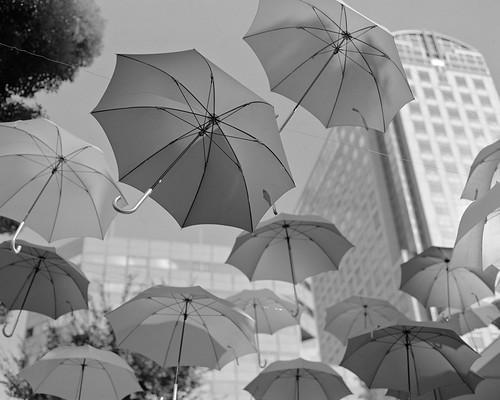
I took a 120-format roll of Ilford PanF 50, exposed it at ISO 50 as usual, using a handheld meter. I developed it in Rodinal mixed 1:50, at 20°, for 11 minutes. 30 seconds of inversions, then 10 seconds every minute. The pictures were scanned, I set the black and white points, cloned out the most visible dust spots, and a slight bit of unsharp masking. Lastly I sharpened them a bit — you have to, as the scanner will soften the scans. No other contrast enhancement, no noise or grain removal or anything else.


Umbrellas

Umbrellas at a festival at Namba temple. This is pretty close to perfect. Smooth, calm gradations, but still feeling sharp and distinct without being overly contrasty. I wish all my pictures came out this well. I exposed for the sky, more or less, which means this is closer to ISO 25 than 50. Shows just how important it is to be generous with exposure for this combination.


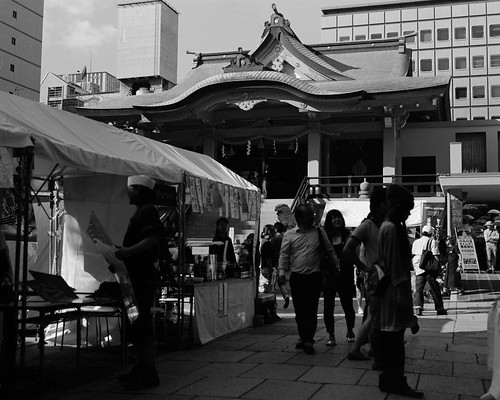
Namba Temple

Namba temple. This is the opposite of the above. I measured for the sunlit areas, so the shadows got underexposed by about 2 stops. The result is dark, mushy and indistinct. If you try to brighten the dark areas you'll only get lots of big, dense grain without any detail. Lesson: whatever you do, don't underexpose.

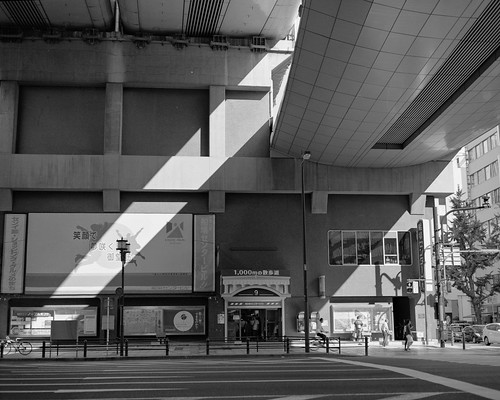
Honmachi

Honmachi highway underpass. Measured for sunlight, then added a stop. The sunlit bits aren't close to blowing out, while the open shadows are smooth and detailed.

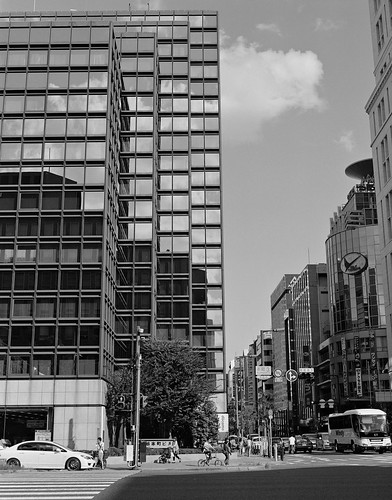
Midosuji

Midosuji street. With straight-on sun and dark shadows the image really is a little contrasty for my taste. A more neutral developer such as D-76, or a less contrasty film, would probably be my first choice in this kind of situation. But if your taste runs toward the strong and bold then this is still quite good.


Portrait

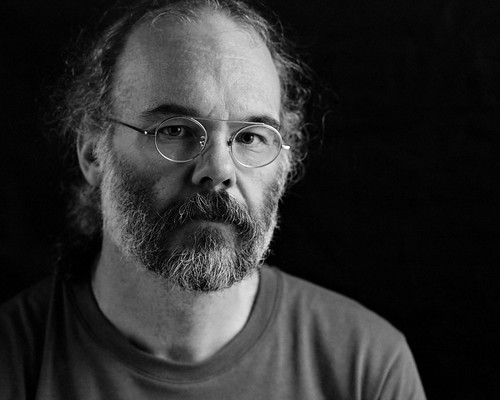
Self portrait. Strobe-lit through a large diffuser on camera up right, then reflectors on camera left and right in front. Damn I'm getting old...

The lighting is fairly smooth. But the film is contrasty, the developer is contrasty and I don't use a colour filter to reduce skin blemishes. The result is that I look every bit my 44 years of age, with bristly beard, scars, wrinkles, pockmarks and all. Definitely a cool look for some subjects, but it's not exactly flattering.


I'm surprised at just how easy Rodinal is to work with; just pipette and mix it right before you develop. Much better than D-76 where you have to mix and store a whole batch a day ahead. And I've rarely had negatives that needed so little post-processing after development. I basically set the black and white points and I was done. The results are great when properly exposed.

But they do have to be properly exposed, and the PanF-Rodinal combination is pretty contrasty. Next up I think I'll try Delta 400 at ISO 250 and see what that is like. In medium format the grain should still be small enough not to be any kind of problem. Between Rodinal for slow films, and Ilford Microphen for low-light and high speed, I don't see much reason to use anything else from now on.

#1 I notice silversalt.jp lists Adox Adonal for only 1300 yen but is out of stock. I've never bought anything from them so no idea how good they are or what the final cost would be.


Wednesday, October 9, 2013

About the new comment system here on this blog

Some time ago I enabled a new comment system on this blog, and I'm curious about how it is working out for people.
The reason I ask is because it seems it's difficult or impossible to comment unless you have a Google account and logged in to it. And I think you don't even see the comments other people are leaving, which is really bad.

Also, I'm unhappy that the comments look really out of place here. So I think I should perhaps go back to the old comment system instead.

If you have any thoughts about this please email me at: jan.moren+blog@gmail.com - if you have a problem with the comments you can obviously not comment here on this post.

Friday, October 4, 2013

Bonsamatic! Bonsamatic!


The Hanoi pictures take time as usual. Meanwhile I'd like to answer the one question no doubt burning in the back of your throat: "Did Bonsai-kun survive our absence? And if he did, how on earth did he manage?" The answer is "Bonsamatic!" But first, a digression:


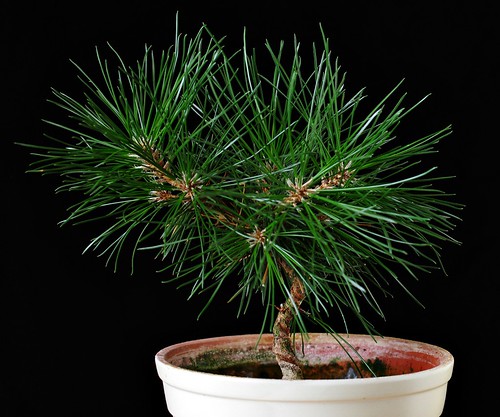
Bonsai-kun
Bonsai-kun. He's a three year-old Japanese black pine. And amazingly still alive after more than six months with us.


I work with big, complicated computer systems to run big, complicated neural models. It's a far cry from the days when I first learned programming on very simple (and very primitive) home computers. But the very simplicity made it a lot of fun. You could learn and understand the entire computer from the inside out.

To recapture some of that fun, I've begun playing with the Arduino in my spare time. It's a series of cheap, simple micro-controller boards with a complete software environment and lots of documentation and examples. You can use it for robotics, home automation or any other kind of electronics project. It's programming stripped to its bare essentials. It's easy to use with electronics and there's a lot of good tutorials around, so if you, like me, have little practical electronics experience, the Arduino is a great way to start.


A bonsai is planted in a fairly small, shallow pot and needs water every day in summer. When you travel, keeping it well watered becomes a real problem. So, what better way to use the Arduino than to help my little black pine friend above survive our week-long absence in Hanoi?

IMGP1835
Bonsamatic Mini.


There's four major parts to the Bonsamatic above: The pump and controller housing; below it the water tank (freezer container from a 100-yen shop); an open-air vessel (discarded PET bottle); and the watering tube in the pot, which is just a T-connector and a loop of clear tubing with a few holes drilled into it.

The Bonsamatic Mini is really a simple timer-based plant watering device, with the Arduino acting as the timer. My eventual plan is to have a moisture sensor that tells Bonsamatic when to water, but I didn't have the time to build and calibrate1 the sensor in time for the trip.

The picture above is mostly self-explanatory. When the time is up (I set it to 36 hours), the Arduino runs the water pump for 30 seconds. The pump draws water from the tank below and into the open-air vessel, on to the watering tube and out into the pot.

You might wonder about the open-air vessel. The pump has no active shut-off valve, so water can still flow through it. Without the open-air vessel the end of the tube in the pot would sit lower than the water tank intake and act as a siphon, slowly emptying the tank even without the pump running.

I figured that out the hard way, by the way, when I found my workbench completely soaked ten minutes after a trial run. First lesson of any water-related construction: do all your testing in the bathroom.


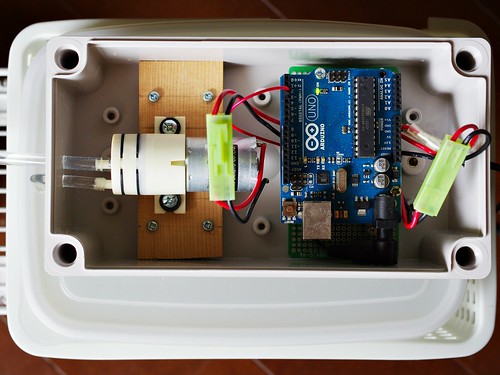
Bonsamatic Mini
Controller housing close-up. You can see the diaphragm pump on the left, the Arduino on the right, while my home-built motor controller board is sitting right underneath the Arduino board. The housing itself is water resistant and designed for outside use. I put the whole thing out on the balcony next to Bonsai-kun, with a 12V cable through the air conditioning duct for power.


The most difficult problem was finding a suitable pump. Small water pumps are used in products everywhere of course, but few retail shops sell them as parts2. You have to go to manufacturers and distributors directly, but they usually deal only with large lots. If I wanted a hundred pumps there's lots of suppliers, but when I want just one there's far less. Some Chinese industrial component websites sell single units, but the freight and handling charges are steep.

Fortunately I discovered this website, where a group of Japanese manufacturers offer all sorts of electronic and mechanical components to designers and hobbyists that don't need big batches of stuff. The site is not an e-commerce site — there's usually no listed prices, you can't order from the site itself and the links simply take you to the manufacturer product pages, but at least you know the stuff is available for people like myself.

There I found this membrane pump from Denso Sangyou. It's perfect — tiny and nearly silent; most versions pump both air and liquid; there's various motor alternatives; and it can pump about 300ml per minute. Bonsai-kun needs about 150ml for a good soak, so it's just the right size. A quick test shows it can pump at least a meter upwards and probably more without a significant reduction in flow.

I sent them an email enquiry in my broken Japanese, and after a few brief exchanges I had ordered two3 of these pumps for a surprisingly low price of 3500 yen each, and a paltry 900 yen shipping charge, cash on delivery. Delivery was quick as well, and arrived just a couple of days after my order. Excellent service.

The pumps work great. A thirty-second run is plenty to water the bonsai. When out on the balcony I can't hear the pump at all, even if I strain to listen; the wind and the traffic below completely drown it out. The motor is rated for 300 hours and the pump housing for far longer, so if I'd regularly use this to water Bonsai-kun the pump would last more than half a century.


My next step is to make a moisture sensor (a couple of nails, a thermistor and a makeshift transistor amplifier) and calibrate it. It will basically involve a cup of soil that I measure when wet and dry, at various temperatures from near-freezing up to 50° or so. Then I'll take a look at that data and find a simple way to model the temperature dependency.

The water tank will be replaced with a larger, more stable version. I also want to get a smaller, cheaper Arduino board to use for this, so I can free the regular board for other things. And I need a way to get data from the Arduino to my web server for a live display of the temperature and moisture — and balcony ambient temperature too while I'm at it. And perhaps measure the light level throughout the day while I'm at it.


The one thing I'm unsure of is if I should always automate the watering in the future, or only use it when we're travelling. On one hand this automated system is really cool. On the other, part of the point of a bonsai is to see it and interact with it on a daily basis, and this would remove some of that. We'll see.


#1 The data from a resistance-based moisture sensor — that is, you measure the resistance between two nails stuck into the soil — depends on the soils temperature. So you need a temperature sensor, and measure how the resistance changes in order to figure out the real moisture level.

#2 Those that do tend to cater to laboratory and medical fields, which means very precise, very clean, very certified and very expensive.

#3 Always try to get spare components when you're tinkering; that way you're not stuck when you break the primary component by accident.