Showing posts with label tokyo. Show all posts

Wednesday, January 26, 2011

Picture Post: Tokyo

Way back then I promised to post images from our Tokyo trip. Life and work intervened and I never got around to it. Better late than never, here's a few impressions.

Tokyo - Night

Big cities are really best at dusk. Dingy, messy streets in daylight turn into golden rivers of light as the sun sets.


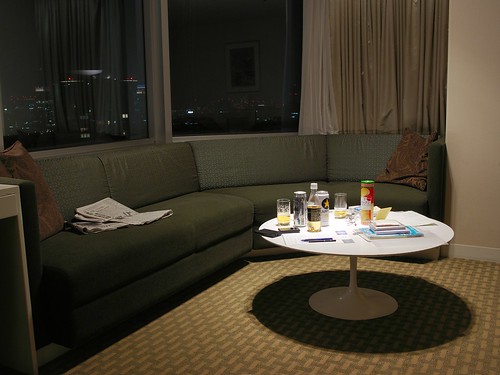
Akasaka Prince Room

We stayed at the Akasaka Prince hotel. It's a pretty cool hotel with a fairly well-done 1970's style interior - yes, it can be tasteful and comfortable, believe it or not. Unfortunately the construction methods also seem to be typical for the 1970's, so renovating the place is too expensive and it will be torn down beginning this April.


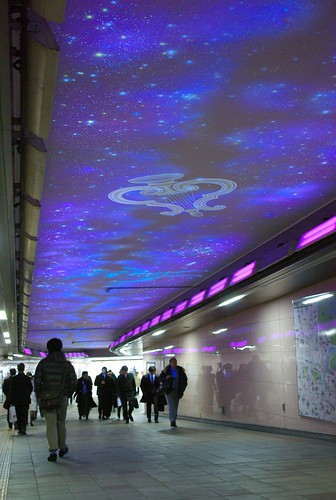
It's Full Of Stars

Best thing about Tokyo is the subways. Lots of separate companies, and lots of restrictions on how you can run tunnels (no tunnelling under the imperial palace, for instance) so lines criss-cross the city in delightfully surprising ways. And with so many different actors, station design can vary a lot. Akasaka station has this blacklight (UV) enabled zodiac in one of the access tunnels, visible at night.


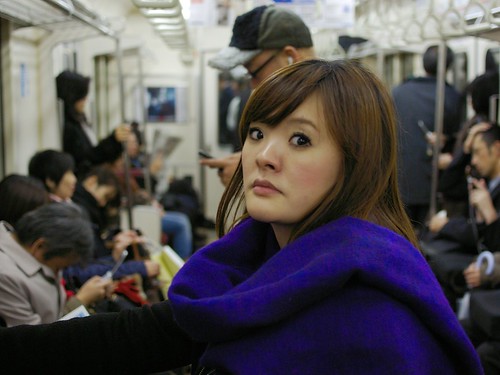
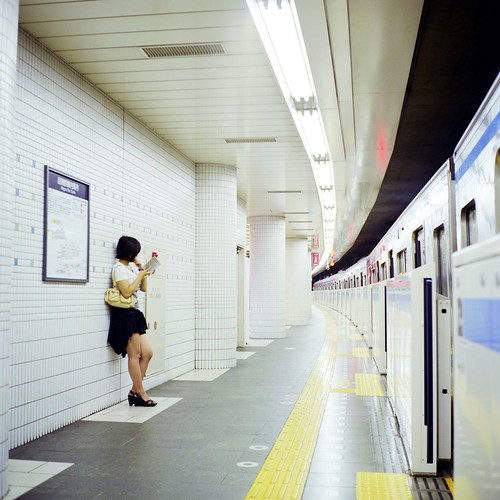
Blue

Blue scarf, Tokyo subway.


We went to Kanda in Jimbocho, just north of Akasaka, where hundreds of used book stores crowd the area. I try to go there every time I'm in Tokyo, and as always I stopped by Meirinkan that specializes in used science and technology books. I finally bought first three volumes of The Art of Computer Programming by Donald Knuth; a true classic in computer science and one I've wanted for many years. They were used, but in perfect condition - I suspect the original owner never actually opened them. As it happens, Knuth has just published part one of the fourth volume.


Another stop was the temple in Asakusa. It's a major tourist attraction of course, and usually crowded. There was a winter market going on selling traditional crafts as wall as the usual touristy stuff. Fun place, but really a bit too commercial to evoke any seasonal feelings.

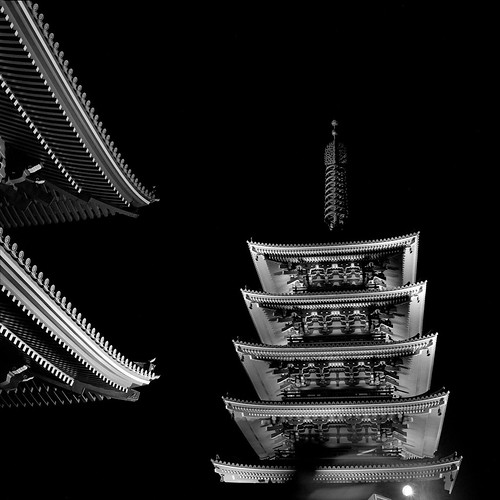
Pagoda

Asakusa Pagoda.


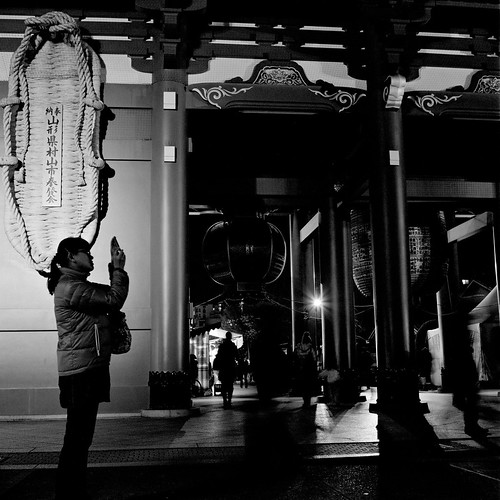
Sandal

Asakusa is famous for the huge straw sandals they have hanging on a gate wall.


Ginza is the traditional high-end shopping street in Tokyo. There's other high-end shopping areas now of course, but Ginza apparently still holds a special place in the mind of many Japanese. Every now and then the street is shut off for traffic and becomes a promenade for the day.

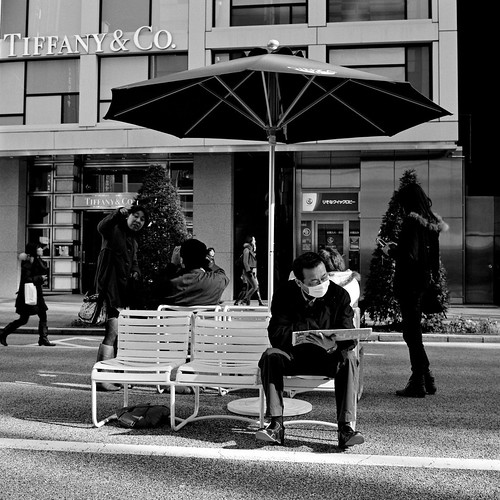
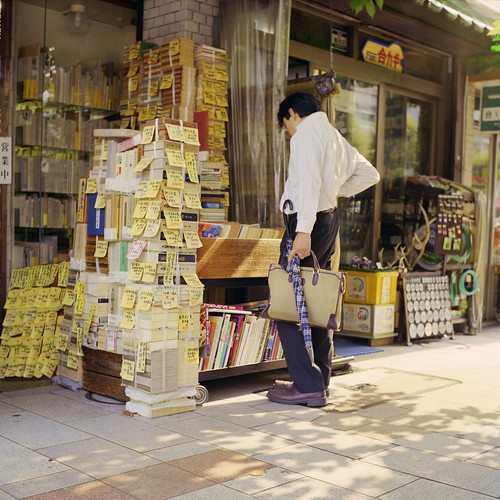
Relax

Take a news break. Perhaps he was waiting for his wife, just as I was waiting for Ritsuko when I took this.


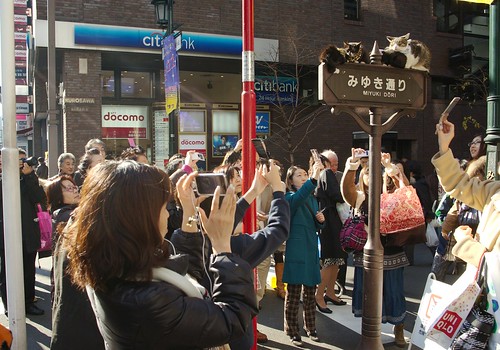
Cats

An entrepreneurial shop owner (I think) placed a group of cats on the sign here, and immediately attracted a sizeable crowd. A crowd that, to a man, proceeded to saturate the area with cellphone cams, compact point-and-shoots and large SLR cameras.


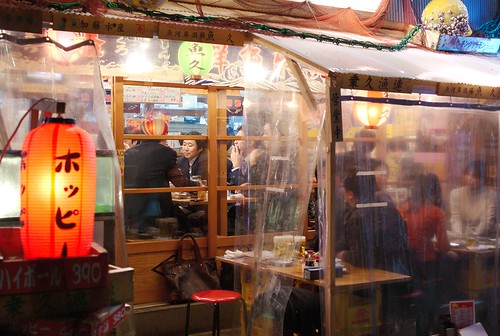
Izakaya


The best kind of place to enjoy food and drink in Tokyo is in a low-end izakaya, the kind that caters to salarymen on their way home. Service is prompt, the food usually good and plentiful, and the atmosphere is pleasantly relaxed. I try to make a point of going to places like this whenever I'm here.


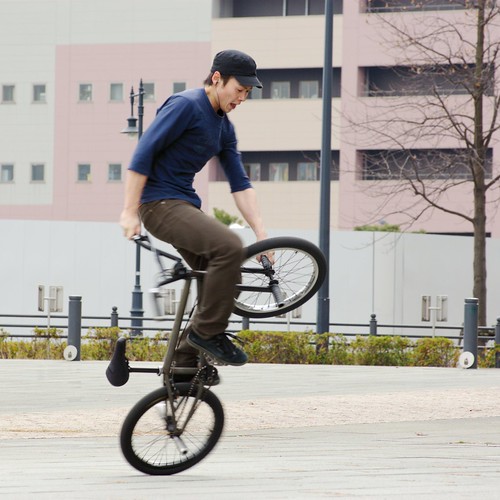
Practice makes Perfect

The last day we went to Yokohama. The weather was not good, but there were still plenty of people using the harbour walk to practice skateboard, rollerblades or, like here, bicycle.

Thursday, December 16, 2010

That Was Fast

Remember that I'd reached 77kg about a month ago? I've lost another kilo since then, without even trying. There's nothing like pervasive stress and lack of sleep to make you lose weight, I guess. Not that I lack appetite, mind you - I'm plenty hungry at dinner time - but I feel full as soon as I start eating.

Anyway, this is just a temporary problem. Tomorrow is my second vacation day of the year. Ritsuko is going to Tokyo even as I write, and after work tonight I will take the train and join her for a long weekend in the capital. We'll go see a big outdoor temple market in Asakusa, spend an afternoon in Jimbocho (home to hundreds of specialist used book sellers), have Smörgåsbord at a Swedish restaurant and probably spend Sunday in nearby Yokohama and its large, lively Chinatown.

I strongly suspect I'll gain back the weight I've lost, and then some, by the time we come back.

Thursday, July 15, 2010

Picture post: Tokyo

I renewed my passport in Tokyo a few weeks ago, and I took the Yashica along.

Meguro

The Swedish embassy is in Roppongi, so you change subway lines in Meguro.


Swedish Embassy

Any embassy design is going to be playing off their national stereotypes of course. The entrance at the Swedish embassy does "Nordic minimalism" and modern design. A better choice than Dala horses and folkloric kitsch: look forward, not back.

A refreshing detail: no flags and no patriotic slogans. I mean, you presumably know which embassy you're at already so why add some big colorful marker to remind you? Oh, and we're technically a monarchy, but there's not a single portrait of the king, or the royal family. There's some aspects of my home culture that I really, really appreciate, and the lack of unthinking, noisy patriotism is one of them.


Restaurant Stockholm

While there were no cheap symbolism at the embassy, Restaurant Stockholm feels no such inhibitions. Still, it's a pleasant place with a fairly good Smörgåsbord. Lunch is not too expensive and Swedish passport holders get a nice discount. My only gripe is that they don't do Janssons temptation during summer. Oh well, it's pretty easy to make yourself. Perhaps post a recipe?


Kanda

You can't go to Tokyo and not stop by Jimbōcho in Kanda. The area is filled with used book stores, and it's a treat to spend some time there. Most books are in Japanese of course, but there's a few places specializing in foreign-language books. A must-go place is Meirinkan, a store that specializes in science and technology works. Again, mostly Japanese but they have a pretty good collection of mathematics in English. I was very good and bought only half a dozen or so, including a good two-volume work on numerical analysis and a book on using sensors in electronics.


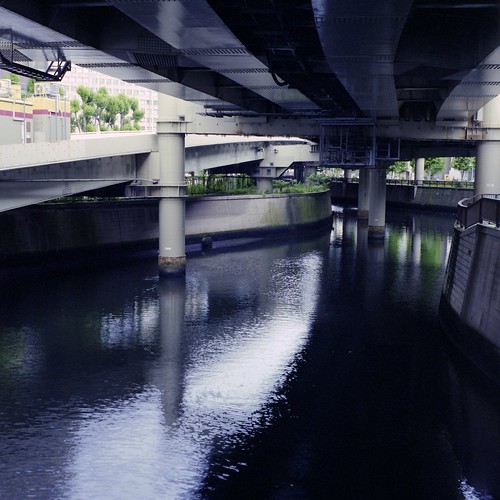
Kandabashi

Kandabashi. Osaka isn't the only place to use its canals as convenient places for highways. I'm torn about this kind of thing. On one hand, you hide away what could be a pleasant waterway through the city. On the other, this kind of industrial brutalism looks pretty cool.


Beer Cafe

The area east of Tokyo station has become fairly upscale. Here's a beer cafe in one of the large office buildings right next to the station. Good place.


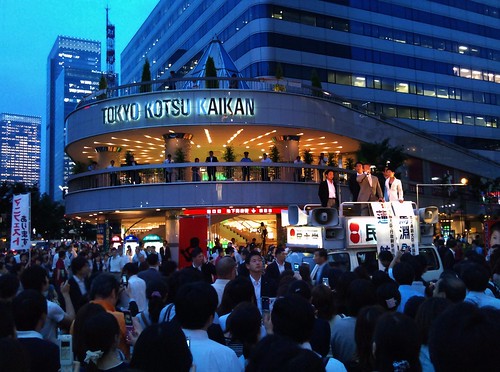
Renhō

The upper-house election was in full swing. Here Renhō, a very popular DPJ politician, was giving a speech in Yurakuchō. A few days later we spotted her in Osaka, stumping for one of the candidates there.

Excuse the image quality; it's a cellphone shot, at dusk, with the phone held over my head. I'm amazed there's anything recognizable in the picture at all.


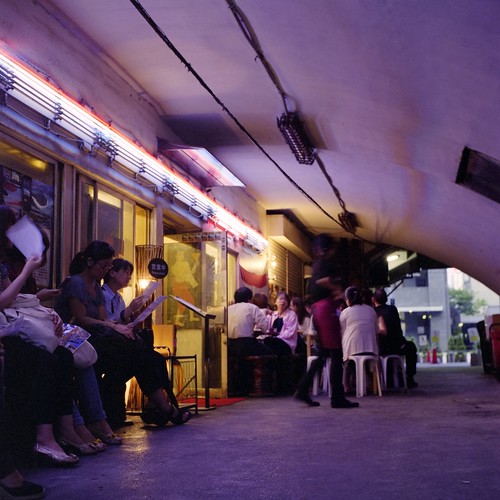
Thai Restaurant

A popular Thai restaurant under the Yamanote line tracks. The lighting and plastic chairs makes it feel very south-Asian in style. The food looked great but the wait was too long for us.

One thing I envy Tokyo is all the cheap, low-grade but friendly eating places under the tracks of the Yamanote loop line especially. They cluster around the stations, and especially where you'd have lots of employees passing through every evening. Namba in Osaka just doesn't have a lot of places like that. Perhaps it's simply the relative lack of elevated train lines, but I think it's a difference in style too. There's plenty of cheap eateries here too, just not this kind.

Friday, January 30, 2009

Tokyo

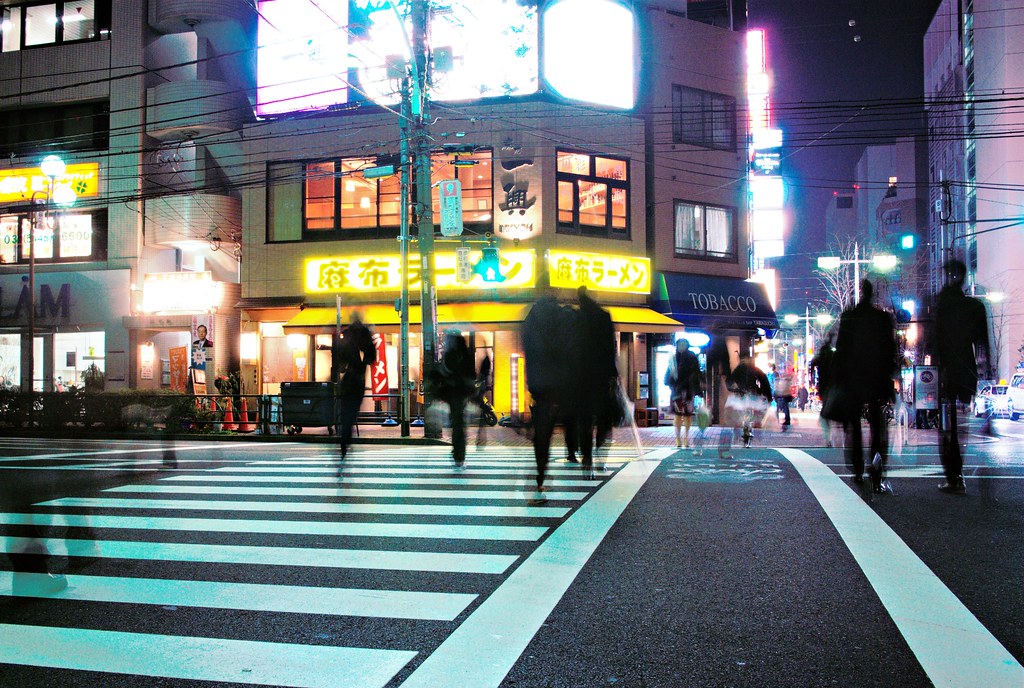
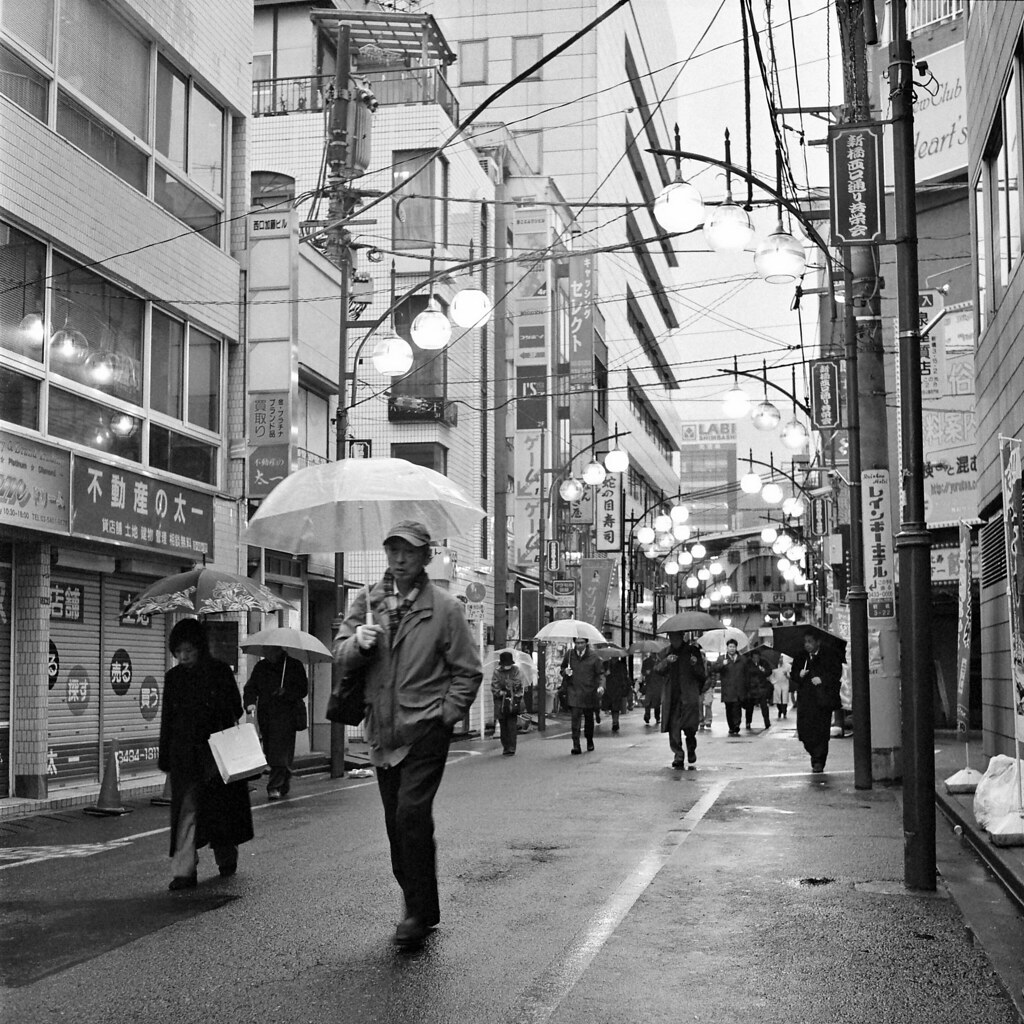
Tamachi Street

Street in the Tamachi area. Don't normally like heavy-handed processing but this one came out good, I think.


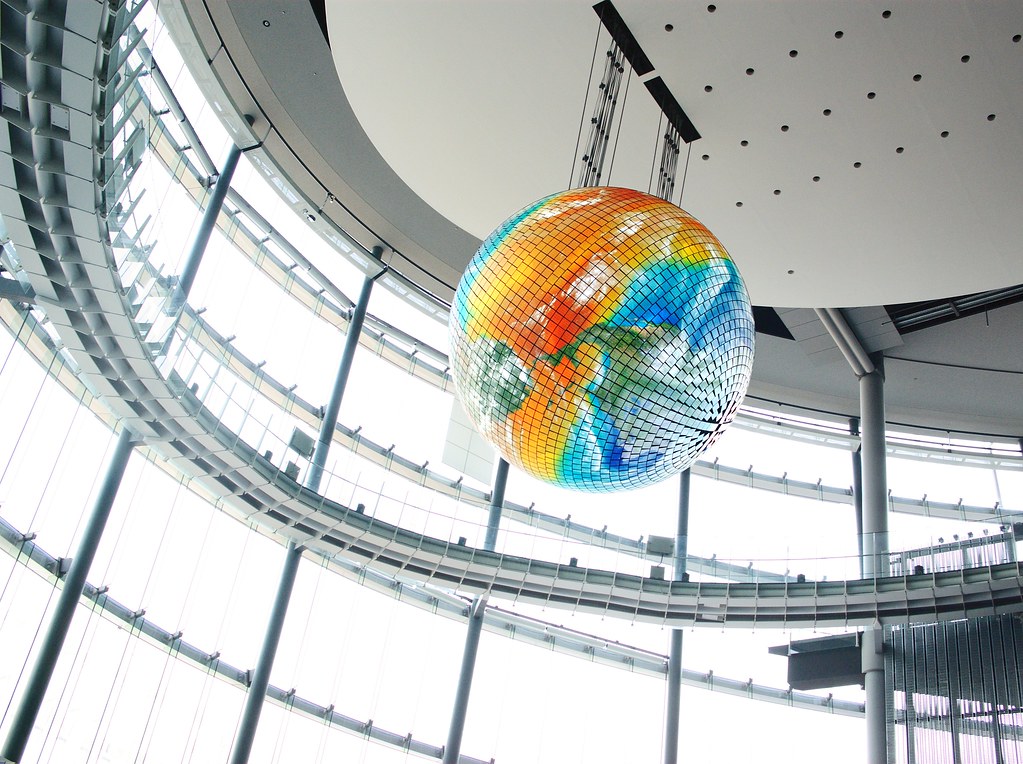
We're back from Tokyo. Wednesday and Thursday was all work, helping out with the project symposium at the Miraikan museum of innovation on Odaiba, a man-made island in Tokyo bay. The weather was miserable so sightseeing was not really an option, but then, I didn't have a huge amount of time to myself so that didn't matter. Ritsuko came up to Tokyo on Thursday evening, improving my mood and weather alike. I took Friday off (have plenty of unused vacation days), so we spent Friday and Saturday in Tokyo by ourselves.

Miraikan

Miraikan science museum was the symposium venue. Unfortunately we had no time to actually look through the museum itself, but from what I could see it should be worth visiting. Near the entrance there's a huge animated globe showing near-realtime views of Earth weather patterns and other data.


Tokyo is huge, of course - Greater Tokyo is more than twice the size of Osaka and the largest in the world - but you only ever see one piece at a time so the overall impression is not that different from Osaka. The atmosphere is different, of course, and since it's so spread out you spend more time in transit but overall it's not a very different experience.

Where Tokyo (and most capital cities) really differ is not in absolute size but the network effects of being the largest city in the country. A larger city attracts more special facilities like theaters, say, than smaller cities, and that in turn attracts more people with an interest in it, which creates even more facilities. As a result, a city like Tokyo (or Stockholm, or Paris, or London...) tends to have more special features like theaters and art-house cinemas, exhibitions, specialist shops, colleges and universities and so on than their size alone would suggest.

Tokyo Bay canal

Canal leading out to Tokyo bay in Tamachi. The elevated track is the Rinkai light rail line, I believe.


I spent the first night in Shinbashi, a somewhat seedy but very likable area south of Tokyo station and Ginza. Lots of eateries and bars around the station, then quiet back streets with small companies and living areas further south.

Shinbashi

The entertainment area of Shinbashi, early morning, with commuters fanning out from the station. Some will be back here in the evening to eat and drink before returning home.


On Friday we visited Jimbōcho, with its cluster of used and new book stores and publishers. Meirinkan book store is amazing - they specialize in used science and math books, mostly Japanese but quite a lot of math and physics books in English too. I'm proud to say I managed to restrain myself and only bought five books altogether. I didn't even get Knuth's The Art of Computer Programming I-III in Japanese translation, much as the volumes beckoned me - this is something I now regret, to be honest. We had lunch at Restaurant Stockholm, a Swedish restaurant. They serve a pretty good if somewhat small smörgåsbord; we haven't cooked a lot of Swedish-style food lately so it was a welcome change of pace.

One thing I wonder about Tokyo is where all the bicycles are? Bicyclists are few and far between, and there's only a smattering of parked bicycles on the streets. Completely different from Osaka where many people use bikes, and they are sometimes parked three or four deep around major stations and shopping areas. Perhaps it's because Tokyo has a lot more hills; perhaps it's because people tend to travel farther within the city so they prefer the trains, or perhaps the street traffic isn't conductive to bicycles. Ritsuko has the theory that Tokyoites are more polite and concerned with appearances, so they don't like parking on the streets and walkways - and when you need to find real parking, bicycling becomes a hassle.

Hikawa Maru, Yokohama

The Hikawa Maru of Yokohama. Oceanliner once trafficking the pacific between Japan and USA, now moored in Yokohama harbor.
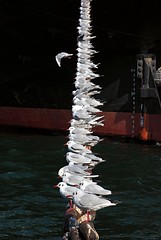

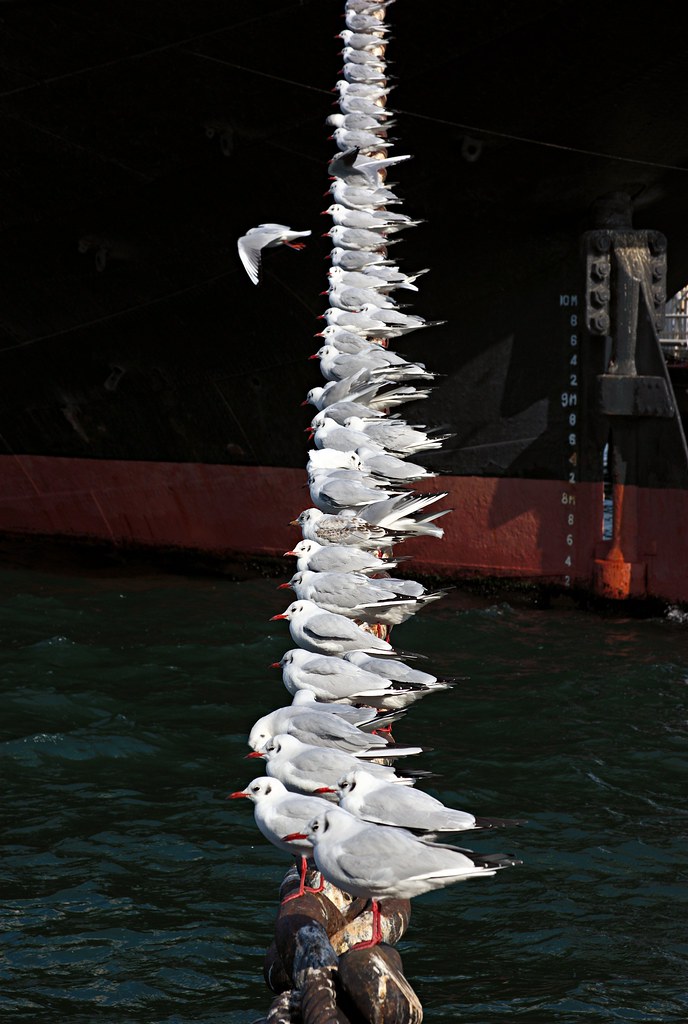
Lineup
Seagull Lineup

Saturday we went to Yokohama. The city is part of greater Tokyo and only twenty minutes away by commuter train. It really feels like a parallel to Kobe; a smaller quieter satellite city near a major metropolis with a history of foreign influx, a nice waterfront and a popular Chinatown (Yokohama Chinatown is much larger, but I like the Kobe waterfront area better). We had ramen and stir-fry pork for lunch, walked around the harbor and bought some kitchen utensils.

One thing that struck us were the dogs. Yokohama has dogs - lots of dogs. Half the people seemed to be walking a pooch of some kind. Our informal impression was that there were more dogs on the streets than there were children. If you saw a couple with a stroller, chances were the stroller contained a dachshund or toy poodle, not a baby. I have no idea why this is so.
 
We returned to Tokyo and stopped by "Eataly", a combined delicatessen, restaurant and café specializing in (of course) Italian food, where we had dinner and bought pasta, beans, cheese and other ingredients before returning to Osaka. Yes, we are obsessed with food.

Finally, a travel tip: send your luggage home with a delivery service company. The last day or two you have a lot of things you no longer need - dirty laundry, italian food, second-hand science books and so on - and when you check out of the hotel on the last day you have nowhere to store it anymore. You can ask the hotel to hold it for you until you leave of course, but then you need to come back to the hotel again. Or, you could stash it in a locker at the train station, but that costs money and you'll have to get it there in the morning. And in either case you'll need to drag it on the train all the way home.

As it turns out, sending a bag directly from the hotel within the country is not expensive at all - about 1200 yen for our crammed-full bag, courtesy of Kuroneko freight company - and we got it delivered right at home the next day. Leaving us free for sightseeing without worrying about our luggage and travel home unencumbered by big, heavy bags when bone tired from the trip.

The whole set of pictures available here.

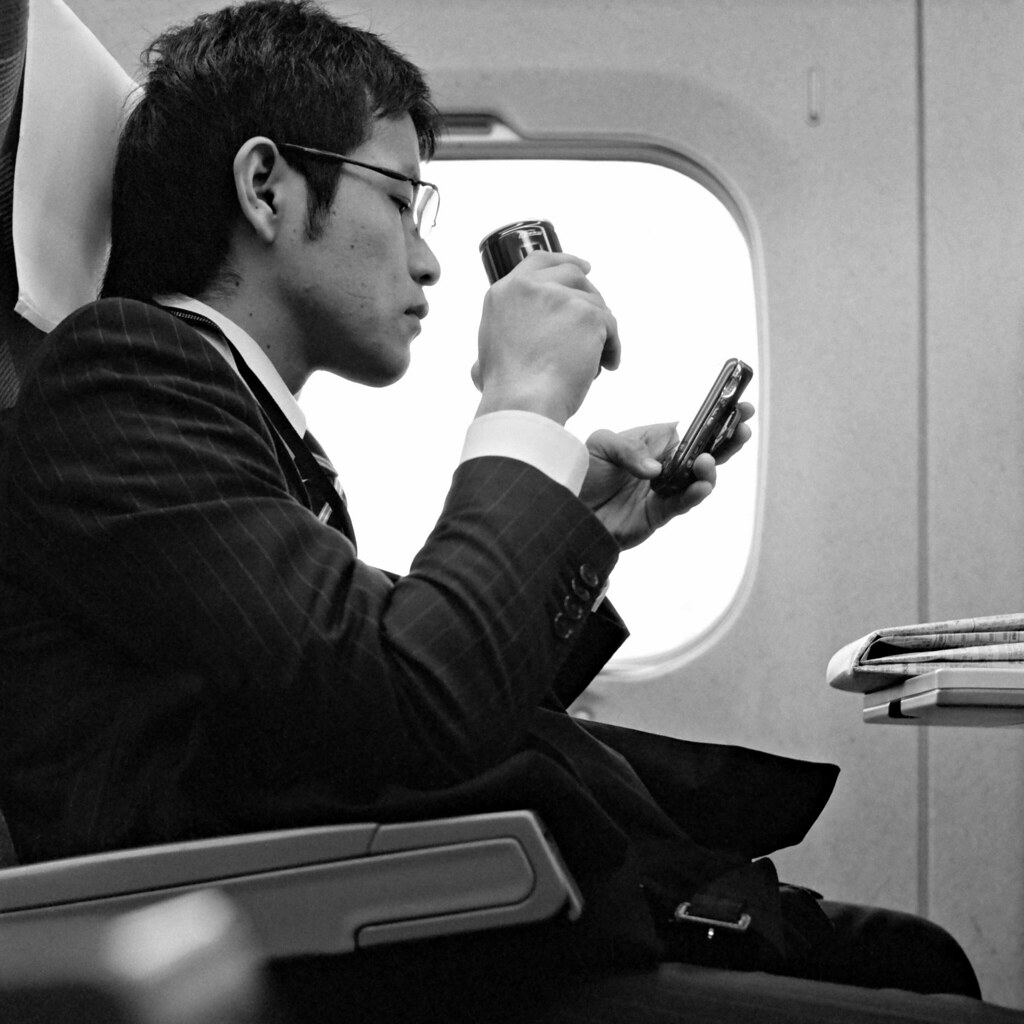
Shinkansen Salaryman

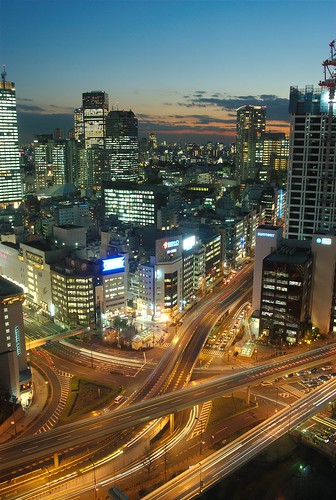
Travel home in comfort and style, unecumbered by bulky suitcases, courtesy of your friendly neighbourhood transport company. Here, a salaryman taking the early Shinkansen to Tokyo. See the lack of bags? See the relaxed yet dynamic posture as a result?

Tuesday, January 20, 2009

To Tokyo

I'm going up to Tokyo for a few days beginning tomorrow; the project has its final symposium at the Future Japanese Science Hall (日本科学未来館 - lousy translation, sorry). There'll be no live demos of the CBi robot as the hydraulic systems and all the rest is really too cumbersome and fragile to set up in Tokyo, but the robot will be there, we'll demo the Gifu hand and HOAP robot, and there'll be presentations, a movie about the project and so on. Ritsuko will join later on too, so we'll be seeing a little bit of Tokyo together before we return. Unless I get (un)lucky I'll be mostly off the net during the trip, so don't expect any updates or comments during this time.

"up to Tokyo", by the way: it's been suggested to me that this expression - even stronger as 上京, joukyou, in Japanese - would somehow be disparaging to people living in Osaka or other non-Tokyo metropli. To me, at least, it isn't. There's a lot of research on how we map concepts onto each other (research I know too little about). "up" of course maps to the raising of some concrete or abstract level - we "level up" in games, and you can "Beauty Up!" at beauty salons here - and Tokyo is after all by far the largest city in Japan, with the highest concentration of political power, academic activity and commerce. In all those senses, "up" seems perfectly appropriate imagery to me.

In addition, with the typical orientation of maps, "up" maps strongly to "north" as well, and for Osaka and Nagoya the mapping with "up" to Tokyo becomes even more natural. It means, of course, that I'm quite comfortable talking of going up to Aomori or Abashiri as well, even though they are much smaller communities than Osaka. My guess is, if anybody is uncomfortable with the "up" mapping it's people in places like Sapporo and Sendai - sizable cities in their own right and clearly north of Tokyo so the designation rubs against this geographical mapping.

[edit: we don't do a live demo of CBi but we do show the Gifu hand and HOAP in action]