 Pentax 67
I got a
Yashica Mat a year ago, just to try out medium format film photography. I got bitten hard, and I now use film as much as digital. The Yashica is compact, lightweight and fun to use; it's a perfect second camera, but as a main camera it has some shortcomings. I'd like a rugged camera with high quality interchangeable lenses and preferably a waist-level finder like the one on the Yashica. Oh, and I prefer a large 6x6 or 6x7 format over 6x4.5; if I use film I may as well use the largest format I find practical. I did consider the Mamiya 7, but it's a rangefinder and known to be somewhat delicate. The Hasselblad 500 system is fairly light and high quality but it's very expensive even used. The Mamiya RB and Bronica systems are large and bulky, and really intended for studio use.
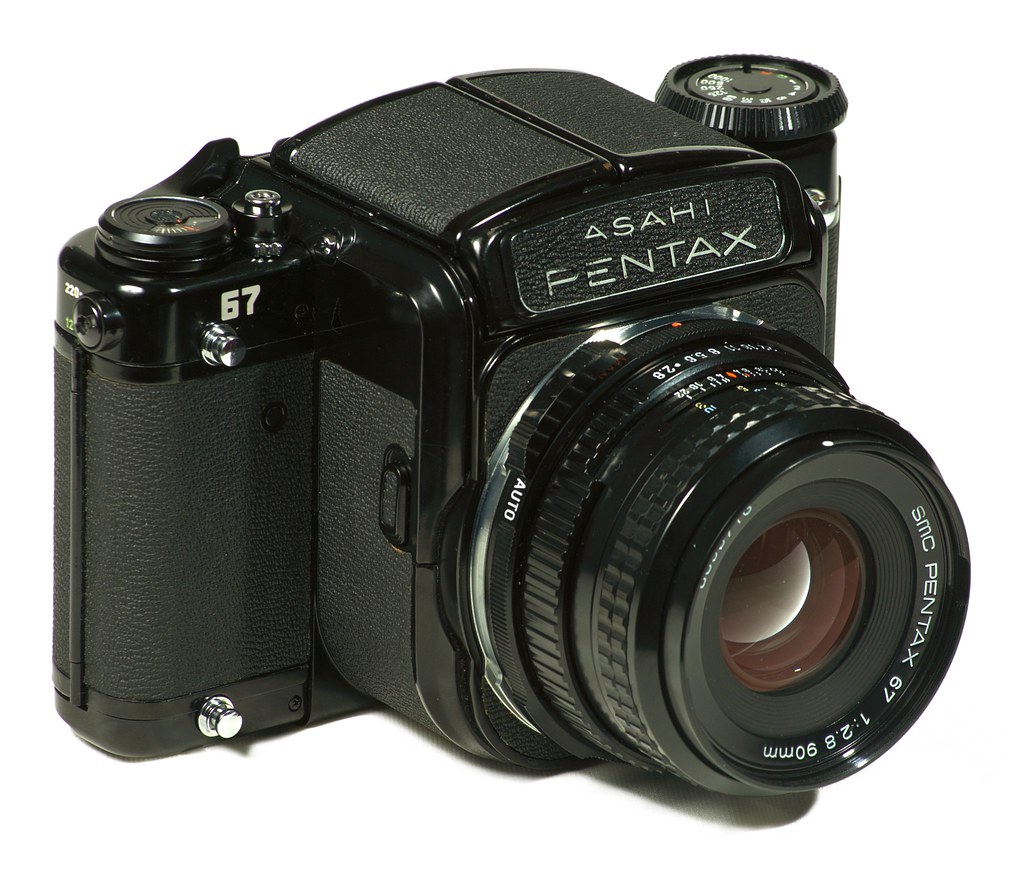
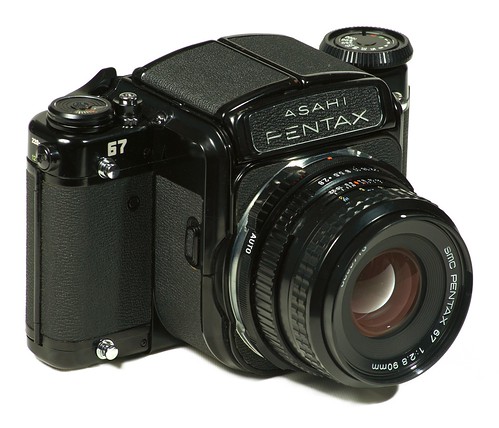
Instead I got a used Pentax 67 with a 90/2.8 lens. It's a manual-focus 6x7 format SLR camera with a body style similar to that of a 35mm camera. This camera system has been around for a long time; it was introduced in 1969 (the same year I was born) and has been in production right up until 2009. Production of the third and last generation will stop in September; parts, lenses and second-hand gear will no doubt be plentiful for decades to come. My camera is a second generation one, introduced in 1989.
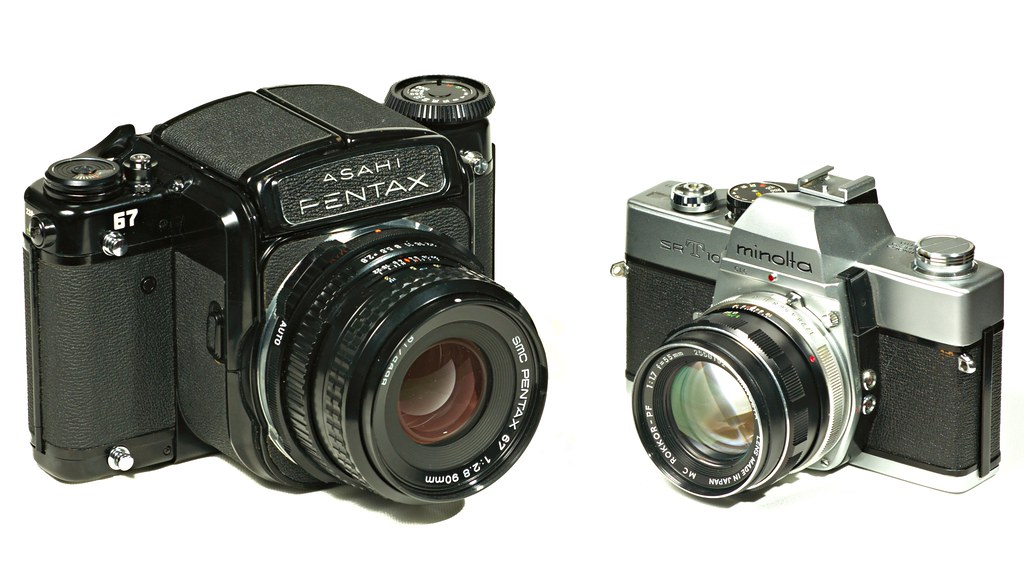
A size comparison between the Pentax and a typical film-era SLR. The Pentax is to the left.
Some people will say the Pentax 67 is huge and heavy; others will say it's compact and lightweight (and all will agree that it's rugged and solid, and has a noisy shutter with lots of vibration). This mixed reputation is due in large part because of its looks. It invites comparison to 35mm SLR cameras, and compared to them it's absolutely huge, like a giant-sized or novelty version of a normal camera. It's heavy too - about 1.7kg with the prism viewfinder, two or three times as much as most 35mm film cameras. Small-format users find it enormous.
To most medium and large-format camera users, on the other hand, it's fairly compact and portable. There is no other 6x6 or larger medium format SLR camera that is as light and compact, and probably none other as rugged. The camera is designed to be a field camera as much as studio equipment, and it's been a long-time favourite of landscape photographers and astro-photographers, hikers and travelers especially. With a waist-level finder the camera is closer to 1.2kg (the glass prism in the prism finder weighs half a kilo by itself), and the 90mm normal lens is again fast and small.
It may look big sitting right next to a small 35mm SLR, but it's really not bulky or cumbersome to bring along; certainly no more so than any other 6x7 format camera.
Besides, when you compare it to current digital SLR cameras it's no longer all that big. The current digital Canon and Nikon flagships - the 1Ds and the D3X - are about the same size and weight as this camera, but a lot more expensive and fragile, and needing multiple batteries or a charger and frequent access to electricity.
The design is clean and basic, and largely unchanged since 1969. Manual focus, aperture and shutter speed, manual film advance (thumb crank) and manual film loading - no motor drives or automation here. There is a prism finder with a light meter meter available for the 67 model I have, but it only meters passively: you set speed and aperture manually and get feedback from the meter. The newest model - the 67 II - does have a modern matrix meter with aperture-priority mode, but only as a prism finder. I prefer a waist-level finder and like to use an external meter anyway so I didn't want to spend a premium for the latest model. Film loading is easy, and it loads and unloads exactly the same way the Yashica Mat does. I mean exactly; you could write one set of detailed instructions covering both cameras.
Back street in Kobe. The residential areas up towards the mountain side often look like this, with a mix of new buildings, traditional Japanese houses and old European architecture. As a major port, Kobe has long had a large influx of foreign residents, and affluent traders built their mansions and residences up on the mountainside rather than near the dingy, smelly harbor. The remaining old European-style buildings are now protected and the ones along the main streets are mostly converted to restaurants and wedding chapels, but the ones along the back streets are still used as family residences.
To me, this camera - the 6x7 format, the near-normal angle of view, the waist-level finder - is perfect for shots like this. You can relax with the camera hanging in front and just wait until you see the picture you want on the large, clear ground glass.
This is an SLR (single lens-reflex) camera with a focal plane shutter (a curtain just in front of the film, covering it), just like your normal SLR or DSLR camera. It has a mirror in front of the shutter that reflects the light from the lens onto the viewfinder screen. When you press the shutter, the mirror first swings up, then the shutter curtains move across the film plane to expose the film. As anyone who's used a 35mm SLR or DSLR camera knows, this design can be a little noisy as the mirror swings up, then the shutter snaps across the film or sensor. The film format here is bigger - almost 6x7 cm in size - so it means the mirror and shutter is also much bigger, heavier and noisier.
To put a not too fine a point on it: the camera is loud. Not the high-pitched metallic click of a small-format camera, but a distinct, heavy "Flubbupp" from the mirror and a solid "Ka-lock" from the shutter. Nobody nearby is in any doubt that A Picture Was Taken. And you're in no doubt yourself either; all that fast-moving mass really shakes the camera in your hands as the shutter fires. Like most SLR cameras the Pentax 67 has a mirror lock-up function; it is a
really good idea on this camera.
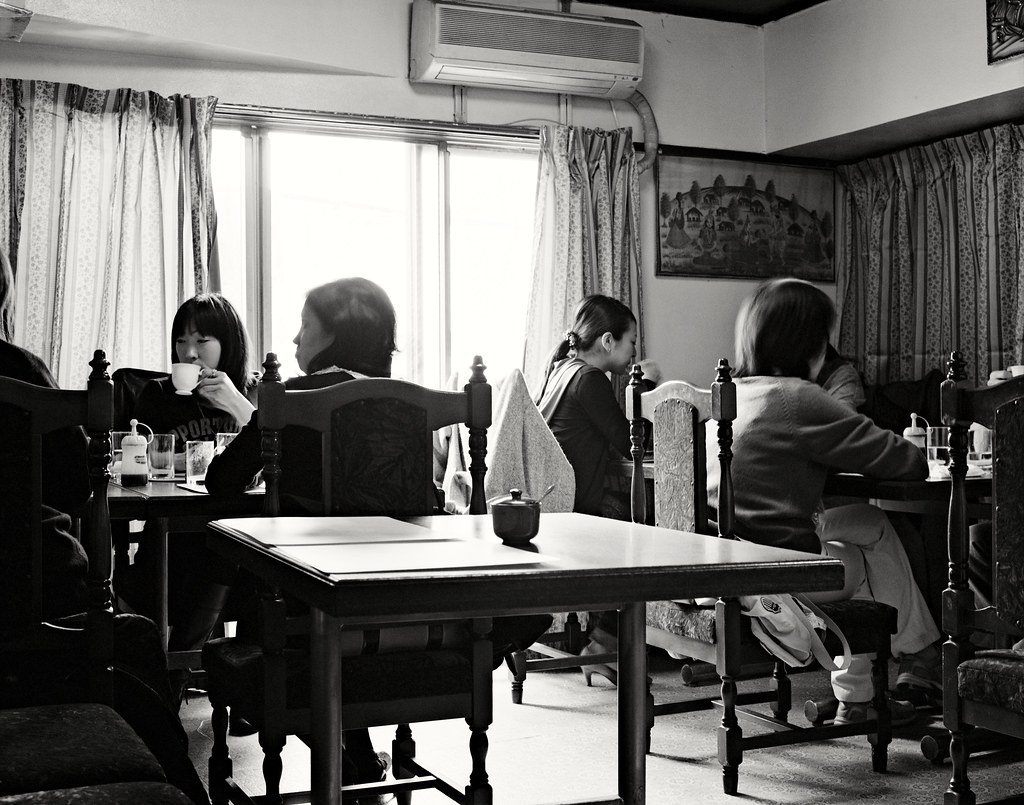
This is Kusumu, an Indian restaurant housed in a dingy, unmaintained 3rd floor apartment in an old concrete building in Kobe. The wallpaper is flagging, the floor buckles, the furniture, cutlery and decorations are mismatched and second hand, and at least part of the place is clearly used as living space for the family that runs it. Next door they have another apartment where they're selling Indian imported ingredients such as spices, rice and lentils in bulk.
The food, however, is cheap, home-cooked (literally) and delicious. There is no menu, just the meal of the day. You get samosa as a starter, then a plate with rice, three kinds of curry and chapati, which you get as much of as you want (in fact it's hard to stop the steady flow of food). In a sign of just how good it is, normally fastidious young Japanese women seem to come here in droves despite the messy, unkempt environment.
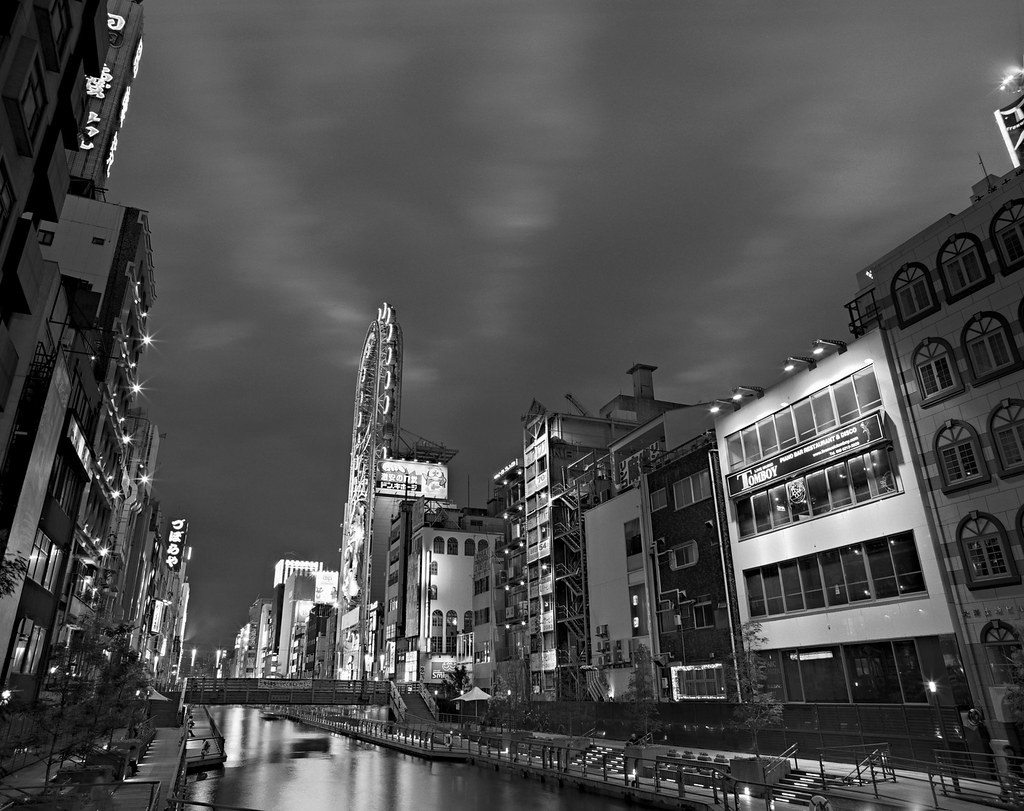
This image - taken on a tripod - pushes my scanner to the limit. It's about 35mp as scanned, and there's more detail on the film than the scanner is able to pick up. No matter; it's more resolution than I know what to do with anyway.
With that said, people exaggerate the problem of shutter and mirror shake. Yes, it does give you a bit of added vibration, but it only really start to matter at slower shutter speeds (1/30 and slower) where you really should be using a tripod and mirror lock-up anyhow. At 1/125 and faster there seem to be no such problems at all. Other large medium-format SLR cameras have the same design issue but don't have the same reputation; I suspect the noise makes people believe the problem is worse than is really the case. There is apparently a specific, real issue with long lenses (200 mm and beyond) and shutter speeds from 1/15 where the shutter can make the setup oscillate unless you have the body and lens anchored to the tripod at two points rather than just one. As I normally only use normal and wide lenses it's a non-issue for me.
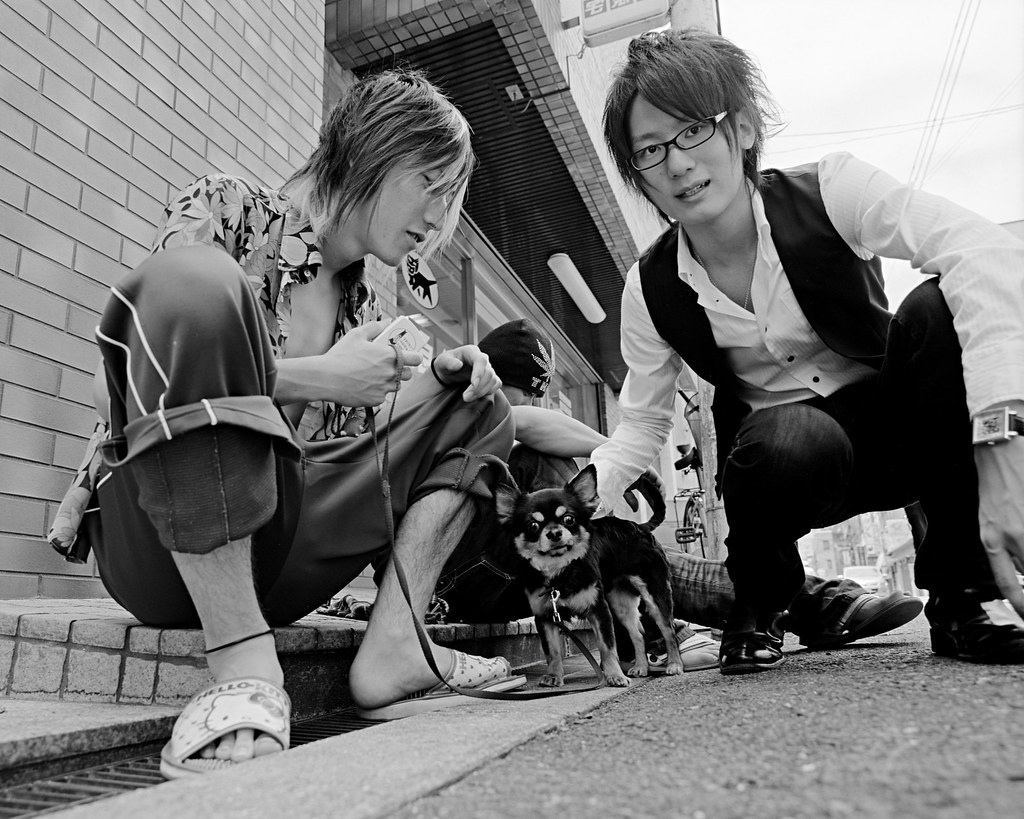
Ritsuko is making a point of me spending too much time taking pictures, I think. Or she just wanted a shot titled "Oddball Foreign Guy With Oversize Camera".
Anyway, this shows one reason to shoot negative film: The white wall is sunlit while the inside of the parking garage is in deep shadow. And yet, the wall is not blown out but has lots of detail and the dark garage is not blocked. This is, take note, after I've actually increased the total contrast to make the sunlit feeling stronger. A digital camera would have given you pure white walls or solid black shadows.
In practice it's really comfortable to use. The weight is no more than my usual K10D and a set of lenses, and it fits into my usual camera bag. It's not a fast camera by any standards however (no MF camera is), so it's not well suited for quick snapshooting. You just can't focus and frame a picture fast enough to follow a rapidly unfolding event. A better way is to decide beforehand where to take an image, set the camera, then wait until the light, the people and other elements come together. You get to decide exactly what background and elements you get in your image, and you give yourself time to prepare. Of course more often than not I never get the combination of elements I was looking for - or the idea turns out not to work at all once I see the result.
Neat & Grog, a tequila bar in Shinsaibashi, and an occasional waterhole for me and Ritsuko. Haru, the owner, is an entertaining guy, and the variety of tequilas he's got is amazing.
In this case I really wanted a more interesting-looking passersby in the image, but I was losing the light (see how long the shadows are on the front) and in another minute or two the front would have been in shadow. Can't get what you want, always.
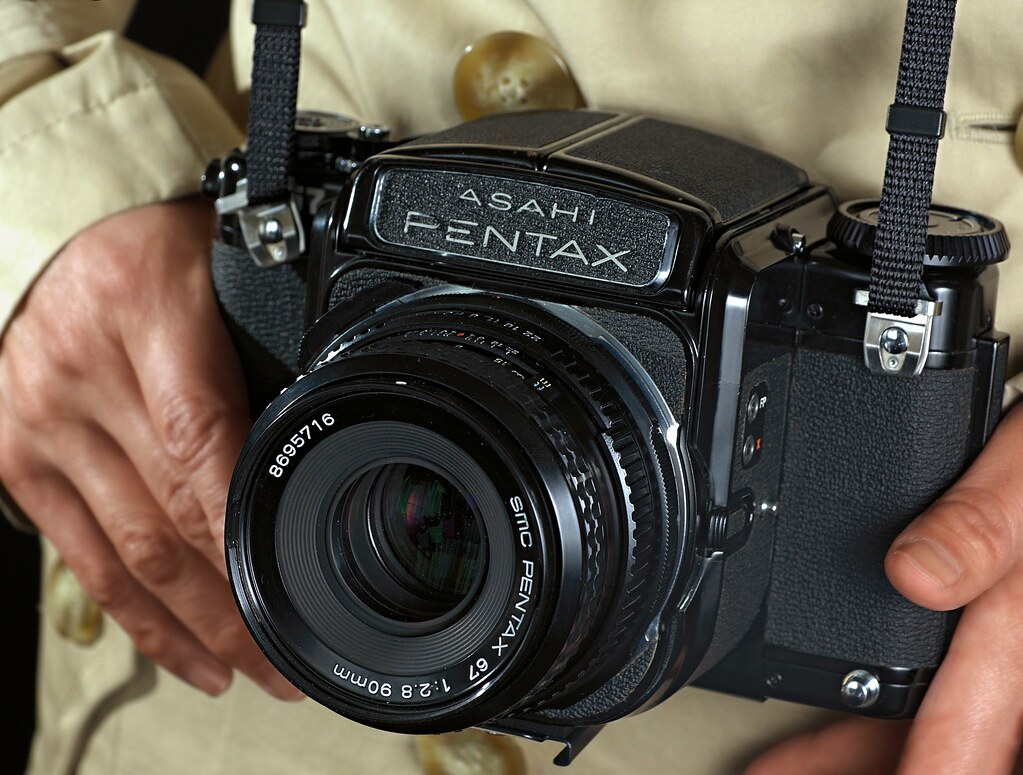
This sit-and-wait approach is very suited for a waist-level finder. You focus once, then let the camera hang from the neck strap when you frame and take the picture. When you use a tripod (and you really should), the waist-level finder is much easier and faster to use than a prism finder. An added benefit is that you're not hiding your face behind the camera so people don't react negatively to you. The camera is big, of course, but despite the size of it and the racket it makes it still looks like a plain old film camera, so people don't feel threatened by it.
A tripod, just to repeat it once again, is a really good idea. You can certainly use the camera hand-held and the results will be fine as long as you stay at 1/125 or faster. Those speeds will still benefit from a tripod, adding just that extra bit of crispness (resolution) to the image, and at slower speeds - 1/30 or slower - some kind of steady support is really no longer an option. Besides, when you're doing sit-and-wait photography a tripod is a lot more comfortable than holding the camera yourself. This goes for your digital camera too, by the way: use a tripod and you'll immediately see an improvement in the quality of your pictures, but especially when you zoom in or when it's getting dark.
At this point I have only the 90mm f/2.8 lens. It's the smallest lens available and one of the fastest. The coverage is about the same as a 45mm lens on film or 31mm on a DSLR; the Yashica, the
Voigtländer and the
Handy Box all sport lenses with similar coverage. It's the focal length I use most often by far so I'm in no hurry to get another one. At some point I would like a really wide lens, like the 45mm f/4, but that is for later. The 90mm will do me fine until I've learned to use this camera fully.
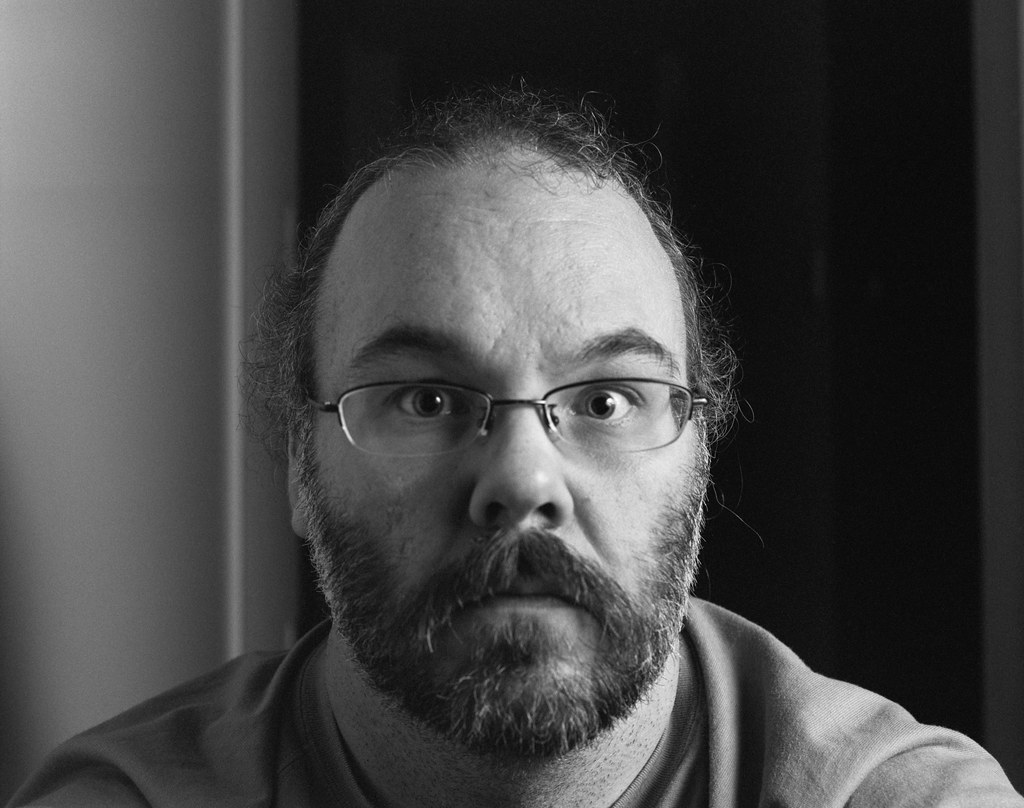
You perhaps saw this shot in an earlier post. Just wanted to test flash photography with the Pentax 67, and it's easier to just do a self-portrait than ask Ritsuko. Out of focus (I'm sitting too close) but otherwise OK.
The Pentax has a flash sync speed of 1/30, which means you have to use 1/30 shutter speed or slower. This is one of the few real drawbacks on this camera. By way of comparison, my Pentax DSLR will sync at up to 1/180, and the Yashica, with its leaf-shutter, will sync all the way to 1/500. A slow sync speed means you can't use a flash in combination with daylight to fill in shadows for instance. For real indoor ("studio") use like here the only light is from the strobes so the sync speed doesn't really matter.