Network socket programming is fun and challenging, with lots of interesting sub-problems and many chances to learn new things about your systems, your libraries and your compiler.
Or, it is a stress-filled exercise in screaming frustration, a tiny slice of hell filled with deadlocks, race conditions, incomprehensible error messages and intermittent bugs that disappear the moment you try to debug them.
Which is it? That seems to depend entirely on the proximity of your deadline.

Showing posts with label work. Show all posts
Showing posts with label work. Show all posts
Wednesday, October 19, 2011

Saturday, June 18, 2011
My Work Done, It is Time to Relax
One of the main jobs of the tutors at OCNC was to give afternoon tutorials on various simulation software; general tools like Python and Matlab as well as specialized packages such as NEURON and Nest. The students use those software packages for their own projects so the tutorials have all been crammed into the first week.
Preparing and holding the tutorials have eaten up a lot of time, but now they're all done and life here is settling down a little bit. We are of course helping the students with their projects but now there's time again for some of our regular work. I've poked at my simulation code for the first time in a week, and a few of us found time to go to nearby Maeda point for a bit of snorkeling. I have to get fins and a good underwater camera.
Preparing and holding the tutorials have eaten up a lot of time, but now they're all done and life here is settling down a little bit. We are of course helping the students with their projects but now there's time again for some of our regular work. I've poked at my simulation code for the first time in a week, and a few of us found time to go to nearby Maeda point for a bit of snorkeling. I have to get fins and a good underwater camera.
Saturday, June 11, 2011
To Okinawa (again)
I'm going to Okinawa tomorrow - yes, again, but this time it's all work, not play. I'll work as tutor at the OCNC summer school at OIST for the next three weeks. Every year OCNC brings together graduate students and post-docs for a three-week intensive course in computational neuroscience. There's a series of lectures by some of the big names in the field, tutorials on commonly used software tools and the students work on a project of their choice.
I use the NEST simulator quite a lot, so my job will be to introduce it to the participants, and to help the students that use NEST for their own projects. It's also a great opportunity for me to follow the lecture series, learn about other software tools and techniques, talk with other neuroscience modelling people and generally learn a lot of new stuff. Of course, I'll still work on my "day job" - my ongoing project - while I'm there.
I've been running ragged trying to get everything prepared in time; that's partly why posting has been light lately. It's not just the tutorials; I've also tried to bring my project to a point where I can easily work on it away from my desk. I'll try to make a point of writing shorter posts while at OIST that don't take me so much time to finish.
I use the NEST simulator quite a lot, so my job will be to introduce it to the participants, and to help the students that use NEST for their own projects. It's also a great opportunity for me to follow the lecture series, learn about other software tools and techniques, talk with other neuroscience modelling people and generally learn a lot of new stuff. Of course, I'll still work on my "day job" - my ongoing project - while I'm there.
I've been running ragged trying to get everything prepared in time; that's partly why posting has been light lately. It's not just the tutorials; I've also tried to bring my project to a point where I can easily work on it away from my desk. I'll try to make a point of writing shorter posts while at OIST that don't take me so much time to finish.
Wednesday, February 9, 2011
My New Homepage
I got myself a new homepage landing page right here on Google sites. It's not pretty or anything - you can't alter the page format very much - and I can't really do anything except keep a static page and a few files, but it's good enough for now.
The idea is just to have some kind of landing page for work-related use. This blog is where I have most of my online self, but it's not really related to my professional1 life. People looking for a research paper of mine don't really need or want to hear about old film cameras, the travails of Japanese politics or where I and Ritsuko had dinner last week.
Now I can link to this page to give people an idea of who I am and what I do, and I can offer the occasional paper and perhaps bits of code as well. If you happen to have a research-related link for me to this blog on some page then you may want to change it to the new landing page above.
The idea is just to have some kind of landing page for work-related use. This blog is where I have most of my online self, but it's not really related to my professional1 life. People looking for a research paper of mine don't really need or want to hear about old film cameras, the travails of Japanese politics or where I and Ritsuko had dinner last week.
Now I can link to this page to give people an idea of who I am and what I do, and I can offer the occasional paper and perhaps bits of code as well. If you happen to have a research-related link for me to this blog on some page then you may want to change it to the new landing page above.
#1 I'm over forty and still a post-doc living on temporary funding. "Professional" is very much a relative term here.
Wednesday, December 8, 2010
We Have a Communications Problem

A few weeks ago, NASA sent out a cryptic press release about an upcoming research finding "that will impact the search for evidence of extraterrestrial life." The net explodes with speculation, some wildly unfounded, some informed and down-to-earth.
The big day arrives, and it turns out to be an entirely terrestrial bit of research: Researchers have taken a type of arsenic-tolerant bacteria that lives in an arsenic-rich lake, and coaxed them to actually incorporate the arsenic into their own body chemistry. Kind of cool, but nothing extraterrestrial, no "new life" or some different kind of life or anything. The first round of news articles did their best to play it up as a major breakthrough, while the first reaction from actual researchers was cautious and not overly enthusiastic.
Good thing they were cautious. People have now studied the paper in more detail and the results don't look nearly as good as the authors first claimed. The results are tenuous and not well supported, and the bacteria may in fact not have incorporated arsenic as a functional part of their body chemistry at all.
So, we go from immense hype and speculation, to uncritical reporting of a less-exciting result, to serious doubt that there is any positive result to report on at all. Enormous excitement to complete letdown in a few weeks. What went wrong?
First, take a look at who finally popped the whole media balloon: working researchers in the field that read and reflected on the paper, then wrote up their comments on their blogs or on news sites. Would it not have been good for everyone if they'd be able to chime in right from the start, rather than weeks after the media frenzy? Why weren't they? Why did the whole thing crash so spectacularly?
One reason is spelled "embargo". Many news outlets refuse to cover events like published research unless they can publish their articles right when it's announced. A research project may take five years, and writing and publishing the paper can take six months or a year, but if your newspaper has to wait for two days while their reporter reads the paper they refuse to mention it. Also, the impact of publication is greater for the journal if it's accompanied by a flurry of press coverage at the same time.
What high-profile research journals do is embargo interesting papers: They forbid anybody involved from speaking about the research until the publication date, and give some science journalists advance access to the paper and to the researchers. That gives them time to prepare their articles and lets them all publish at the same time, with higher public impact for everyone.
There's a few problems with that of course. Since nobody else knows about the research the journalist can't ask other researchers for a different perspective. The "journalist" is reduced to a PR-flack rewriting the press release1 in their own words. That gives us all those completely uncritical, overly positive science articles like the ones accompanying this arsenic paper.
And the people who really are well-placed to give a solid opinion on the paper - other researchers - didn't have advance access, and couldn't give their opinion right at publication. We had to wait a week for that, and by that time the damage - to the researchers, to NASA's reputation and to the science journalists - had already been done.
This was made worse in this case by a misleading and sensationalist press release by NASA well before publication. It was designed to fan the flames of media hype from the start, and it succeeded admirably. The people who could normally pour some cold water of reason on those flames could not, since the paper was embargoed and could offer no solid opinion on it.
But research is peer-reviewed; why weren't the problems caught well before publication in the first place? We can't know for sure of course, but people are speculating that the problems were caught by reviewers, but were overruled by the journal editors.
The highest-profile journals like Science and Nature are different from the normal journals most papers get published in. They aim for a wide audience and tend to go for the ground-breaking and surprising stuff - the kind of research that leads to prices and fame (they are called glamour journals for a reason).
Now, they normally publish very high-quality research, don't get me wrong, and having a paper in either of those can make a career. I'd give a body part to have a paper in either journal2. But the reality is that while the research is often very high quality, the actual papers are not. Their allowed page count is too low to give a lot of details or a good bibliography, and in the scramble to be first they can sometimes be rushed and badly edited. I rarely cite a paper in Science or Nature - it's usually better to look for a longer, more thorough paper from the same group published in a normal research journal.
Newsworthiness can trump thoroughness, and people speculate that this is what happened here. From what I understand (this is not my own field) the group would have needed to conduct another series of control experiments to rule out plausible error sources, and that would have added six months or another year to the publication time. The editors may well have felt it was more important to get it out now, rather than wait another year and get scooped by a different group and different journal.
So, here's the problems, in turn: A paper gets substandard peer review, or the journal overrides the review in the interest of speed; the paper gets embargoed - kept in the dark from anybody with the competence to evaluate it - leaving journalists to interpret the results themselves, with no input from specialists; a besieged and attention-starved research organization publishes a factually wrong, hype-inducing press release that triggers a frenzy of speculation and media attention.
The one thing that's not a problem in this mess is the paper itself. Wrong papers are published all the time; that's part of how science works. We don't have peer review to catch wrong papers. It's there to catch papers that are uninteresting, or just replicating earlier results, or that have methodological or experimental problems.
You usually don't know if a paper is wrong until later - years or decades later, sometimes - when pitted against other results and analysed by other research groups. Einsteins theory of general relativity took four years to the first tentative tests and more than fifty years to get definite confirmation. The idea of an ether was around for centuries before getting disproved, and nobody still has a clue if some version of the string theory is the right description of the subatomic universe, more than forty years after it first appeared.
Now, if we'd not had an embargo this would never have become such a big problem. The paper would be published, people chime in on the science and it would never have become such a media debacle. Most journalists would probably have refrained from covering it, once they'd realized the paper wasn't all that amazing, and quite possibly wrong. The only reason to embargo results is to fan media attention, and as we see this can backfire spectacularly. If a newspaper refuses to cover a result unless they can get advance, exclusive access then tough - don't cover it. Embargoes are a bad idea.
But if you must have an embargo, make sure that 1) Everybody respects it - no advance press releases; and 2) include a selection of other researchers, not just journalists, among the people getting advance access. That'd cut the damaging hype, and it would give journalists a better basis on which to write their articles, and perhaps to decide it's not worth covering after all.
--
#1 And the paper, theoretically, though you'd be surprised how many science journalists have no background in science and couldn't read a research paper if their life depended on it. Rewritten press releases is too often all that you get.
#2 Well... One that grows back.
Monday, September 6, 2010
Back - again, for real
The three day conference in Kobe is over. It was just on the heels of the Paris conference, so I've really had no time to sort out the material from Paris nor any time to prepare pictures or blog posts about anything. I commuted to Kobe each day, and the conference started early - morning sessions from 8:30 - so I've had the joy of getting up at half past five every morning while shrugging off jetlag and suffering through a cold I brought back. Not much energy left for anything else1.
I got some free time yesterday, so I finally developed the rolls I've shot in Paris. My fixer2 was apparently used up, but my head was still mushy enough that I just noted that the films seemed strangely foggy and opaque without making the connection until I'd already developed, dried and cut them all. I did get the point eventually, so I re-fixed, washed and dried them again, and now the negatives looks fine. Not a disaster, but it did waste an hour of my bedtime. Live and learn.
In fact, one reason I didn't get it was that I don't often test my fixer. You're supposed to take a small piece of exposed, undeveloped film and see how long it takes for it to clear. If it takes more than a couple of minutes, the fixer is exhausted and it's time to mix another batch. If you develop 35mm film you always get a good-sized piece of undeveloped film leader left that you can use. But with 120-format film you don't get any extra bits to use. Now I'm thinking I should use one roll of 35mm BW film as "fix tester", and just cut off slices to test it every now and then. You only need a thin slice, so one roll would last almost forever.
---
I got some free time yesterday, so I finally developed the rolls I've shot in Paris. My fixer2 was apparently used up, but my head was still mushy enough that I just noted that the films seemed strangely foggy and opaque without making the connection until I'd already developed, dried and cut them all. I did get the point eventually, so I re-fixed, washed and dried them again, and now the negatives looks fine. Not a disaster, but it did waste an hour of my bedtime. Live and learn.
In fact, one reason I didn't get it was that I don't often test my fixer. You're supposed to take a small piece of exposed, undeveloped film and see how long it takes for it to clear. If it takes more than a couple of minutes, the fixer is exhausted and it's time to mix another batch. If you develop 35mm film you always get a good-sized piece of undeveloped film leader left that you can use. But with 120-format film you don't get any extra bits to use. Now I'm thinking I should use one roll of 35mm BW film as "fix tester", and just cut off slices to test it every now and then. You only need a thin slice, so one roll would last almost forever.
---
#1 Cue the worlds tiniest violin playing the worlds saddest song.
#2 Film is covered with a light-sensitive silver salt. Light changes the crystal structure of the salt, and the developer converts those changed crystals to pure silver (which looks black). The fixer dissolves the remaining, unexposed, salts afterwards, leaving just the pure silver. If you don't get it all off, the remaining salts will turn a murky dark gray when exposed to light. It's not permanent (not in a short time frame) so you can re-fix the negatives, but it's a hassle and you risk scratching and damaging the negatives.
Friday, August 13, 2010
So Quiet
It's Obon, when most Japanese take time off and hit the road to go back to their hometowns, see old relatives and visit the family grave. Which means that out there is a circus of backed-up traffic, overflowing trains and frayed nerves right in the hottest part of summer, with the first typhoon of the season making landfall across half the country. But in here it's cool, it's still, and it's so very quiet.


My mornings normally look something like the shot at the top. The picture at the bottom is from yesterday. Practically empty.
The reason being, I'm the only one at the office today. There's a couple of heavy deadlines breathing down my neck, so I'm not taking any time off this year. A lone doctoral student was working over in the common room yesterday, but today I'm all by myself.
This suits me just fine right now. I like having people around, but when alone I can sit and argue loudly with myself, play music when I feel like it, and generally act out. It helps me focus when I'm stressed, and right now I need all the focus I can get.
I miss Obon, though. Last year we saw the World Press Photo exhibition, dried our homemade umeboshi and went up Rokko mountain in Kobe for sightseeing and dinner. No such fun this year.

I did manage to help Ritsuko spread out the umeboshi to dry this morning. And we'll be meeting friends for dinner tonight, so Obon's not all devoid of fun this year.
My mornings normally look something like the shot at the top. The picture at the bottom is from yesterday. Practically empty.
The reason being, I'm the only one at the office today. There's a couple of heavy deadlines breathing down my neck, so I'm not taking any time off this year. A lone doctoral student was working over in the common room yesterday, but today I'm all by myself.
This suits me just fine right now. I like having people around, but when alone I can sit and argue loudly with myself, play music when I feel like it, and generally act out. It helps me focus when I'm stressed, and right now I need all the focus I can get.
I miss Obon, though. Last year we saw the World Press Photo exhibition, dried our homemade umeboshi and went up Rokko mountain in Kobe for sightseeing and dinner. No such fun this year.
I did manage to help Ritsuko spread out the umeboshi to dry this morning. And we'll be meeting friends for dinner tonight, so Obon's not all devoid of fun this year.
Wednesday, February 10, 2010
Rusutsu: Hokkaido Redux
In mid-January, barely back from our christmas vacation, I was back in Hokkaido again, this time for a three-day neuroscience workshop. It's a yearly event, held at Rusutsu ski resort west of Sapporo. It's in the middle of nowhere, but it's easy to get there by bus directly from Chitose airport.

Rusutsu resort hotel. The green-clothed skiers are a high-school tour group, enrolled in a snowboard class. There were lots of school and university student groups staying at the hotel. Unlike working people, students can take time off mid-week for skiing, and they're price-sensitive travellers so cheaper weekday skiing probably appeals to them for that reason too, I guess.
It may sound a little strange to schedule a workshop at a resort hotel, but it's not a bad idea at all. They have a lot of experience handling large travel groups and have very good group discounts; they have much more and cheaper space than cramped city hotels so there's plenty of room for presentations, poster sessions and demonstrations; and they're well provided with restaurants, pubs, shops and the like so people don't need to venture away - and split up - for food or drinks. Most of their business is on weekends, so hosting conferences and tour groups is a good way to fill up rooms during the week.
Rusutsu is a full-service resort. There's a dozen restaurants, cafés, various shops (both souvenirs and actual useful stuff like ski-wear), convenience stores, a bathhouse and swimming pool, conference rooms, playground, equipment rental and ski schools and so on. It's actually two mountains and two hotels, with a cable car and a monorail connecting them. I didn't check the slope maps but the system looks to be fairly extensive and the slopes seemed very well prepared from what I saw.

The cabin main room, at 2:30 in the morning, and some of the students were having a party. Of course, it being graduate students, the talk was mostly about the day's presentations and each other's research.
Our accommodation (I stayed at a log cabin with a dozen other people rather than a hotel room) was breakfast and dinner included; for dinner you got a meal ticket you could use for a dinner course at any restaurant. We had washoku the first night and chinese the second, and both courses were extensive and enjoyable. We only had one hour scheduled for dinner, however, which was too short for these slow-paced meals - we had to skip dessert the first night so we didn't miss the speaker.
There was some time set aside for skiing, but I passed this time. It's still business travel, ski slopes or not, and I had plenty of work to focus on, especially as it was my first time at this workshop. Also, I haven't actually stood on a pair of skis for over twenty years; I'd really hate to miss half the workshop on account of having my leg set and put in a cast. If I return next year, however, I'd love to take a half-day snowboarding course. Never done that, and it looks like fun.

Rusutsu is a summer resort as well, with golf courses, and a large amusement park. The park is completely snowed over in winter but to me that just makes it more interesting. I couldn't get far into the park itself due to the snow; next time I'll rent snow shoes.
Instead, I took some time for a walk and a few pictures. I couldn't get very far with all the snow, but there's still a fair amount of interesting scenery near the hotel. I only brought the Pentax 67 with me, which forces you to slow down and think things through before pressing the shutter. You only have ten images on a roll. The film was Ektar 100, a very fine-detail film with good colour, but as it's fairly slow you're pretty much forced to rely on a tripod for everything but daytime outdoor shots.

The amusement park is pretty large. They have the shrewd idea of buying up the better attractions of closed amusement parks rather than having original - expensive - designs. If you like rides, this is probably a very good place to come in summer.

I love this kind of still winter dusk, when the light is fading and colors are muted. There's no wind and not a sound to stir the moment.

Main hall, New Chitose airport south of Sapporo. This kind of public decoration I like. It's thematically right for the place, and I enjoy the whimsy of taking a child-like design, blow it up to full size and display as if it really could work. It hangs opposite a Da Vinci flying machine-style design; an interesting contrast in imagination, though of course neither would ultimately be able to fly in reality.
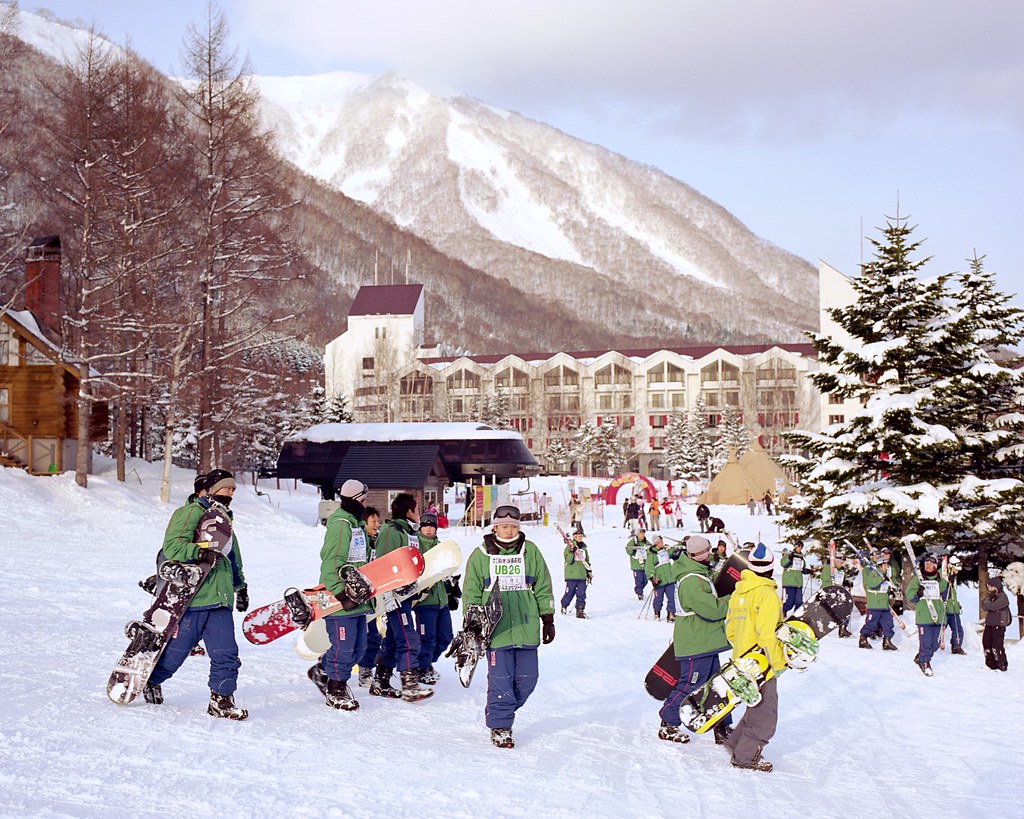
Rusutsu resort hotel. The green-clothed skiers are a high-school tour group, enrolled in a snowboard class. There were lots of school and university student groups staying at the hotel. Unlike working people, students can take time off mid-week for skiing, and they're price-sensitive travellers so cheaper weekday skiing probably appeals to them for that reason too, I guess.
It may sound a little strange to schedule a workshop at a resort hotel, but it's not a bad idea at all. They have a lot of experience handling large travel groups and have very good group discounts; they have much more and cheaper space than cramped city hotels so there's plenty of room for presentations, poster sessions and demonstrations; and they're well provided with restaurants, pubs, shops and the like so people don't need to venture away - and split up - for food or drinks. Most of their business is on weekends, so hosting conferences and tour groups is a good way to fill up rooms during the week.
Rusutsu is a full-service resort. There's a dozen restaurants, cafés, various shops (both souvenirs and actual useful stuff like ski-wear), convenience stores, a bathhouse and swimming pool, conference rooms, playground, equipment rental and ski schools and so on. It's actually two mountains and two hotels, with a cable car and a monorail connecting them. I didn't check the slope maps but the system looks to be fairly extensive and the slopes seemed very well prepared from what I saw.

The cabin main room, at 2:30 in the morning, and some of the students were having a party. Of course, it being graduate students, the talk was mostly about the day's presentations and each other's research.
Our accommodation (I stayed at a log cabin with a dozen other people rather than a hotel room) was breakfast and dinner included; for dinner you got a meal ticket you could use for a dinner course at any restaurant. We had washoku the first night and chinese the second, and both courses were extensive and enjoyable. We only had one hour scheduled for dinner, however, which was too short for these slow-paced meals - we had to skip dessert the first night so we didn't miss the speaker.
There was some time set aside for skiing, but I passed this time. It's still business travel, ski slopes or not, and I had plenty of work to focus on, especially as it was my first time at this workshop. Also, I haven't actually stood on a pair of skis for over twenty years; I'd really hate to miss half the workshop on account of having my leg set and put in a cast. If I return next year, however, I'd love to take a half-day snowboarding course. Never done that, and it looks like fun.
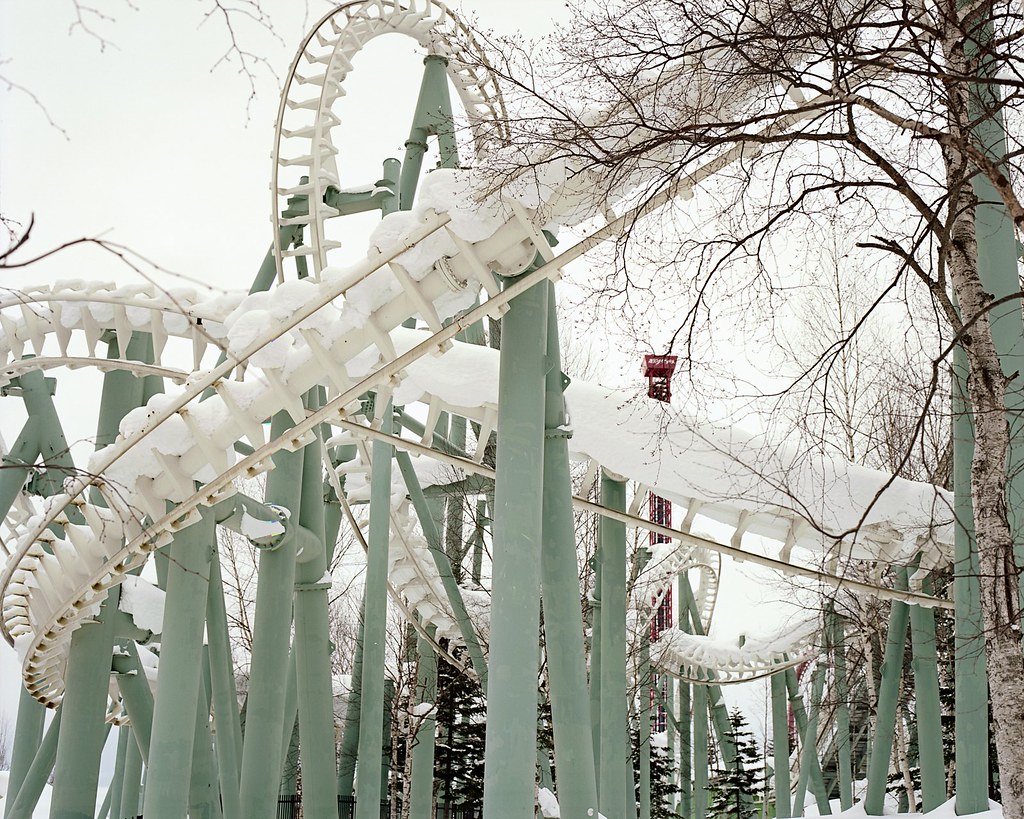
Rusutsu is a summer resort as well, with golf courses, and a large amusement park. The park is completely snowed over in winter but to me that just makes it more interesting. I couldn't get far into the park itself due to the snow; next time I'll rent snow shoes.
Instead, I took some time for a walk and a few pictures. I couldn't get very far with all the snow, but there's still a fair amount of interesting scenery near the hotel. I only brought the Pentax 67 with me, which forces you to slow down and think things through before pressing the shutter. You only have ten images on a roll. The film was Ektar 100, a very fine-detail film with good colour, but as it's fairly slow you're pretty much forced to rely on a tripod for everything but daytime outdoor shots.

The amusement park is pretty large. They have the shrewd idea of buying up the better attractions of closed amusement parks rather than having original - expensive - designs. If you like rides, this is probably a very good place to come in summer.

I love this kind of still winter dusk, when the light is fading and colors are muted. There's no wind and not a sound to stir the moment.
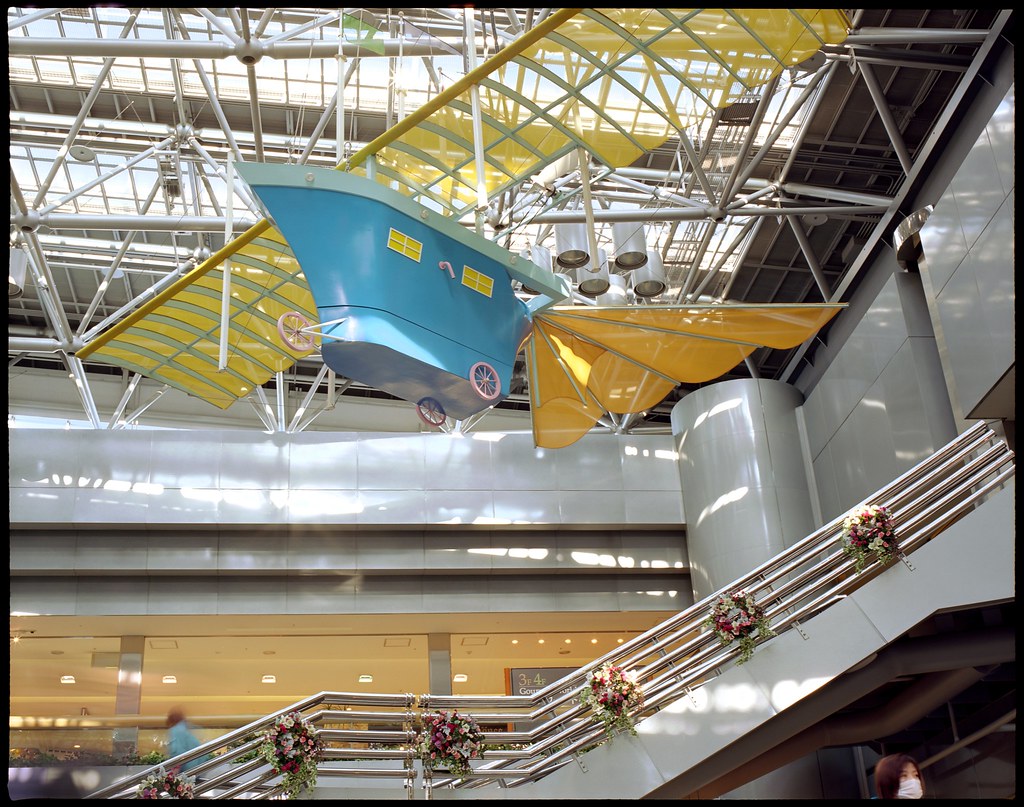
Main hall, New Chitose airport south of Sapporo. This kind of public decoration I like. It's thematically right for the place, and I enjoy the whimsy of taking a child-like design, blow it up to full size and display as if it really could work. It hangs opposite a Da Vinci flying machine-style design; an interesting contrast in imagination, though of course neither would ultimately be able to fly in reality.
Sunday, January 10, 2010
To Hokkaido (again)
I'm off to Hokkaido yet again, next week. This time it's work though; there's a three-day workshop on neuroscience and neurocomputing and we're presenting a couple of posters on our work so far. This workshop is held twice a year and I attended last summer too. It's a fairly informal meeting so it's easy to talk with people and learn about what other groups are doing.
The venue for the winter workshop is Rusutsu, a large winter sports area in Hokkaido. Which sounds glamorous and all, but I'll be bunking in a cabin with five other, completely unknown, people, and I'll be too busy to have any time for any actual skiing. Also, this is a resort-type of place so there's no internet in the cabin, and I can't be sure there's a connection available at the workshop either. On the upside it gives me some truly free time to work on stuff without distraction.
The venue for the winter workshop is Rusutsu, a large winter sports area in Hokkaido. Which sounds glamorous and all, but I'll be bunking in a cabin with five other, completely unknown, people, and I'll be too busy to have any time for any actual skiing. Also, this is a resort-type of place so there's no internet in the cabin, and I can't be sure there's a connection available at the workshop either. On the upside it gives me some truly free time to work on stuff without distraction.
Tuesday, November 24, 2009
Wako Business
I'm off to Wako-shi northwest of Tokyo. Wako is not called "The Pearl of Saitama", the birthplace of no celebrities of note and not the site of a fondly remembered romantic drama from the 1950's that now doesn't draw hordes of visitors eager to walk the same cobblestoned streets as the young couple in the movie, on account of no such movie existing.
Its claim to fame, relatively speaking, is instead the Riken institute headquarters. The research project I'm a small part of is financed through Riken, so it's a natural place for us to hold project meetings. It's far enough that I can't get there the same day; instead I leave this afternoon, stay in illustrious Ikebukuro and take the train out to Wako tomorrow morning. I can just make the last Shinkansen to Osaka tomorrow, which gets me to my front door right about half past midnight. Pretty OK.
If that maglev between Tokyo and Osaka ever becomes reality I'd be able to make this a day trip - more likely I'm already retired by then of course.
Its claim to fame, relatively speaking, is instead the Riken institute headquarters. The research project I'm a small part of is financed through Riken, so it's a natural place for us to hold project meetings. It's far enough that I can't get there the same day; instead I leave this afternoon, stay in illustrious Ikebukuro and take the train out to Wako tomorrow morning. I can just make the last Shinkansen to Osaka tomorrow, which gets me to my front door right about half past midnight. Pretty OK.
If that maglev between Tokyo and Osaka ever becomes reality I'd be able to make this a day trip - more likely I'm already retired by then of course.
Monday, February 2, 2009
New Job
 I don't normally cover work-related things on this blog - I write it as a diversion from work after all - but occasionally work and private life will intersect. The project at ATR I've been working at is ending, and the department is moving into different directions in the coming year. As a result I am leaving ATR and joining a new project. Friday was my last day at ATR.
This is not a sudden development of course; neither is it unusual - project positions are inherently temporary and unstable, and research groups usually change constantly as people join and leave. At ATR for instance, more than half of the people in the group when I first visited almost three years ago are no longer there today. This instability has a lot of consequences - positive and negative - for research groups and people alike, by the way, but that's a subject better covered in a separate post.
My new position will be at NAIST - Nara Institute of Science and Technology - at the Theoretical Life-Science Lab, though I'll be an employee of Kyoto University as the project funding comes through them. The two-year project is briefly to create a neural simulation framework for early vision processes - the optic tectum and oculomotor areas, more or less. Our intention is to integrate this with models of the retina and other areas by other groups and get a complete early perception-action loop implemented. Two years is an ambitious schedule for this sort of thing - I leave ATR early to get a head start - but we'll manage it, I believe.
NAIST is fairly close to ATR, conveniently right on the same train line I already use. It's just one train stop earlier and a little closer to the station so my commute - and my study time - will be about the same as now, at slightly over an hour one-way. I've only visited once, but NAIST seems to be a pretty spacious, well-equipped facility. It's substantially larger than ATR so it has a better library and other shared facilities. The cafeteria seems like a distinct improvement from ATR too; there's just about nothing else around so that's actually pretty important.
Anyway, with a new job I may have my hands full until I get settled a bit; if posting is light in the coming weeks you now know why.
Tuesday, July 29, 2008
How Not To Handle Job Interviews
A person applies for a job as a network engineer. As part of the hiring process he is given a technical questionnaire to fill in at home. He is expected to know the answers (most questions are quite easy), or to use Google or similar resources to find out for himself. Instead of doing so, though, the applicant posts the entire questionnaire on a technical online forum and asks its participants to please fill it in for him.
Hilarity ensues when it turns out the interviewer finds the forum post and tells the applicant not to bother turning in the form any more.
Hilarity ensues when it turns out the interviewer finds the forum post and tells the applicant not to bother turning in the form any more.
Subscribe to:
Posts (Atom)