
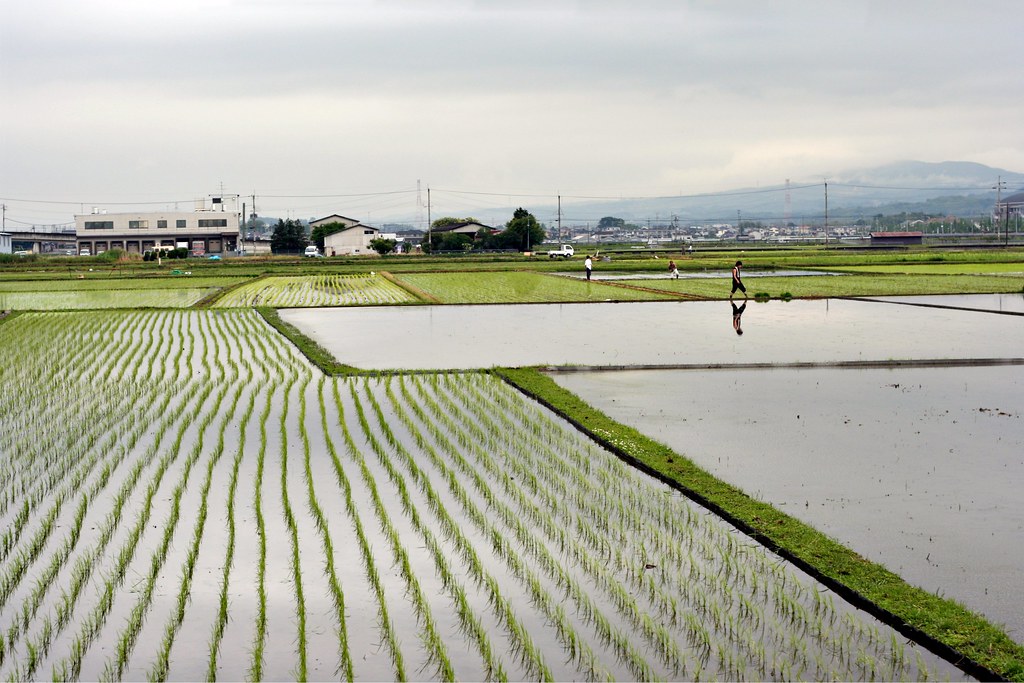
Ricefields in south Kyoto.
Another aspect not touched on in this article is that small farmers are small for a reason - land use and ownership is also tightly regulated. A small farmer can often not build up his operation since local regulations forbid him from owning more land. And land once used for rice production can often not be used for anything else without explicit permission from the local council. And not only does a lot of land lie fallow because of a wish to limit rice production; a fair amount of land is owned by people not even living in the area. They inherited the land from their parents or grandparents, but they are living and working in a distant city, not in their home village. With a sentimental attachment to the place and the difficulty of selling the land a lot of it lies unused. A Yomiuri article last year mentioned that over 10% of members of Japan's farming association doesn't actually farm in any way.
The basic problem - which I brought up here before - lies in that Japanese agricultural policy treats farming, and rice farming especially, as a cultural activity, not an industrial one. Either perspective is defensible up to a point of course. But you can't have it both ways; traditional, protected agriculture will not give you industrial-scale efficiency. And industrial agriculture will not preserve old traditional ways. You choose one or the other, really, and with a self-sufficiency rate at a low
[edit: got the self-sufficiency rate wrong]
