Thursday, October 11, 2012

Working Time


A letter to graduate students from faculty at some astronomy department has circulated on the interwebs lately. Starts With a Bang has a good take on it.

I'd like to highlight just one thing in that letter:

if you informally canvass the faculty (those people for whose jobs you came here to train), most will tell you that they worked 80-100 hours/week in graduate school. No one told us to work those hours, but we enjoyed what we were doing enough to want to do so. We were almost always at the office, including at night and on weekends.

Working 80-100 hours a week — all nights and all weekends? Bullshit. I've been studying or working at four or five separate places so far, with hundreds of people in total, and I've yet to see anybody, faculty or student, keep that kind of pace on a sustained basis. Yes, you may do a 100-hour week or two when it's crunch time. A hard deadline looms large; you're running a time-intensive experiment; or you have limited-time access to some special equipment. A week or two can occasionally be necessary, just like in many jobs. But nobody keeps up that pace permanently, and nobody can.

You can see the occasional grad student staying late every night, always sitting in the lab if you come in on a weekend. In practice, though, they're rarely actually working; they simply find the lab a comfortable, quiet place for web surfing, chatting or online gaming. They may have intended to work, but in practise they don't get much done. Spending 80 hours a week at work is not the same thing as actually working for all that time.

And that's a general truth: trying to work above a set number of weekly hours — around 40 hours or so - will simply add more time for procrastination, not increase your productivity. We can't keep our concentration up for that long on a sustained basis. If you really want to be effective, stick to around 40 hours of sustained, actual work, then use the rest of the time to recharge.

My guess is that those letter writers well know that. They know how much they can work themselves, and some of them may even feel a bit guilty and ashamed that they don't actually work for as long as everybody claims they do. Also, they're likely somewhat misremembering how much time they actually spent working versus time spent playing, talking, drinking beer and just generally behaving like young people in general. If somebody says "You'll have to work 100 hours a week — we did!", then take that advice with a rather large lump of salt.

Wednesday, October 10, 2012

Word Verification

The amount of spam comments continues to increase. I've turned on word verification; let's see if that helps. If not, I may decide to disallow anonymous comments. I'd rather not do that; while there's not a lot of comments on the blog, a number of very good ones are anonymous and I'd like to keep the option open.

Oh, as for the lack of updates, life is very busy at the moment, and I'm ever-so-slowly going through our Hakodate pictures in preparation for a post on that trip.

Friday, October 5, 2012

Last of Summer


It's still warm on sunny days, but no longer unbearably hot. Mornings and evenings already have the crisp, cool air of autumn during my commute, and a few trees are starting to turn red and yellow in anticipation of winter.

It has been a long, hot, stressful summer and I'm glad it's finally over. Let's hope next year will be better.

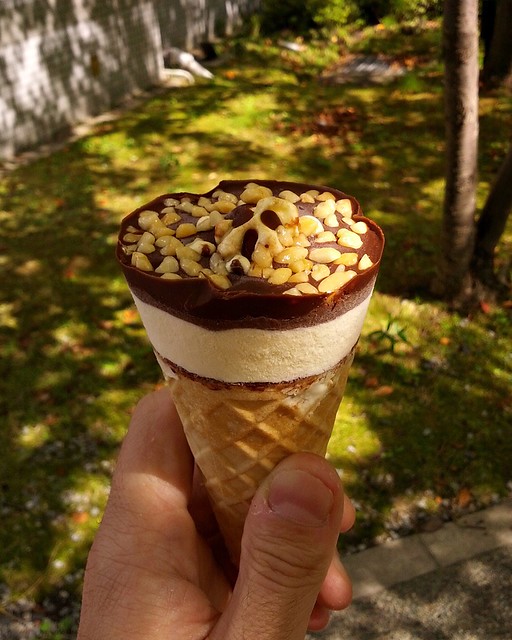
icecream

Last Ice Cream of Summer

Tuesday, September 25, 2012

Ten Years


Test Tubes


It's ten years to the day since I defended my thesis and could call myself a researcher. You do research well before you get your doctorate of course, but this is the "driving license" of science that qualifies you for research jobs, apply for funding in your own name and all the rest.

Science is an apprentice system. Your Ph.D. is your apprenticeship, followed by a post-doc in a different place for a few years to make connections and work independently. After which you get a "tenure track" (to take the US term) job that eventually leads to a full-time position as a lecturer or even a tenured professor or PI.

But there are far more qualified people today than there are positions. That two-year post-doc can now be a decade or more of temporary research jobs. The vast majority of PhD:s will never get a full-time position anywhere. Of course, not everybody enjoys teaching, and a tenured research position is a high-stress job similar to starting, funding and running your own research company. Most young researchers eventually leave for a career in industry or government.

I've had six jobs at four places1 so far, and there is no full-time position in sight. I'm pretty gruntled2 though, and the situation is a deliberate choice on our part. I have neither the interest nor capability to become a PI, and I lack the teaching experience and the Japanese I'd need to be a lecturer. Instead we figure I'll continue to work on research projects for as long as it is fun and as long as I can find new projects to join.

Once I no longer want or can find new research jobs I'll look for something else. But until then I'm quite happy doing what I do, and I hope I'll be able to for the next ten years as well.
 

#1 Administrative shuffling has given me a different employer or title a couple of times, even as the actual project has stayed the same.

#2 That is, not disgruntled. It should be a word.

Friday, September 21, 2012

Busy Busy

I've had one of my busier working weeks ever, as our current project gradually winds down. Did finally get some decent data, so pictures from Hakodate will appear sooner or later, I promise.

Meanwhile, I can happily note that temperatures are finally down to 30° around here, and life starts to feel bearable again. From next week I may bring only one spare T-shirt to work again instead of two. ^_^ Fall is my favourite season and I very much look forward to it.

Monday, September 10, 2012

Sense of Direction, Sense of Place


We got back from Hakodate last week. I'm still dealing with the pictures I took so a post about it will have to wait a while; in short it was fun, the food was great, but the weather too hot.

Meanwhile, something odd happened to me on the subway this morning: I suddenly, without warning, lost my sense of direction and my sense of place.

It was a temporary thing and I'm fine again. I knew where I was — on the subway, standing at Tanimachi 4-chome station, on the way to work. But I suddenly didn't feel where anything else was.

We're constantly moving in an invisible location field of our own making. Face a direction and you just know what landmarks are located that way. And when you recall a particular place in the area — home, a nearby train station, the NAIST cafeteria — you'll intuit the direction and distance without thinking; I experience it almost as if a heat lamp is shining on my face from the right direction. That's how you can walk towards a place without a map and without having to explicitly plan your route every step of the way.

This sense of place suddenly disappeared. I didn't forget anything and I wasn't confused, but I could no longer say what direction I was facing or which direction the train would be moving. I could no longer tell the direction to common landmarks such as home, the previous station or Osaka castle. In fact, I could no longer say anything about what lay beyond my line of sight without explicitly digging through my memories. I could tell what the street above the station looks like only by a conscious effort to recall the stairwell beyond the ticket gate, then follow it in my mind up to the street level.

The feeling wasn't scary, just, well, …odd; similar to a feeling of deja vu, perhaps. I realized we see everything in relation to our location, but now I was experiencing the station, the train and myself without the context of place. It felt liberating in a way, as if I was seeing it all clearer and more objectively without the added clutter of other things in the area. It would be severely debilitating — not to mention frightening — to lose this sense of place permanently, but as a temporary effect it was quite interesting.

The doors closed, the train started moving again, and gradually my sense of place returned. By the time we reached the next station it was fully back and only the odd memory of it remained. Why did it happen? No idea; it's the first time. It's listed as one effect of dementia, but the described symptoms differ from my experience. I put it down simply to stress and lack of sleep.

Friday, August 31, 2012

Akashi

Summer is soon over. I'm taking my summer vacation late, and we're going to Hakodate for three nights beginning tomorrow. The plan was that it'd be pleasantly cool by now; as it turns out it's still almost 30° there, so while it's better than in Osaka it's not by much.

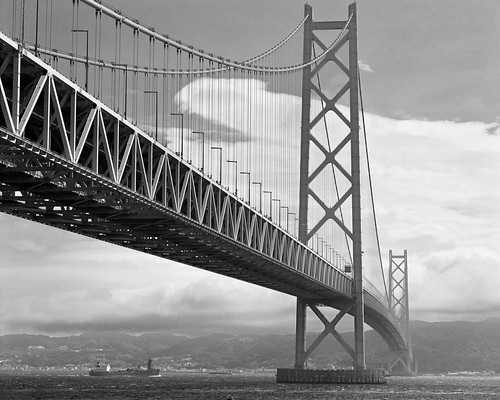
Meanwhile, here a few shots from a day trip we did to Akashi Kaikyo Õhashi earlier. Spectacular bridge.

Akashi Kaikyō Ōhashi
Akashi Kaikyou Õhashi - Akashi strait Great bridge. And great it is, absolutely huge close up.

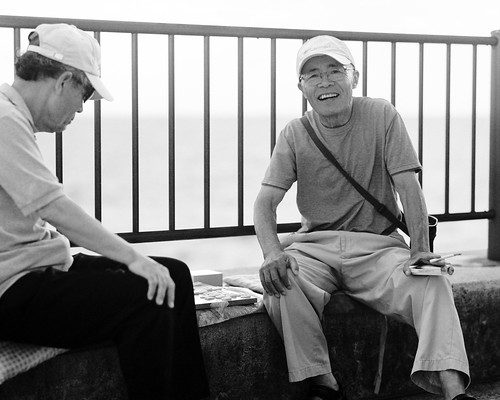
Shōgi
Shōgi players in the shadow of the bridge. The foot of the bridge is a park of sorts, with seaside walks, museum and exhibition and so on. There's quite a lot of people around, including a group of elder men that spend their time smoking and playing Japanese chess in the cool breeze and shadow under the bridge span itself.

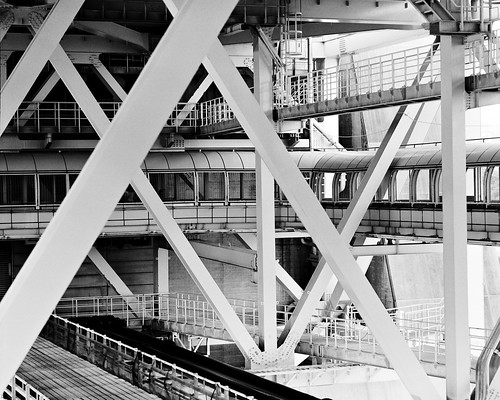
Akashi Kaikyō Ōhashi
Inside the bridge span. The span is huge, with another dedicated roadway inside for repairs and emergency vehicles. And there's a covered walkway inside, leading to a observation deck complete with cafeteria and souvernir shop.