Sunday, May 6, 2018

Golden Week

Golden Week — the string of back-to-back national holidays — is almost over. We spent it in Osaka, mostly doing nothing in particular. I'm returning to Okinawa today, while Ritsuko stays in Osaka for another week.

I've taken a lot of pictures as usual, but you're mostly not going to see them in this post. It takes weeks for me to get around to prepare digital images, and this time around it'll be even longer. I brought my Pentax 67 and challenged myself to use only the 45/4 lens (about equivalent to 24 mm on a 35mm camera). It was a lot of fun and I hardly used the digital camera at all. But it will be some time before I will get around to develop and scan the film.

Instead I will post a mix of images from this and earlier visits to Osaka. I've been really bad about doing this lately, and I have a lot of pictures from February, from the New Year and even from last summer. If a picture seems surprisingly wintery you now know why.


That is the largest USB port I've ever seen.


Golden Week is the main travel holiday in Japan, alongside with New Year. Fortunately, people mostly travel to Okinawa for holidays, rather than away from it, so it's fairly easy to get an airplane seat to Osaka at the start, and back to Okinawa at the end. Osaka itself is crammed to the rafters with travellers, however. The multi-year boom in South-Asian tourists shows not sign of stopping, and Golden Week adds trainloads of domestic tourists. Everywhere is busy.


Unfortunately, the tourist influx is turning some areas into tourist traps. Shinsaibashi shopping street used to be a pretty good mix of small shops, restaurants and a couple of large department stores. But the southern part of Shinsaibashi is turning into a desert of back-to-back souvenir shops and drug stores. Chinese tourists especially love buying medicines and make-up here, because it's tax-free and possibly because the merchandise is guaranteed to not be fake. But that change, and the hordes of suitcase-wielding tourists clogging the streets, have chased away most local shoppers.

The Kuromon market is even worse. It used to be a food market catering to restaurants early in the morning and locals in the afternoon. But local people I know (my wife included) have all given up on shopping there, and many of the wholesalers have moved out altogether (they've mostly moved to Nishi-ku). With a few exceptions, what's left is hordes of tourists and stalls mostly selling snacks and fast food.


One trend among Chinese tourists: Come her with an old, half-broken suitcase with your stuff. Buy a brand new set of luggage for all your tax-free shopping, then throw away your old bag somewhere. Can leave it on the street, throw into somebody else's garbage or whatever - never mind that it's illegal and may cost someone money to dispose of your stuff. Make sure to throw away any cardboard boxes you don't need as well. It will become somebody else's problem.

People I know here are for the most part tolerant and open-minded. But the behaviour of the Chinese travellers could tax the patience of a saint. They are not winning hearts or making friends to say the least.


People are no doubt making good money selling aspirin, moisturiser and grilled-things-on-a-stick to travellers. But when the original stores and the locals disappear, so do the very things that made these places — Kuromon market especially — attractive to tourists in the first place. And when the tourists inevitably tire of the commerce and abandon these areas, we'll be left with a desolate shutter street. I'm really afraid that Shinsaibashi and Kuromon will turn into grisly object lessons on the folly of chasing short-term profits rather than planning for the long-term.


Umeda, Osaka.


I spent most of my time just walking. I'd wander from Shinsaibashi up small side streets up to east Umeda where I visit the Junkudo bookstore, amble through central Umeda and have lunch, then walk down south again by early evening. It feels great, but I realized I'm seriously out of shape. I could easily walk all day with a heavy camera bag before moving to Okinawa; but after a year with a car I now have to sit down and catch my breath every hour. Not good, not good at all. I need to find some way to fit a bit of daily exercise into my life.


When you're in Osaka this is perfectly normal. She could be on her way to a masquerade or to the office. It's hard to be sure.

As you know, Ritsuko took her driving license this winter. She really enjoys driving — so much, in fact, that we rented a car for a day and drove to Kobe. Well, she drove; I didn't get to touch the steering wheel. Which is fine by me, as I rather sit in the passenger seat and play with my phone and look at the view.


Most Indian restaurants in Japan are north-Indian or Nepalese. Madras Kitchen in Kobe is a south-Indian restaurant, and it is very good. It's one of the Indian places we alternate between whenever we visit Kobe. Here a Dosa with a selection of curry toppings.

It's not hideously expensive (8000 yen in all for a day) but it's also not very fast. Oh, driving to Kobe is faster than taking the train, but with searching for a parking spot for half an hour, then walking to your destination it's really faster to just take the local train. That wasn't the point for us of course. Ritsuko got her driving fix and we got to see parts of Hyogo we wouldn't normally visit.

Pedestrians and bicyclists in Osaka seem to view traffic regulations as quaint traditions you can follow or not as you will. But overall it's actually easier to drive in Osaka than in Okinawa. The streets are fairly wide and straight, and people are far better drivers. Okinawa drivers tend to ignore stop signs and red lights; cut in front and weave uselessly through traffic; drive _really_ slow or very fast; break and accelerate strongly and suddenly without warning (looking at you Y-plate cars) and just generally drive poorly. Osaka traffic is much better behaved.


Henrietta is a bar and ice cream parlour in Tsuruhashi. It's run by Benjamin, the guy on the left, and it's become one of our favourite places for a bar night out. Me on the right, and a lovely couple that used to run a bar in Shinsaibashi in the center. It's a really fun, relaxed water hole; I can recommend it.

Ice cream, by the way? Yes, absolutely. On weekends it's open in the afternoon as well, and they have a selection of very good ice creams sourced from a small maker in Kobe. Do try the Pistachio; it's absolutely delicious.


We spent a lot of time eating and drinking well of course. A couple of relatives invited us over for tetchiri, or fugu hot pot. I'd only had fugu sashimi once many years ago, so this was a first for me. You order a fugu from the fishmonger and they prepare it for you. It really uses all of the fish: the most tender flesh became sashimi, while the rest went into the hot pot with the bones. The skin is thinly sliced and vinegared and served as an appetizer. Even the fins are used: dried and roasted, then steeped in hot sake for flavour. Excellent.


Umeda Sky Building


We're going back to Osaka together again in August; I will at least try to process my current images before then.

Thursday, April 12, 2018

Spring? Summer!

Life is good right now. We had some happy family news just recently; and the weather here on Okinawa sprinted from a chilly winter, right through spring, and into early summer over the course of a few weeks.


Spring in Okinawa is a pretty subtle thing; the winter is just as green and almost as warm as the other seasons. You barely notice that spring has started.


I'm surprised just how rare it is to get fog here. I expected it every few weeks or something but apparently not. When it does roll in, though, it's plenty heavy. I was happy I didn't have to drive to work this particular morning.
Ritsuko is taking every chance to practice driving with her new license, so lately we've spent our weekends on the road. We've been visiting areas all along the coast, usually for lunch and a leisury afternoon in the sun before we head back again.

Almost all hotels and resorts let people use their beaches (I suspect the beaches may legally be public property), and many let you park for free as well. There's always a cafe or something like that around, and quite a few hotel restaurants serve lunches at very reasonable prices. It's still too early for the main tourist season so it's never crowded.


I'm taking a rest near Mirai beach.
It's plenty warm enough in April to sit outside in a t-shirt and sip ice coffee; on  sunny days you may actually want to get out of the sun to avoid getting burned.

Beaches all open around the beginning of April. I swam at Mirai beach two weeks ago, and it felt great. The sea is still a bit chilly but you quickly get used to it, and as long as it's sunny you don't feel cold. The weather is still unsteady, though, so you can't really plan for a beach holiday just yet.


Moon beach. Beautiful weather and no crowds.


Spring sea.


Thursday, March 29, 2018

Fish gratin!

Every so often — once a month or so — Ritsuko goes to Osaka while I stay here in Okinawa to work. It works really well; she visits our relatives and meets her friends in Osaka, while I can geek our with computer games and hobby projects(1)  here in Naha.

And I can cook any food I like for myself. Ritsuko is in Osaka this week; I had a can of cooked salmon at home, and I just realized that I haven't had a real fish gratin in years and years. It's easy to make and it's a very forgiving dish, so you can easily substitute ingredients. It took only an hour from stepping through the door to sitting down for dinner, and I managed to take a shower and hang the laundry as well.

I took some cooked salmon (you could just fry or steam a bit of raw salmon filet), about half a broccoli, two potatoes, and some milk, shredded cheese and fresh dill for the sauce.

Peel and boil the potatoes for potato mash. Meanwhile briefly boil or steam the broccoli bouquets, just enough that they soften a bit.

Make a bechamel sauce on about 150cc milk. Add the fresh cut dill, take off the heat and mix in the grated cheese.

Make the potato mash with the remaining milk, butter and salt, pepper and nutmeg to taste. Make it a little toward the soft or runny side.

In a oven-proof container, spread the mashed potatoes on the sides.

Assemble the bits, with the mashed potatoes around the rim.

Add the salmon, in bite-sized pieces, then the broccoli in the center.

Mix in the sauce. Make sure no fish sticks out (it burns easily) and that the vegetables are covered with the sauce. The mash looks better without.

Pour over the sauce, and gently mix the sauce, the broccoli and the salmon so it's all covered.


Finished! I would perhaps give it a little bit more colour next time.

Bake in a hot oven (220°-240° or so) for about 20-25 minutes until it takes colour. It's all cooked already so it just needs mixing and heating up.


Dinnertime. A simple salad goes well with the heavy gratin.

It was tasty! I can't believe I've waited this long to make it again. The trick here is really that the fresh dill mixes with the flavour from the fish as it bakes. You can use any firm fish, really, but cod and salmon are common.


1. Not to mention practice the ukulele out of her earshot...

Wednesday, February 28, 2018

Congratulations!

Beginner Drivers' Mark
My wife Ritsuko has just taken her drivers license. She took the driving test a couple of weeks ago, took the written test yesterday, and she passed both on the first try!

And as it happens, today is also her birthday! Congratulations!

Although taking your license the day before your birthday is not, perhaps, the best possible timing. Had she waited another two days, her license would be valid for a whole extra year before she needs to renew...

But no matter. I see a glorious future ahead of me, a future where I can sleep or read email in the passenger seat while she practices her driving :)


In other news, it's the end of February, which means that spring has arrived on Okinawa. Flowers are blooming, the weather is turning warm(er), and half the office has started wearing kariyushi shirts again. We'll be back to sweaty, humid summer heat again soon enough, but for a little while at least it will be pleasantly warm, dry and comfortable.


Fukushuen
is a Chinese garden in Naha. Very pleasant and quiet. It's a perfect place to visit now in early spring, before it gets too hot and too crowded. This model and her photographer apparently had the same idea.


Fukushuen


Fukushuen


Pokemon Go player on his lunch break outside the Naha city hall.


Had an errand to run in Onna village over lunch, so I got a supermarket bento on my way back and had lunch outside by the seashore. Relaxing.


Thursday, January 25, 2018

Internet, Oh Glorious Internet

We finally have internet again! It took four months, two visits, and a construction approval to get our fibre-optic connection, and we finally did. I spent the first hour running OS updates on all our machines while grinning from ear to ear.

Four months may sound ridiculously long. But in all fairness, we could have gotten a network connection through a cable-TV company in two weeks or less. That would have had a pretty bad upstream speed, though (6Mbit/s), and we wouldn't have had IP telephone (which Ritsuko uses a lot).

A real fibre-optic connection gives us a high-speed, low-latency bidirectional connection and IP telephone for slightly less than the cable-TV connection would have cost. But our building is a bit weird, and there is no existing fibre network on the upper floors.

This is a mixed-use building, with a television company as the main tenant. There's a TV-mast on the roof and everything. Every cable conduit in the building is already full with cabling, and rerouting other things to make space would risk disrupting the businesses renting there. They had to run our fibre up through an elevator shaft, then drill through the walls for a conduit into our apartment. I'm surprised and grateful they agreed to do it at all. Total installation cost? 1500 yen... I almost feel bad.

Anyway, a quick test showed me getting about 140Mbit/s down, and 250Mbit/s up, with a 54ms latency. Not as good as we had in our previous place, but more than good enough. It should vary a lot by time of day, and weekday evenings, when I tested, tend to be slow. I'm happy.

Sunday, December 31, 2017

Happy New Year

Happy New Year


The Year of the Dog.

Janne and Ritsuko

Summer Vacation: Singapore

It's New Year, and we're spending it is Osaka. That means I've got access to a real internet connection again for a change. What better time to post about our summer vacation?

OIST has a 7-day summer leave that we can/must take in August or September. That's also the peak tourist season on Okinawa, so we decided to escape the crowded beaches for the streets and high-rises of illustrious Singapore.


Singapore.

This was the first time in Singapore for me, and I didn't really know what to expect. Everybody keeps saying that the food is great but the city itself isn't too exciting. We mostly travel for the food anyway, so we figured it was worth a shot.


Cafe.


We had to go there on a roundabout route: Naha to Osaka, then another 7 hour flight from Osaka to Singapore. It's _really_ roundabout; we passed right over Okinawa and Naha again two hours into the second flight. Fortunately Jetstar (an LCC) have now started direct flights between Naha and Singapore, so it'll be much easier next time we go.


"I can see my house from here!" Not quite; this is Taketomi island in the western part of Okinawa. We did pass right over Naha, but I didn't get a picture.

Singapore is about half the size of Okinawa island; that's small of course, but still a lot bigger than I thought. I'd somehow assumed that Singapore was just a city state, but there's clearly (a bit) more to it than that. It is completely dominated by the city, though, and we didn't see any other part of the country.


A well-groomed park near Newton. This is about as close as we got to actual nature during this trip. Not that we ever go looking for it of course; we travel to cities for a reason.

There's not a lot of nature, but there is a lot of greenery. Singapore is right on the equator after all, and the city is very lush and green. Very pleasant.


Singapore has a lot of manufacturing industries, one of the largest seaports in the world, and is one of the major financial centers. Over 25% of the population are immigrants, ranging from Malaysians cleaning hotel rooms to expat European bankers. It is also the richest city on the planet. This means a lot of in-your-face conspicuous consumption. It gets a little silly at times.

Corporate towers and high-end apartment complexes have (very visible) flourishes such as roof-top gardens, light shows and terraces. Expensive cars are _everywhere._ Some people desperate for attention resort to painting their million-dollar Ferraris and Lamborghinis in loud colours and patterns just to stand out from the crowd.


We stayed at Goodwood Park Hotel. A nice resort-style place right in the city center.

Your humble correspondent in front of some shopping mall or other. Which one doesn't matter; they're all lined up cheek to jowl, and all with the same worldwide brands.


Cars, by the way, cost 3-5 times more than in Japan, and you need to bid for one of a limited total number of permits. Singapore also has excellent public transport, with a dense network of subways, buses and local trains. And if you live in the city itself, you are apparently only allowed to drive every other day, so you can't even rely on your car for your daily transportation. Unless you're driving in from outside the city, a personal car is really a pure status symbol.

Salary levels are high, but so are living costs. I may be wrong, but I get the impression that "keeping up" with other people by having the right car, home, schools and so on is very important here.


The subway is clean, neat and efficient.

A nap in the midday heat.

Coffee break.


We largely spent our time around the city center, walking or taking the subway to the different areas. There's an enormous variety of very good food for any budget level here. Singapore is mostly ethnically Chinese but there are sizeable Indian, Arab and Malay minorities, and they each leave strong impressions on the culture and foods in the city.


A lot of the good food is in outdoor food courts like this one. As a guess, these were originally actual open-air food stalls like you can find all over Asia, before they got regulated away and moved into fixed storefront locations like this.


Noodles and pork.


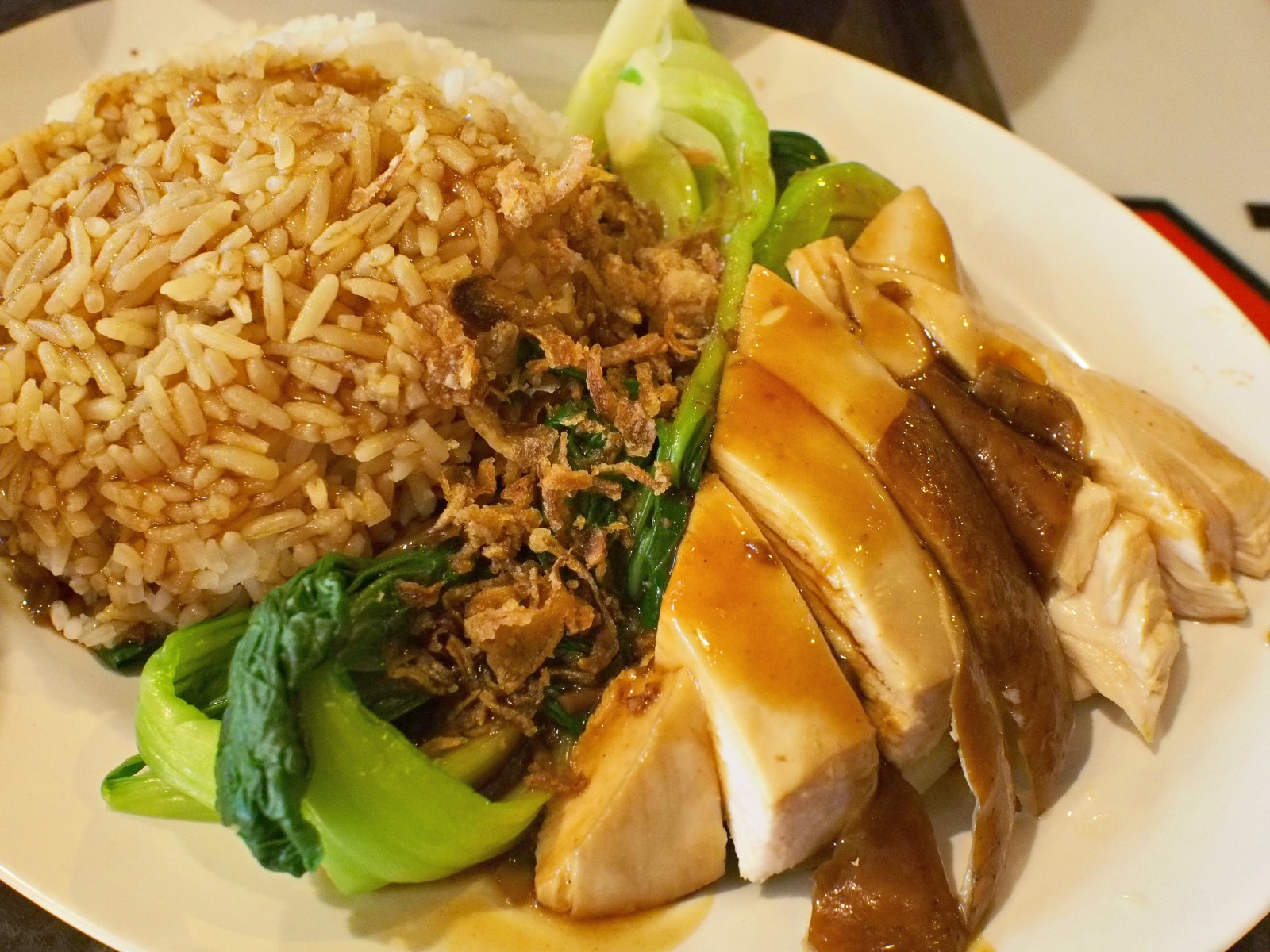
Chicken rice. The point here is the flavoured rice; some people apparently like to order chicken rice without the chicken.

Fish market in Chinatown.


Dinner time. Laksa, stir-fried vegetable, fried rice and fried spring rolls. Like Singapore itself it's mostly Chinese with a strong influence of Malay cuisine.

We spent a few days around Little India and Arab Street, where we had Indian and Arab food. Unsurprisingly, the most fun is the cheaper eateries where the focus is on the food itself rather than class and ambiance.


The Sultan mosque in the Arab section.


Good food this way. Or any way; while it varied a lot, we didn't have a single truly bad meal during this trip.


Super Star Hair Cut. Little India.


Outdoor lunch in Little India. The food came on a piece of baking paper right on your tray, you ate it with your fingers — and it was perhaps the single best thing we ate during our stay in Singapore.


Wherever we go, we try to find the time for a cooking class. It's a fun way to spend a morning, and a good way to learn a little more about the local food traditions. More often than not we also come away with a recipe or two we put into rotation at home.


The Food Playground cooking school. A small group of students, an engaging and knowledgeable teacher, and we got to do most of the prep work and cooking ourselves. It had a very similar kind of vibe to Hanoi Cooking Centre (in Hanoi, obviously), our favourite cooking class so far. I can warmly recommend this place.


Our chicken curry with roti jala. We've made this a couple of times since, and it turns out great.


My biggest disappointment was electronics. I'd hoped that, as one of the major electronics manufacturing and trading centers, I'd be able to find fun offbeat stuff and cheap devices. But overall, things such as laptops, computer parts and circuit boards were actually more expensive in Singapore than in Osaka or Tokyo; and the parts stores had nothing I couldn't just as easily find at home.


Apartments. Hanging the Singaporean flag is something you do, apparently.

Little India.
Coffee break.


Nighttime on Arab street.

The city itself is beautiful and colourful, but, well, bland. It's organized and regulated to within an inch of its life. This is really the first Asian city to make Japanese society feel excitingly spontaneous and unpredictable by comparison. It's the kind of place where warning signs have warning signs. I won't say it's downright boring, but I don't feel very compelled to take pictures when even the street views seem carefully preplanned and designed.


Apartments.


Mural in Little India.

A bridge fundament. I like the shapes.


Is it worth going? If you like food, then yes, absolutely. The reputation as a food center is well deserved. If you expect an exotic experience or an Asian atmosphere you may be disappointed. And if you like shopping you'll just find the same brands, at the same prices, as absolutely everywhere in the world. But we like food, and for that we will certainly return.


Umbrellas.