I have an Xperia Z tablet. I've had it for three years now, and I'm as happy with it now as I were when I first wrote about it. Speedy, tough and extremely light.
Except for one thing. For whatever reason, this particular model (SGP312), with this particular Japanese version of Android, haven't had an update in two years. This is especially surprising as Sony Mobile is pretty good at keeping older hardware updated, and as other country versions of this tablet still get regular updates.
The last year has seen several serious security issues with Android, and many older devices got updated to Android 5.1.1. this autumn. I'd very much like it on my tablet as well, for peace of mind if nothing else.
Fortunately, Sony Mobile is pretty enlightened when it comes to giving you access to your own hardware. Many manufacturers will go to great lengths to stop you from unlocking or changing their products in any way. But Sony will help you unlock your phone, and even provides information to custom system makers to help them do a better job.
So, while I ideally would have gotten updated automatically, with a Sony tablet I can at least do it myself without jumping through too many hoops.
If you look up how to update manually on the net, chances are you'll encounter a nightmare of complicated, conflicting information. Long, convoluted instructions that have you manually unlock and root your tablet, install recovery software, download custom system images from sketchy Russian file servers and so on.
But all this is completely unnecessary. We have some simple, reliable tools around today that will easily let you download and install official system images, even if they haven't been released in your part of the world yet. They'll even root your device for you if you want.
So here is my quick guide to updating your Xperia device, using Ubuntu 15.10. If you're a Linux user, like me, you will find the process a bit unsettling. Instead of just installing the software with the software updater, you need to visit different web sites and download packages from file sharing sites, blindly trusting you're not downloading something bad. Apparently Windows users do this all the time.
You need two applications, both of which are cross platform and work on Windows, Linux and OSX:
The first application is XperiFirm. It's a download tool for the official Sony system versions for all Xperia devices. It's like the official "PC Companion" application, except that it lets you download any official system version no matter what device you have.
Follow the explanations on that page — download the file, install mono and the ssl certificates, and run the tool. Select your device type and device, and choose the specific system variant you want. If you select one of the available variants, you'll see the latest release version available.
The variants mostly differ by region in the world, but sometimes there's also carrier-specific versions here. In the screenshot above, I've selected "SGP312 Wi-Fi" on the left, and I've looked at the "EU4" and the "Japan" variant. As you can see, the latest Japan release ("10.3.1 ...") is a lot older than the EU4 ("10.7.A ...") one — that's exactly my problem.
Which variant to pick? For phones it can matter, since different variants set up the mobile phone hardware for different regions. A variant for Europe may have trouble getting a good connection in Japan. For tablets it's not really important. The difference is mostly things like the default language, installed extra apps and things like that. You can really pick any one you like. I picked EU4 for no particular reason. Click the version number up in the right corner and it will download the firmware.
Once done, we need to package the firmware and install on the tablet. For that we need a second application, called Flashtool. It's just a little cumbersome to install, but follow the instructions and we're good to go.
First, make sure Linux will recognize your Sony as a valid USB device (Windows and Mac users need to install a driver that basically does the same thing):
$ cd /etc/udev/rules.d
$ sudo gedit 51-sony.rules
In the file, add the line:
SUBSYSTEM=="usb", ACTION=="add", ATTRS{idVendor}=="0fce", ATTRS{idProduct}=="*", MODE="0777"
Save and exit. Restart the USB device manager:
$ sudo service udev restart
Download Flashtool. Follow the "Linux" link for the latest release. At the time of writing, you first download 0.9.19.8 — just click on the Torrent link and when Ubuntu asks, select the default "Transmission" as the app to use. The download will start after a while. Unpack the file:
$ 7z e flashtool-0.9.19.8-linux.tar.7z
(If you don't have "7z", install it with 'sudo apt-get install p7zip').
Now, dowload the 0.9.19.10 'patch' from the page above (this might not be available, and not necessary by the time you read this). It's a file called 'x10flasher.jar'. Just move it into the Flashtool directory where it replaces the existing version:
$ mv x10flasher.jar Flashtool/
On your tablet, go to "developer options" at the bottom (tab "build number" in "about tablet" repeatedly if you don't have that) and activate USB debugging. Go to "Security" and activate "Allow unknown sources". Connect the tablet to your computer with an USB cable. Start Flashtool:
$ cd Flashtool
$ ./Flashtool
Select Tools-> Bundles-> Create. In "Select source folder", select the directory full of files you downloaded earlier. It's named something like "SGP312_VMo EU1_1273-3865_10.7.A.0.222_R4E". For device, branding and version you can probably put anything you want, but it's a good idea to enter the right values — "SGP312", "EU1", and "10.7.A.0.222" for instance — so you know what version it is. Select all in the folder list and press the right-arrow button to say that everything in the bundle will be installed.
Click the lightning bolt (flash device), and select "flashmode" in the popup. You get a window looking much like this:
Pick the directory where you downloaded the firmware earlier. Pick it in the list (here I have two different ones). I left all other options at their defaults. Press "Flash" and follow the on-screen instructions. Basically you need to put your tablet or phone in flash mode, and how to do that differs a bit.
After a long while, the process will finish. Reboot and enjoy your new version!
Flashtool can do a lot of other useful things. It can unlock your device, it can root it, and you can remove things you don't want from the system image. I haven't tried any of these functions, and don't know how well they work. I would recommend not doing any of these things unless you actually need to. Some Sony software (like the camera, for some models) don't work properly with a rooted device, for instance. And if you remove something important from the firmware by mistake your tablet will fail to boot.
How is the update itself? I updated from 4.2.2 to 5.1.1. There's some visual tweaks and changes, and the operating system itself has no doubt seen a lot of internal improvements and bug fixes. My main reason for updating is the security fixes.
But the most significant change I experience is the keyboard. The Sony International Keyboard is great; it lets you use more than one language (such as Swedish and English) at the same time and gives you typing suggestions for both. In version 5 the keyboard is much better, with faster, more accurate suggestions.
The Japanese keyboard has also improved a lot, and now lets you input text by drawing kanji and kana by hand if you want to. It no longer defaults to romaji every time you select it, but remembers the state you used last. Switching between keyboards also feels faster and smoother than before.
The on-screen keyboard is the primary way to input text, and improvements here have a big impact. I'm happy I could update for this reason alone. Well worth spending my day off on this.
Sunday, December 13, 2015
Wednesday, November 4, 2015
An easy way to cut smartphone bills by a third (if you live in Japan)
I have a post up on Japan Mobile Tech on how I cut my smartphone cost to
less than 1/3 of before — from 7500 yen to 2000 yen — while keeping the
same service on the same physical network.
The trick? Split voice and data into separate subscriptions. I got myself a brand-new flip-phone as my actual phone, and changed my Docomo account to a FOMA voice-only account. 1050 yen a month in total.
Then I got a data-only SIM from IIJmio for my smartphone. That's 935 yen a month for 3GB. We can keep our free family calls on Docomo, while paying only a fraction of the data cost. And IIJmio uses the same physical network as Docomo, so there's no practical difference in reception or data speeds.
In all, I will save about 100 000 yen over the next two years. Not bad for a bit of creative contract juggling.
The trick? Split voice and data into separate subscriptions. I got myself a brand-new flip-phone as my actual phone, and changed my Docomo account to a FOMA voice-only account. 1050 yen a month in total.
Then I got a data-only SIM from IIJmio for my smartphone. That's 935 yen a month for 3GB. We can keep our free family calls on Docomo, while paying only a fraction of the data cost. And IIJmio uses the same physical network as Docomo, so there's no practical difference in reception or data speeds.
In all, I will save about 100 000 yen over the next two years. Not bad for a bit of creative contract juggling.
Thursday, October 8, 2015
Meopta Flexaret test roll
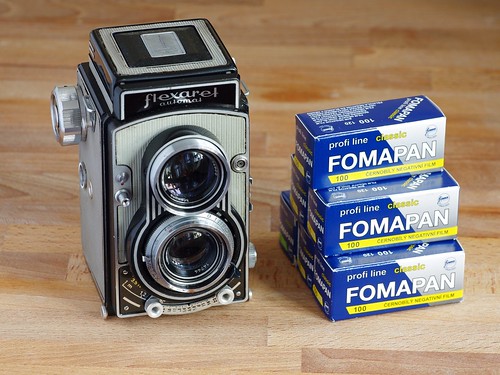
Remember that Meopta Flexaret I brought with me from Prague? This one:
I scanned the roll from it a while ago. I used Fomapan 400, an old-style black and white film; and the camera itself is older than me. Developed them in Rodinal, my current go-to developer.
As expected, the pictures are subdued, almost dreamy. There's not a huge amount of small detail — the lens probably doesn't resolve all that well — and the camera is fairly sensitive to direct light. Flare seems to be a common problem for TLR cameras in general. The pictures really look and feel like they're from a different era.
Unfortunately, I neglected to lock the back properly at first (you need to screw in the little locking knob on the left side). The back opened at one point, costing me a couple of frames. And a couple of pictures are of Ritsuko, which I don't post in public. That leaves me with a total of three shots left to show you:
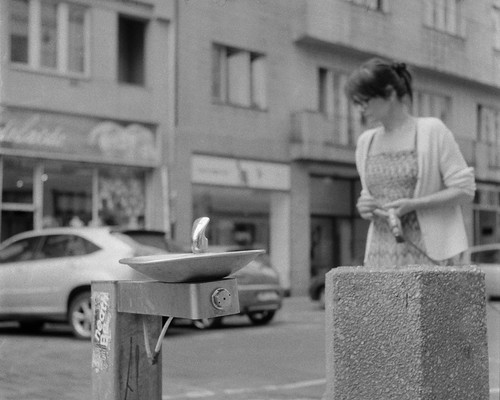
This is very typical of what this camera and film combination will give you. Soft light and smooth gradations. Not a great deal of fine detail and not a lot of micro-contrast. The grain with this film — using Rodinal especially — is fairly noticeable. You capture structure both in the deepest shadows and the brightest highlights, and tones are very kind to human subjects. This makes for a very nice old-style portrait set-up I think.
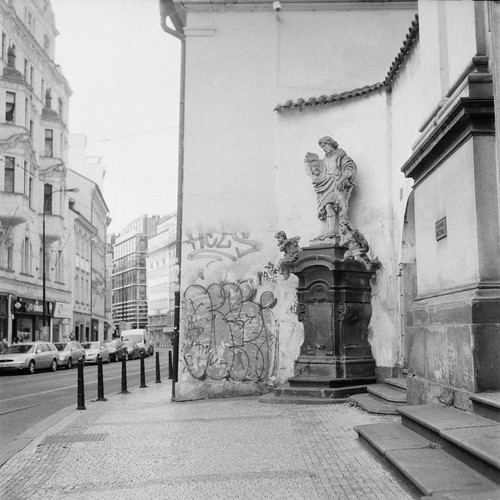
OK, so the picture is meh. I don't really think this old look works here. The contrast is low already in this scene, so it ends up flat and dull. With a higher-contrast film and camera (Delta 100, for instance) there would have been enough variation in the light around the statue and wall to make it interesting.
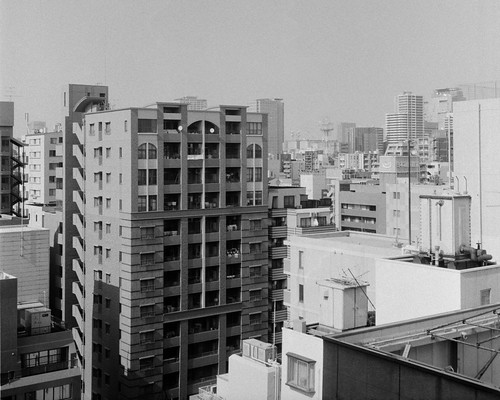
My standard shot from the balcony. I really like this one. The chaotic, contrasty jumble of sunlight and shadow becomes smooth and restful. Quiet and still, with lots of small things happening if you look closely. This has become one of my favourite shots of this scene. I might have to try printing this and see how it looks on paper.
Overall, the camera works quite well. The shutter speeds are not hugely off, and the finder and controls all work. There's some flocking sticking into the exposure area, but that's easy to fix. The Fomapan 400 is an excellent choice if you want this old-style look. I want to try a roll of Delta 100 or something like that next time, see if I can coax a bit more contrast and detail out of this lens.
A fun camera. Happy I got it.
I scanned the roll from it a while ago. I used Fomapan 400, an old-style black and white film; and the camera itself is older than me. Developed them in Rodinal, my current go-to developer.
As expected, the pictures are subdued, almost dreamy. There's not a huge amount of small detail — the lens probably doesn't resolve all that well — and the camera is fairly sensitive to direct light. Flare seems to be a common problem for TLR cameras in general. The pictures really look and feel like they're from a different era.
Unfortunately, I neglected to lock the back properly at first (you need to screw in the little locking knob on the left side). The back opened at one point, costing me a couple of frames. And a couple of pictures are of Ritsuko, which I don't post in public. That leaves me with a total of three shots left to show you:
This is very typical of what this camera and film combination will give you. Soft light and smooth gradations. Not a great deal of fine detail and not a lot of micro-contrast. The grain with this film — using Rodinal especially — is fairly noticeable. You capture structure both in the deepest shadows and the brightest highlights, and tones are very kind to human subjects. This makes for a very nice old-style portrait set-up I think.
OK, so the picture is meh. I don't really think this old look works here. The contrast is low already in this scene, so it ends up flat and dull. With a higher-contrast film and camera (Delta 100, for instance) there would have been enough variation in the light around the statue and wall to make it interesting.
My standard shot from the balcony. I really like this one. The chaotic, contrasty jumble of sunlight and shadow becomes smooth and restful. Quiet and still, with lots of small things happening if you look closely. This has become one of my favourite shots of this scene. I might have to try printing this and see how it looks on paper.
Overall, the camera works quite well. The shutter speeds are not hugely off, and the finder and controls all work. There's some flocking sticking into the exposure area, but that's easy to fix. The Fomapan 400 is an excellent choice if you want this old-style look. I want to try a roll of Delta 100 or something like that next time, see if I can coax a bit more contrast and detail out of this lens.
A fun camera. Happy I got it.
Wednesday, September 23, 2015
Sweden
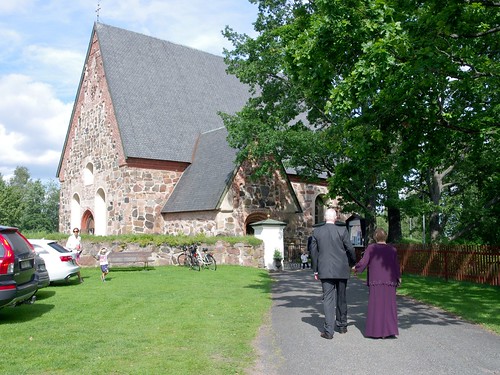
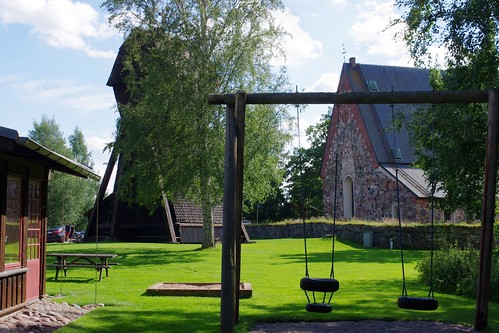
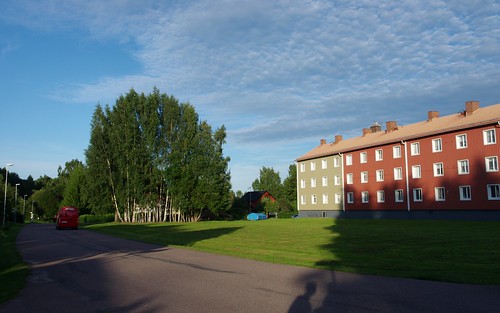
Long trip this summer, first to Borlänge in Sweden, then to Istanbul in Turkey. The reason for Sweden was my brothers wedding. Per and Sanna have been together for many years already so it's not really a major change in practice, but it's a fun reason to bring family and friends together. And it really was fun. I don't get to see my relatives very much, and this was a rare chance. I met some I haven't seen for many years, and made a couple of new friends as well.
Torsång church, with my parents. It's an old church, and insanely popular for weddings. I noticed there were another two weddings booked the same day.
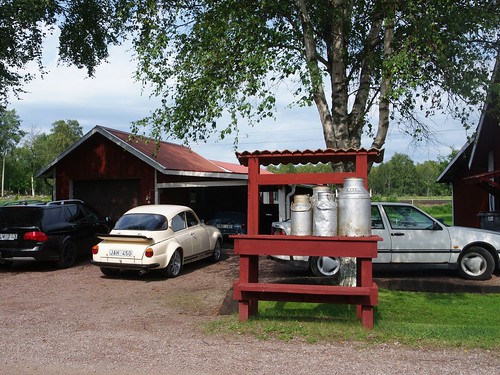
Rural Dalarna. The milk stand and metal canisters are almost certainly only left as decoration. The cool custom Saab 94 on the other hand, is likely in happy use by its owner.
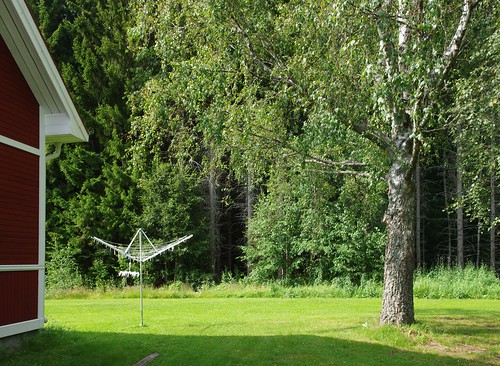
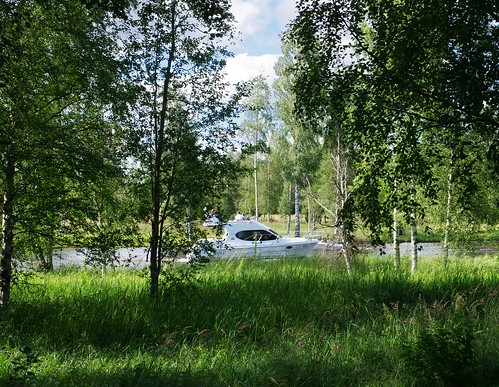
When you spend your time in cities it's easy to forget that much of the country is all heavy forest. But now and again, that border between urban life and wilderness becomes obvious.
The area is quite beautiful in summer when the weather is good. That's about three weeks per year or so; the rest of the time it's freezing or raining.
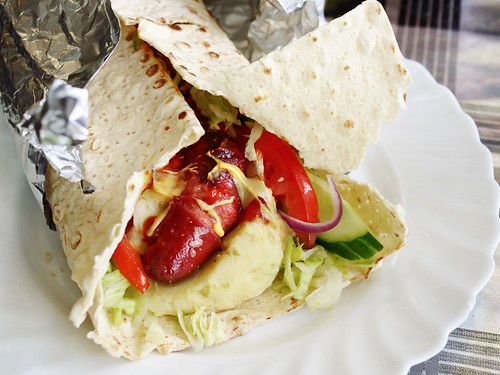
I love tunnbrödsrulle. Sausage and mashed potatoes wrapped in a roll of northern flatbread. The lettuce, tomato and cucumber adds a light, crispy texture to the heavy mash, while the onion, mustard, ketchup and pickles add spice.
After years in Osaka, Borlänge feels, well, empty. There's just not a lot of people around, and not a lot is happening. That can be very pleasant for a while, but I'm happy we're back home.
We spent a day in Stockholm on our way back. The return flight left in the morning, and it's much less painful to get to the airport from Stockholm than taking an early dawn train from Borlänge.
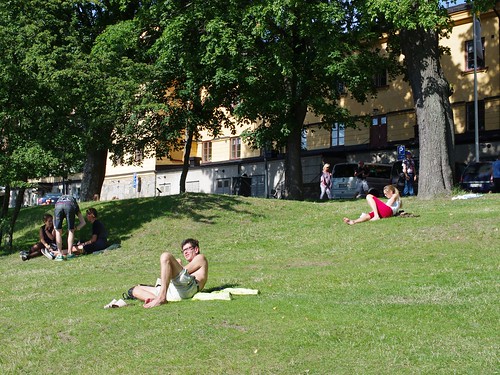
For once Stockholm had great summer weather. People were enjoying the sun and the warmth any which way they could.
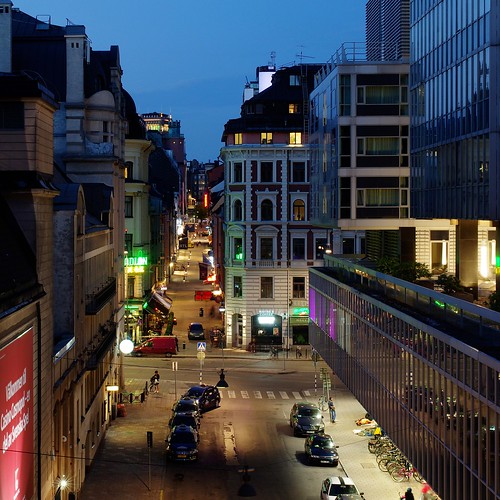
Hotels are expensive in Sweden for some reason; almost ridiculously so. On the upside, even the cheapest places seem to have the budget to spruce things up a little, with fun design, good breakfasts and so on.
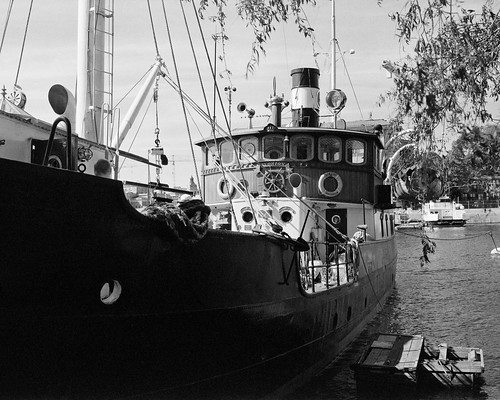
Much of the city is built on islands, so there's waterways and piers everywhere. And where there's water there's boats. Here S/S Orion, on Skeppsholmen.
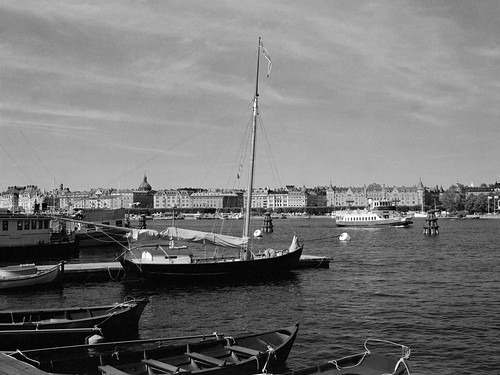
A beautiful wooden sailboat on Skeppsholmen, with a public transport passenger ferry in the background. At times like this I could see myself living here. When it's -1°, pitch dark and the air is full of sleet, not so much.
Friday, September 11, 2015
Coffee and Happiness
I get good quality beans and I grind my own coffee, both at home and at work. Sometimes, just for fun, I also roast green beans myself, though admittedly the result is usually worse than what I can buy. I usually brew filter coffee, though we have no shortage of other ways to make coffee at home by now. And normally, the end result is good. Pleasant, drinkable, and quite a lot better than what a coffee chain will serve you.
But once in a while it all comes together. The bean, the roast, the amount of coffee and water, the grind, the temperature, brewing time — it all aligns precisely, and the resulting cup of coffee is amazing. Divine. A cup of bliss I would pick over any other drink in the world. I can spend half an hour happily drinking it, savouring each and every drop, and trying to prolong the pleasure as much as I can. One day I'll be able to make this consistently. One day.
I'm slowly chewing through all the images from our recent trip, but it takes a while. Deadlines at work are coming hard and fast. Zoning out over a perfect coffee certainly doesn't help. Things are bound to slow down eventually, though.
But once in a while it all comes together. The bean, the roast, the amount of coffee and water, the grind, the temperature, brewing time — it all aligns precisely, and the resulting cup of coffee is amazing. Divine. A cup of bliss I would pick over any other drink in the world. I can spend half an hour happily drinking it, savouring each and every drop, and trying to prolong the pleasure as much as I can. One day I'll be able to make this consistently. One day.
I'm slowly chewing through all the images from our recent trip, but it takes a while. Deadlines at work are coming hard and fast. Zoning out over a perfect coffee certainly doesn't help. Things are bound to slow down eventually, though.
Wednesday, August 5, 2015
More Travels
I did get myself a souvenir back from Prague: a Meopta Flexaret Automat VI. It was made from 1961 to 1967, and judging from the serial number mine is from the mid-1960's. It's not in particularly good condition; some chrome and paint has flaked off, there's a few rust spots, and the leatherette is starting to come off in a few places. There's no case or lens covers, and I didn't get the 35mm film adapter.
But the lenses are clean and free of scratches. The shutter and film winder both work fine. It was pretty grimy and dirty when I got it, but it cleaned up quite well. It'll never be a collectors item but it's a perfectly usable beater camera, well worth the (quite low) price I paid for it. I'm curious to see what the pictures are like; I expect this old lens will give them a fairly soft, low-contrast look.
And since I was in Prague, I used up my last Czech Krone on a small pile of Fomapan film for the camera. Fomapan is made in the Chzech republic and a fairly popular film in Europe. In fact, I rather regret not buying a whole tray or two when I had the chance, since it costs only half what it does home in Osaka.
We're off to Europe again, this time to Sweden. My brother and his girlfriend are finally getting married, after eight years, four children and a house. Nobody can accuse them of rushing into things. Seems the weather will be great — a high of about 20° and lows of 11° or so. It'll be a welcome change after the past couple of weeks with 35°+ temperatures at home.
After the wedding we'll spend a few days in Istanbul for our summer vacation. I've never been to that part of Europe so I'm very much looking forward to this. We'll wander the city, eat lots of Turkish food, and make time for a cooking class. And I'm not even going to think of work the whole time.
But the lenses are clean and free of scratches. The shutter and film winder both work fine. It was pretty grimy and dirty when I got it, but it cleaned up quite well. It'll never be a collectors item but it's a perfectly usable beater camera, well worth the (quite low) price I paid for it. I'm curious to see what the pictures are like; I expect this old lens will give them a fairly soft, low-contrast look.
And since I was in Prague, I used up my last Czech Krone on a small pile of Fomapan film for the camera. Fomapan is made in the Chzech republic and a fairly popular film in Europe. In fact, I rather regret not buying a whole tray or two when I had the chance, since it costs only half what it does home in Osaka.
We're off to Europe again, this time to Sweden. My brother and his girlfriend are finally getting married, after eight years, four children and a house. Nobody can accuse them of rushing into things. Seems the weather will be great — a high of about 20° and lows of 11° or so. It'll be a welcome change after the past couple of weeks with 35°+ temperatures at home.
After the wedding we'll spend a few days in Istanbul for our summer vacation. I've never been to that part of Europe so I'm very much looking forward to this. We'll wander the city, eat lots of Turkish food, and make time for a cooking class. And I'm not even going to think of work the whole time.
Monday, August 3, 2015
Prague
[A note: Flickr has changed the way you can embed images. If you have any problems with the pictures here, please let me know.]
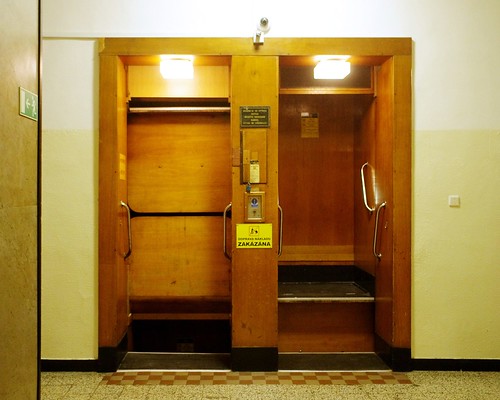
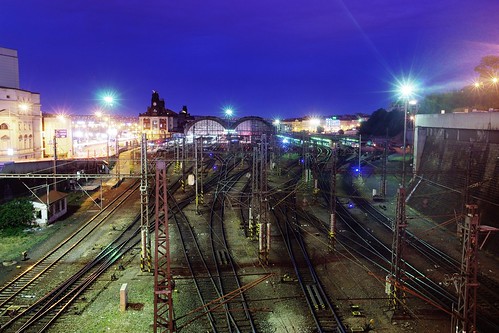
A week in Prague. Old buildings, beer and heavy food away from the oppressive July heat of Osaka. I guess three out of four isn't too bad, as Prague was in the midst of a heatwave, with temperatures above 30° every day. Not as hot as in Osaka — the humidity here is much worse — but many places in Prague lack air conditioning.
This was a business trip for me. The CNS 2015 conference was held in Prague and I gave a tutorial on the use of MUSIC and NEST. Ritsuko has never been to Prague, so this was a chance for her to see the place. I was usually busy so she spent time in the city by herself, although she did join the conference dinner and we had dinner together a couple of times.
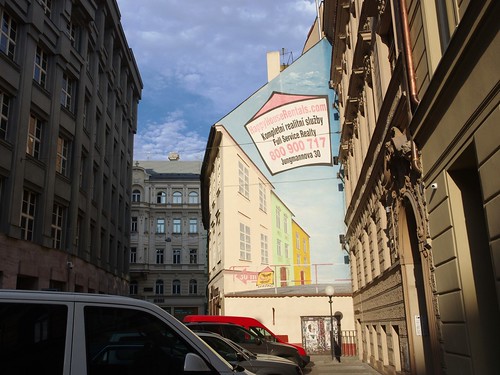
I'd been to Prague once before, almost fifteen years ago, but the place is still mostly as I remember: Lots of beer places, lots of book stores and lots of quiet beautiful streets. The cityscape is a mix of the old and the new of course, but it's clear they have building codes in place to make sure new construction fits in with the old. No new buildings can be higher than existing ones, for instance. They're doing a good job of keeping the atmosphere. I don't remember there being this much graffiti though, or perhaps I'm just no longer used to it.
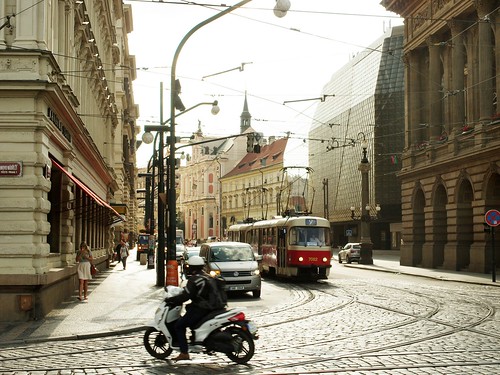
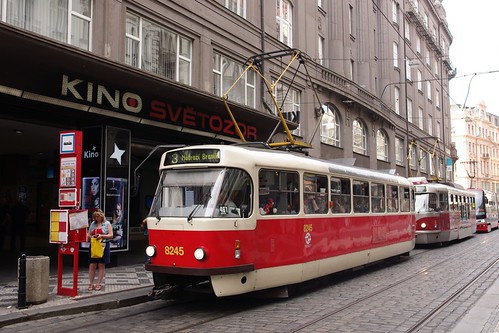
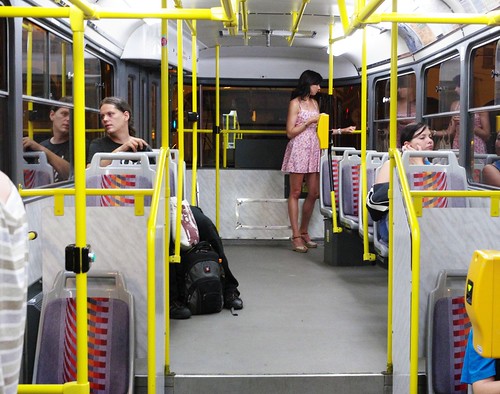
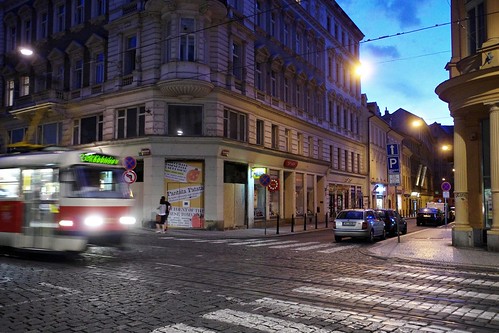
The trams are by far the best way to get around the city. They're quicker to use than the metro since you catch them on the street with no need to run up and down stairs. You see where you're going so you don't get disoriented, and you can see a lot of the city this way. Public transport is really easy: you buy a ticket good for 30 or 90 minutes, stamp it in a machine as you board, then you can travel on the trams, metro and buses until your time is up.
The area next to the river has always been the focus for tourists, but now it's all souvenir shops, hotels and restaurants for foreign tourists (with prices to match). We walked to the Charles bridge one early morning and it was already filling up with salesmen, tour operators, "funny" caricaturists, schlock painters and so on. A walk along the river is nice, but you're generally better off avoiding the two-three blocks around it.
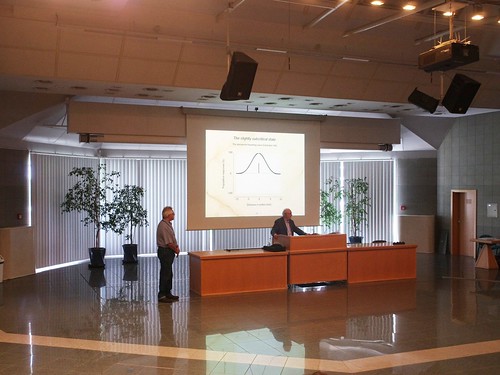
The conference was at the university of Economics, on the east side of the train station. The city is much quieter there, as fewer tourists find reason to visit the area. Tree-lined streets with apartment buildings, small shops, restaurants and convenience stores. A large, pleasant park abuts the university on the south end. The venue was in a couple of quite modern buildings, with meeting rooms around a large atrium, and the main presentation hall off to the side. The lack of air conditioning made the tutorials and poster sessions almost unbearably hot at times.
This was the first time I attended CNS — I should have done this before; it's a great conference — and as I'd heard, the highlights really were the tutorials and the workshops. The main three-day meeting and presentations were good, certainly, but it was the smaller, focused events that really delivered. I took more notes during the one-day neuromechanics workshop than I did over three days of general presentations.
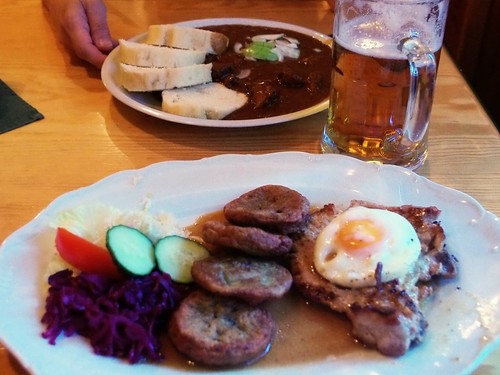
The food is good, it's heavy and there's a lot of it. It skews heavily towards fried meat and dumplings, stews and heavy sauces. Fresh vegetables is limited to the occasional token tomato wedge or cucumber slice. The amounts are almost ridiculous; a starter is a whole meal, and I and Ritsuko could share a main dish between us if we wanted.
The beer is likewise abundant, cheap, and very, very good. Modern, filtered beer pretty much originated here, and there must be dozens of breweries around Prague alone. It tends to be light but flavourful and refreshingly low in alcohol, often 3.5-4% or so rather than the heady 5% you always get in Japan. And so very tasty; even Ritsuko, normally no fan of beer, found it very easy to like.
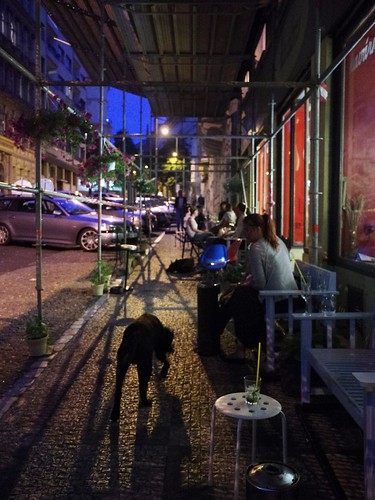
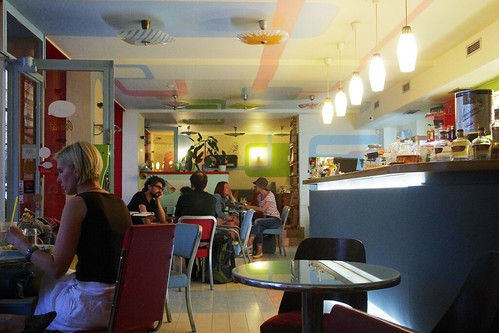
The final night we wanted something a little different from the ever present pork-dumpling-sauce track of Czech cuisine, so we found a retro cafe/bar/restaurant called "Kaaba" southeast of the train station. Furnished with mid-century furniture and an overall design from the 1960's, it draws young, hip people from the neighbourhood. The atmosphere was pleasant and the food was quite good.
I had high expectations coming to Prague. Did the city deliver? Yes, I think it did. The river area was a bit too touristy for my taste, but I spent most of my time toward the eastern areas away from the worst parts. It doesn't strike you as a big city (though it is), but a friendly, walkable place that's a joy to visit.
A week in Prague. Old buildings, beer and heavy food away from the oppressive July heat of Osaka. I guess three out of four isn't too bad, as Prague was in the midst of a heatwave, with temperatures above 30° every day. Not as hot as in Osaka — the humidity here is much worse — but many places in Prague lack air conditioning.
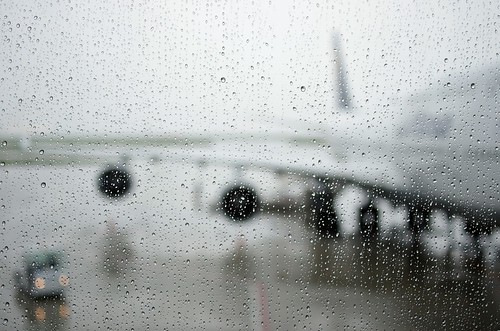
Typhoon #11 was approaching when we were due to leave. We were really worried for a few days, but in the end it went a little west of Kansai and had already mostly passed by, so our flight left right on time.
This was a business trip for me. The CNS 2015 conference was held in Prague and I gave a tutorial on the use of MUSIC and NEST. Ritsuko has never been to Prague, so this was a chance for her to see the place. I was usually busy so she spent time in the city by herself, although she did join the conference dinner and we had dinner together a couple of times.
I'd been to Prague once before, almost fifteen years ago, but the place is still mostly as I remember: Lots of beer places, lots of book stores and lots of quiet beautiful streets. The cityscape is a mix of the old and the new of course, but it's clear they have building codes in place to make sure new construction fits in with the old. No new buildings can be higher than existing ones, for instance. They're doing a good job of keeping the atmosphere. I don't remember there being this much graffiti though, or perhaps I'm just no longer used to it.
The trams are by far the best way to get around the city. They're quicker to use than the metro since you catch them on the street with no need to run up and down stairs. You see where you're going so you don't get disoriented, and you can see a lot of the city this way. Public transport is really easy: you buy a ticket good for 30 or 90 minutes, stamp it in a machine as you board, then you can travel on the trams, metro and buses until your time is up.
The area next to the river has always been the focus for tourists, but now it's all souvenir shops, hotels and restaurants for foreign tourists (with prices to match). We walked to the Charles bridge one early morning and it was already filling up with salesmen, tour operators, "funny" caricaturists, schlock painters and so on. A walk along the river is nice, but you're generally better off avoiding the two-three blocks around it.
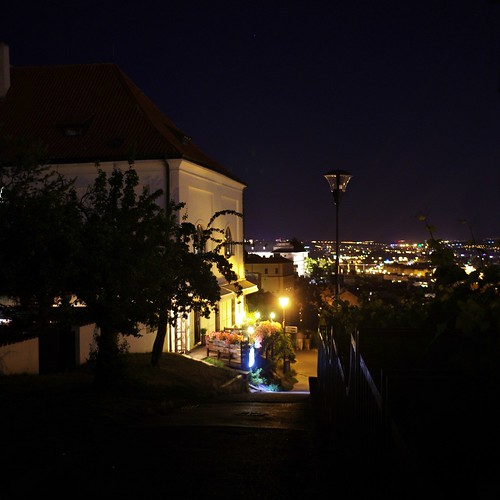
The castle area on the west bank gives you some very good views of the city. We had the conference banquet at a (former?) monastery there.
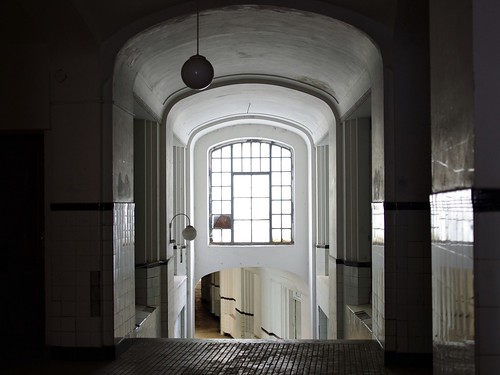
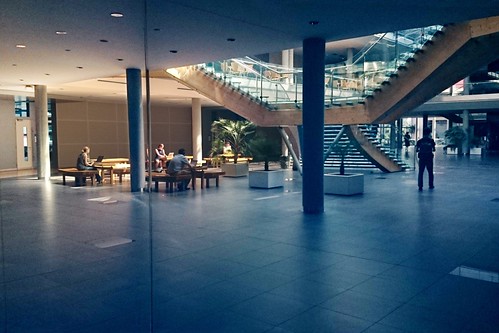
The conference was at the university of Economics, on the east side of the train station. The city is much quieter there, as fewer tourists find reason to visit the area. Tree-lined streets with apartment buildings, small shops, restaurants and convenience stores. A large, pleasant park abuts the university on the south end. The venue was in a couple of quite modern buildings, with meeting rooms around a large atrium, and the main presentation hall off to the side. The lack of air conditioning made the tutorials and poster sessions almost unbearably hot at times.
This was the first time I attended CNS — I should have done this before; it's a great conference — and as I'd heard, the highlights really were the tutorials and the workshops. The main three-day meeting and presentations were good, certainly, but it was the smaller, focused events that really delivered. I took more notes during the one-day neuromechanics workshop than I did over three days of general presentations.
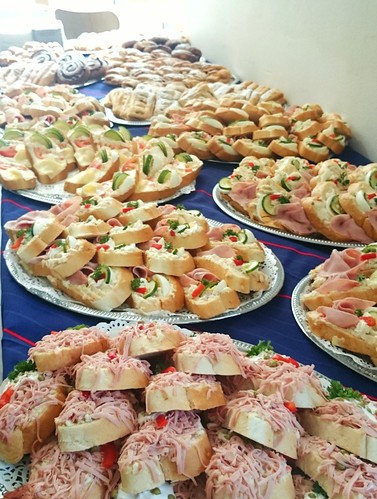
The food just kept piling up everywhere. We got a spread of sandwiches and cakes like this at both 10am and 3pm coffee breaks every day.
The food is good, it's heavy and there's a lot of it. It skews heavily towards fried meat and dumplings, stews and heavy sauces. Fresh vegetables is limited to the occasional token tomato wedge or cucumber slice. The amounts are almost ridiculous; a starter is a whole meal, and I and Ritsuko could share a main dish between us if we wanted.
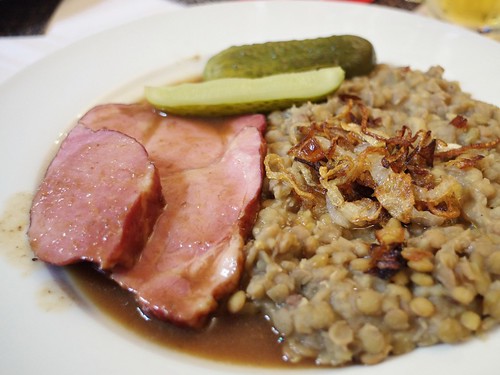
Pork with lentil stew. This was probably the best thing I ate in Prague. Succulent, juicy slabs of salty pork, and a creamy herb-infused stew topped with fried onion.
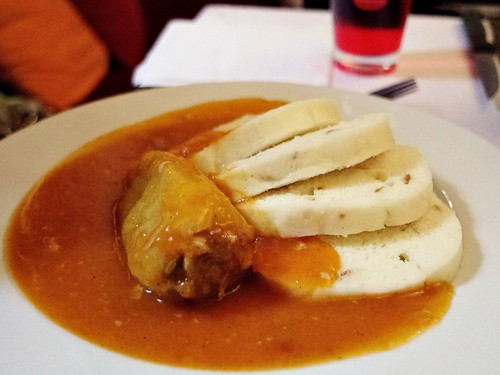
Stuffed pepper with bread dumplings. Dumplings are really common; they take the role of potatoes in Sweden or rice in Japan. The local kitchenware stores even sold a variety of dumpling slicers, so people are clearly making them at home too.
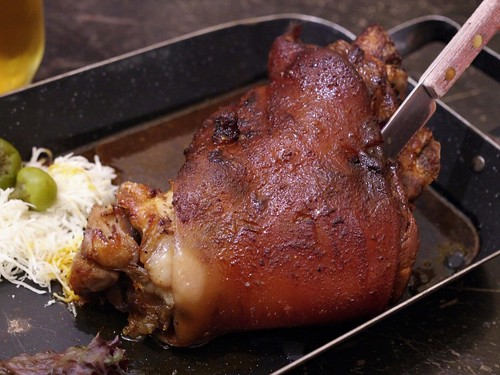
A joint of pork. This is intended for one person. In Japan I'd expect this to be served for a party of four.
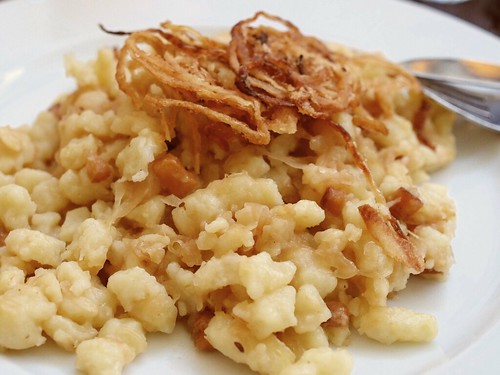
Halusky. Looks like — and sort of tastes like — fried potatoes in a cream sauce, but it's actually small dumplings. Here with bits of bacon and fried onion.
The beer is likewise abundant, cheap, and very, very good. Modern, filtered beer pretty much originated here, and there must be dozens of breweries around Prague alone. It tends to be light but flavourful and refreshingly low in alcohol, often 3.5-4% or so rather than the heady 5% you always get in Japan. And so very tasty; even Ritsuko, normally no fan of beer, found it very easy to like.
Pork chops with some kind of batter fry; and in the background goulash with the ever-present bread dumplings. And, of course, a beer.
The final night we wanted something a little different from the ever present pork-dumpling-sauce track of Czech cuisine, so we found a retro cafe/bar/restaurant called "Kaaba" southeast of the train station. Furnished with mid-century furniture and an overall design from the 1960's, it draws young, hip people from the neighbourhood. The atmosphere was pleasant and the food was quite good.
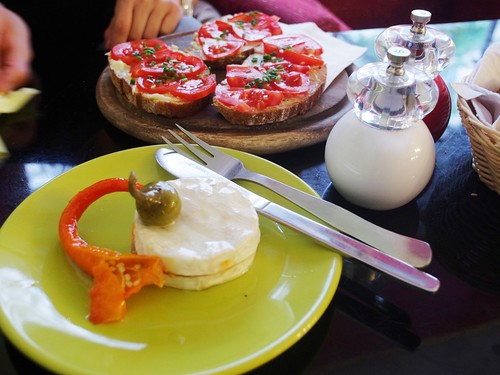
Cheese and tomato sandwiches, and pickled camembert cheese. By Czech standards, this truly is light food.
I had high expectations coming to Prague. Did the city deliver? Yes, I think it did. The river area was a bit too touristy for my taste, but I spent most of my time toward the eastern areas away from the worst parts. It doesn't strike you as a big city (though it is), but a friendly, walkable place that's a joy to visit.
Subscribe to:
Posts (Atom)