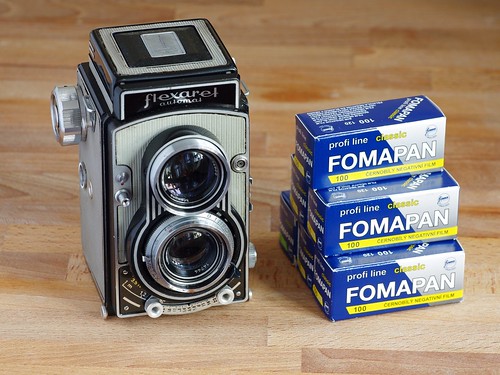
I did get myself a souvenir back from Prague: a Meopta Flexaret Automat VI. It was made from 1961 to 1967, and judging from the serial number mine is from the mid-1960's. It's not in particularly good condition; some chrome and paint has flaked off, there's a few rust spots, and the leatherette is starting to come off in a few places. There's no case or lens covers, and I didn't get the 35mm film adapter.
But the lenses are clean and free of scratches. The shutter and film winder both work fine. It was pretty grimy and dirty when I got it, but it cleaned up quite well. It'll never be a collectors item but it's a perfectly usable beater camera, well worth the (quite low) price I paid for it. I'm curious to see what the pictures are like; I expect this old lens will give them a fairly soft, low-contrast look.
And since I was in Prague, I used up my last Czech Krone on a small pile of Fomapan film for the camera. Fomapan is made in the Chzech republic and a fairly popular film in Europe. In fact, I rather regret not buying a whole tray or two when I had the chance, since it costs only half what it does home in Osaka.
We're off to Europe again, this time to Sweden. My brother and his girlfriend are finally getting married, after eight years, four children and a house. Nobody can accuse them of rushing into things. Seems the weather will be great — a high of about 20° and lows of 11° or so. It'll be a welcome change after the past couple of weeks with 35°+ temperatures at home.
After the wedding we'll spend a few days in Istanbul for our summer vacation. I've never been to that part of Europe so I'm very much looking forward to this. We'll wander the city, eat lots of Turkish food, and make time for a cooking class. And I'm not even going to think of work the whole time.
Wednesday, August 5, 2015
Monday, August 3, 2015
Prague
[A note: Flickr has changed the way you can embed images. If you have any problems with the pictures here, please let me know.]
A week in Prague. Old buildings, beer and heavy food away from the oppressive July heat of Osaka. I guess three out of four isn't too bad, as Prague was in the midst of a heatwave, with temperatures above 30° every day. Not as hot as in Osaka — the humidity here is much worse — but many places in Prague lack air conditioning.
This was a business trip for me. The CNS 2015 conference was held in Prague and I gave a tutorial on the use of MUSIC and NEST. Ritsuko has never been to Prague, so this was a chance for her to see the place. I was usually busy so she spent time in the city by herself, although she did join the conference dinner and we had dinner together a couple of times.
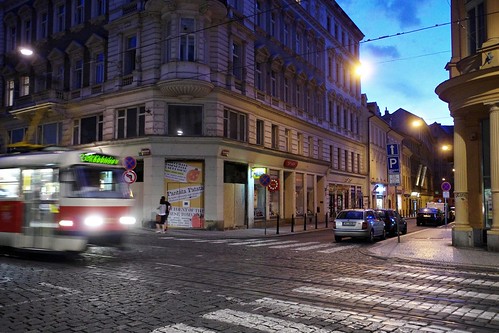
I'd been to Prague once before, almost fifteen years ago, but the place is still mostly as I remember: Lots of beer places, lots of book stores and lots of quiet beautiful streets. The cityscape is a mix of the old and the new of course, but it's clear they have building codes in place to make sure new construction fits in with the old. No new buildings can be higher than existing ones, for instance. They're doing a good job of keeping the atmosphere. I don't remember there being this much graffiti though, or perhaps I'm just no longer used to it.
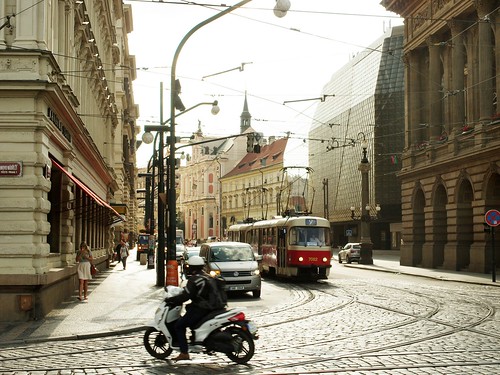
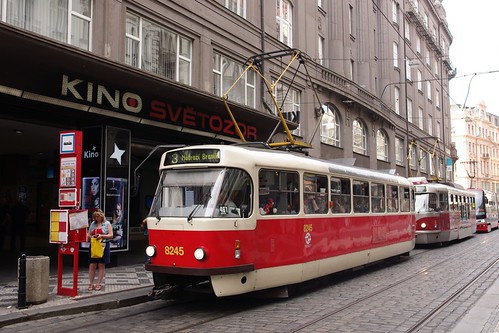
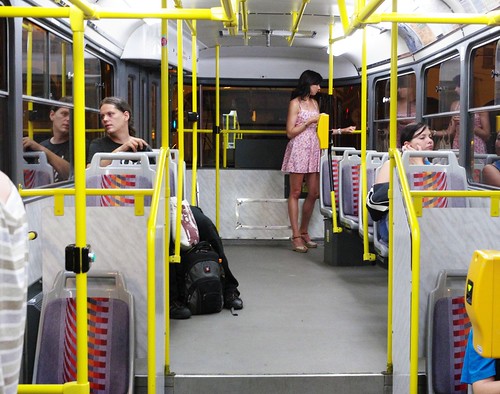
The trams are by far the best way to get around the city. They're quicker to use than the metro since you catch them on the street with no need to run up and down stairs. You see where you're going so you don't get disoriented, and you can see a lot of the city this way. Public transport is really easy: you buy a ticket good for 30 or 90 minutes, stamp it in a machine as you board, then you can travel on the trams, metro and buses until your time is up.
The area next to the river has always been the focus for tourists, but now it's all souvenir shops, hotels and restaurants for foreign tourists (with prices to match). We walked to the Charles bridge one early morning and it was already filling up with salesmen, tour operators, "funny" caricaturists, schlock painters and so on. A walk along the river is nice, but you're generally better off avoiding the two-three blocks around it.
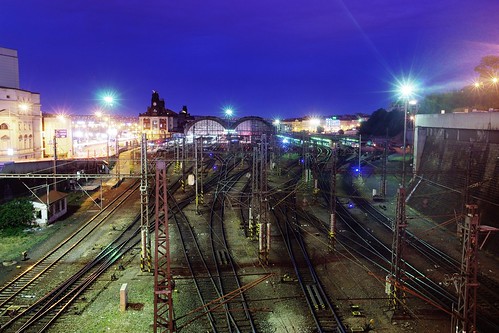
The conference was at the university of Economics, on the east side of the train station. The city is much quieter there, as fewer tourists find reason to visit the area. Tree-lined streets with apartment buildings, small shops, restaurants and convenience stores. A large, pleasant park abuts the university on the south end. The venue was in a couple of quite modern buildings, with meeting rooms around a large atrium, and the main presentation hall off to the side. The lack of air conditioning made the tutorials and poster sessions almost unbearably hot at times.
This was the first time I attended CNS — I should have done this before; it's a great conference — and as I'd heard, the highlights really were the tutorials and the workshops. The main three-day meeting and presentations were good, certainly, but it was the smaller, focused events that really delivered. I took more notes during the one-day neuromechanics workshop than I did over three days of general presentations.
The food is good, it's heavy and there's a lot of it. It skews heavily towards fried meat and dumplings, stews and heavy sauces. Fresh vegetables is limited to the occasional token tomato wedge or cucumber slice. The amounts are almost ridiculous; a starter is a whole meal, and I and Ritsuko could share a main dish between us if we wanted.
The beer is likewise abundant, cheap, and very, very good. Modern, filtered beer pretty much originated here, and there must be dozens of breweries around Prague alone. It tends to be light but flavourful and refreshingly low in alcohol, often 3.5-4% or so rather than the heady 5% you always get in Japan. And so very tasty; even Ritsuko, normally no fan of beer, found it very easy to like.
The final night we wanted something a little different from the ever present pork-dumpling-sauce track of Czech cuisine, so we found a retro cafe/bar/restaurant called "Kaaba" southeast of the train station. Furnished with mid-century furniture and an overall design from the 1960's, it draws young, hip people from the neighbourhood. The atmosphere was pleasant and the food was quite good.
I had high expectations coming to Prague. Did the city deliver? Yes, I think it did. The river area was a bit too touristy for my taste, but I spent most of my time toward the eastern areas away from the worst parts. It doesn't strike you as a big city (though it is), but a friendly, walkable place that's a joy to visit.
A week in Prague. Old buildings, beer and heavy food away from the oppressive July heat of Osaka. I guess three out of four isn't too bad, as Prague was in the midst of a heatwave, with temperatures above 30° every day. Not as hot as in Osaka — the humidity here is much worse — but many places in Prague lack air conditioning.
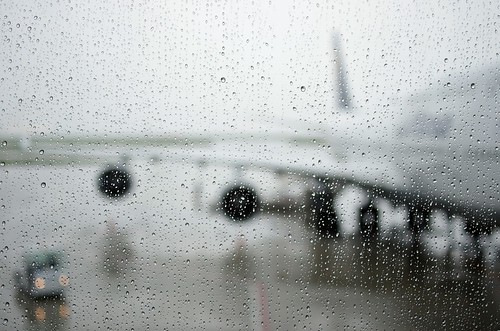
Typhoon #11 was approaching when we were due to leave. We were really worried for a few days, but in the end it went a little west of Kansai and had already mostly passed by, so our flight left right on time.
This was a business trip for me. The CNS 2015 conference was held in Prague and I gave a tutorial on the use of MUSIC and NEST. Ritsuko has never been to Prague, so this was a chance for her to see the place. I was usually busy so she spent time in the city by herself, although she did join the conference dinner and we had dinner together a couple of times.
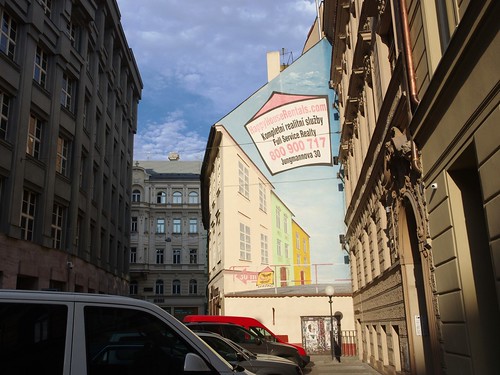
I'd been to Prague once before, almost fifteen years ago, but the place is still mostly as I remember: Lots of beer places, lots of book stores and lots of quiet beautiful streets. The cityscape is a mix of the old and the new of course, but it's clear they have building codes in place to make sure new construction fits in with the old. No new buildings can be higher than existing ones, for instance. They're doing a good job of keeping the atmosphere. I don't remember there being this much graffiti though, or perhaps I'm just no longer used to it.
The trams are by far the best way to get around the city. They're quicker to use than the metro since you catch them on the street with no need to run up and down stairs. You see where you're going so you don't get disoriented, and you can see a lot of the city this way. Public transport is really easy: you buy a ticket good for 30 or 90 minutes, stamp it in a machine as you board, then you can travel on the trams, metro and buses until your time is up.
The area next to the river has always been the focus for tourists, but now it's all souvenir shops, hotels and restaurants for foreign tourists (with prices to match). We walked to the Charles bridge one early morning and it was already filling up with salesmen, tour operators, "funny" caricaturists, schlock painters and so on. A walk along the river is nice, but you're generally better off avoiding the two-three blocks around it.
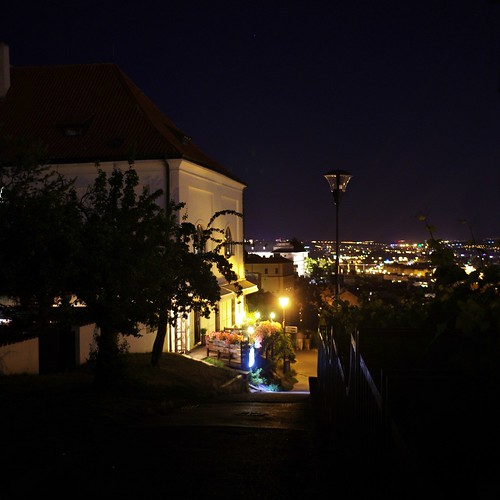
The castle area on the west bank gives you some very good views of the city. We had the conference banquet at a (former?) monastery there.
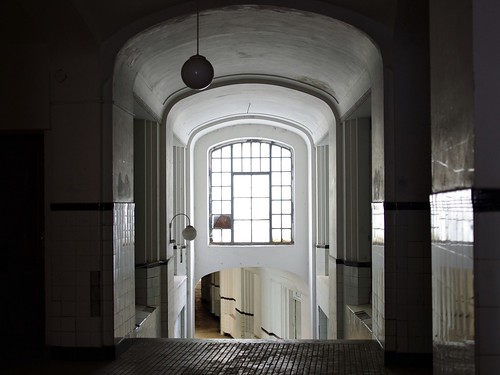
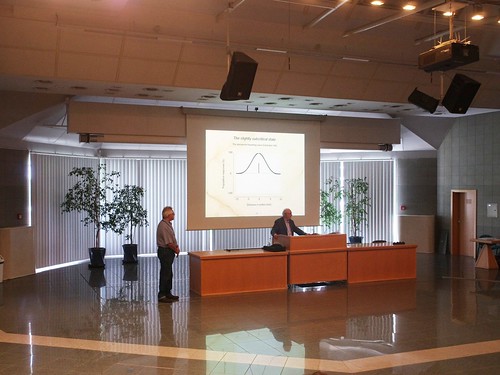
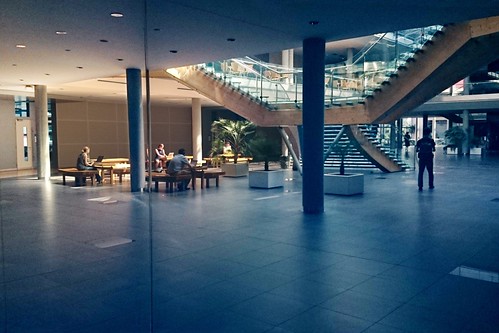
The conference was at the university of Economics, on the east side of the train station. The city is much quieter there, as fewer tourists find reason to visit the area. Tree-lined streets with apartment buildings, small shops, restaurants and convenience stores. A large, pleasant park abuts the university on the south end. The venue was in a couple of quite modern buildings, with meeting rooms around a large atrium, and the main presentation hall off to the side. The lack of air conditioning made the tutorials and poster sessions almost unbearably hot at times.
This was the first time I attended CNS — I should have done this before; it's a great conference — and as I'd heard, the highlights really were the tutorials and the workshops. The main three-day meeting and presentations were good, certainly, but it was the smaller, focused events that really delivered. I took more notes during the one-day neuromechanics workshop than I did over three days of general presentations.
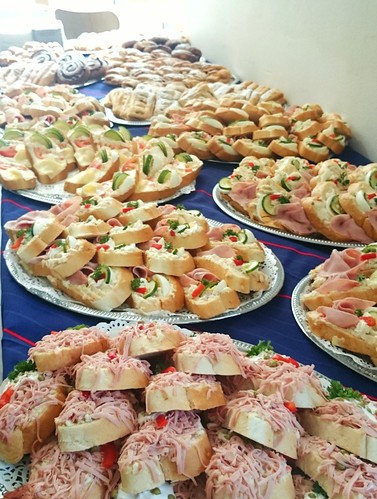
The food just kept piling up everywhere. We got a spread of sandwiches and cakes like this at both 10am and 3pm coffee breaks every day.
The food is good, it's heavy and there's a lot of it. It skews heavily towards fried meat and dumplings, stews and heavy sauces. Fresh vegetables is limited to the occasional token tomato wedge or cucumber slice. The amounts are almost ridiculous; a starter is a whole meal, and I and Ritsuko could share a main dish between us if we wanted.
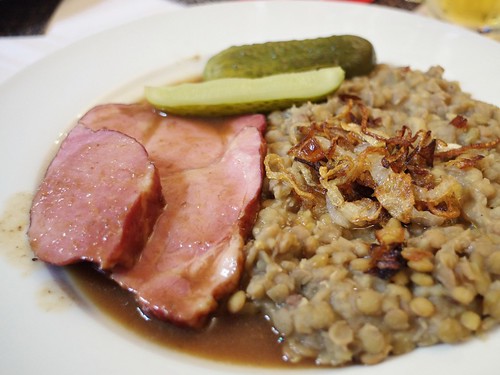
Pork with lentil stew. This was probably the best thing I ate in Prague. Succulent, juicy slabs of salty pork, and a creamy herb-infused stew topped with fried onion.
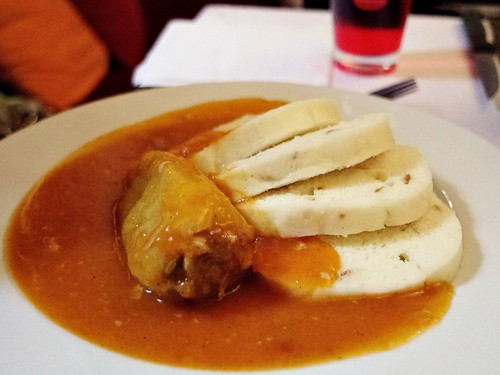
Stuffed pepper with bread dumplings. Dumplings are really common; they take the role of potatoes in Sweden or rice in Japan. The local kitchenware stores even sold a variety of dumpling slicers, so people are clearly making them at home too.
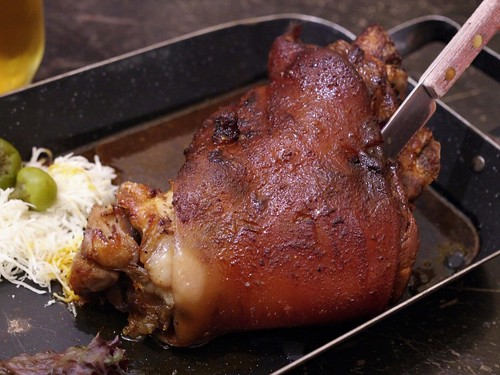
A joint of pork. This is intended for one person. In Japan I'd expect this to be served for a party of four.
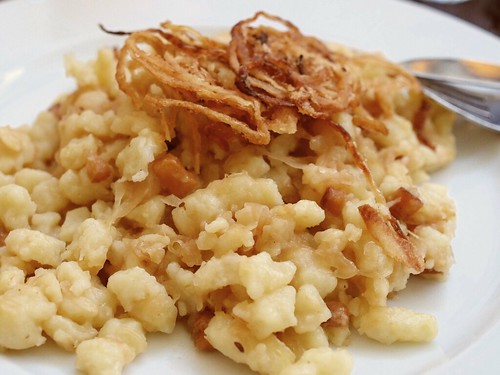
Halusky. Looks like — and sort of tastes like — fried potatoes in a cream sauce, but it's actually small dumplings. Here with bits of bacon and fried onion.
The beer is likewise abundant, cheap, and very, very good. Modern, filtered beer pretty much originated here, and there must be dozens of breweries around Prague alone. It tends to be light but flavourful and refreshingly low in alcohol, often 3.5-4% or so rather than the heady 5% you always get in Japan. And so very tasty; even Ritsuko, normally no fan of beer, found it very easy to like.
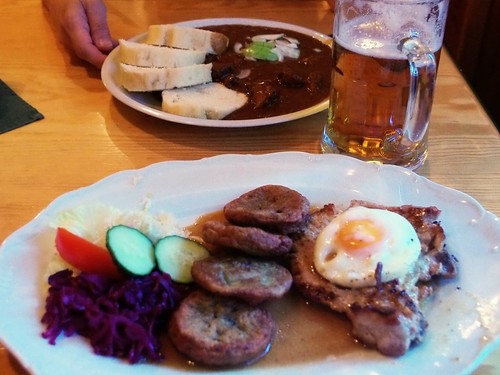
Pork chops with some kind of batter fry; and in the background goulash with the ever-present bread dumplings. And, of course, a beer.
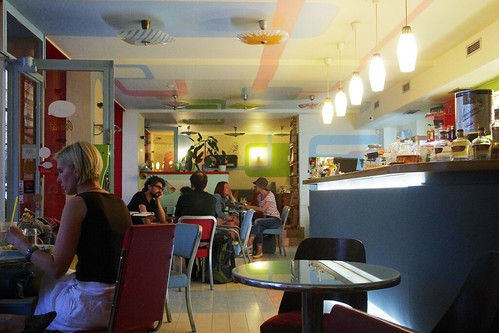
The final night we wanted something a little different from the ever present pork-dumpling-sauce track of Czech cuisine, so we found a retro cafe/bar/restaurant called "Kaaba" southeast of the train station. Furnished with mid-century furniture and an overall design from the 1960's, it draws young, hip people from the neighbourhood. The atmosphere was pleasant and the food was quite good.
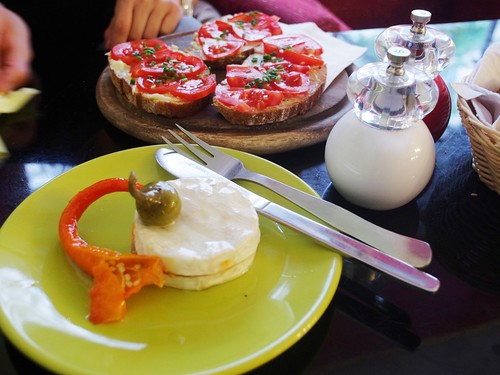
Cheese and tomato sandwiches, and pickled camembert cheese. By Czech standards, this truly is light food.
I had high expectations coming to Prague. Did the city deliver? Yes, I think it did. The river area was a bit too touristy for my taste, but I spent most of my time toward the eastern areas away from the worst parts. It doesn't strike you as a big city (though it is), but a friendly, walkable place that's a joy to visit.
Tuesday, July 14, 2015
Typhoon #11
This is the current projected path of typhoon #11. See the white circles? That's the probable area of strong effect. Se the small yellow circle? That's Osaka with Kansai Airport in the center.
That last, big white circle? That's the projection for Friday at 3am. That's a few hours before our morning flight from Kansai Airport to Prague. Yes, the center of that small yellow circle.
We night have a problem. It's not just the flight itself; Kansai Airport lies on an island, connected to the mainland by a longish bridge. That bridge closes for traffic if the winds are high or gusty enough. We might have our flight leaving on time but we can't get to the airport over the closed bridge.
Time to look for a few alternatives. I'm going to Prague and CNS to hold a tutorial, and that tutorial is scheduled for Saturday, the morning after we arrive. If the flight is delayed by a day I miss the tutorial. And as that's the main point of me being there, that wouldn't be good.
We'll see if we perhaps can rebook the flights a day earlier (though that adds another hotel night) or perhaps fly from Tokyo (adding the cost of both hotel and train). If neither is possible — or they ask for too much extra money to rebook — we'll just have to take our chances and hope we leave on time after all.
As they say: oh well.
That last, big white circle? That's the projection for Friday at 3am. That's a few hours before our morning flight from Kansai Airport to Prague. Yes, the center of that small yellow circle.
We night have a problem. It's not just the flight itself; Kansai Airport lies on an island, connected to the mainland by a longish bridge. That bridge closes for traffic if the winds are high or gusty enough. We might have our flight leaving on time but we can't get to the airport over the closed bridge.
Time to look for a few alternatives. I'm going to Prague and CNS to hold a tutorial, and that tutorial is scheduled for Saturday, the morning after we arrive. If the flight is delayed by a day I miss the tutorial. And as that's the main point of me being there, that wouldn't be good.
We'll see if we perhaps can rebook the flights a day earlier (though that adds another hotel night) or perhaps fly from Tokyo (adding the cost of both hotel and train). If neither is possible — or they ask for too much extra money to rebook — we'll just have to take our chances and hope we leave on time after all.
As they say: oh well.
Thursday, July 9, 2015
Odds and Ends
I did the JLPT again last Sunday. Gave it one more shot to see if I might pass it. I won't. The listening comprehension isn't too bad — it'd be odd if I didn't do well at that by now — and I can sort-of digest most texts they throw at you. But grammar... It's not just that I'm not good at grammar; it's that I find it boring and tedious, and really, really dislike studying it. "It's amazing what you can't accomplish if you really don't want to." as someone said.
So I give up on JLPT for now. I don't actually need the test for anything, and it robs me of the enjoyment I normally find in learning the language. Instead I'll go back to reading fun stuff again — I haven't read a line in my latest mystery novel for months — and on improving my writing skills. Real-world useful skills (such as knowing terms for "autopsy" and "blunt instrument") rather than test questions. Perhaps I'll try again in a few years.
We're going to Prague in a week. The CNS 2015 conputational neuroscience conference is held between July 18-23, and we'll hold a tutorial on using NEST, MUSIC and other simulation tools. I'll have a poster on our current work of course, and there are some interesting-looking workshops at the end of the conference. While I work, Ritsuko will spend the week rambling through the streets of Prague.
I've been to Prague once more than 15 years ago, as a grad student, and I remember it as perhaps the most beautiful city I have ever visited. I'm both anticipating and dreading the return visit. I hope that it will be as amazing as it was that one time; and worry that my nostalgia-tinted memories are setting me up for disappointment.
The weather is uncommonly lousy this year. We have two typhoons approaching at the same time (I hope our flight next week is OK), and it's been raining almost every day the past few weeks. The only upside is that the train smells less of Eau de Sweaty Salaryman than it usually does this time of year.
But this morning, as I was walking from the station, I heard the cicadas for the first time this year. Not a lot of them, yet, and the morning drizzle put a damper on those that were there, but at least there's hope that the rainy season will soon be over. It better be; our umeboshi will need sun-drying in a few weeks.
So I give up on JLPT for now. I don't actually need the test for anything, and it robs me of the enjoyment I normally find in learning the language. Instead I'll go back to reading fun stuff again — I haven't read a line in my latest mystery novel for months — and on improving my writing skills. Real-world useful skills (such as knowing terms for "autopsy" and "blunt instrument") rather than test questions. Perhaps I'll try again in a few years.
We're going to Prague in a week. The CNS 2015 conputational neuroscience conference is held between July 18-23, and we'll hold a tutorial on using NEST, MUSIC and other simulation tools. I'll have a poster on our current work of course, and there are some interesting-looking workshops at the end of the conference. While I work, Ritsuko will spend the week rambling through the streets of Prague.
I've been to Prague once more than 15 years ago, as a grad student, and I remember it as perhaps the most beautiful city I have ever visited. I'm both anticipating and dreading the return visit. I hope that it will be as amazing as it was that one time; and worry that my nostalgia-tinted memories are setting me up for disappointment.
The weather is uncommonly lousy this year. We have two typhoons approaching at the same time (I hope our flight next week is OK), and it's been raining almost every day the past few weeks. The only upside is that the train smells less of Eau de Sweaty Salaryman than it usually does this time of year.
But this morning, as I was walking from the station, I heard the cicadas for the first time this year. Not a lot of them, yet, and the morning drizzle put a damper on those that were there, but at least there's hope that the rainy season will soon be over. It better be; our umeboshi will need sun-drying in a few weeks.
Friday, July 3, 2015
Better Instant Ramen
In an ideal world we'd leave our offices around midday and sit down for a leisury two-hour meal with our families. A few hours of slow home-cooked food and brisk conversation to clear our minds before we stroll back to work for the afternoon.
For most of us that ideal world does not exist. We have half an hour at a local lunch restaurant or a quick convenience-store bento before going back to work. And sometimes we're reduced to eating a sandwich or instant ramen at our desks.
That's not all bad, though. I like instant ramen. It's quick and tasty, you can prepare it with only a microwave or a hot-water bottle, and it's not so much unhealthy as simply lacking in healthy bits. It's really, really easy to improve on the plain packet of ramen. Here's my lunch Wednesday last week:
You need a pack of ramen. This time I use old-fashioned Chicken Ramen, but any kind is good. I also got a small bag of store-brand cut vegetables — lettuce and corn in this case. And I brought the raw egg from home in the morning. For cooking you only need a pair of chopsticks and a microwaveable bowl with a lid.
Start by heating water in the bowl. It takes about four minutes. Feel free to surf the web while you wait.
Add the ramen into the almost-boiling water. Chicken Ramen is a little special since the flavouring is mixed with the noodle, not in a separate bag. That makes the noodles really tasty even before they're cooked, by the way; and Nissin even sells pre-broken Chiken Ramen noodles as a snack.
Cook the noodles in the microwave. Use the same time it says on the packet. You can cook pasta in the microwave in this way too.
Add the egg and mix it roughly. You don't actually want the egg to set; instead it should thicken the soup and make it thick and filling. The egg adds protein, rounds off the flavour and makes it less salty.
Lastly, mix in the cut salad into the thick soup. You have soft, springy noodles and crunchy, fresh vegetables in a thick, rich soup. Add an orange or apple for dessert and you've got yourself a meal!
For most of us that ideal world does not exist. We have half an hour at a local lunch restaurant or a quick convenience-store bento before going back to work. And sometimes we're reduced to eating a sandwich or instant ramen at our desks.
That's not all bad, though. I like instant ramen. It's quick and tasty, you can prepare it with only a microwave or a hot-water bottle, and it's not so much unhealthy as simply lacking in healthy bits. It's really, really easy to improve on the plain packet of ramen. Here's my lunch Wednesday last week:
![]() |
Almost everything you need for a nice lunch. |
Start by heating water in the bowl. It takes about four minutes. Feel free to surf the web while you wait.
![]() |
Adding the ramen. |
Cook the noodles in the microwave. Use the same time it says on the packet. You can cook pasta in the microwave in this way too.
![]() |
Add the egg, and mix. |
Add the egg and mix it roughly. You don't actually want the egg to set; instead it should thicken the soup and make it thick and filling. The egg adds protein, rounds off the flavour and makes it less salty.
![]() |
Mix in the cut salad. |
Sunday, June 28, 2015
The Birthday Time of Year
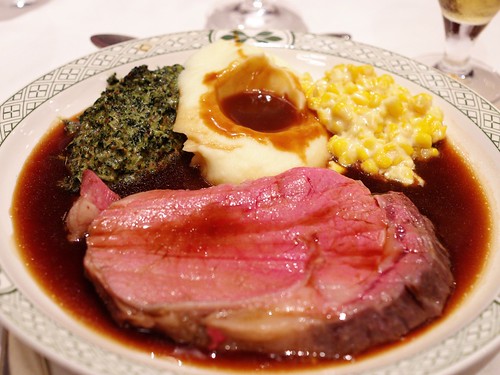
It was my birthday yesterday, and true to form we took the chance to go out to eat. This time we headed to a place called "Lawry's", an American steak chain in Umeda. It was quite good, especially the main dish, a cut of rib roast with mashed potato, stewed spinach and creamed corn. I particularly appreciate the grated horseradish and cream - though perhaps in deference to Japanese palates he horseradish was served separately from the whipped cream, not mixed into it.
The main dish was a cut of rib roast. Very good, but a lot of food. This was the "California" cut, the next to smallest cut they had, and it was really too much for me. They offer a still smaller cut in Japan called the "Osaka" or "Tokyo" depending on the location, and that would have been plenty. Even that was too much for Ritsuko, who had to leave some behind.
About this blog
As it is my birthday, and as I was away for a week in Tokyo for work just recently, I decided to take the whole weekend off. And this is when I realized I haven't updated this blog in a month.
It's not just the blog either. I have film scans from this winter still waiting to be edited. I haven't read a page in my current book for months. There's a bag of parts on my desk for an antenna amplifier just waiting to be put together, and it's been there since April. I sat down to work a bit on a small software project of mine today and realized I last touched the code in January.
An office building in Umeda has an outdoor office space, so people can work and have meetings outside. Good idea.
The reason is work, of course. This is the last year of our project and the last year of my employment, and the effective deadline for results is uncomfortably close. That's why I spent a week in Tokyo earlier in June, working directly with the other researchers on the project.
But there's other things as well. I'm going to a conference called CNS (Computational NeuroScience) in Prague in mid-July, where I'll hold part of a tutorial on using NEST and MUSIC for neural network simulations. And the next JLPT — Japanese Language Proficiency Test — is the coming Sunday.
So it's difficult to find time for things that need sustained focus. There's always something more I should be doing for our project, or preparing for the conference. When I do have a stretch of uninterrupted time it's better spent on studying Japanese rather than on an idle hobby.
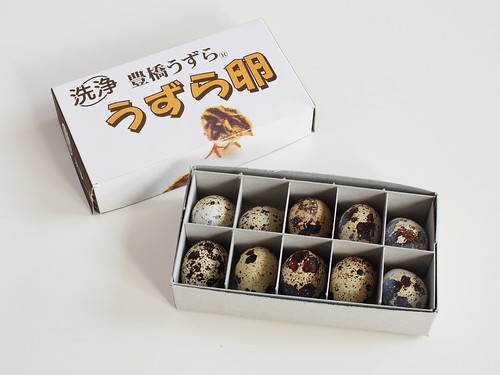
Quail eggs are common here, but they're usually sold in the same kind of clear, plastic packages you get hen eggs in. Practical and cheap, but boring. Ritsuko found one place that still sells them in cardboard boxes like this one. Makes them look special, even precious, doesn't it? Like marbles, or polished rocks.
But all is not lost. The end is in sight. JLPT will be over next week (not that I'll pass, mind you). And much as I look forward to CNS in July, it'll be one less thing to spend time on afterwards. Our project will effectively end with a symposium in October, so that, too, will calm down a bit in a few months time.
Once we get into autumn I should have more time to spend on other things — and more time to write about it.
Sunday, May 31, 2015
Fukuoka
Golden Week saw us heading to Fukuoka, out toward the northern end of KyÅ«shÅ«. It's not too far — just 2.5 hours on the train — and reputed to be a very pleasant, relaxed city, famous for its food. Besides, I have never set foot on KyÅ«shÅ« in my life, so it was time we went(1). The plan was to spend three relaxing, quiet nights there right at the beginning of Golden Week.
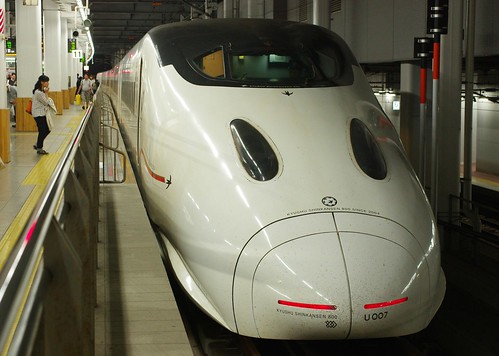
Japan is decently large, but transportation is excellent, so most of the country is close if you live near a major city. From Osaka you can reach pretty much all of Japan within three-four hours or so, using the Shinkansen or low-cost airlines. We can leave on a Friday evening after work and be anywhere by late evening, then return home Sunday night, leaving two full days of vacation on a normal weekend.
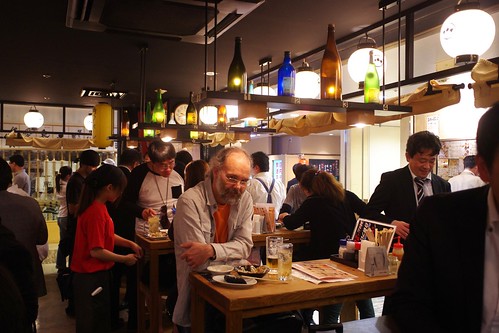
I met Ritsuko at the station right after work and only ate a little before boarding the train. Pretty hungry by the time we arrived so we had a bite at a standing izakaya at the Hakata station.
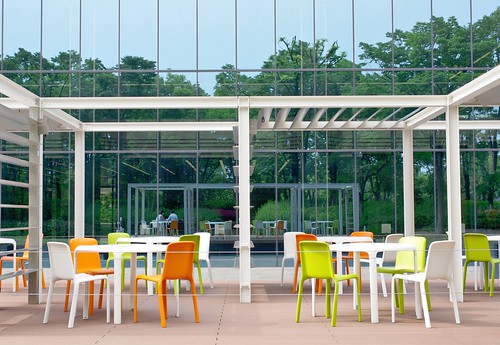
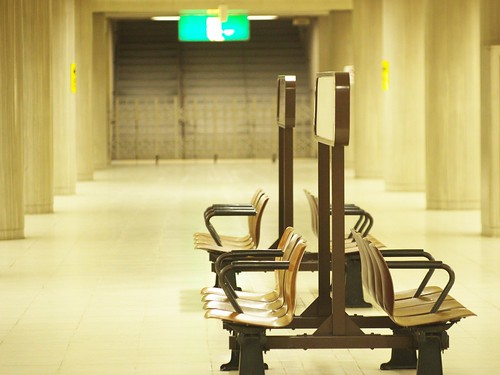
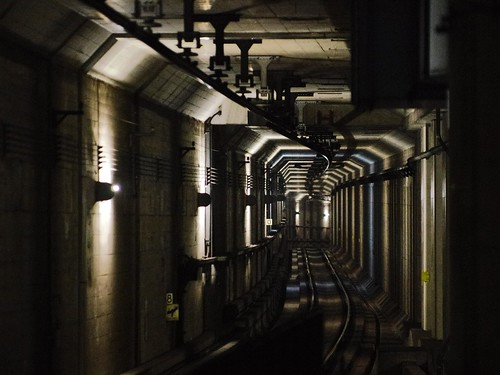
Fukuoka is plenty large enough to have a subway system. It's uncommonly well-designed I think; it's modern and well-maintained, but retains a neat retro aesthetic with wooden benches and cream stone tile.
We were looking for peace and quiet, but that didn't take Hakata Dontaku into account (Hakata is the largest ward in Fukuoka). It's a summer festival, held — unbeknowst to us — every year in Fukuoka, right at the beginning of Golden Week. With about 2 million visitors it's one of the largest festivals in the country and Fukuoka, needless to say, is anything but calm and tranquil during those days. We did wonder why hotel rooms were so curiously hard to find when we booked the trip.
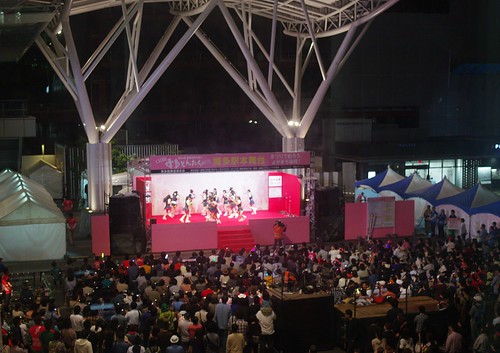
HKT48, an AKB48-spinoff performing at one festival scene. Note the glittering points of light in the audience as people record the event with their phones. This is the only festival-related shot I took.
Festival or not, we would have peace and quiet or kill ourselves trying. Fortunately it was quite easy. The festival itself is held only in part of the city center; stay away from that area and you have a surprisingly pleasant city and its surroundings to explore.
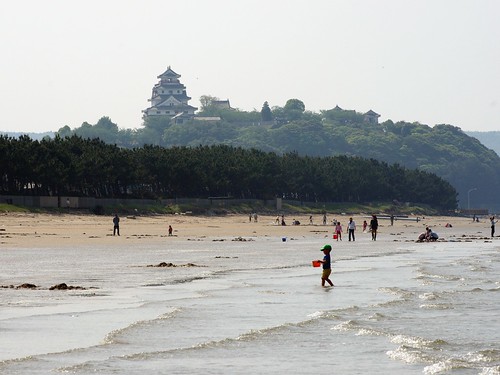
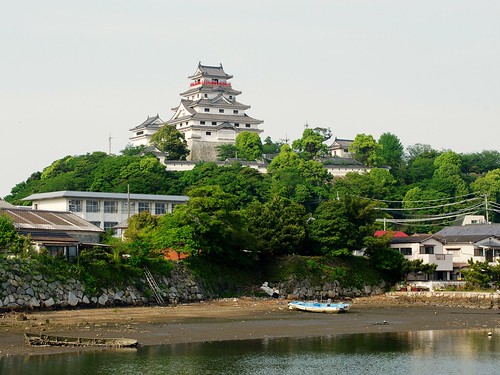
The first day we took a train down the coast for a day trip to Karatsu. It's a small town with a castle, a beautiful seaside landscape and nothing much else. The weather was great; sunshine but slightly hazy to take the edge off the light and the heat. It's a 45-minute ride, but that makes it sound farther than it really is. The train connects directly from the subway, and lets you see everything as you slowly pass by. It all feels like you've stumbled into a Miyazaki-movie.
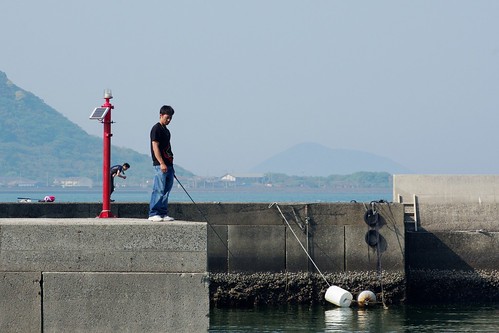
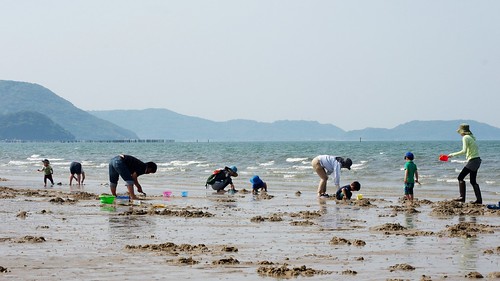
We took a walk to the seaside area from Higashi Karatsu station. After lunch we walked down to the beach. The tide was out, and most people were searching for shellfish in the sand. Big clams are grilled, and small ones are used to flavour miso soup.
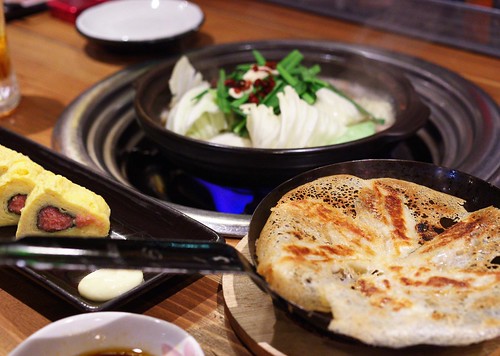
Fukuoka is famous for its food — a major reason we picket it as a destination of course. Hakata ramen is a popular type of tonkotsu ramen, but it's also well known for mentaiko (pickled, salted fish roe - think "Kalles Kaviar" if you're Swedish) and motsunabe (hotpot made from tripe or offal).
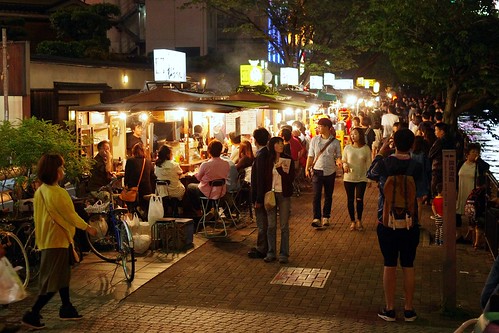
The canal-side ramen stalls in Fukuoka are famous. Too famous — it's become a tourist trap. It was right around the time of the festival of course, but there were huge throngs of people along the river side. Anyplace you wanted to eat, you had to wait in line for 10-15 minutes or longer, and order your food beforehand.
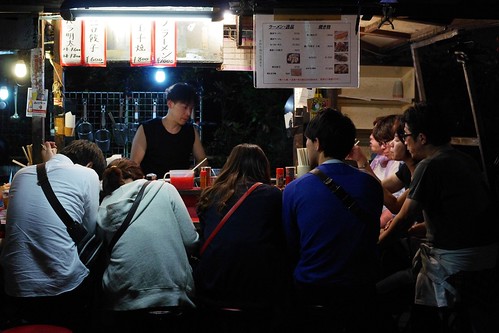
Hakata ramen stall. You take a seat, and your ramen — assembled at great speed from ingredients cooked elsewhere — is shoved into your lap. Eat, then leave for the next one in line. The ramen? Not very good. The experience? Stressful and no fun. Go here for the pictures, but eat elsewhere. The famous ramen chains likewise had long lines of people, but we discovered that it's only true for the shops in the central district where all the tourists come. Get away from the center and the shops are quiet, peaceful and without waiting lines.
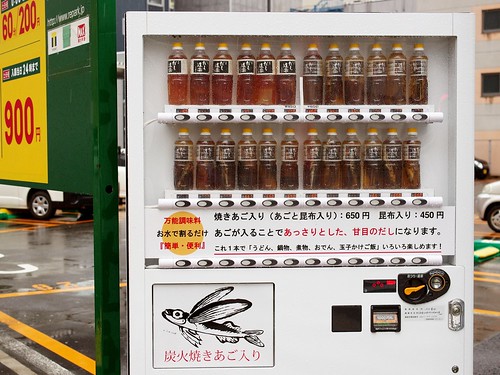
I thought I'd seen pretty much every kind of vending machine around by now. Apparently not; this one sells fish-based dashi, with or without a whole fish in it. I guess the manufacturer is located right in this neighbourhood, and the machine is a clever advertisement. The demand for street-side dashi can't be enough to make a profit.
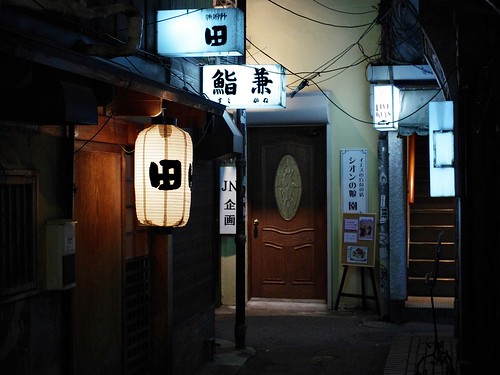
Fukuoka feels very unhurried. People just aren't rushing around the way they do in Osaka. It's as if it's managed to become a big city (over 2 million people) without losing the sense of being a local town. Walking around is a lot of fun.
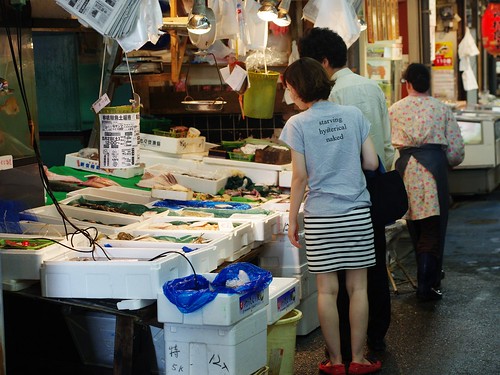
Another "interesting" t-shirt at a local market. It's a bit different from the normal word salad though; I suspect this may be an actual slogan, a band name or something like that.
The last day, still determined to avoid the festival, we first visited the Hakozakigu botanical gardens — at least in part because it was just down the road from the hotel. It's not a big garden but it's quite beautiful, with a large variety of flowering plants. The outside cafe was a pleasant spot for a break before leaving.
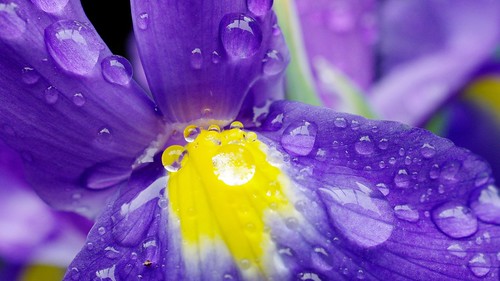
More close-up water drops. I like how some drops add enough magnification that you can clearly see the petal cell structure.
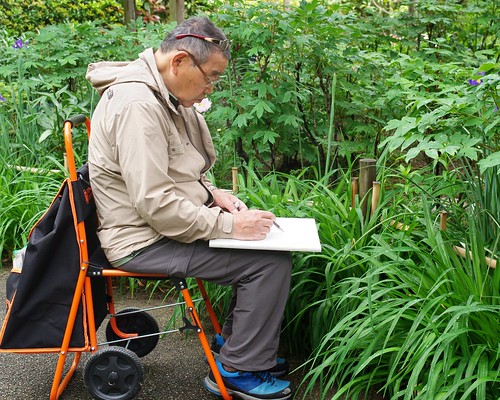
A fair amount of people around, including this sketching gentleman. I'm impressed by his glasses; I would never be able to keep them apart.
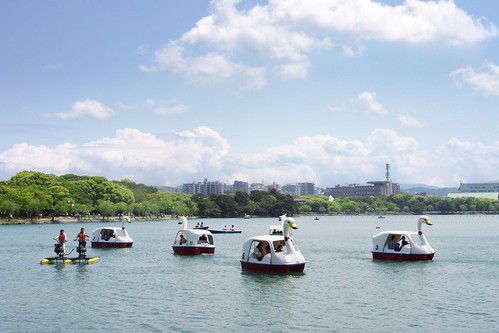
Ohori park is a large, varied park close to the city center, with a good-sized lake and a few islands in the middle. It's a wonderful spot to spend your free time, and many people do. There's cafes and restaurants along the north edge; you can walk around or sit and rest; jog, run and play at the playground; you can fish in the lake, or rent a paddle boat or water cycle.
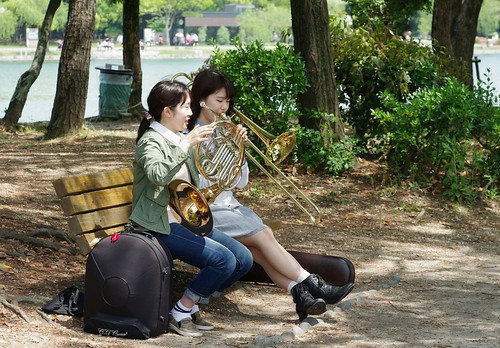
Japanese have a problem. Many, many people play instruments — it's part of a well-rounded education — but most people also live in fairly tight quarters, close to their neighbours. Flutes, ukuleles and so on are quiet enough, and pianos, drums and guitars have electric versions. But where do you practice if you play the trombone, or the French horn? Public parks is the answer. You see this quite often.
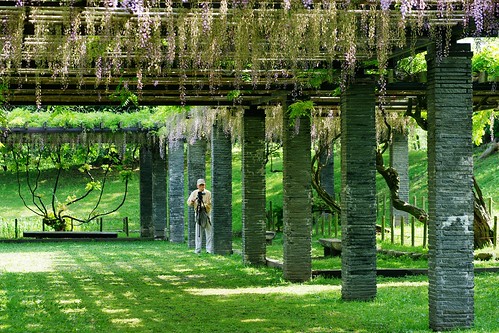
Hanging wisteria. You couldn't turn around around here without bumping into wedding photographers taking wedding pictures of their clients.
This was not just a fun trip. Fukuoka was much more of a city than I expected it to be; big and bustling, but the pace was unhurried and pleasant, the city is beautiful and the food is delicious. It shows up in rankings of the most livable cities in the world, and it's easy to understand why.
#1 Actually I've never set foot on Shikoku or even Awajishima either and they're what - half an hour away? I see Awajishima from my desk every day, yet I've never been there. Ridiculous, I know.
Subscribe to:
Posts (Atom)