Ahh, early summer! The daytime temperature is reaching the 30's now, and even the mornings are getting too warm for comfort. Time to start bringing an extra t-shirt to work, to fill the thermos with ice tea, pack ear plugs for noisy fans and air conditioners, and look forward to a few months of everybody complaining about the heat.
And once again, like every year, the packed-to-the-gills Kobe Port Liner air is infused with the makeup and toiletries
of overly enthusiastic university students; mixed with the delicate
fragrance of Eau de Salaryman (a distinctive blend of unwashed suits, stale cigarette smoke and hangovers); and combined with the stale air of a hundred sweating passengers to produce a truly unique and evocative aroma. What it mostly evokes, of course, is an intense wish for you to be somewhere else.
And I will be. This summer I will be a tutor at the OCNC summer course in Okinawa. It's held at OIST, my home institution, so I'll spend some extra time before the course working on our project. In all I'll be away in Okinawa for over a month. The summer school takes a lot of time (it's 24 hours a day for the whole three weeks) and I need to keep up my regular work, but I'm sure there will be some occasional opportunities to enjoy the balmy Okinawan seas. I might accidentally pack snorkel, mask and fins along for the trip, and I'll make sure I act very surprised when I find out. ^_^

Wednesday, May 28, 2014

Thursday, May 8, 2014
Lenovo X240S, and Ubuntu 14.04
I got a new work laptop this week, a small and light Lenovo X240S. It's one of their "ultrabook" machines, where weight and size is more important than performance. A lighter, smaller and newer sibling to my own T430, more or less.
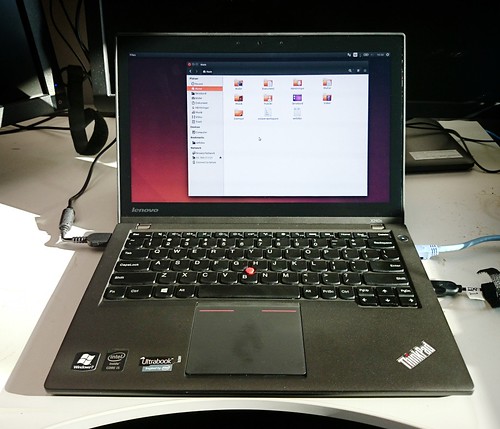 Lenovo X240S. I'm a bit short on time so it's a quick shot with my Xperia Z1, taken at my non-too-clean desk.
It's got 8Gb memory and an 128Gb SSD drive. The Intel CPU and graphics are fairly low-end; a fair bit slower than the T430, despite being two years newer, though I don't notice any speed difference in normal use. The matte 12" touchscreen is low resolution at 1366x768 but it renders colour better than my own laptop. There's a touchpad, a keyboard nipple, and the usual ports.
I installed Ubuntu 14.04, and every single thing works flawlessly. The touchscreen, the special keys and the lid camera work right out of the box, and it found our office printer without any trouble. With the lone exception of my oddball keyboard layout, I could pretty much install, restart and be on my way.
Just about all tweaks and fixes I used to do in Ubuntu are unnecessary by now. It's so polished that I really don't need to do anything. Of course I still need to install a bunch of apps and move data over; that's going to take weeks or months as I gradually find out what I need on this machine.
The keyboard is a bit cramped, and retains the dumb layout with a too-easy-to-hit print screen button to the right of the space bar. I wish they'd kept the larger Enter key too. But the feel is good and the keyboard works well overall.
The touchpad is a major regression. It's much larger than on the T430, so you easily touch it by mistake, and it lacks separate hardware buttons. Instead the touchpad surface itself buckles as you press it. But when you do, the pointer inevitably moves, and often moves right out of the area you aimed at. It seems to emulate two buttons on the bottom and only one at the top, but it's hard to tell. There's no middle button at all. You need a mouse with this machine, no question about it.
This model has a touchscreen, and it's neat. It works right out of the box in Ubuntu, and works really well. I guess this is where Canonicals work on Ubuntu Touch is paying off; it figures out when I'm moving, dragging and clicking without missing a beat. Using Inkscape is a joy, and drawing on it feels very natural. It'd be a much better input than the touchpad, in fact, if it didn't keep my hand away from the keyboard and up in the air.
I plan to separate my home and work machines from now on, but I still need to have some data available on both machines. Firefox syncs bookmarks and other things already. I've also set up Zotero to sync the biographical database through Zoteros servers, and I sync the actual PDFs through my ownCloud server at home. I still haven't decided how to handle other data, but I'll probably sync that too over ownCloud for now. A lot of it is managed by Git already, so once I update my server I'll keep it as git repositories there instead.
Overall, the big surprise is that there's no surprises. Ubuntu just works. It's now so polished that it gets out of your way, leaving you to focus on your job. The X240S is a bit better than the T430 in some ways, a bit worse in other, but overall I'm hard pressed to find any notable differences. A very non-eventful upgrade, and that's a good thing.
It's got 8Gb memory and an 128Gb SSD drive. The Intel CPU and graphics are fairly low-end; a fair bit slower than the T430, despite being two years newer, though I don't notice any speed difference in normal use. The matte 12" touchscreen is low resolution at 1366x768 but it renders colour better than my own laptop. There's a touchpad, a keyboard nipple, and the usual ports.
I installed Ubuntu 14.04, and every single thing works flawlessly. The touchscreen, the special keys and the lid camera work right out of the box, and it found our office printer without any trouble. With the lone exception of my oddball keyboard layout, I could pretty much install, restart and be on my way.
Just about all tweaks and fixes I used to do in Ubuntu are unnecessary by now. It's so polished that I really don't need to do anything. Of course I still need to install a bunch of apps and move data over; that's going to take weeks or months as I gradually find out what I need on this machine.
The keyboard is a bit cramped, and retains the dumb layout with a too-easy-to-hit print screen button to the right of the space bar. I wish they'd kept the larger Enter key too. But the feel is good and the keyboard works well overall.
The touchpad is a major regression. It's much larger than on the T430, so you easily touch it by mistake, and it lacks separate hardware buttons. Instead the touchpad surface itself buckles as you press it. But when you do, the pointer inevitably moves, and often moves right out of the area you aimed at. It seems to emulate two buttons on the bottom and only one at the top, but it's hard to tell. There's no middle button at all. You need a mouse with this machine, no question about it.
This model has a touchscreen, and it's neat. It works right out of the box in Ubuntu, and works really well. I guess this is where Canonicals work on Ubuntu Touch is paying off; it figures out when I'm moving, dragging and clicking without missing a beat. Using Inkscape is a joy, and drawing on it feels very natural. It'd be a much better input than the touchpad, in fact, if it didn't keep my hand away from the keyboard and up in the air.
I plan to separate my home and work machines from now on, but I still need to have some data available on both machines. Firefox syncs bookmarks and other things already. I've also set up Zotero to sync the biographical database through Zoteros servers, and I sync the actual PDFs through my ownCloud server at home. I still haven't decided how to handle other data, but I'll probably sync that too over ownCloud for now. A lot of it is managed by Git already, so once I update my server I'll keep it as git repositories there instead.
Overall, the big surprise is that there's no surprises. Ubuntu just works. It's now so polished that it gets out of your way, leaving you to focus on your job. The X240S is a bit better than the T430 in some ways, a bit worse in other, but overall I'm hard pressed to find any notable differences. A very non-eventful upgrade, and that's a good thing.
Monday, May 5, 2014
The EU Election — I've voted; will you?
It's time to vote for the EU parliament again. As I don't reside in Sweden I vote by post, and I've alredy cast my vote. What did I vote for? The Swedish Pirate Party.
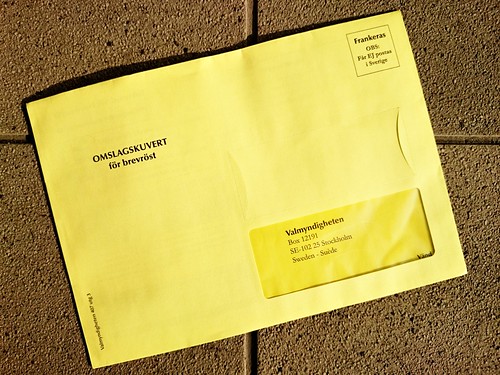 I've cast my vote.
The EU parliament is a bit different from national parliaments. Most regular political questions are not decided there. Pensions, welfare, medical care, defence, immigration, schools and so on are all decided at a national level; the EU simply doesn't have much or anything to do with such things. Whatever your views on any of it, this election does not affect it.
What they do decide on tend to be big, EU-wide questions or the transnational aspects of national issues, especially when it affects the fundamental rights of EU citizens. Take movement within the union for instance, where the EU assures your right to move freely as a member, but doesn't regulate the national rules for work benefits, certifications or work eligibility limits, as long as the rules aren't discriminatory.
As your national politics don't map onto the EU level, there's little point in casting a protest vote or use it to show national party support. National parties aren't really affected by this vote, and their positions on national issues may not say a lot on their policy for different EU-wide questions. So just as it can make perfect sense to split your vote in local elections, it can make a lot of sense at the EU level as well.
So, why the Pirate Party? One of the major responsibilities of the EU are our fundamental rights as citizens and as humans. Traditionally that has included rights to speak or to publish, congregate and unionize, the right to travel, the right to privacy, and ethnic and gender equality. You could arguably add things like a level economic and legal playing field to the list as well.
But these rights are all increasingly exercised through the internet. The net is becoming the printing press, the town square, the trading market, the meeting hall, the library — and yes, both the quiet coffee-shop corner booth and shady alley, as well as the microphone in the wall, the concealed tele-lens and the secret registers and dossiers.
The future of the net is the future of our fundamental rights as individuals. And as events the past few years have shown us, that future is currently under sustained, serious attack. Safeguarding that future is far too important to leave to private companies, lobbyists and unelected security organizations. None of them have any interest in safeguarding these rights, and every reason to pervert or erase them. What use is your right to speak today if the net will refuse to carry your words?
The net is truly international, to a greater degree than any other system we've ever created. It's too big and too diffuse for any national organization to regulate or safeguard. This is exactly where a transnational body such as the EU can really make an important and long-lasting difference for the better.
And despite all missteps, they often do; just two months ago the parliament voted through a data protection reform that greatly limits how and when personal data can be collected by others. And they did it because parliament members from parties such as the Pirate Party worked long and hard to make it happen.
Which is why I choose to vote for the Pirate Party. The net is vital for our fundamental rights as citizens in the EU, and the Pirate Party is working to safeguard it. If the net is important to you too, then you may want to vote the same way.
The EU parliament is a bit different from national parliaments. Most regular political questions are not decided there. Pensions, welfare, medical care, defence, immigration, schools and so on are all decided at a national level; the EU simply doesn't have much or anything to do with such things. Whatever your views on any of it, this election does not affect it.
What they do decide on tend to be big, EU-wide questions or the transnational aspects of national issues, especially when it affects the fundamental rights of EU citizens. Take movement within the union for instance, where the EU assures your right to move freely as a member, but doesn't regulate the national rules for work benefits, certifications or work eligibility limits, as long as the rules aren't discriminatory.
As your national politics don't map onto the EU level, there's little point in casting a protest vote or use it to show national party support. National parties aren't really affected by this vote, and their positions on national issues may not say a lot on their policy for different EU-wide questions. So just as it can make perfect sense to split your vote in local elections, it can make a lot of sense at the EU level as well.
So, why the Pirate Party? One of the major responsibilities of the EU are our fundamental rights as citizens and as humans. Traditionally that has included rights to speak or to publish, congregate and unionize, the right to travel, the right to privacy, and ethnic and gender equality. You could arguably add things like a level economic and legal playing field to the list as well.
But these rights are all increasingly exercised through the internet. The net is becoming the printing press, the town square, the trading market, the meeting hall, the library — and yes, both the quiet coffee-shop corner booth and shady alley, as well as the microphone in the wall, the concealed tele-lens and the secret registers and dossiers.
The future of the net is the future of our fundamental rights as individuals. And as events the past few years have shown us, that future is currently under sustained, serious attack. Safeguarding that future is far too important to leave to private companies, lobbyists and unelected security organizations. None of them have any interest in safeguarding these rights, and every reason to pervert or erase them. What use is your right to speak today if the net will refuse to carry your words?
The net is truly international, to a greater degree than any other system we've ever created. It's too big and too diffuse for any national organization to regulate or safeguard. This is exactly where a transnational body such as the EU can really make an important and long-lasting difference for the better.
And despite all missteps, they often do; just two months ago the parliament voted through a data protection reform that greatly limits how and when personal data can be collected by others. And they did it because parliament members from parties such as the Pirate Party worked long and hard to make it happen.
Which is why I choose to vote for the Pirate Party. The net is vital for our fundamental rights as citizens in the EU, and the Pirate Party is working to safeguard it. If the net is important to you too, then you may want to vote the same way.
Friday, April 25, 2014
Holiday
Yes, Golden Week is soon upon us. The time of year when Japanese workers escape the stress of work with the stress of endless traffic jams and packed trains. We're taking a few days off early to beat the crowds, so tomorrow morning we'll be on our way to Ho Chi Minh city in Vietnam. To nobody's surprise we'll mostly spend our time eating, buying foods, and walking between places to eat. We'll probably take a cooking class as well, though we don't yet know where.
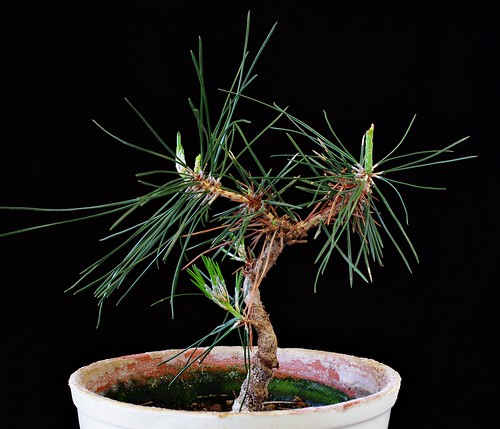 My bonsai is alive, and possibly even healthy, one year on. I call it "bonsai" because it's a small tree, it's in a pot and it's alive; that seems to cover most definitions. From the looks of it I suspect that were it a human it would have a spinal problem, work in an ominous basement lab and say "Yeth, mathter" a lot. Anyway, it survived its first year, so now I have to figure out how to start shaping it into an actual bonsai plant.
 Swiss chard is surprisingly photogenic. And it tastes very good; just separate leaves and stems, fry the stems in butter for 20 seconds, then add the leaves and fry a few seconds until they almost start to wilt. Black pepper and a dash of either soy sauce or ponzu and you're done. This, by the way, is my new desktop wallpaper.
And some recent pictures:
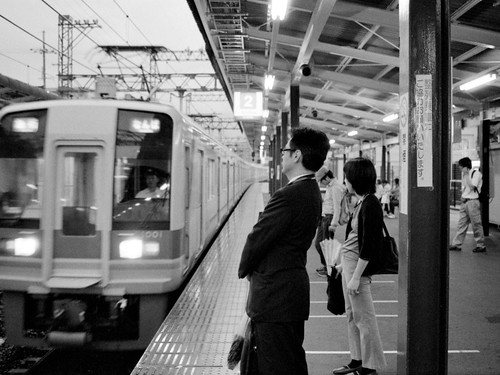 Kawachi Nagano station, in south Osaka. A typical small, edge-of-rural kind of station.
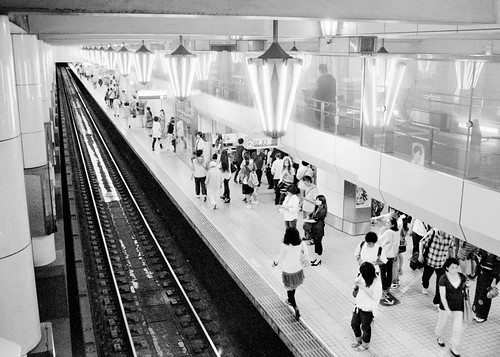 Tennoji Midosuji line subway station. This, on the other hand, is one of the larger stations in central Osaka. It still has the insanely cool ceiling lights specific to the Midosuji line; unfortunately it seems they're being removed in Umeda as part of a platform renovation, and I suspect the same thing will happen on other stations along the line.
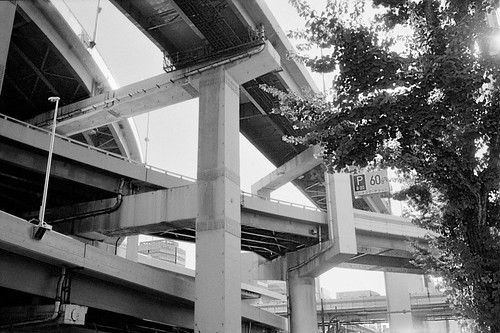 The elevated highway crossing in Honmachi, Osaka. I actually like this; I'm happy all that traffic up there isn't happening down on street level, and I approve in general of anything that brings us closer to the Blade Runner/William Gibson aesthetic.
And some recent pictures:
Friday, April 11, 2014
Spring

The long, chilly winter is finally over. The weather has been typical for April, with warm and sunny days alternating with cold and rain, The cherry blossom season was unusually short. Last weekend was our only chance for hanami, but the weather was mostly miserable. We gave up on a proper cherry blossom picknick this year, and just took a quick walk through Utsubo park before we escaped the weather at a nearby cafe.
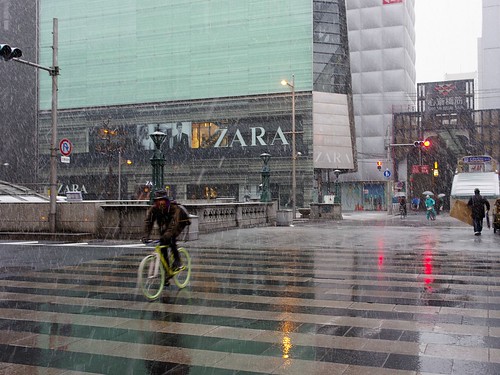
April is a time of change for people as well. April is when you start school, graduate, start a new job, a new project and move house, and it's usually the start of the fiscal year. Budgets and research grants go from April to March, so if you need something for work you either buy it in March to use up the last of your old budget, or buy it in April when you get access to the new one.
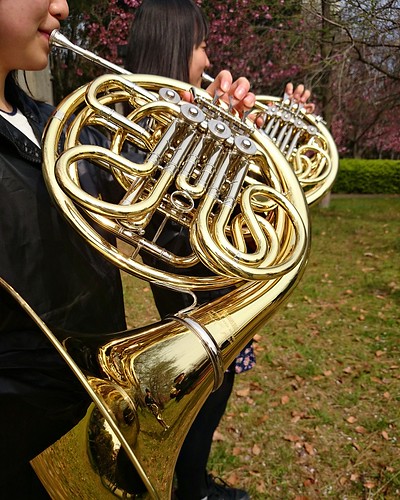
As I walked to work this morning, the sun was shining. It was already warm enough that I could walk in my shirt sleeves, and the trees were all glowing green with new leaves. I heard a brass band tuning up in the nearby park; a local high school were welcoming this years new students to the school. There's a hint of summer heat in the air today, not the threat of another cold wave. Today it finally felt as if the balance has shifted, and summer is coming. Change is in the air, and for now that feels good.

Friday, March 28, 2014
Short Notes
I had my one-month eye exam the other day. Both eyes are 1.5, which is great. My left eye has a bit of residual astigmatism, but not enough for repeat surgery or to add correction for it to my reading glasses. The surgery has been a success, and I'm happy I went through with it. I'm particularly happy and surprised that my frequent headaches now are almost gone.
That doesn't mean I'm free of glasses. I've converted one pair to reading glasses for work, and added dark lenses to another pair for use as sunglasses. I'll add weak bifocals to my favourite pair so I can comfortably read and use my phone on the train. I'll actually have more pairs of glasses now than when I really needed them. Which is fine as I like glasses; I just didn't like having bad eyesight with glasses as well as without.
The Japanese sales tax will increase in a couple of days and it's been impossible to miss. Signs everywhere profusely apologize that commuting passes, vending machines or whatever will regrettably become more expensive on April 1st. Morning TV shows have run daily segments on this for weeks.
I got drawn into the hysteria this morning as well. There was a segment about sporting equipment will become more expensive. Some store manager points out that you should get expensive golf clubs now rather than wait until April. And I find myself thinking:
"Ah, perhaps I should pick up a set of ...WHAT AM I DOING?! I DON'T EVEN PLAY GOLF! I'VE NEVER BEEN ON A FREAKING GOLF COURSE IN MY LIFE!"
I'll be really happy come April 1st. A 3% tax hike is a small price to pay for the media frenzy to end.
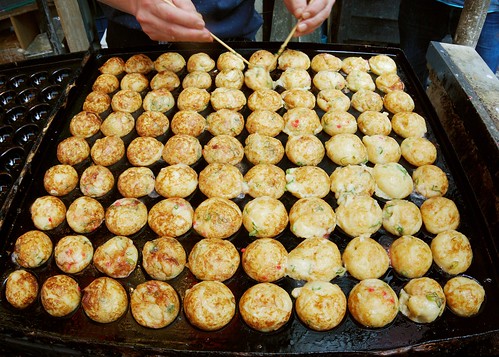
We're having a Takoyaki party at work tonight. We'll make takoyaki, akashiyaki and side dishes. The organizer suggested we try making rice cooker cake for dessert. Should be a lot of fun; I'm bringing a camera and if it's a success I'll try to post about how to make it.
We'll be about a dozen people, so we need a fair amount of food and drink. Normally we'd assign a couple of people to take a car and do all the heavy shopping at some supermarket. This time the guy who organizes it simply ordered everything from an internet supermarket. Have to love the net.
Tuesday, March 25, 2014
Siphon Coffee
Or: The Amazing, Reversible Coffee Spraycan!
There was a time when I was young and dumb and drank coffee only for the caffeine. I bought cheap pre-ground coffee, brewed it in an electric maker that I never got around to cleaning, then kept it warm by reheating it in a microwave oven. I've learned better since, and we now have a number of ways to brew, grind and roast coffee at home. But my favourite way to make coffee has to be the siphon brewer.
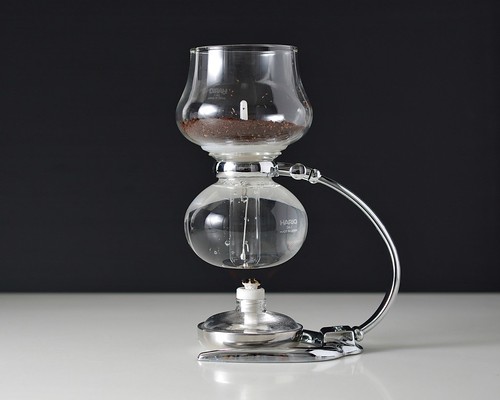
I had never heard of siphon coffee before I came to Japan. It's an old coffee making method and used to be quite common until electric makers became widespread. It was largely forgotten in the west for many years but it remained popular here in Japan. Several Japanese companies make brewers, and a few coffee chains even specialize in serving it.
When I left NAIST in 2012, I received a small Hario one-cup siphon brewer as a gift. It's one of my favourite things, and I frequently use it on slow, lazy weekends, when coffee is a way to relax and unwind. The one drawback with this brewer is that I can make only one cup at a time, so I usually use it only when I'm home alone. One day I'll get a larger 2-3 cup siphon so we can have siphon coffee together.
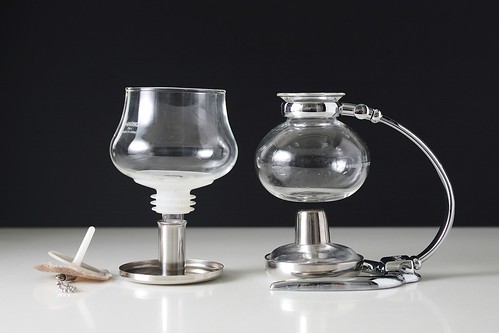
A siphon brewer works exactly like a spray can. You've got a sealed container with a liquid in the bottom and some empty space at the top. A pipe descends from the top down to the bottom of the container. Pressurized gas in the space at the top pushes the liquid through the pipe and up a hole at the top.
A spray can is filled with paint or other liquid and pressurized gas, and has a push-valve with a nozzle. A siphon brewer is filled with hot water, and when it boils the steam pressure pushes the boiling water up the pipe and into the top bowl where it mixes with the ground coffee. A filter over the hole to the top prevents the coffeegrounds from dropping down into the bottom container.
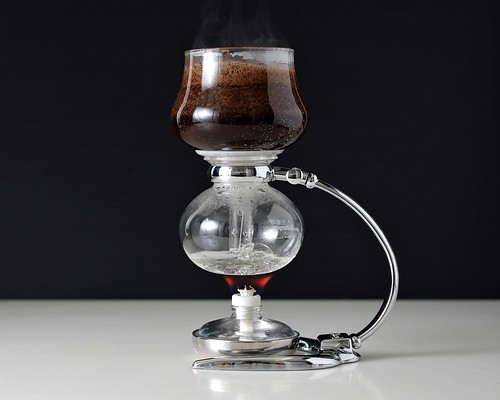
Once the coffee is done — about a minute and a half or so — you remove the heat source and the siphon goes into reverse. Without the heat source the steam condenses, the air cools and so the pressure quickly drops. The coffee in the top bowl gets sucked back down through the filter, leaving the coffee grinds at the top. Remove the top and you're left with a bowl of delicious coffee.
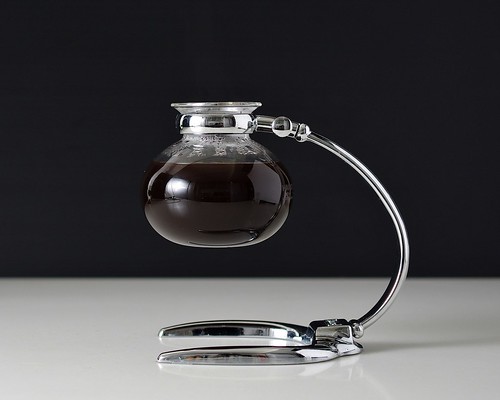
Since I had a stack of shots from the brewing process I figured I should try to use them for a simple stop-motion animation. I used GIMP to make a simple gif animation of the process(1), and here's the result.

A few notes:
- The filter is kept in place with a spring that is hooked on to the bottom rim of the tube. Don't forget to hook it properly. If you forget, you end up with no coffe and a big mess to clean up. No points for guessing how I know that.
- Stir the grinds with a chopstick when the hot water rushes up into the top bowl. If you don't, some coffe grinds might not get soaked properly in the hot water.
- There's a short length of chain hanging off the filter hook at the bottom. This provides extra surface area for the hot water to turn into steam. Without it you could get superheated water and a sudden boil with too high pressure as a result.
- This model has a small hole in the tube near the top. I think this is a simple pressure regulator. The water level is very close to the top in this small maker, so as the water and the air at the top is heating up, that small extra pressure would be enough to push water up the tube too early. With the hole the pressure is strong enough to push the water up only once it's boiling properly. Larger models apparently don't have this hole, as the pressure you need is great enough already.
Siphon coffee is smooth and fragrant, without the bitterness you can get with other methods. It's delicious, especially with good-quality beans. It does take a fair amount of time to prepare and there's a lot to clean up afterwards, so it's not something I do every day. But the process itself is slow and deliberate, almost meditative, so when I have the time, making the coffee is just as enjoyable as drinking it when done.
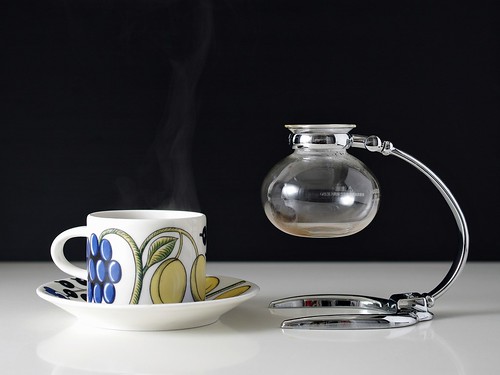
#1 I shot the frames on a tripod and lit with strobes. But the brewer shifted around just a little bit as I handled it, and the ambient background light from a window changed slightly over time. Those subtle changes become very obvious when you stick the frames together as an animation. So I had to use GIMP to manually align the shots and correct the exposure on each one. Makes me appreciate why movie equipment is so oversized, precise and expensive.
I also used GIMP to generate the fading with a fade script. You can set individual frame transition times and preview animations within GIMP itself, and you can save optimized animated gifs directly from a stack of layers. The process is a bit clumsy, and for a more complicated animation I would write a set of scripts instead. But GIMP is plenty good enough for something simple such as this.
I also used GIMP to generate the fading with a fade script. You can set individual frame transition times and preview animations within GIMP itself, and you can save optimized animated gifs directly from a stack of layers. The process is a bit clumsy, and for a more complicated animation I would write a set of scripts instead. But GIMP is plenty good enough for something simple such as this.
Subscribe to:
Posts (Atom)