I haven't written about politics here for a while. I'm kind of burnt out on it, frankly, and my focus has been split up over Japan, the upcoming Swedish elections (it starts to look like a nailbiter) and general European activities as well. But with the latest turns of events here I'm long overdue for an update.
The political situation here is a complete, utter dysfunctional mess. Nothing new in other words. The very short summary of the current state is that support for the DPJ, who won the last lower-house election, and the Hatoyama government has dropped from solid 70% support ratings down to the 20-odd percent disaster zone, in less than a year. Even more amazing, they've managed that stomach-churning drop all by themselves; the opposition LDP has been invisible, has not managed to pick up any support - that's more than a little impressive, frankly - and doesn't even seem to be in the game at all. The two largest parties now have a combined support from only 40% of all voters. Shisaku has the latest numbers (though no links to the sources).
This past week the DPJ has very publicly and very noisily reneged on an election promise - one that is fundamental to their SDP coalition partner - after wavering for over six months. The SDP has proceeded to break the coalition a month or so before the upcoming upper-house election. The only question now, really, is whether Hatoyama leaves before the election (unlikely; it's too close and there's nobody willing to step up), or if he gets kicked out after it to take responsibility for what promises to become quite a disaster at the polls.
The Hatoyama government has displayed many facets of venal incompetence the past year - let it never be said they're not a well-rounded team - but what has sealed its fate is the American military base in Futenma, Okinawa. The Futenma base is right next to Naha city, causing a lot of disturbance, noise and pollution, and the base isn't able to expand. The LDP and the US signed an agreement many years ago to move the base to Nago, again in Okinawa. There's two problems with the move, however: The area has still-unspoiled coral reefs and is home to endangered species. A base on the coast would wipe it out. Also, most US bases are in Okinawa already, and Okinawans are understandable more than a little angry that they alone have to accept the burden while the rest of the country mostly does not. A move, many think, should be somewhere else, and especially out of Okinawa to distribute this burden a bit more equitably.
Up until last year's election, this was all mostly of interest to Okinawan residents and to foreign-policy wonks. The DPJ technically only promised to review the Futenma move; the way it was presented and received by the public, however, it was effectively a promise to move Futenma base out of Okinawa. This impression was reinforced by the coalition with the SDP that has vocally and strongly opposed the base move from the outset.
When Hatoyama brought up changing the agreed-on plan with the US, they flatly refused to even discuss the matter. Over the past winter Hatoyama has repeatedly set new deadlines for resolving the issue, and sent up trial balloons for any number of solutions all of which have been shot down without even a hearing by the US authorities as well as any local government that would be affected. Hatoyama's been back-tracking in a series of public and humiliating steps - forced by US stonewalling and his own political incompetence - until last week when he announced that the existing plan would be implemented without so much as a face-saving cosmetic change.
The SDP leader Fukushima, a cabinet minister, publicly refused to sign the decision, and was kicked out of the government by Hatoyama last week and yesterday the SDP announced they're withdrawing from the coalition altogether.
Who are the losers? Hatoyama, of course. He has amply demonstrated his lack of decision-making and political skills, and his remaining time as prime minister is probably mercifully short. The DPJ takes a lot of political damage over this as well; it's their government after all, and they're the ones that elected Hatoyama prime minister candidate in the first place. The LDP has completely failed to capitalize on this in opposition. The current government inherited the whole mess from them, and if there was any issue they could not use to their advantage this was it.
The US is another loser, and they can partly blame themselves for it. The move was locally unpopular but it wasn't a major problem; people still elected local pro-base leaders based on other political issues. Had they agreed to review the decision and to make some substantive but peripheral changes to it, they would have been able to defuse much of the opposition. They may well even have been able to keep the base in Okinawa. But the stonewalling, the public humiliating treatment of the Japanese prime minister and the resulting six-month non-stop media coverage has brought the issue front and center. As Our Man in Abiko says, the public debate has shifted from base relocations to a larger, and more questioning, debate about the presence of foreign military in Japan. The public was previously non-committal towards the whole issue; now opinion has hardened into opposition.
The "victory" itself is likely to prove illusory. As Kamei, the politically shrewd leader of the People's New Party, another minor coalition member, said, this decision probably doesn't mean a thing in practice, since actually relocating the base to Nago has now become politically impossible. The current governor and local mayor are solidly anti-base and opposition runs strong thanks to the combination of US indifference and Hatoyama's bumbling. As a result, the US isn't going to actually see a new base for a generation, perhaps longer. Meanwhile, using Futenma will continue to become less viable over time due to the noise and danger. Another plane crash in an urban area like the one a few years ago, and using the base may become untenable.
Winners? The SDP, of course. They lost much of their electorate once due to a compromise over their core values; sticking with them this time seems to have paid immediate dividends in the healthy bounce in support reported by MTC above. With the election only about a month away, and with the Futenma issue fairly certain to stay fresh in the media in the run-up, they're likely to see an election payoff from those numbers too. Another winner is, likely, Your Party (Minna No To). which has sailed up as the third largest party lately, and looks well placed to soak up a good deal of disappointed centrist voters (I heard one of their speaker trucks a while ago; a major slogan was "we're neither LDP nor DPJ").
A final, perhaps surprising, winner may be the Okinawans. The move itself looks likely to be a dead duck, a resolution on paper only with little chance of actually being implemented. Meanwhile, the long-festering local problem has burst on to the national stage, a bona-fide election issue, with the public largely in support. Their chances of getting a fair hearing nationally has probably never been as good.

Monday, May 31, 2010

Thursday, May 27, 2010
Toba and Toshijima
We try to go somewhere from time to time, if only overnight, no matter how busy we are. During Golden Week this year we went to Toba and Toshijima island in Mie prefecture. Mie is right on the coast on the eastern end of Kansai - it's not even clear if the area properly belongs in Kansai or in Tohoku - a couple of hours away by train. Mie is probably most famous for Ise, where the main Shinto temple, said to house the mirror used by Amaterasu, resides. We didn't go there; we're not religious, and apparently you don't get to see more than the outer wall of the temple complex anyhow.

The sea between Toba and Toshijima.
Toba is a coastal city most known for its pearl industry. This is where pearl cultivation was first developed, and where Ama, female pearl divers, live and work. Surprisingly, pearl diving is still a viable business here, with over a thousand local women working as divers at least part time. Why women? They claim they can hold their breath for longer than men. I would hazard a guess that it started as a form of division of labour; with the men away working as fishermen it left the women available to pick up diving. Once the pattern was established, it became tradition.

Ama diver during a show at Pearl Island. The show, or display, is fun and informative, and short enough never to drag. The pearl museum is also well worth a visit, with the whole process explained, from oyster types around the world and their pearls, to how to sort and string pearls for a necklace.

Ama diver.

Wagu port, Toshijima island.
Toshijima is the largest of several islands just off the coast from Toba. You get there by small passenger boats that run from the harbour. It's not far - the trip takes twenty minutes or so - but you do have to keep an eye on the timetable as they only run every couple of hours or so. There's three or four other islands in the same area, with boats running between them all.

A woman is mending nets by the berths at hte end of the harbour.

Women are packing hijiki seaweed on the pier. During season - exactly when we were there - every flat, dry surface on the island is used to dry the seaweed which seems to be a major seasonal product.

Sidewalks, side streets, stairs, playgrounds - dried seaweed is everywhere.
The island seems to mostly live off fishing, though there's a fair amount of ryokan and hotels as well. Toshiijima, like so many places, seems to be a victim of the real estate bubble of the 1990's. There's plenty of nice-looking ryokan, but a number of disused former hotels as well. I get the impression of a brief holiday boom and bus, followed by a slow decline as the island returned to a sleepy fishing community. As a visitor, I can't say I find it too regrettable though. The slow, languid, relaxed atmosphere really was the highlight of this trip.

Nakamura ryokan, overlooking the harbour. There's a public sento and private outdoor baths, a sundeck on the roof, and the sandy beach is only just across the road. This seems a great place for quiet beach life.

Rooms are all Japanese style. A bit old but clean and well maintained. Dinner is served in your room, and afterwards you can sit by the window and follow the lights of the fishing boats.
We stayed at Nakamuraya, a fairly large ryokan overlooking the harbour. Old slightly worn building but clean and pleasant. The highlight of the stay is the food. It's all seafood of course, and the dinner was if anything overabundant. Really - the variety and amount was just plain too much for two people. It was all you could to just to taste everything before you were full. There were some truly delicious dishes; they sadly got overshadowed by the sheer amount of other stuff. I would frankly have wished for a dinner with a bit less food and fewer dishes.

Breakfast was near perfect. My only regret with Japanese breakfasts is the lack of coffee.

Breakfast with a view. The baths are on the next floor, with the same view from the outdoor pool.

Tobacco shop, Wagu town. This kind of old tobacco shop is rapidly disappearing in most places, but get to survive in sleepy places like this.

The sea and Toba seem from our window.
Back in Toba we spent an afternoon wandering through the town. It's not very large, and a lot of it is dedicated more or less to the tourist trade. The aquarium seemed to be full of people (we didn't go this time), and many restaurants and shops seemed to do a lot of business too. We had lunch at an Italian restaurant that had enough guests that we had to wait our turn.

Steep alleyway behind a row of houses in Toba. A restaurant worker is picking up supplies out the back.

Takama café, a second-floor café between Pearl Island and the station. Wonderful atmosphere, good coffee and some seriously tasty ice cream desserts. I wish we could find a café this good in our neighbourhood.
A fun bit of this town is that there's lots of tiny museums and such dotted around the center. A local doctor's preserved home and office is displayed fairly prominently near the harbour, and there's a string of small but fun museums commemorating well-known authors from the area further towards the mountain-side. "Good authors" include Edogawa Rampo, a prolific producer of pulp murder mysteries and horror stories of the more improbable kind. Really, the place is worth a look.

Crane ship, and a boy was running up and down the gangplank with bottles of soda. I guess his father must work on the ship.

Kintetsu Express train, ready for boarding at Toba station.
We took the Kintetsu express train from Osaka. They're fast and comfortable - it doesn't make sense to pay the extra for express service between Osaka and Nara, say, but for this two-hour journey it was well worth it. We had "salon car" seats one way, with facing seat pairs and tables; and first-class the other way (the price difference is small). The first-class seats are more comfortable, and you get to see the panoramic view out the front of the train, something I could never tire of. But overall we both found the salon car to actually be better. The seats are large, and you can sit facing each other with a table for snacks, newspapers and books. It feels cosy and a little private.
There's plenty more pictures in the Toba set and the Toshijima set over on Flickr.

Rushing back towards Osaka. The panorama window is great.

The sea between Toba and Toshijima.
Toba is a coastal city most known for its pearl industry. This is where pearl cultivation was first developed, and where Ama, female pearl divers, live and work. Surprisingly, pearl diving is still a viable business here, with over a thousand local women working as divers at least part time. Why women? They claim they can hold their breath for longer than men. I would hazard a guess that it started as a form of division of labour; with the men away working as fishermen it left the women available to pick up diving. Once the pattern was established, it became tradition.

Ama diver during a show at Pearl Island. The show, or display, is fun and informative, and short enough never to drag. The pearl museum is also well worth a visit, with the whole process explained, from oyster types around the world and their pearls, to how to sort and string pearls for a necklace.
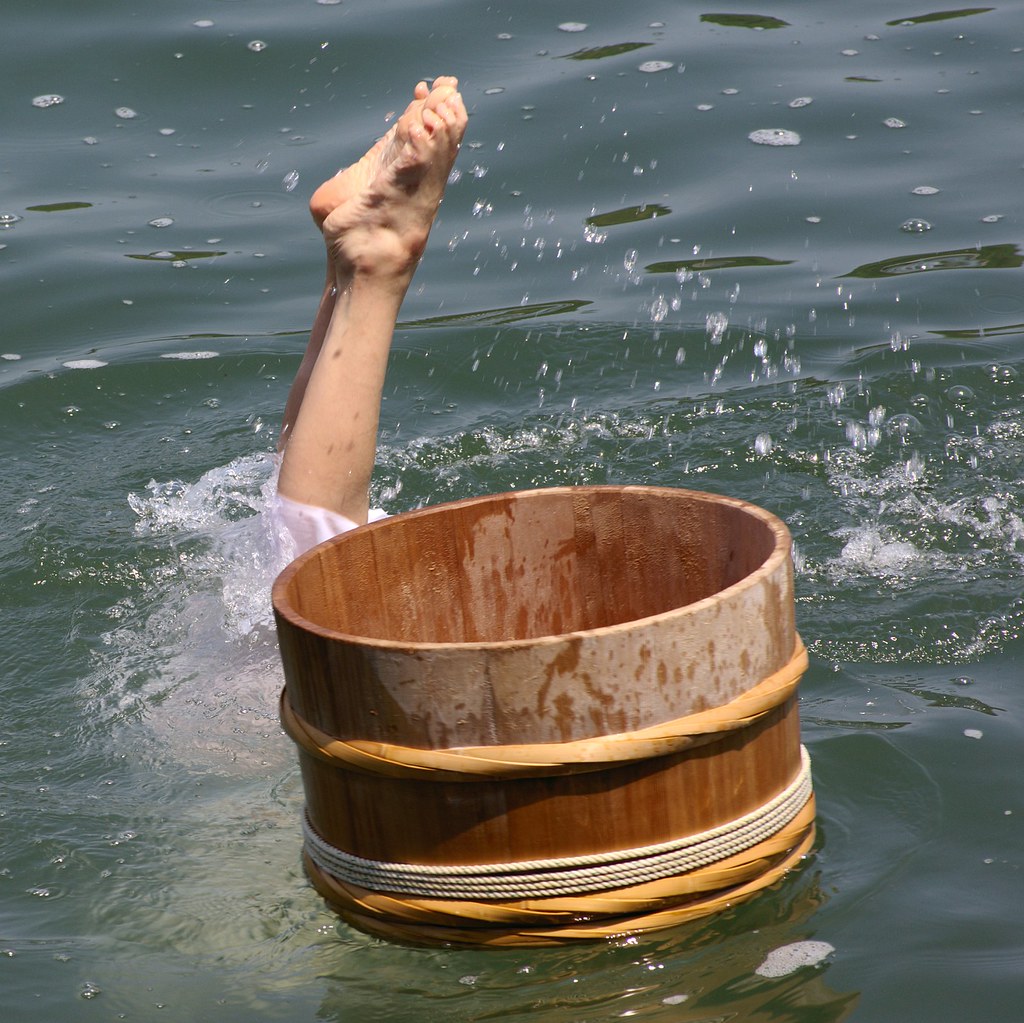
Ama diver.
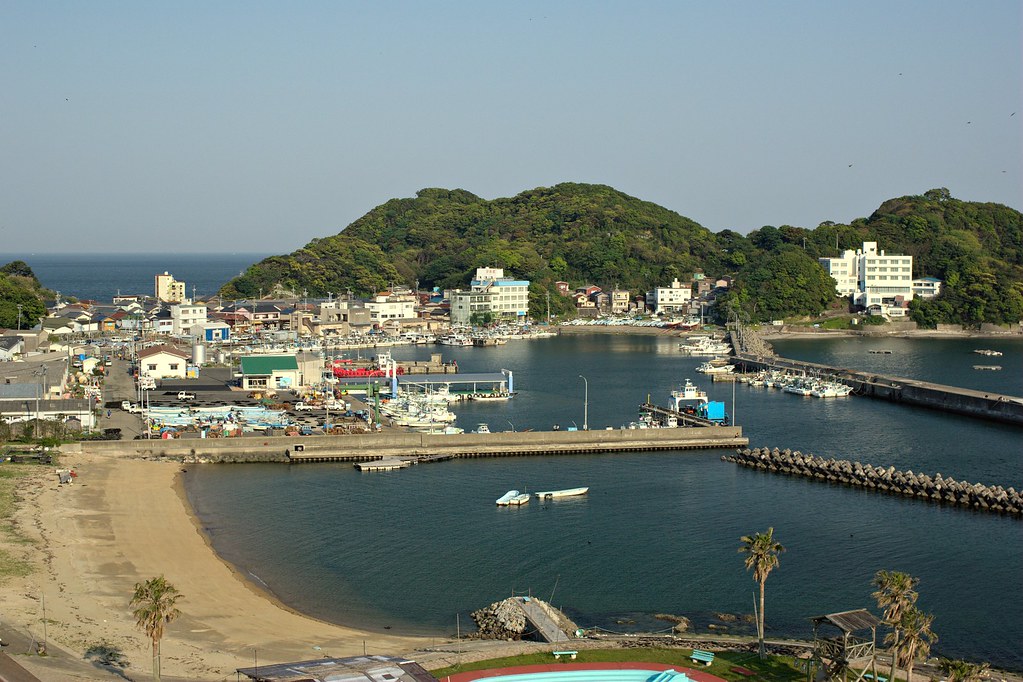
Wagu port, Toshijima island.
Toshijima is the largest of several islands just off the coast from Toba. You get there by small passenger boats that run from the harbour. It's not far - the trip takes twenty minutes or so - but you do have to keep an eye on the timetable as they only run every couple of hours or so. There's three or four other islands in the same area, with boats running between them all.

A woman is mending nets by the berths at hte end of the harbour.

Women are packing hijiki seaweed on the pier. During season - exactly when we were there - every flat, dry surface on the island is used to dry the seaweed which seems to be a major seasonal product.

Sidewalks, side streets, stairs, playgrounds - dried seaweed is everywhere.
The island seems to mostly live off fishing, though there's a fair amount of ryokan and hotels as well. Toshiijima, like so many places, seems to be a victim of the real estate bubble of the 1990's. There's plenty of nice-looking ryokan, but a number of disused former hotels as well. I get the impression of a brief holiday boom and bus, followed by a slow decline as the island returned to a sleepy fishing community. As a visitor, I can't say I find it too regrettable though. The slow, languid, relaxed atmosphere really was the highlight of this trip.
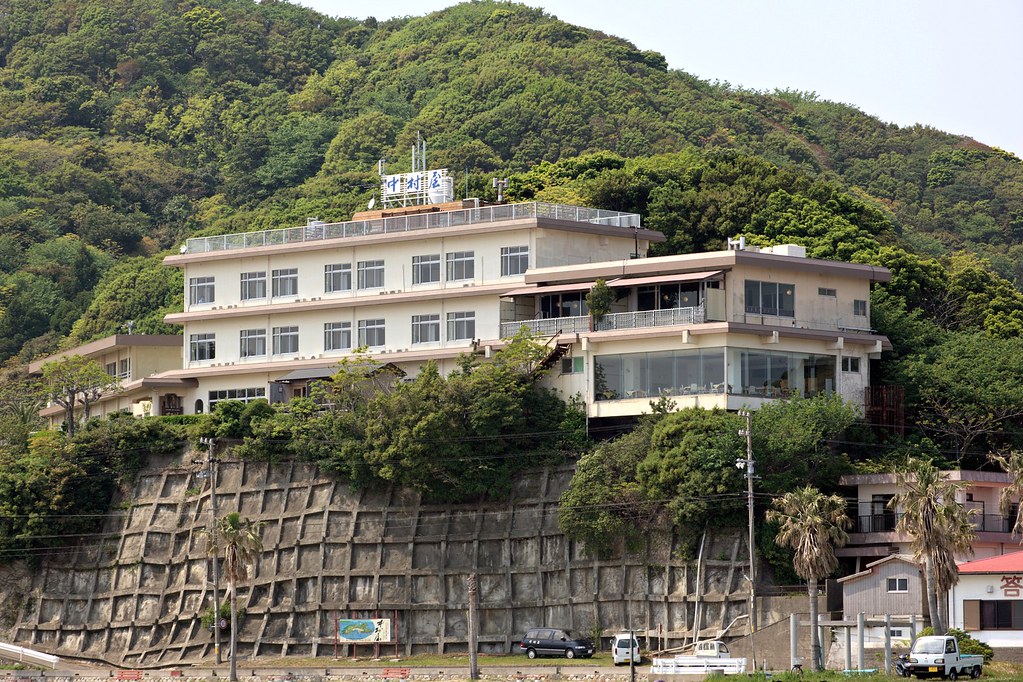
Nakamura ryokan, overlooking the harbour. There's a public sento and private outdoor baths, a sundeck on the roof, and the sandy beach is only just across the road. This seems a great place for quiet beach life.

Rooms are all Japanese style. A bit old but clean and well maintained. Dinner is served in your room, and afterwards you can sit by the window and follow the lights of the fishing boats.
We stayed at Nakamuraya, a fairly large ryokan overlooking the harbour. Old slightly worn building but clean and pleasant. The highlight of the stay is the food. It's all seafood of course, and the dinner was if anything overabundant. Really - the variety and amount was just plain too much for two people. It was all you could to just to taste everything before you were full. There were some truly delicious dishes; they sadly got overshadowed by the sheer amount of other stuff. I would frankly have wished for a dinner with a bit less food and fewer dishes.

Breakfast was near perfect. My only regret with Japanese breakfasts is the lack of coffee.
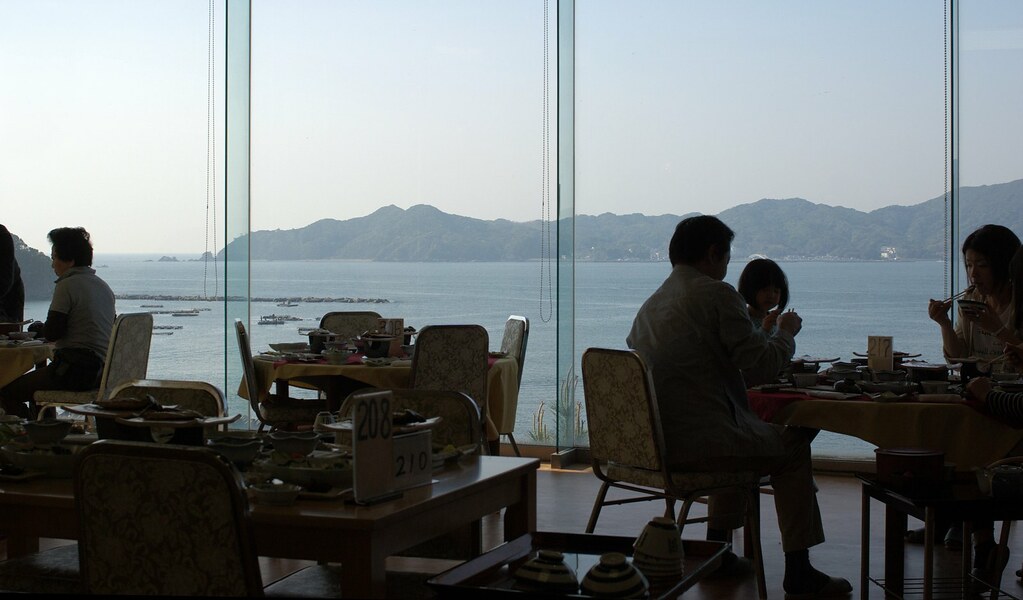
Breakfast with a view. The baths are on the next floor, with the same view from the outdoor pool.

Tobacco shop, Wagu town. This kind of old tobacco shop is rapidly disappearing in most places, but get to survive in sleepy places like this.

The sea and Toba seem from our window.
Back in Toba we spent an afternoon wandering through the town. It's not very large, and a lot of it is dedicated more or less to the tourist trade. The aquarium seemed to be full of people (we didn't go this time), and many restaurants and shops seemed to do a lot of business too. We had lunch at an Italian restaurant that had enough guests that we had to wait our turn.
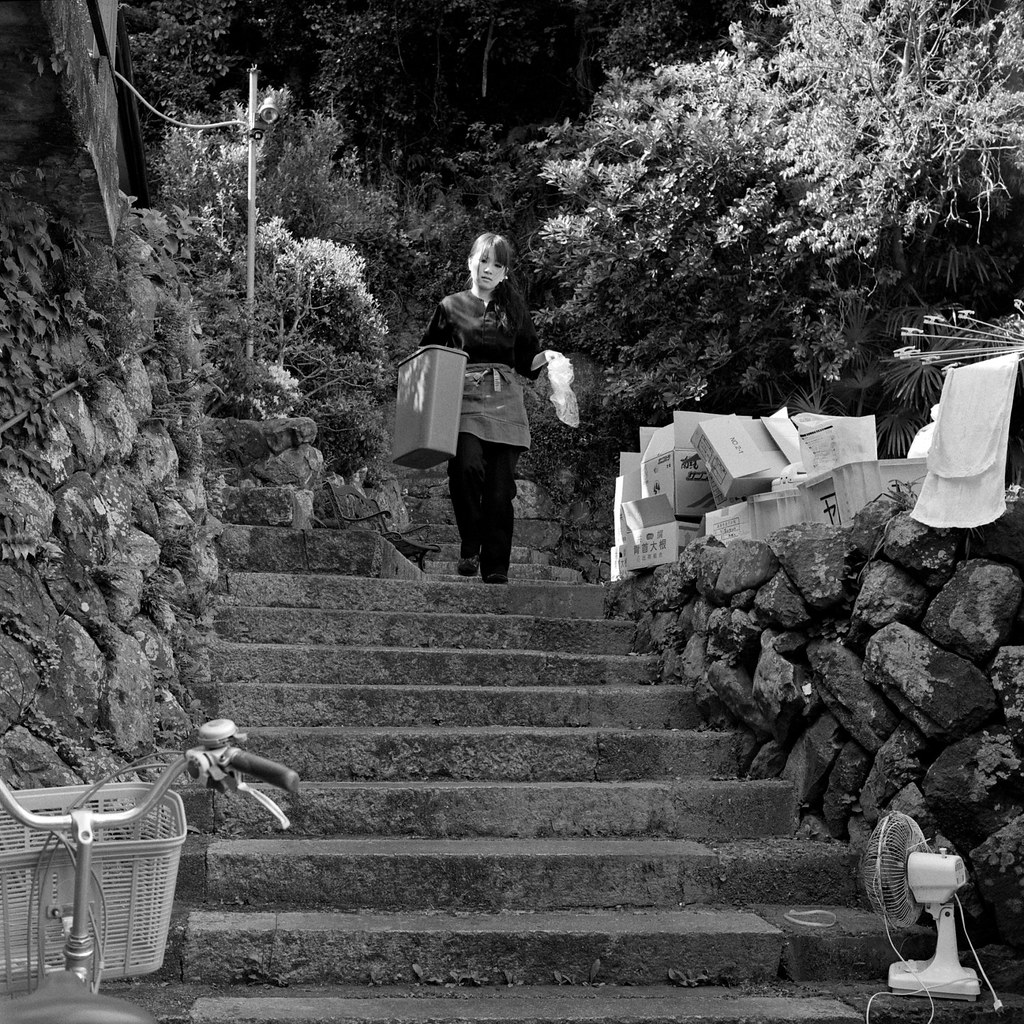
Steep alleyway behind a row of houses in Toba. A restaurant worker is picking up supplies out the back.
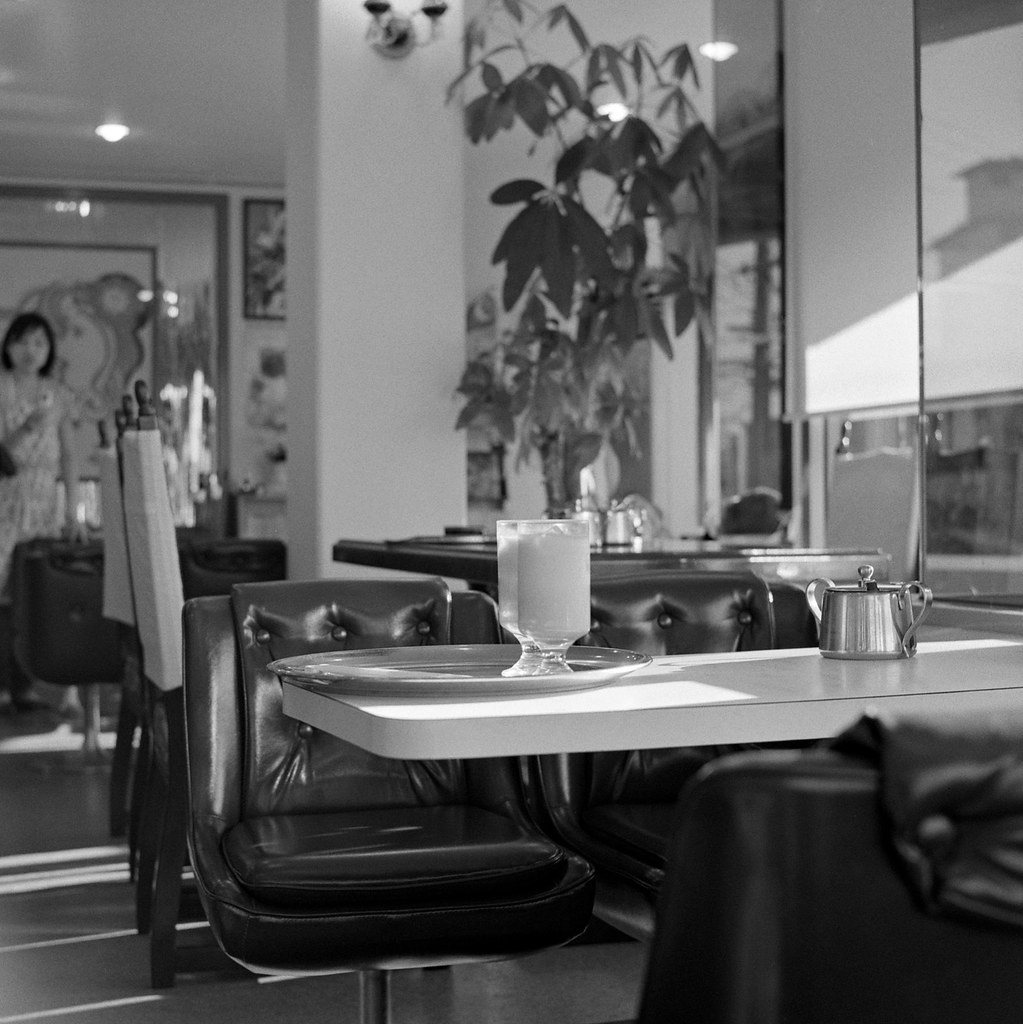
Takama café, a second-floor café between Pearl Island and the station. Wonderful atmosphere, good coffee and some seriously tasty ice cream desserts. I wish we could find a café this good in our neighbourhood.
A fun bit of this town is that there's lots of tiny museums and such dotted around the center. A local doctor's preserved home and office is displayed fairly prominently near the harbour, and there's a string of small but fun museums commemorating well-known authors from the area further towards the mountain-side. "Good authors" include Edogawa Rampo, a prolific producer of pulp murder mysteries and horror stories of the more improbable kind. Really, the place is worth a look.
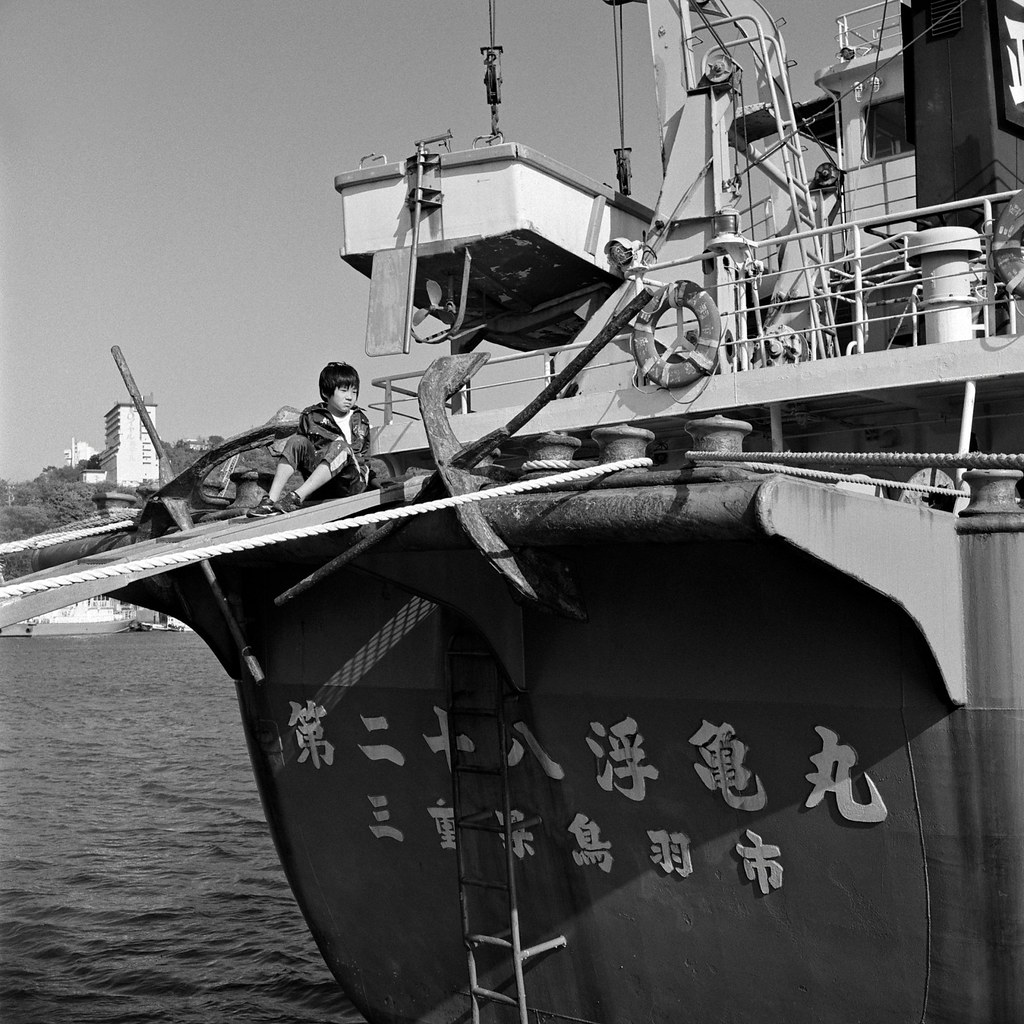
Crane ship, and a boy was running up and down the gangplank with bottles of soda. I guess his father must work on the ship.

Kintetsu Express train, ready for boarding at Toba station.
We took the Kintetsu express train from Osaka. They're fast and comfortable - it doesn't make sense to pay the extra for express service between Osaka and Nara, say, but for this two-hour journey it was well worth it. We had "salon car" seats one way, with facing seat pairs and tables; and first-class the other way (the price difference is small). The first-class seats are more comfortable, and you get to see the panoramic view out the front of the train, something I could never tire of. But overall we both found the salon car to actually be better. The seats are large, and you can sit facing each other with a table for snacks, newspapers and books. It feels cosy and a little private.
There's plenty more pictures in the Toba set and the Toshijima set over on Flickr.
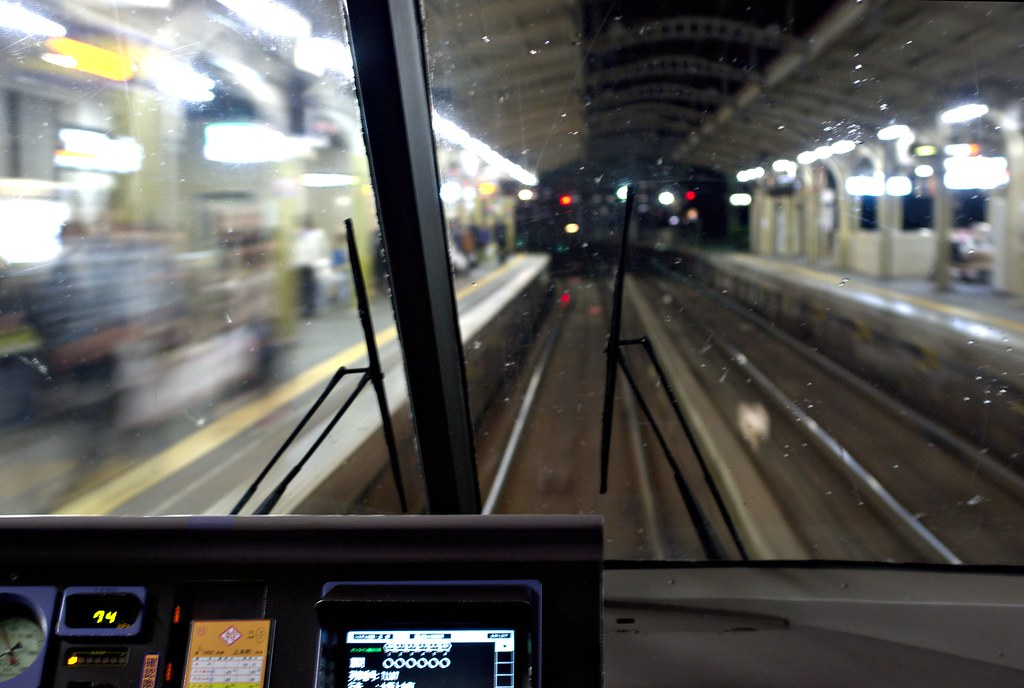
Rushing back towards Osaka. The panorama window is great.
Friday, May 21, 2010
End of the Draft
The Swedish parliament voted yesterday for a bill that ends compulsory draft and military service for male 18-year old citizens. From July 1st the draft and military service will officially be voluntary.
In practice, though, service has been voluntary for years already. In Sweden, every 18-year old man (it was always voluntary for women) got called in for a day or two of physical and mental testing, and those considered fit to serve got assigned to a military position. When I had the misfortune of encountering the system, most people were still actually assigned, and you were expected to do anything from seven months to a year and a half of service (guess who got a year and a half). Conscientious objectors could do civilian service instead, being assigned as a wartime nurse, firefighter or similar, and spend a year or two training for that job instead.
Over time, technological change and shifting priorities made the mass army obsolete. Military planning now aims for fewer but better trained and equipped soldiers, and towards targeted missions rather than mass homeland defence (Sweden has a fair number of UN troops in Afghanistan for instance). For the past decade people have still been drafted, but automatically placed in the inactive reserves unless they ask to do active duty. And a fair number of people do; completed military service can be good to have on your CV, especially if you want to become a policeman, firefighter or anything like that.
So while service has become voluntary, the draft - compulsory for men, voluntary for women - has remained one of the few areas with legal gender discrimination. The actual military utility of the draft is long gone; most defenders of the practice have had to resort to vague arguments about camaraderie and building character. Yesterdays decision to abolish the draft is finally removing a long-standing discriminatory practice that should have disappeared years ago.
In practice, though, service has been voluntary for years already. In Sweden, every 18-year old man (it was always voluntary for women) got called in for a day or two of physical and mental testing, and those considered fit to serve got assigned to a military position. When I had the misfortune of encountering the system, most people were still actually assigned, and you were expected to do anything from seven months to a year and a half of service (guess who got a year and a half). Conscientious objectors could do civilian service instead, being assigned as a wartime nurse, firefighter or similar, and spend a year or two training for that job instead.
Over time, technological change and shifting priorities made the mass army obsolete. Military planning now aims for fewer but better trained and equipped soldiers, and towards targeted missions rather than mass homeland defence (Sweden has a fair number of UN troops in Afghanistan for instance). For the past decade people have still been drafted, but automatically placed in the inactive reserves unless they ask to do active duty. And a fair number of people do; completed military service can be good to have on your CV, especially if you want to become a policeman, firefighter or anything like that.
So while service has become voluntary, the draft - compulsory for men, voluntary for women - has remained one of the few areas with legal gender discrimination. The actual military utility of the draft is long gone; most defenders of the practice have had to resort to vague arguments about camaraderie and building character. Yesterdays decision to abolish the draft is finally removing a long-standing discriminatory practice that should have disappeared years ago.
Wednesday, May 19, 2010
No Beard Rule
According to Mainichi news, the city of Isesaki has banned the wearing of beards by male employees (females are presumably still allowed to wear them). The reasons cited is that citizens may find beards "unpleasant", and that as civil servants they need to keep up appearances.
I certainly don't mind; it's not as if I lack other reasons to be unfit for public service. And if beards don't maintain proper decorum in the eyes of the good citizens of Isesaki, I doubt that a pony-tail and sandals would be wildly popular either.
I certainly don't mind; it's not as if I lack other reasons to be unfit for public service. And if beards don't maintain proper decorum in the eyes of the good citizens of Isesaki, I doubt that a pony-tail and sandals would be wildly popular either.
Monday, May 17, 2010
Anything at All
We've all had this conversation1:
"These Intarwebs are great," someone says, "you can find anything out there!"
"Anything?", says you, "anything at all?"
"Yep, anything," says they, "there's a site for whatever you could think of!"
"Like a site.. umm, ok.. a site about Leonard Nimoy, Sunsets and Pie?", says, you, smiling just a little condescendingly.
"Absolutely!", says they, face beaming with childlike joy, "it's right here!"
Drat.
--
"These Intarwebs are great," someone says, "you can find anything out there!"
"Anything?", says you, "anything at all?"
"Yep, anything," says they, "there's a site for whatever you could think of!"
"Like a site.. umm, ok.. a site about Leonard Nimoy, Sunsets and Pie?", says, you, smiling just a little condescendingly.
"Absolutely!", says they, face beaming with childlike joy, "it's right here!"
Drat.
--
#1 OK, so we haven't actually had any conversation like it. This is a dramatization, for dramatic effect. Any resemblance to any actual people, living or dead, is purely coincidental. This episode was written in front of a live studio audience (we still used a canned laughter track because of the annoying, badly timed, loud snorting laugh from that guy in the third row that completely ruined everything). No polar bears were harmed in the writing of this episode. Ei saa peittää. Do not douse with gasoline. If ingested, seek medical attention. Mooning your local dentistry school should do the trick. If it looks like it would lead to a exotically painful, violent death or lifelong maiming then just don't do it. Unless you have a friend with a video camera. The owls are not what they seem. They're actually sparrows wearing big glasses and fake eyebrows working the night shift. Damn those sparrows, taking over everything with their efficiency charts and incentive-based wage scales and matrix organization and that annoying happy "tweet-tweet-chirp" sound whenever they get to add another found worm in their daily productivity ledger. Have you considered the ukulele?2
#2 I have a tight deadline coming up. One part of the model that I need for that deadline just doesn't work as it should, and right now I'm all out of ideas. Some judicious venting is in order.
Thursday, May 13, 2010
Improved Campaign Laws
MTC is on the ball and has posted about some good legislative news around these parts. As you may know, the Japanese campaign laws are Byzantine, old-fashioned, inconsistent, and - to put a not too fine a point on it - designed to favour the ruling party and established society over the opposition and grassroots movements. Chalk it up as another legacy of the cold war; Japan had a very active, very violent communist revolutionary movement, and while the repression went rather over the line, fears of civil unrest was not completely unfounded.
Part of those rules put very strict limits on what parties and their candidates can do or say in the run-up to the election. The limits are permissive - they tell you what you can do, and anything not listed is forbidden. As a result, any internet-based campaigning has basically been forbidden.
If you are a candidate with a website and a blog, for instance, you are forbidden from updating the site or writing on the blog from the moment official campaigning starts up until the election a month or more later. Which is more than a little ridiculous, since everybody else can talk about you and your program online, and even put words in your mouth, without you having any way to respond. Worse, campaign rules have not been applied consistently; the ruling party (the LDP) has routinely got away with borderline cases that the opposing parties have not. The DPJ has long wanted to liberalize the online campaign rules, but the LDP has been opposed.
Today the shoe is on the other foot, with LDP in opposition and the DPJ in power. The way the DPJ has been backsliding - occasionally making a credible imitation of LDP at its most craven and nakedly power-hungry - it would not have been surprising to have them renege on this as well, now that the restrictions favour them. To their credit, they did not, but have submitted a bill to liberalize online campaigning in time for the upper house election this summer. The LDP, knowing what's good for them, have actually agreed to the bill, making it bipartisan and all but sure to not only get enacted but kept no matter how the electoral winds may change in the future.
The bill, as described by MTC and newspaper reports, is fairly sensible. Basically, you can publish stuff on your own site - your website, your blog and so on - but restrictions stay in place for more direct communication such as twitter and email. It's much harder to verify the origin of email than a website, and the fear is that people will impersonate candidates for smear campaigns. I'm happy about that restriction, for a different reason: I get plenty of spam across my accounts already, and I don't need long-winded Japanese campaign mails added to it if I can at all avoid it.
This, by the way, shows how change of government really is a good thing, even when the change is between two about equally disagreeable alternatives. The most partisan, ideological legislation tends to get modified or repealed over time. And when you expect to be both in power and in opposition from time to time, you don't want any rules too heavily favouring one over the other.
Part of those rules put very strict limits on what parties and their candidates can do or say in the run-up to the election. The limits are permissive - they tell you what you can do, and anything not listed is forbidden. As a result, any internet-based campaigning has basically been forbidden.
If you are a candidate with a website and a blog, for instance, you are forbidden from updating the site or writing on the blog from the moment official campaigning starts up until the election a month or more later. Which is more than a little ridiculous, since everybody else can talk about you and your program online, and even put words in your mouth, without you having any way to respond. Worse, campaign rules have not been applied consistently; the ruling party (the LDP) has routinely got away with borderline cases that the opposing parties have not. The DPJ has long wanted to liberalize the online campaign rules, but the LDP has been opposed.
Today the shoe is on the other foot, with LDP in opposition and the DPJ in power. The way the DPJ has been backsliding - occasionally making a credible imitation of LDP at its most craven and nakedly power-hungry - it would not have been surprising to have them renege on this as well, now that the restrictions favour them. To their credit, they did not, but have submitted a bill to liberalize online campaigning in time for the upper house election this summer. The LDP, knowing what's good for them, have actually agreed to the bill, making it bipartisan and all but sure to not only get enacted but kept no matter how the electoral winds may change in the future.
The bill, as described by MTC and newspaper reports, is fairly sensible. Basically, you can publish stuff on your own site - your website, your blog and so on - but restrictions stay in place for more direct communication such as twitter and email. It's much harder to verify the origin of email than a website, and the fear is that people will impersonate candidates for smear campaigns. I'm happy about that restriction, for a different reason: I get plenty of spam across my accounts already, and I don't need long-winded Japanese campaign mails added to it if I can at all avoid it.
This, by the way, shows how change of government really is a good thing, even when the change is between two about equally disagreeable alternatives. The most partisan, ideological legislation tends to get modified or repealed over time. And when you expect to be both in power and in opposition from time to time, you don't want any rules too heavily favouring one over the other.
Wednesday, May 12, 2010
Remarkable Illusion
Here's the winner of the Best Visual Illusion 2010, by Koukichi Sugihara. No computer graphics, no video tricks, no hidden mechanisms. Just paper, glue, marbles and a very carefully chosen vantage point. See it on YouTube if this video below doesn't work:
Subscribe to:
Posts (Atom)